
Netflix-shares-plunge-after-weak-guidance-and-news-that-cofounder.jpeg

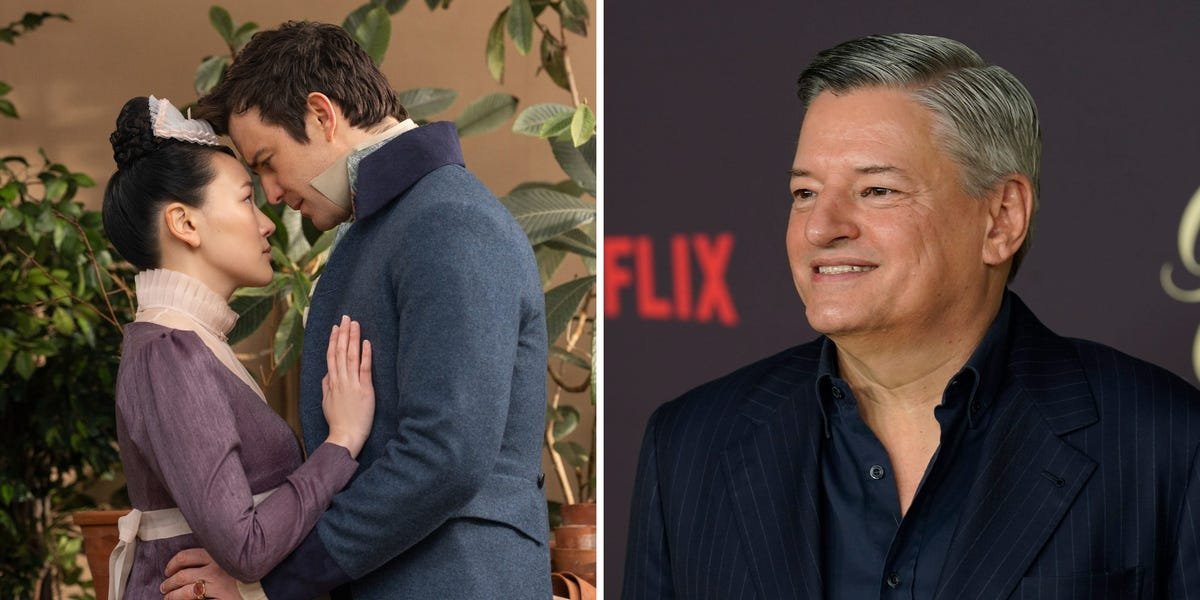
Netflix shares plunge after weak guidance and news that cofounder Reed Hastings will leave the board

Netflix’s post-Warner Bros. honeymoon is over.

Wall Street wasn’t pleased with the streaming giant’s first-quarter earnings report, which was also its first since it backed out of its bid for WBD’s streaming and studio assets.

Netflix’s stock dropped by over 9% in after-hours trading. Netflix beat both revenue and earnings estimates last quarter, the company told investors on Thursday afternoon. However, Netflix’s second-quarter guidance came in below Wall Street’s estimates.

Netflix also announced that cofounder and former CEO Reed Hastings will leave the board in June.

“Netflix changed my life in so many ways, and my all‑time favorite memory was January 2016, when we enabled nearly the entire planet to enjoy our service,” Hastings said in a statement. “My real contribution at Netflix wasn’t a single decision; it was a focus on member joy, building a culture that others could inherit and improve, and building a company that could be both beloved by members and wildly successful for generations to come.”

Netflix’s revenue rose 16% to $12.25 billion in the first quarter, just over the consensus estimate of around $12.2 billion, as tracked by S&P Global.

Operating income also rose to $3.96 billion, roughly in line with the $3.9 billion estimate. Earnings per share came in at $1.23, well above S&P Global’s estimate of $0.77, in part because of the $2.8 billion breakup fee that Netflix collected from Paramount Skydance.

Shares had risen by more than 40% from their late-February low, when doubts mounted about the company’s chances of landing Warner Bros.

Wall Street wasn’t a fan of Netflix’s WBD deal, as its shares had lost about a third of their value during its pursuit of the company’s streaming and studios assets.

Boosting prices and ad revenue

Ahead of Netflix’s earnings report, analysts focused on two key catalysts: its recent price hikes and its growing advertising business.

Netflix raised prices by $1 to $2 a month in mid-March. Its ad tier now costs $8.99 a month, compared to $19.99 a month for its ad-free standard plan and $26.99 for its premium plan.

Luke Stillman, an advertising analyst at research firm Madison & Wall, told Business Insider before Netflix’s earnings report that “there’s more runway than most people believe to increase subscription prices.”

If Netflix subscribers balk at the cost of its pricier plans, they can trade down to its ad plan, which costs as much or less than comparable plans from other major streaming services.

Adding more ad-tier subscribers can help Netflix land larger brand deals and higher ad rates, said Mike Proulx, the marketing research director at Forrester.

Netflix on Thursday reiterated its forecast to double ad revenue from $1.5 billion last year to around $3 billion in 2026.


Source link

Google-apologizes-for-a-news-alert-about-the-BAFTAs-that.jpeg

Google apologizes for a news alert about the BAFTAs that contained the N-word

Google apologized on Tuesday for a news alert about a controversial moment at the British Academy Film Awards that contained the unedited N-word.

“We’re deeply sorry for this mistake,” a Google spokesperson said in a statement. “We’ve removed the offensive notification and are working to prevent this from happening again.”

The now-deleted news alert previewed a story about Sunday’s BAFTA awards, where an attendee with Tourette syndrome shouted the N-word while “Sinners” stars Michael B. Jordan and Delroy Lindo — both of whom are Black — were on stage to present an award.

Deadline.com initially reported that AI was to blame for the racial slur appearing in the push alert. Google said that was not the case, and Deadline has since clarified its report.

Google said it caught the mistake quickly and only a “small subset of users” received the alert with the unedited racial slur. The search giant said that its push alert systems recognized a euphemism for the slur used in stories and incorrectly inserted the full word.

“This system error did not involve AI,” Google said. “Our safety filters did not properly trigger, which is what caused this.”

Tourette syndrome advocate John Davidson, whose life story served as the inspiration for the BAFTA-nominated film “I Swear,” later said in a statement that he was “deeply mortified if anyone considers my involuntary tics to be intentional or to carry any meaning.”

According to the Tourette Association of America, roughly 10% of the millions of people living with Tourette and tic disorders experience coprolalia, which is “the involuntary vocalization of obscene or socially inappropriate words or phrases.”

“Importantly, these vocal tics are not reflective of the beliefs or values of the person experiencing them,” the association said in a statement.

The BBC and the BAFTAs have faced intense criticism for broadcasting the moment, even though the award ceremony was subject to a two-hour tape delay. On Monday, both the BBC and BAFTAs offered separate public apologies for the moment.

“We take full responsibility for putting our guests in a very difficult situation and we apologize to all,” the BAFTAs said in a statement. “We will learn from this, and keep inclusion at the core of all we do, maintaining our belief in film and storytelling as a critical conduit for compassion and empathy.”

Kate Phillips, the BBC’s chief content officer, said in a note to staff that another racial slur was edited out of the broadcast.

“We take full responsibility for what happened,” Phillips wrote on Tuesday in the note, which was provided to Business Insider. “When I was made aware it was audible on iPlayer, I asked for it to be taken down. As I’m sure you’re aware we put out a statement yesterday morning apologising that the remark was not edited out prior to broadcast.”

During the award ceremony, host Alan Cumming made multiple statements about the language the audience might be hearing. Variety reported that “shut the fuck up” among other phrases could also be heard during the show.

“You may have noticed some strong language in the background,” Cumming told the audience. “This can be part of how Tourette’s syndrome shows up for some people as the film explores that experience.”


Source link

Longevity-doctor-Peter-Attia-steps-down-from-his-CBS-News.jpeg

Longevity doctor Peter Attia steps down from his CBS News contributor role after appearing in the Epstein files

  • Longevity influencer Peter Attia has stepped down from his role as a CBS News contributor.
  • Attia’s name appears in the Epstein files over 1,700 times.
  • Attia also stepped down from his role at David Protein and is no longer listed as an Eight Sleep advisor.

Peter Attia, a popular longevity doctor with ties to Jeffrey Epstein, has stepped aside from his new role as a CBS News contributor, a person familiar with his decision confirmed to Business Insider.

The Hollywood Reporter first reported the news.

The 52-year-old influencer, known for his podcasts and videos about living longer and his book “Outlive: The Science and Art of Longevity,” was brought on by CBS News’ top editor, Bari Weiss, in late January, along with more than a dozen other new contributors.

Days later, the latest round of the Epstein files was released. Attia appears over 1,700 times in the files, which include crude emails he sent about women’s genitalia that he later called “embarrassing, tasteless, and indefensible.”

“The man I am today, roughly ten years later, would not write them and would not associate with Epstein at all,” Attia said of his emails with the disgraced financier and convicted sex criminal.

Attia has also stepped down from his role as chief science officer at the protein bar brand David Protein and is no longer listed as an advisor at Eight Sleep.

Other famous and powerful people, including former Prince Andrew, have also faced consequences after appearing in the Epstein files.


Source link

James Faris headshot

Bari Weiss fielded tough questions from CBS News staffers about political bias and the network’s future at a town hall

CBS News employees put top editor Bari Weiss in the hot seat during an all-hands meeting on Tuesday, asking about her vision and standards for the nearly century-old broadcast network.

The first question in the Q&A part of her town hall asked how she would respond to criticism that CBS News is turning into “a right-wing network” under her leadership.

“I’m here to do one thing. It’s not to be a mouthpiece for anybody. It’s simply to be a mouthpiece for fairness and the pursuit of truth,” Weiss said at the all-hands meeting, according to a recording obtained by Business Insider.

Weiss, who became the editor in chief of CBS News in October after Paramount Skydance CEO David Ellison bought her opinion site The Free Press, asked staffers to examine the coverage since her appointment.

“There’s a lot of noise out there, but I would just urge anyone who suggests that to look at our work and judge for yourself,” she said.

Weiss was then asked how the network’s news-gathering standards had changed since she took over.

“I don’t think our standards have changed,” she said, adding that the network was “in very capable hands” regarding editorial standards.

Weiss said she ‘was not pressured’ to hold the ’60 Minutes’ segment

Weiss caused a stir in December for a late-hour decision to delay a “60 Minutes” segment about the Trump administration deporting migrants to the CECOT prison in El Salvador. Critics questioned her commitment to hard-hitting journalism and wondered whether Paramount leadership was influencing editorial decisions at CBS News — a notion that Weiss strongly denied on Tuesday.

“I want to just say this as plainly and clearly as possible. I was not pressured by David Ellison or anyone else,” Weiss said during the town hall. Weiss acknowledged that delaying the segment after commercials had already run for it was bad timing.

“I didn’t know the screening schedule for every single thing, that specific logistical nightmare,” she said. “That’s never going to happen again. So please rest assured that nothing of that kind is ever going to happen again. You have my promise.”

That said, she added that “asking for more information” and “trying to go back to a source” for a comment was an editorial policy she wanted to prioritize to build trust with audiences, as she explained in a December memo to employees.

“I felt it was important to do our best to try and get a voice from the administration, and I’m always going to be pushing for that,” Weiss said.

Weiss had little experience in traditional TV before joining CBS News. Instead, she became known in 2020 for her dramatic exit from The New York Times, during which she alleged anti-conservative bias. Her next move, starting The Free Press, turned out to be lucrative when Ellison bought it for $150 million in October.

‘Loving America is not about jingoism’

On Tuesday, Weiss was also asked about her core values, including what one of the new guiding principles for CBS Evening News — “We Love America” — means for journalists.

“Loving America is not about jingoism. It’s not about blind patriotism,” Weiss told employees. “It’s about vociferous defense of the principles and values that have made this country exceptional and that allow us to do the work that we do. And so anyone that disagrees with that, I’d love to have a conversation with you.”

When asked whether “CBS Mornings” would undergo another shake-up, Weiss noted that it had already undergone a major change, with longtime anchor Tony Dokoupil moving to the evening show.

“Speculation about Gayle King seems to be a favorite parlor game of a lot of newspapers and people in this building, and I just want everyone here to know that she’s absolutely beloved and see her long into the future here at CBS,” Weiss said.

A shift to a ‘streaming mentality’

In prepared remarks, Weiss said that CBS News needed to “shift to a streaming mentality immediately” and that if the broadcast network stuck mainly to its linear TV strategy, “we’re toast.”

When asked about staffing or potential layoffs at CBS News, Weiss said that she couldn’t make any promises amid a “tsunami of technological change.”

“I can’t stand up here and tell you that in a moment of incredible transformation that that’s not going to mean transformation of our workforce,” Weiss said. She added that CBS News is “also hiring people to suit that.”

On Tuesday, CBS News announced 19 new contributors to the network, including writers and podcasters like Coleman Hughes and Derek Thompson.

Weiss said that if she didn’t believe digital revenue could eventually replace linear TV revenue, she “wouldn’t be standing here.” She said that linear TV wouldn’t go away, but that revenue would “decline sharply, as will the audience.”

“What winning looks like writ large for this company is building incredible journalism for audiences that are so much bigger than the one that we currently have and are maintaining on linear,” Weiss said. “That’s what winning looks like. It’s really simple.”

Have a tip or thoughts on Bari Weiss’ strategy for CBS News? Contact this reporter via email at jfaris@businessinsider.com or Signal at @jamesfaris.01. Use a personal email address and a nonwork device; here’s our guide to sharing information securely.


Source link

BI-readers-told-us-their-grocery-bills-keep-going-up.jpeg

BI readers told us their grocery bills keep going up. That’s bad news for more rate cuts.

Sometimes you have to take matters into your own hands.

The government shutdown ended a while ago, but there’s been at least one lingering effect: a lack of inflation data.

The last CPI report was for September and released way back on October 24. November’s inflation report — sorry October, we’ll catch you next year — was scheduled to drop December 10, but got bumped to December 18.

But who wants to wait another two-plus weeks?

Business Insider took matters into its own hands, surveying readers about how prices have changed. We heard from roughly 200 of you, and BI’s Madison Hoff has the results, along with some personal anecdotes from readers about what they are seeing.

Unfortunately, one area readers feel prices keep climbing is something they can’t skip: Food. Whether it’s groceries (90%) or dining out (87%), the vast majority said those prices have gone up.

The data shows the affordability issue that many Americans say they’re facing.

Despite a stock market that continues to rise, people are finding themselves stretching their budgets. And unlike luxury items that one can hold off on purchasing, groceries are a day-to-day expense that Americans continue to feel the pain of.

“It’s so frustrating that people like us who are financially responsible, who are doing everything right, are still just feeling like we’re stretched every step of the way,” one reader told Madison.

That puts the Fed in an interesting position when it comes to rate cuts.

Central bankers will convene next week for their final meeting of the year. As always, Jerome Powell and co. aim to strike a balance between keeping inflation in check and maintaining a robust job market.

While our survey is far from scientific, the main takeaway is clear: most people feel prices keep going up. If you’re looking to address those concerns, cutting interest rates risks pushing inflation (and prices) even higher.

On the other hand, the job market remains largely frozen. And the best way to kickstart things on that front would be to continue easing up the policy.

So what will the Fed do? Wall Street seems bullish on another cut, with 87.6% of interest-rate traders betting on one next week, according to CME FedWatch.


Source link

Scientists-finally-think-they-know-where-the-most-dangerous-part.jpeg

Scientists finally think they know where the most dangerous part of this US earthquake zone is and it’s bad news for Washington

Hidden off the US Western shore, beneath the Pacific Ocean, is the Cascadia Subduction Zone. This fault is capable of generating earthquakes larger than magnitude 8 that can be felt hundreds of miles away, and a recent study has pinpointed the most dangerous segment along its 700-mile-long stretch.

The results will help scientists assess earthquake and tsunami risk for this region, including one particularly vulnerable state: Washington.

“This has been a subduction zone that’s been under-studied with the kinds of tools that we have available now,” geophysicist Suzanne Carbotte, a Bruce Heezen Lamont research professor at Columbia University, told Business Insider.

Armed with state-of-the-art technology that can probe deep beneath the ocean floor and create images, Carbotte and her team produced the first comprehensive survey of Cascadia’s complex, below-ground composition. They published their work today in the peer-reviewed journal Science Advances.

The researchers discovered that Cascadia is broken up into at least four segments, which had been suggested by previous studies but never confirmed, Carbotte said.

The picture “before our study was a smooth surface with no obvious relationship to this segmentation,” Carbotte said. “But that smooth surface was based on very, very sparse data. And in places, no data.”

This new picture provides a much more accurate view of Cascadia’s complexity, and of the risk it poses to the US West Coast.

How the Cascadia Subduction Zone causes earthquakes


Diagram of the cascadia subduction zone

In the Cascadia Subduction Zone, the Juan de Fuca plate is slowly subducting under North America. As these two tectonic plates move against each other, it could trigger a giant earthquake.

USGS/Wikimedia commons


Cascadia is essentially the border between two tectonic plates: the massive North American continent, and the smaller Juan de Fuca plate.

The Juan de Fuca plate is gradually sliding (or subducting) eastward beneath the North American plate, which creates a megathrust fault: a place where tectonic plates move against each other in a dangerous way.

The stress that’s driving the Juan de Fuca plate under North America is continuous, Carbotte explained, but the plate’s movement is not. Sometimes, it gets stuck.

When locking up like this, the plates can only absorb stress for so long before they finally rupture, triggering an earthquake, she said.

This is what scientists think happened about 300 years ago when the zone ruptured offshore and the resulting earthquake formed a massive tsunami that slammed into the coast of Japan.

While Cascadia hasn’t produced a great earthquake since 1700, it’s only a matter of time.

Scientists can’t predict earthquakes but they can get a better idea of risk by understanding the fault’s complex structure deep below ground.

Carbotte and her team have moved the needle significantly on that front.

Zeroing in on risk


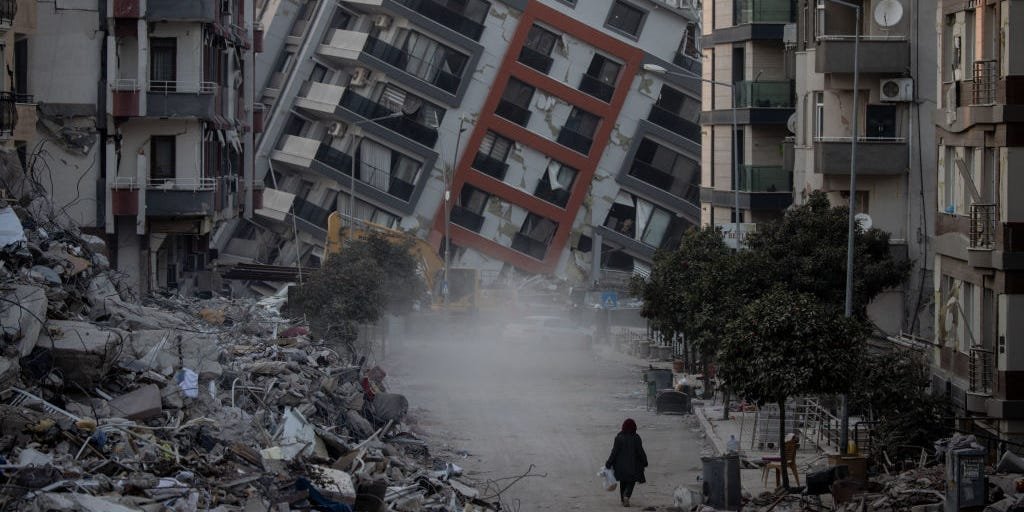
A partially collapsed building in Turkey after an earthquake

A partially collapsed building in Gaziantep, Turkey, after a 7.8 magnitude earthquake rocked the city. The Cascadia Subduction Zone can produce even larger, more dangerous quakes.

Chris McGrath/Getty Images


Carbotte and her team found lots of variability in the megathrust’s structure, which likely means that the hazard varies at different locations along the fault, said Janet Watt, research geophysicist at US Geological Survey Santa Cruz who was not involved in the study.

“It’s not a one-size-fits-all answer, but it gives us an appreciation for that complexity,” Watt, speaking about Carbotte’s results, told BI.

Additionally, understanding that Cascadia is broken up into segments is key to assessing earthquake hazard, Watt said. That’s because this segmentation means that the megathrust could rupture in pieces, rather than all at once. This could impact the size of future earthquakes, because shorter ruptures trigger smaller quakes.

What’s more, the unique characteristics of each of these segments means each one poses a different level of risk. Another key finding from Carbotte’s study is that one of Cascadia’s segments is probably more likely to produce a great earthquake than the others.

This particularly dangerous segment essentially spans the coast of Washington, running from the northern Oregon border to southern British Columbia. It’s flatter and smoother than the other segments, meaning it could trigger the largest earthquakes, Carbotte told BI in an email.

Plus, this segment likely extends further into the US than the others, which is bad news for the state of Washington. If this segment ruptured, Washington’s coastal communities could face the most extreme shaking, although the quake would extend far beyond state borders, Carbotte wrote.

Knowing that could help this state prepare for the worst-case scenario. “I think this is an example of a study that will lead to action in the future in terms of building resiliency along the coastline. And it’ll be exciting to see where the science takes us,” Watt said.

Carbotte’s research emerges in the context of many other studies that are currently working to bring our picture of Cascadia into sharper focus.

“This is one particular study of a larger community effort that is going on to [understand] the system, and then communicate what that means to communities on the coastline and inland, and how we can actually turn science into action,” Watt said.


Source link