From-NFL-team-owners-to-computer-science-researchers-Meet-the-12.jpeg

From NFL team owners to computer-science researchers: Meet the 12 billionaires who have won Oscars

Updated

  • These 12 billionaires are also Oscar winners.
  • Some are the famous filmmakers behind some of the most commercially successful movie franchises.
  • Others are billionaires who have accumulated their wealth through other avenues.

When thinking about Oscar winners, NFL team owners and computer-science researchers might not immediately come to mind.

But some of these icons of their industries have joined other, more famously creative billionaires to accept Hollywood’s highest honors.

Out of the hundreds of Academy Award winners each year, only a tiny minority have net worths comparable to those of tech and industry leaders who define the ultrawealthy class.

The “Avatar” and “Titanic” director James Cameron recently became the newest member of the exclusive club, with Forbes reporting that the filmmaker surpassed the $1 billion net worth mark in December.

Cameron, whose films have earned an estimated $9 billion at the box office, is joining the minds behind some of the biggest box-office hits, including director Steven Spielberg, “Star Wars” creator George Lucas, and “Lord of the Rings” creator Peter Jackson.

In February, Forbes also crowned Spielberg, who has a net worth of $7.1 billion, as the world’s wealthiest celebrity in 2026.

As you start getting ready for your Oscars’ watch party, see which 12 billionaires have won Academy Awards, and see the movies, documentaries, and short films they’ve worked on as directors, producers, writers, executive producers, or in other capacities.

We’ve ranked them on their estimated net worths, as reported by Forbes as of March 12.

Steven Rales

Rales has worked closely as a producer in Wes Anderson films since 2006.

Rodin Eckenroth/Getty Images

Estimated net worth: $7.8 billion

Rales, the chairman and cofounder of medical manufacturer Danaher, founded the film production company Indian Paintbrush in 2006 and has worked closely with director Wes Anderson ever since.

Rales also owns film distributors Janus Films and The Criterion Collection and has a 20% in the NBA Indiana Pacers.

He won the best live-action short film award in 2024 with Anderson’s “The Wonderful Story of Henry Sugar,” which he produced.

Jeffrey Lurie


Jeffrey Lurie looked on during a Philadelphia Eagles game.

Jeffrey Lurie purchased the Philadelphia Eagles in 1994.

Brooke Sutton/Contributor/Getty Images

Estimated net worth: $7.6 billion

The Boston businessman purchased the Philadelphia Eagles for $185 million in 1994 and has won two Super Bowls since. But Lurie has a background in film, and has produced and executive-produced more than a dozen movies.

His grandfather founded the General Cinema movie-theater chain, which operated 1,500 screens at its peak in 1991 before it was acquired by AMC in the early 2000s.

Lurie has won three Oscars for best documentary as executive producer of “Inside Job” in 2011, “Inocente” in 2013, and “Summer of Soul” in 2022.

Steven Spielberg


Steven Spielberg at the Oscars.

The filmmaker is regarded as the most commercially successful film director of all time.

Amy Sussman/WireImage

Estimated net worth: $7.1 billion

The film director and producer has worked on some of the most successful films of the past 30 years, including “Jurassic Park,” “Jaws,” and “E.T. the Extra-Terrestrial.”

He’s regarded as the most commercially successful film director of all time and a pioneer of the modern blockbuster, with his films amassing a box-office total of over $10.7 billion over 37 films, as reported by The Numbers.

He won the Oscar for best director in 1999 with “Saving Private Ryan” and in 1994 with “Schindler’s List,” which also won best picture that year.

In February, he also achieved EGOT status when he took home a Grammy for best music film for “Music by John Williams,” which he produced.

Jeff Skoll


Jeff Skoll, Ricky Strauss, Davis Guggenheim, winner Best Documentary Feature for

The former eBay president (left) has executive-produced two best picture award-winning films.

Jeff Vespa/WireImage

Estimated net worth: $5.3 billion

Skoll, who was eBay’s first president from 1996 to 1998, founded film production company Participant Media in 2004 to create films that increased awareness of social issues.

He won best picture as executive producer of “Spotlight” in 2016 and “Green Book” in 2019.

In total, Participant Media won 21 Academy Awards over 86 nominations, including best international film for “Roma.” The company shuttered in 2024.

George Lucas


George Lucas holds Irving G. Thalberg Memorial Award at the 64th Annual Academy Awards

The founder of Lucasfilm sold his production company to Disney in 2012.

Frank Trapper/Corbis via Getty Images

Estimated net worth: $5.1 billion

The creator of the “Star Wars” and “Indiana Jones” franchises founded the film production company Lucasfilm in 1971 and sold it to Disney for $4 billion in 2012.

In 1992, he won the Oscars’ Irving G. Thalberg Award, which awards “creative producers whose bodies of work reflect a consistently high quality of motion picture production.” He was also nominated for best director and best original screenplay for “American Graffiti” and “Star Wars” in 1973 and 1977, respectively.

Oprah Winfrey


Oprah Winfrey speaks onstage during the 87th Annual Academy Awards at Dolby Theatre on February 22, 2015 in Hollywood, California.

The media mogul was nominated for best supporting actress in 1985 and won an honorary award in 2011.

Kevin Winter/Getty Images

Estimated net worth: $3.2 billion

The TV host and media mogul has often been regarded as the most powerful woman in media and was once the world’s only Black billionaire.

She won the Oscars’ Jean Hersholt Humanitarian Award, which recognizes “outstanding contributions to humanitarian causes” in 2011. She was also nominated for best supporting actress in 1985 for “The Color Purple.”

Steve Tisch


The New York Giants co-owner (right) has produced over 40 films, including “Forrest Gump.”

Jim Smeal/Ron Galella Collection via Getty Images

Estimated net worth: $2.2 billion

The chairman, co-owner, and executive vice president of the New York Giants has produced over 40 films and has worked closely with Columbia and Sony Pictures.

He won the Oscar for best picture in 1995 with “Forrest Gump.”

Peter Jackson


Peter Jackson, winner of Best Director for

The “Lord of the Rings” and “Hobbit” creator has amassed over $6.5 billion at the box office.

Albert L. Ortega/WireImage

Estimated net worth: $1.9 billion, per Forbes

The “Lord of The Rings” and “Hobbit” filmmaker has written, directed, and worked on over 20 films and is the fifth highest-grossing director of all time, with his films surpassing $6.5 billion at the box office, per The Numbers rankings.

In 2004, he won Oscars for best director, best adapted screenplay, and best picture for “The Lord of the Rings: The Return of the King.”

Pat Hanrahan


Pat Hanrahan arrives at the Academy Of Motion Picture Arts And Sciences' Scientific And Technical Awards Ceremony at Beverly Hills Hotel on February 15, 2014.

Pat Hanrahan has won multiple Academy Awards.

Valerie Macon/Getty Images

Estimated net worth: $1.6 billion

The computer graphics researcher, founding Pixar Animation Studio employee, and computer-science and electrical-engineering professor at Stanford University has worked on groundbreaking animation software that led to films like “Toy Story.”

He won a scientific and engineering Academy Award in 1993 and two technical achievement Oscars in 2004 and 2014.

Richard Anthony Wolf


Dick Wolf attends Variety Power of Law presented by City National Bank.

The “Law & Order” producer won best short film as a producer for “Twin Towers” in 2003.

Araya Doheny/Variety via Getty Images

Estimated net worth: $1.5 billion

The film producer, best known for creating the “Law & Order” franchise, founded Wolf Entertainment in 1988. It has become one of the most prolific companies in the television business.

He won the Academy Award for best short film as a producer with “Twin Towers” in 2003.

Tyler Perry


Tyler Perry holding his Oscar statue.

The Madea creator has an estimated net worth of $1.4 billion.

ABC via Getty Images

Estimated net worth: $1.4 billion

The filmmaker and playwright created the Madea character in 1999 and founded his own production company, Tyler Perry Studios, in 2006. In 2019, he unveiled the new 330-acre studio grounds in Atlanta. His films have made over $765 million at the box office.

He received the Oscars’ Jean Hersholt Humanitarian Award in 2021.

James Cameron


James Cameron Oscars win in 1998

The director of “Titanic” and “Avatar” has earned over $9 billion at the box office.

Getty Images/Bob Riha, Jr.

Estimated net worth: $1.1 billion

The director of “The Terminator,” “Titanic,” and “Avatar,” has directed three of the top five highest-grossing movies of all time, as listed by Box Office Mojo. Despite having directed only 10 feature films, Cameron is the second-highest-grossing director of all time.

He won the Academy Award for best director and best picture with “Titanic” in 1998.


Source link

Take-a-look-inside-an-NFL-stadium-in-the-chaotic.jpeg

Take a look inside an NFL stadium in the chaotic hours leading up to game day

  • A few times each year, NFL stadiums like Mercedes-Benz Stadium have events on consecutive nights.
  • Crews have to strip and repaint the field, clean up confetti, and make food for thousands of people.
  • Take a look at how crews prepare Mercedes-Benz Stadium in Atlanta for game day in just 18 hours.

A few times each year, NFL stadiums pull off a logistical feat that most fans never see.

When venues like Atlanta’s Mercedes-Benz Stadium, home of the Falcons, host major events on consecutive nights, crews race against the clock to transform the space in less than a day — repainting the field, clearing confetti, cleaning the stands, and prepping food for tens of thousands of people.

Here’s a behind-the-scenes look at how Mercedes-Benz Stadium gets ready for kickoff in just 18 hours.

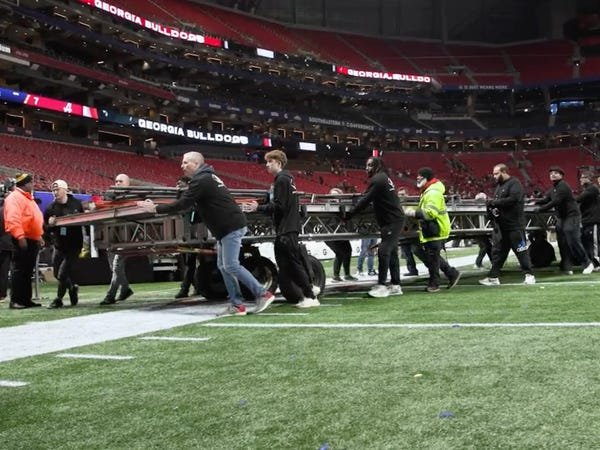
As soon as the final whistle blows, the clock starts ticking to reset Mercedes-Benz Stadium in Atlanta for its next event.

Staff have to move stages and prepare the field for the next game.

Jeffrey Moustache/Joseph Funk/Business Insider

To prepare the field for an NFL game in less than 18 hours, crews have to strip and repaint the field, clean 2 million square feet of stadium space, and fire up thousands of meals in crowded kitchens, all in a matter of hours.

Cleanup starts with collecting all of the confetti dropped onto the field during the last game.


mercedes-benz stadium

Crews cleaned up millions of pieces of confetti off the field.

Jeffrey Moustache/Joseph Funk/Business Insider

The first step in clearing the field and prepping for it to be painted with the Falcons’ logo is collecting roughly 5 million pieces of confetti launched from confetti cannons.

Beyond raking, crews use vehicles fitted with large nets to collect every piece of confetti.


mercedes-benz stadium

A truck with a net used to collect confetti.

Jeffrey Moustache/Joseph Funk/Business Insider

Cleanup crews use rakes, leaf blowers, and utility vehicles fitted with large nets to collect every last piece — even the smallest piece of debris can interfere with repainting the turf.

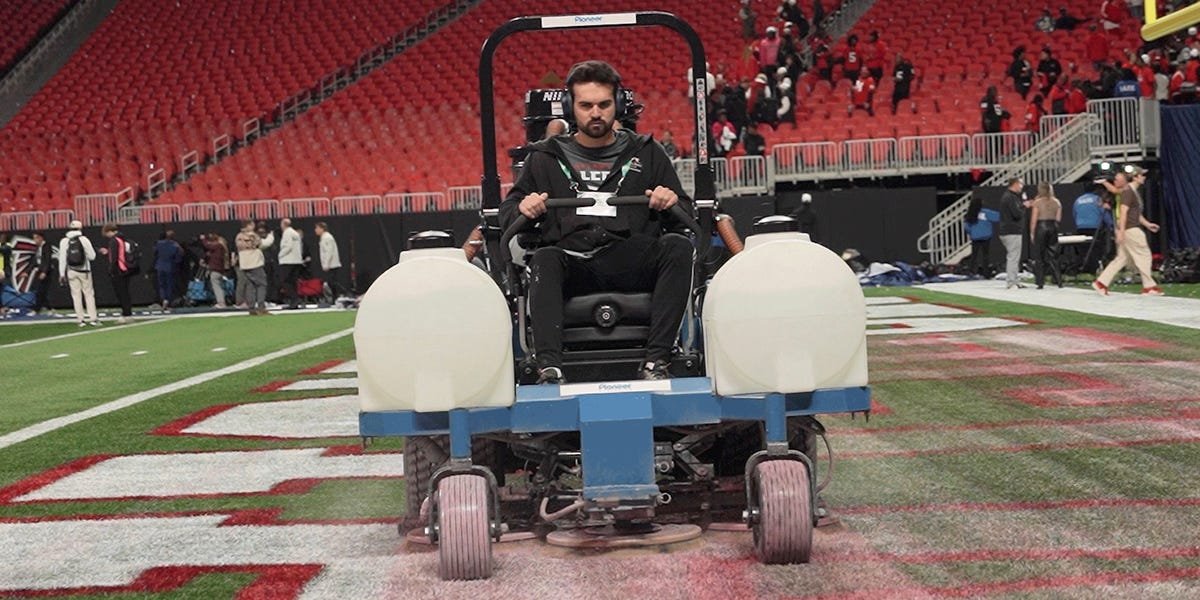
Groundskeepers deploy a P-Rex machine to scrub paint from the field’s logos and end zones.


mercedes-benz stadium behind the scenes

A P-Rex machine helped scrub the field of logos from the previous game.

Jeffrey Moustache/Joseph Funk/Business Insider

The paint removal process takes around one to two hours to complete.

To speed things up, P-Rex machines spray a cleaning solution onto painted logos and use spinning brushes and a vacuum to remove the paint.

The process is surprisingly precise. Too many chemicals can soak the turf, and too much pressure can permanently damage the field.

While the field is being scrubbed, teams of clean-up workers fan out across the stadium’s 2 million square feet.


mercedes-benz stadium

Crews fanned out across the stadium to clean up waste.

Jeffrey Moustache/Joseph Funk/Business Insider

Every area has to be cleared of waste, including the private suites, locker rooms, kitchens, and stadium bowl seating.

What fans leave behind adds up fast.


mercedes-benz stadium

Trash left behind in the seating bowl.

Jeffrey Moustache/Joseph Funk/Business Insider

In the seating bowl, workers hand-pick everything from aluminum cans and plastic bottles to food containers and pom-poms, with each person assigned a specific type of waste to speed up sorting.

By the end of the cleanup process, crews will have collected hundreds of thousands of pounds of trash.

Pressure-washing crews move in right behind them to clear away spilled drinks, dirt, and other residue.


mercedes-benz stadium

Pressure washers were used to clean the seating bowl after waste was collected.

Jeffrey Moustache/Joseph Funk/Business Insider

After trash is collected from the stands, power-washing crews race behind the waste-collecting crews, scrubbing away spills and sticky residue before the next crowd arrives.

Trash flows nonstop into the stadium’s Resource Recovery Room, where workers sort bags of trash by hand.


mercedes-benz stadium

The Resource Recovery Room in Mercedes-Benz Stadium.

Jeffrey Moustache/Joseph Funk/Business Insider

Even though waste is pre-sorted, each bag still has to be inspected.

The goal: recycle or compost 96% of all waste generated during the event.

Then, repainting begins, with crews tackling the center logo and the end zones first.


mercedes-benz stadium

Workers painted the center logo and the end zones first.

Jeffrey Moustache/Joseph Funk/Business Insider

Once paint is removed from the field, the turf must completely dry before repainting can begin.

Grounds crews use this small window of time to prep stencils and get ready to tackle the “hot areas” of the field — the center logo and the end zones — which are the most time-consuming.

Crews use a large stencil to speed up the painting process.


mercedes-benz stadium

A large stencil was used to paint the Falcons logo.

Jeffrey Moustache/Joseph Funk/Business Insider

The logo is hand-painted using spraying machines that ensure accuracy.

Crews have to pay special attention to the sidelines and end zones to ensure everything is up to code before kickoff.

By midnight, all painting is finally finished.

Mercedes-Benz Stadium’s food operation is more complex than just hamburgers and chicken tenders.


mercedes-benz stadium

Kitchen staff must handle food production for concessions, suites, and more.

Jeffrey Moustache/Joseph Funk/Business Insider

About 100 cooks prepare different menus for concessions, suites, catering, and eight all-inclusive clubs — some serving up to 1,000 people.

At this game, the stadium’s food team sold more than 25,000 hot dogs, 10,000 slices of pizza, and over 5,000 pounds of wings.

Kitchen staff have just a few hours of rest after a big game before they’re back preparing food for the next night.


people preparing food at mercedes-benz stadium

Cooks had just a few hours of rest before prepping for the next night.

Jeffrey Moustache/Joseph Funk/Business Insider

The menu changes for every event, and food is largely prepared in a central kitchen and distributed to multiple secondary kitchens throughout the stadium.

Kitchen staff rely on production boards to keep everything organized.


mercedes-benz stadium

Production boards with the team and menus for the following event.

Jeffrey Moustache/Joseph Funk/Business Insider

Executive chef Matt Cooper told Business Insider that having detailed boards allows him to keep track of his massive team and ensure everything runs smoothly.

“This is the magic behind everything we do,” he said. “We have all the chefs, all the supervisors, junior sous chefs, all the cooks, and we’re able to kind of move the pieces around. It’s a big kitchen, a lot of space, and I love being able to kind of visualize and see the whole team.”

By 10 a.m., concessions are up and running. Not long after, barbecue platters are delivered to the private suites.


mercedes-benz stadium

Workers delivered barbecue platters to private suites before the gates open to fans at 11 a.m.

Jeffrey Moustache/Joseph Funk/Business Insider

At the same time, club spaces are stocked with fruit and sandwich trays, employees place fan giveaway items on every seat inside the stadium, and excitement builds for kickoff.

Eighteen hours after the last crowd left, the stadium is once again full of screaming fans.


mercedes-benz stadium

The entire process of resetting the stadium took 18 hours to complete.

Jeffrey Moustache/Joseph Funk/Business Insider

Lights flash, cameras roll, fans cheer, and players take the field, with most of the stadium’s attendees oblivious to the overnight operation that made it all happen.

When the final whistle blows, it’s mere hours before employees at Mercedes-Benz Stadium start planning for the next event.


Source link

The-overnight-scramble-to-prep-an-NFL-stadium.jpeg

The overnight scramble to prep an NFL stadium

Mercedes-Benz Stadium in Atlanta has hosted everything from Super Bowl weekend to concerts by Beyoncé and Taylor Swift. It’s also set to host matches during the 2026 FIFA World Cup. On its busiest weekends, the stadium holds major events on back-to-back days. When that happens, more than 1,000 employees work through the night to flip the site in under 18 hours, cleaning the stadium, repainting the field, and preparing thousands of meals. We spent 24 hours with the team as it switched from a Saturday night college football championship to a Sunday afternoon NFL game between the Atlanta Falcons and a 2026 Super Bowl team, the Seattle Seahawks.


Source link

Meet-the-billionaire-owners-behind-every-NFL-team.jpeg

Meet the billionaire owners behind every NFL team

The New York Giants were founded in 1925 by Tim Mara and have been part of the Mara family ever since.

Team ownership was passed to Tim’s sons, Jack and Wellington Mara, in 1959, and now the team is run by principal owner, CEO, and president John Mara, who took over in 2005 after his father, Wellington’s, death. John Mara had been with the organization since 1991.

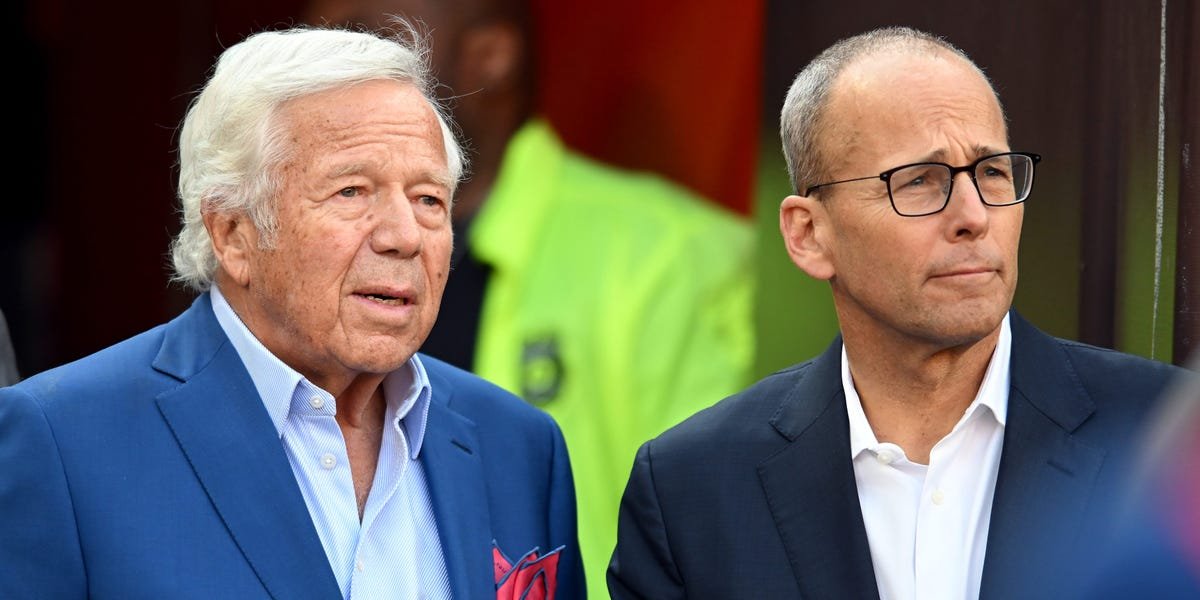
However, while John Mara is listed as the team’s principal owner, he’s actually shared ownership with Steve Tisch since 2005.

Steve Tisch’s father, Preston Robert Tisch, purchased a 50% stake in the Giants in 1991, and after his death, Steve became chairman and executive vice president.

Together, Mara and Tisch helped plan and build MetLife Stadium, and the team has won two Super Bowls (2008 and 2012) under their leadership. However, the team has struggled in recent years, winning just four games last season.

Still, the Giants are the fourth most valuable team in sports, worth $10.1 billion. Tisch has an estimated net worth of $1.6 billion, Forbes reported, while Mara reportedly has an estimated net worth of $500 million.

Tisch was not named in the 2025 report card; Mara was given a C+ ownership ranking by the NFLPA.


Source link

Peter Kafka

Streaming big events like an NFL game used to be question mark. Amazon just got more than 31 million people to stream the Bears-Packers.

On Saturday, the Chicago Bears beat the Green Bay Packers in an NFL playoff game that had everything: a bitter rivalry, an old-school outdoors atmosphere, and a historic comeback (or choke-job, depending on your POV).

It also happened to be a (mostly) streaming-only game. Did you notice? Or care?

I didn’t. Except for about 30 seconds, when I was trying to find out what network was showing the game, and it took me a beat to realize it was on Amazon’s Prime Video. Then I booted up my app and watched the game without any issue. Just like any other NFL game.

In 2026, “Guy doesn’t have a problem watching the Bears/Packers” is a true dog-bites-man story. But that’s why I’m writing about it here: Not very long ago, the idea of streaming a super-high-profile NFL game — and requiring NFL fans to subscribe to a streaming service in order to watch it — would have been a very big deal.

Now it’s a yawner: I was one of 31.6 million people who watched the game, the vast majority of whom streamed it (fans in local markets could use broadcast TV). That’s a streaming record for an NFL game, and it’s more than some other games got last weekend on conventional TV.

And that tells you just how far sports and streaming have come.

Flash back to 2013, for instance, and the idea of whether the “internet” — a catch-all term that included everything needed to get streaming video onto your screen, from web servers to fiber-optic lines to the router in your house — could support a big NFL game watched by many millions of people was an open question. “Why Web TV Skeptic Mark Cuban Thinks Google Can Make the NFL Work on the Web,” was an ungainly headline I tapped out at the time.

Back then, the NFL and other sports giants were routinely streaming big events like the Super Bowl and World Cup — but only as a sort of secondary outlet for weirdos who didn’t have traditional TV. And anyone who did stream sports had to expect to run into problems, like ESPN did when it streamed a World Cup game in 2014.

A year later, the NFL put on a streaming-only game for the first time — but made sure it was a relatively niche one, and made sure that people knew it was an experiment.

Cut to today, and streaming is just a way we watch some football games now. Amazon pays a gazillion dollars a year to show one game a week during the regular season; Netflix has paid up to show a couple games on Christmas Day. A new deal the NFL struck with Disney last year will give the league the opportunity to sell even more games to digital players.

And two years ago, the league passed another new threshold by moving one of its most valuable assets — a playoff game — to Comcast’s Peacock streamer, where it was only available to paid subscribers. That one generated a ton of complaints from people who said they didn’t want to pay another service to watch an NFL game — along with millions of sign-ups for Peacock, which showed they would.

The NFL is not ditching TV for streaming anytime soon. For many people, watching NFL games is the main reason to watch TV, and that gives the league a ton of leverage to extract ever-increasing fees from the likes of NBC and CBS. So they will almost certainly keep the majority of their games on old-time TV for the foreseeable future. But they’re going to sell them to streaming platforms too — because they’ll pay up to get them, and you’ll pay, too.


Source link