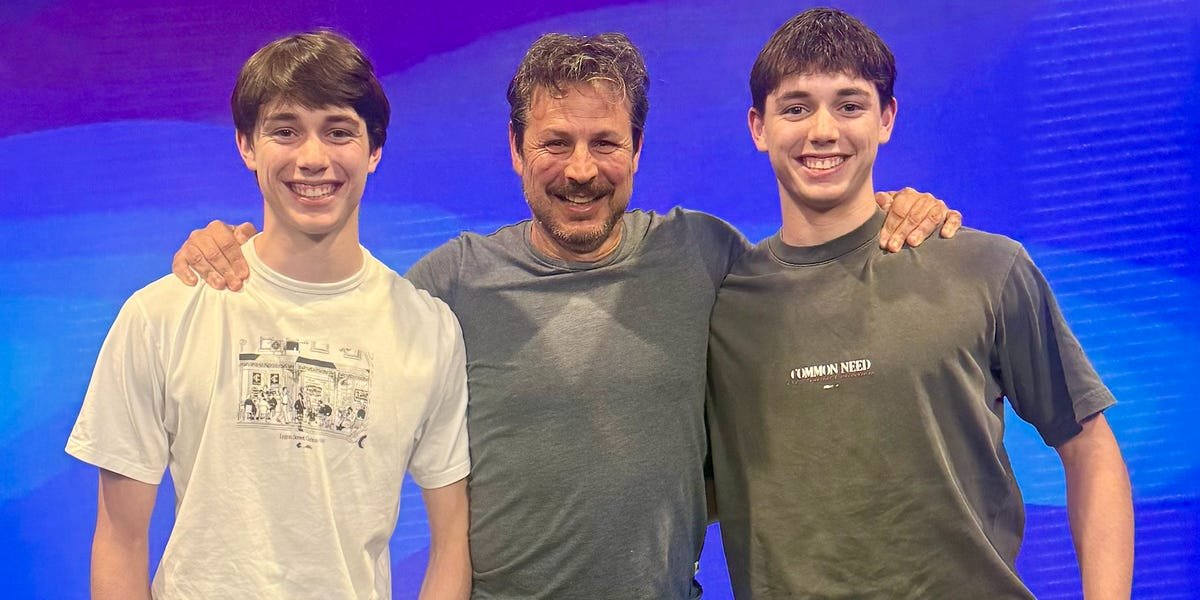
My-twins-had-never-spent-more-than-a-night-apart.jpeg

My twins had never spent more than a night apart. When one went to Europe for 6 weeks, they barely spoke.

My identical twin sons are 19 and have done everything together their whole lives. Same schools, same sports teams, same friends, same produce department at the grocery store. Until last month, they’d never spent more than a night or two apart.

Then Thomas got accepted for a two-week college placement in Italy, and his best friend Brad landed the same one. They decided to tack on another four weeks and travel Europe together. Charlie stayed home.

I helped Thomas plan his trip, giving him recommendations for cities to visit, tips on getting around, and more unsolicited advice than any 19-year-old wants from his dad. I probably talked about the trip more than he did.

Thomas sent Charlie 1 text in 6 weeks

I texted Thomas most days about his trip, and he replied to about a third of my questions, usually two or three days later. His updates were minimal. “Munich. Walked around, saw lots of stuff.” “Prague. Cool. Walked around. Cheap beer.” My wife said I should’ve known better than to expect detailed updates from a 19-year-old travelling Europe with his friend.

I expected the brothers would at least stay in touch, but Charlie heard from Thomas even less than I did. Only once.

Early one morning, our time, Thomas texted asking Charlie to log into his sports betting account and place some bets for him. Charlie was getting ready for work and said no. That was their entire communication for the trip.

Charlie didn’t want to see a single photo

Thomas sent me photos from across Europe, and I’d be happy to show them to Charlie. Every time he’d say he wasn’t interested, and if I tried to show him, he wouldn’t look up from his phone.


College aged men taking selfie

The author’s twin with his friends. 

Courtesy of the author


With Thomas and Brad away, I half expected Charlie to feel the gap. His twin and their best mate were backpacking across Europe without him. But if Charlie felt anything, he didn’t show it. He picked up their shifts at the grocery store, hit the beach, saw his girlfriend, and went out with mates.

You wouldn’t have known anything was different. He never once asked about his brother’s trip.

But then Charlie checked a score he’d normally never care about

People have called them “Charlieandthomas” their whole lives, one word, like they’re a single person. So when they went six weeks barely exchanging a word, I found it strange.

But then, at dinner one night, I mentioned that Thomas had attended an Ajax match in Amsterdam the previous night. It finished 4-1. Charlie said he already knew. He’d checked the score as soon as he woke up that morning.

Charlie follows some soccer, but he wouldn’t normally care about an Ajax game. The only reason he’d check the result was to see if his brother saw an interesting match. He was keeping tabs, in his own way.


Identical twin boys posing for photo

The author’s twins have been known as “Charlieandthomas” 

Courtesy of the author


I’d worried about the silence at first. But the Ajax score changed the way I saw their six weeks apart. When you’ve shared every day of your life with someone, you don’t need to check in to prove you still care.

Thomas came home, and Charlie barely looked up

The night before Thomas landed, I asked Charlie if he was glad his brother was coming back. He shrugged and said not really. When I asked whether he thought Thomas might bring him a gift, “0%” was his response.

My wife and I were at the door when Thomas walked in, pulling him in for hugs and firing questions about the trip. Charlie was on the couch and didn’t get up.

After a while, Thomas reached into his bag and started pulling out gifts. Something for me, a few things for my wife, and then a cap for Charlie from Wolfsburg, his favourite European soccer team. Charlie tried to play it cool, but I could see the excitement on his face.

Six weeks of silence, one rejected betting text, zero interest in any photos, and yet Thomas knew exactly what gift to buy.

They were back at work together in the produce department the next day.


Source link

Im-stuck-in-Dubai-after-our-flight-was-canceled-Im.jpeg

I’m stuck in Dubai after our flight was canceled. I’m paying more than $650 a night for a hotel.

This as-told-to essay is based on a conversation with Kunal Trehan, a luxury interior designer. It has been edited for length and clarity.

We arrived in Dubai on February 20th to expand our business into the UAE, fully expecting to fly home to the UK on February 28th at 10:20 p.m. local time.

On Saturday, the day we intended to leave, we decided to chill by the beach connected to our hotel. Around midday, we heard what sounded like an explosion — a very faint but deep sound. My partner and I assumed it was demolition until an hour later, when people started messaging me on WhatsApp asking if I was OK. I couldn’t understand what they were worried about.


Two men posing for photo inside a car

Kunal Trehan and his partner are stuck in Dubai after the airport closed.

Courtesy of Kunal Trehan


I quickly opened the Qatar Airways app and saw that our flight had been canceled. I started to freak out a bit, wondering if something was going on and how we would escape.

We heard more explosions

As we sat on the beach, still trying to figure out what was happening and what to do next, we could hear more explosions and see accompanying clouds of smoke in the distance. We rushed inside, with me telling my pragmatic self to stay calm and not to panic.

In the evening, more explosions could be heard. We could see the orange light of missiles racing across the sky. We didn’t know where they were being launched from or who was launching them.

I was getting increasingly nervous after looking at the news and social media online. Hotel staff told guests to come inside from their balconies and close their room curtains. Everyone obeyed.

By this point, the sky had become a large plume of smoke over the Fairmont hotel. In the lobby, people were notably panicked. It felt quite claustrophobic, unsettling.

We got emergency alerts on our phones

At midnight, my partner and I got ready to head to sleep when we heard yet another explosion. We opened our curtains, and it looked as if a missile was headed right towards us. Our phones started alarming with the emergency government message to take shelter. “What the hell do we do?” I asked my partner.


Emergency alert

Kunal Trehan received emergency alerts on his phone.

Courtesy of Kunal Trehan


Hotel staff knocked, told us to gather our passports and valuables, and to make our way to the basement. The basement was a concrete-floored area. People were perched on the ground, the elderly in chairs. The staff was doing what they could to calm people and make them as comfortable as possible, providing pillows and blankets.

Even the staff, many of whom are locals, were alarmed. They’ve told us that they haven’t experienced this before. We’ve tried to calm others, to make sure they’re OK.

For three hours, we stayed in the basement, but eventually made our way back to the room as my sciatica was flaring up. We had two hours of sleep in our room before we were woken by another explosion around 9 a.m. on Sunday.

We are advised to stay inside the hotel

The hotel has continued to advise people to stay inside — although we know we aren’t directly being attacked, we are caught in the crossfire of a war, and who knows what could fall from the sky. We’ve followed the advice given to us and done what we can to stay safe.


People sheltering in hotel

Kunal Trehan had to take shelter in the hotel’s basement.

Courtesy of Kunal Trehan


We’ve asked to move hotel rooms to a first-floor room. If our hotel gets hit, we’d rather be able to get outside quickly. My partner and I keep reminding each other that, for right now, we are relatively safe.

But whereas yesterday, I felt a sense of purpose in helping others, today, I’m feeling very flat. We are incredibly fortunate, yet completely out of control, and have no idea when we will be able to get home.

We are paying $670 a night at the hotel

Fortunately, we have the funds to continue paying for our hotel room, which is about $670 a night, and to eat and buy necessities. Our meal tonight — just mains and water — came to about $120. We haven’t been told that any of this will be reimbursed by our travel insurance company.


Man taking selfie at Dubai hotel

Kunal Trehan and his partner moved to a first-floor room in case they need to evacuate.

Courtesy of Kunal Trehan


Over and over, my partner and I speak of how lucky we are. Lucky that we are safe. Lucky that we have money to stay here. Lucky that we didn’t attempt to go to the airport. And yet, we are still so worried. So many emotions — from fear to gratitude.

Our friends and family are so worried for us — we have had hundreds of messages asking how we are. No matter how much we tell them we are safe, their worry continues, and we can hear it in their message and voice notes.

We are hoping to fly out on Thursday, but nothing is set in stone. Just another thing out of our control for now.


Source link

5-big-takeaways-from-Sam-Altmans-Saturday-night-AMA-on.jpeg

5 big takeaways from Sam Altman’s Saturday night AMA on OpenAI’s Pentagon deal

  • Sam Altman went on X on Saturday night and told users to ask him anything about OpenAI’s Pentagon deal.
  • Altman on Friday night announced that OpenAI will work with the Pentagon and let it use its AI models.
  • Here are five big takeaways from Altman’s AMA session.

Sam Altman hopped onto X on Saturday night and told users to ask him anything about OpenAI’s agreement with the Pentagon.

Altman, late on Friday, announced that his company had finalized a deal with the Department of War to use its AI models. OpenAI’s deal came after Anthropic refused an ultimatum regarding the terms of use of its frontier model, Claude, for deployment in mass domestic surveillance and fully autonomous weapons.

Here are 5 big takeaways from Altman’s AMA.

The OpenAI-Pentagon deal was ‘rushed,’ and Altman knows the ‘optics’ don’t look good

The Pentagon deal was done quickly in “an attempt to de-escalate the situation,” Altman wrote on X.

He added in a separate post that the deal had been “rushed.”

Still, the “optics don’t look good” for OpenAI, he wrote.

“If we are right and this does lead to a de-escalation between the DoW and the industry, we will look like geniuses, and a company that took on a lot of pain to do things to help the industry,” he wrote.

“If not, we will continue to be characterized as rushed and uncareful,” he wrote.

Altman added that he sees “promising signs” for where this will all land for OpenAI.

OpenAI took the Pentagon deal because it ‘got comfortable’ with the ‘contract language’

Altman was asked why the Department of War went with OpenAI over Anthropic. He said he wouldn’t speak for his competitor, but did speculate on why OpenAI got the contract inked first.

“First, I saw reporting that they were extremely close on a deal, and for much of the time both sides really wanted to reach one,” Altman wrote. “I have seen what happens in tense negotiations when things get stressed and deteriorate super fast, and I could believe that was a large part of what happened here.”

He added that OpenAI and the Department of War “got comfortable with the contractual language” as well.

“I think Anthropic may have wanted more operational control than we did,” he added.

OpenAI has 3 redlines, but it’s open to changing them as tech evolves

Altman said that OpenAI has “three redlines.” But those redlines could change — and there could be more of them put in place — as the technology evolves, and “new risks” come into play.

“But a really important point: we are not elected. We have a democratic process where we do elect our leaders,” Altman wrote. “We have expertise with the technology and understand its limitations, but I think you should be terrified of a private company deciding on what is and isn’t ethical in the most important areas.”

“Seems fine for us to decide how ChatGPT should respond to a controversial question,” he added. “But I really don’t want us to decide what to do if a nuke is coming towards the US.”

Altman says Anthropic is on a ‘dangerous’ path

Altman said OpenAI had been talking to the Department of War for “many months” about non-classified work, before “things shifted into high gear on the classified side.”

“We found the DoW to be flexible on what we needed, and we want to support them in their very important mission,” he wrote.

“I think the current path things are on is dangerous for Anthropic, healthy competition, and the US,” Altman wrote on X as well. “We negotiated to make sure similar terms would be offered to all other AI labs.”

He also asked for “some empathy” for the Department of War, given its “extremely important mission.”

And, in Altman’s words:

Our industry tells them “The technology we are building is going to be the high order bit in geopolitical conflict. China is rushing ahead. You are very behind.”

And then we say

“But we won’t help you, and we think you are kind of evil.”

I don’t think I’d react great in that situation.

I do not believe unelected leaders of private companies should have as much power as our democratically elected government. But I do think we need to help them.

Altman says AI can help counter big security threats on two fronts

Altman says AI could come in useful on two fronts. Firstly, the US’s “ability to defend against major cyber attacks,” particularly, an attack that might take down the country’s electrical grid.

Secondly, biosecurity is an area where AI could help.

“I do not think we are currently set up well enough to detect and respond to a novel pandemic threat,” Altman said.


Source link

Shuby headshot

DeepMind’s CEO does a ‘second day’ of work at night: ‘I come alive at about 1 a.m.’

You’re not the only one with a strange sleep routine.

In a video interview with Fortune released on Wednesday, Google DeepMind CEO Demis Hassabis said he sleeps very little and splits his waking hours into two working days.

“I do try and get six, but I have unusual sleeping habits,” he said, about his number of hours of sleep. “I sort of manage during the day.”

He said that any less sleep than that would be bad for the brain.

Hassabis cofounded DeepMind in 2010, which Google acquired in 2014. It merged with Google Brain in 2023 to form Google DeepMind, the lab behind tools such as Gemini and Nano Banana. The CEO and a DeepMind coworker, John Jumper, were awarded the 2024 Nobel Prize for Chemistry for their work on protein structure prediction.

Hassabis said that he tries to pack his day in the office with as many meetings as possible with “almost no time” in between. He then gets home, spends time with family, and has dinner.

“Then I sort of start a second day of work about 10 p.m. and go to 4 a.m., where I do my thinking and kind of more creative work and research work,” he said.

The CEO added that he’s followed this schedule for about a decade. Hassabis earlier spoke about his sleep routine in a 2017 interview with BBC Radio.

“I can’t imagine being creative at four in the morning. But, I come alive at about 1 a.m.,” he told Fortune’s Alyson Shontell.

Hassabis’ routine matches what other tech founders have shared about their sleep schedules, especially during the early stages of founding or growing their businesses.

Elon Musk has said that he functions best with about six hours of sleep — any less affects his performance. In a 2018 interview with Bloomberg, Musk said that he slept on the floor of a Tesla factory during some production periods.

Marc Benioff, meanwhile, said in a 2023 interview that he averages about eight hours of sleep.


Source link

Ukrainian-Droid-lay-in-wait-on-a-road-at-night.jpeg

Ukrainian ‘Droid’ lay in wait on a road at night and ambushed Russians with an M2 Browning

A Ukrainian brigade has released footage of one of its uncrewed ground vehicles opening fire on a Russian armored personnel carrier, offering a rare glimpse at the emerging technology in action.

The 5th Separate Assault Brigade said on Wednesday that it deployed a Droid TW 12.7 — a remotely operated tracked system developed by a Ukrainian defense tech company — on a road deemed likely to be a route for advancing Russian troops.

The brigade said that the ground-based drone later encountered a Russian MT-LB, a lightly armored fighting vehicle often used to transport infantry.

Thermal footage filmed at night from the uncrewed ground vehicle, or UGV, shows it opening fire on the vehicle, its operator swerving a targeting reticle across the MT-LB’s front.

Business Insider could neither independently verify when nor where the footage was filmed.

The Droid TW 12.7 is equipped with an M2 Browning machine gun that fires .50 caliber rounds, which would typically pierce an MT-LB’s armor.

The 5th Brigade said it used armor-piercing incendiary rounds for the mission.

Sparks fly from the armored vehicle’s chassis as it slows to a crawl and drifts in front of the UGV, which continues firing point-blank.

“The 12.7 mm bullets punch through the MT-LB’s side, striking the crew and onboard systems,” a narrator said in the 5th Brigade’s video, referring to the metric measurement for .50 caliber bullets.

The MT-LB appears to be aimlessly crawling past the drone, indicating that its driver is incapacitated or its controls are damaged.

The UGV then pivots and begins firing on the rear of the MT-LB, “killing the infantry in the troop compartment,” the narrator said.

The 5th Brigade said that it found in the morning that the MT-LB crew and their passengers were “completely wiped out,” publishing short clips of the aftermath shot by a first-person-view aerial drone.

Wednesday’s published footage provides insight into how UGVs are increasingly used on the battlefield in Ukraine, where troops on both sides are experimenting with ground drones to perform missions that human soldiers must otherwise conduct.

While official statistics show that uncrewed aerial vehicles still dominated the drone warfare space last month, the spread of UGVs offers a possible future where Kyiv can rely on remotely operated systems for ground operations instead of risking its troops.

This year, Ukraine said that it aims to manufacture and deploy at least 15,000 UGVs across the battlefield.

Ukrainian and Russian teams have developed hundreds of such systems, ranging from buggies that can ferry provisions near the front lines to trucks outfitted with remotely operated machine guns.

The 5th brigade and DevDroid, the company that makes the Droid TW 12.7, did not respond to requests for comment sent outside regular business hours by Business Insider.


Source link