
Scatter Plot

The one number driving Americans’ frustration with the economy

Americans are feeling despondent about gas.

It’s a dour time for consumers — in April, the University of Michigan’s Consumer Sentiment Index, which surveys consumers on how they feel about current and future economic conditions, hit an all-time low.

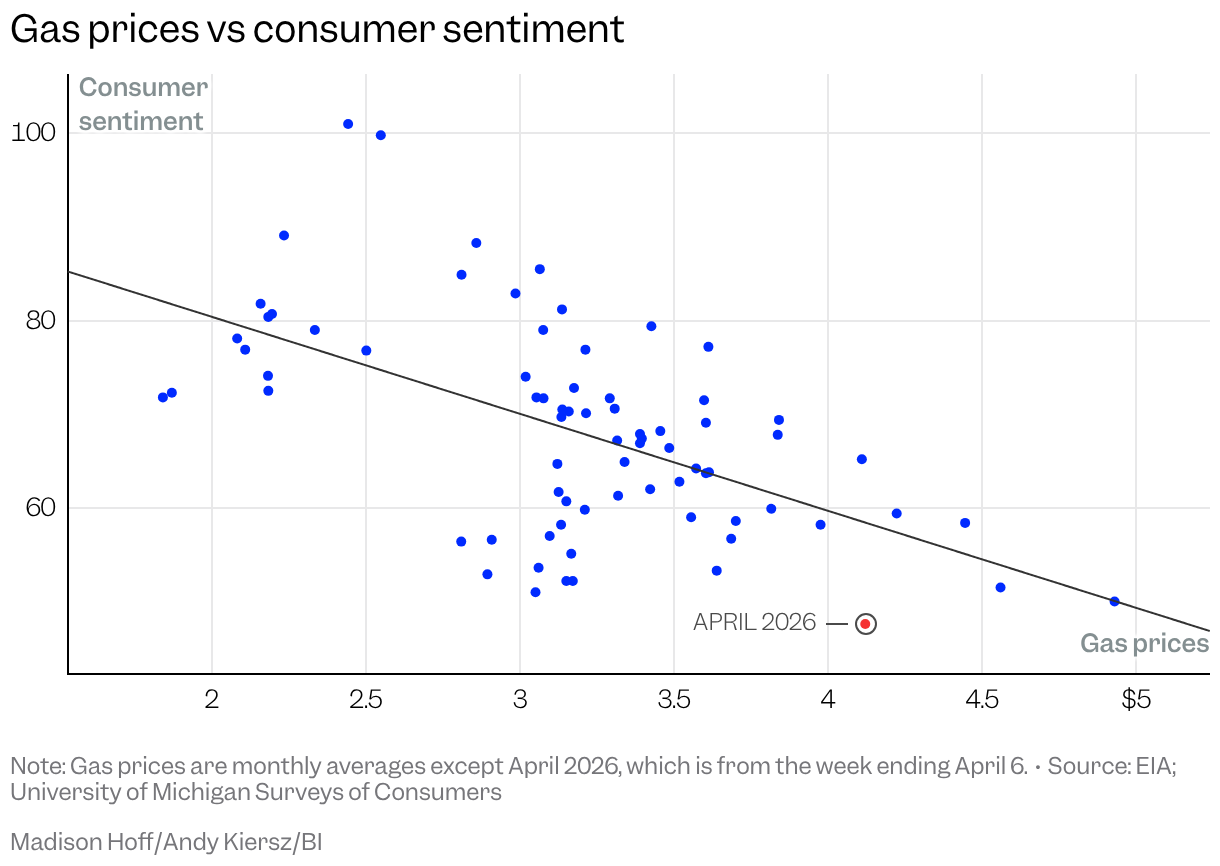
It turns out that one small (or not-so-small) number has a lot of sway over how Americans feel about the economy: Gas prices. In recent years, there’s been a pretty solid relationship between gas prices and consumer sentiment: When it’s more expensive to fill up the tank, Americans tend to report more dire feelings about economic conditions and where they’re going. A Business Insider analysis of retail gas prices from the Energy Information Administration and consumer sentiment from the University of Michigan showed a moderate negative correlation between the two.

Gas prices are a hyper-visible economic marker for many Americans, who might experience immediate sticker shock every time they drive past their local gas station or stop to refill on the way to work. After all, only a small share — under 4% — of Americans use public transportation to get to work, according to Census Bureau data on commuting. A touch over 69% of workers drove alone to work in 2024, meaning that gas prices are likely omnipresent in calculating their commutes and daily expenses.

“Prices at the pump hold a very uniquely salient point in people’s minds,” Matt Colyar, an economist at Moody’s Analytics, told Business Insider. “Maybe it’s the big signs with the big luminescent numbers that everyone drives by constantly. They’re very aware of these prices.”

The last time sentiment was close to being this low was in June 2022. That might seem counterintuitive; it would stand to reason that the depths of the COVID-19 pandemic or the 2008 financial crisis and its aftermath might trump the current fluctuations. But June 2022 marked record-high gas prices amid soaring inflation and the fallout from Russia’s war in Ukraine.

Now, as sentiment hits that record low, gas prices are rising at the fastest pace on record, with last week’s consumer price index report showing a 21% month-over-month increase. As of the week ending April 6, the most recent date for which the Energy Information Administration has data, gas prices hit $4.12 a gallon; as of April 13, they were hovering around the same level, and up 50 cents over the month, per AAA.
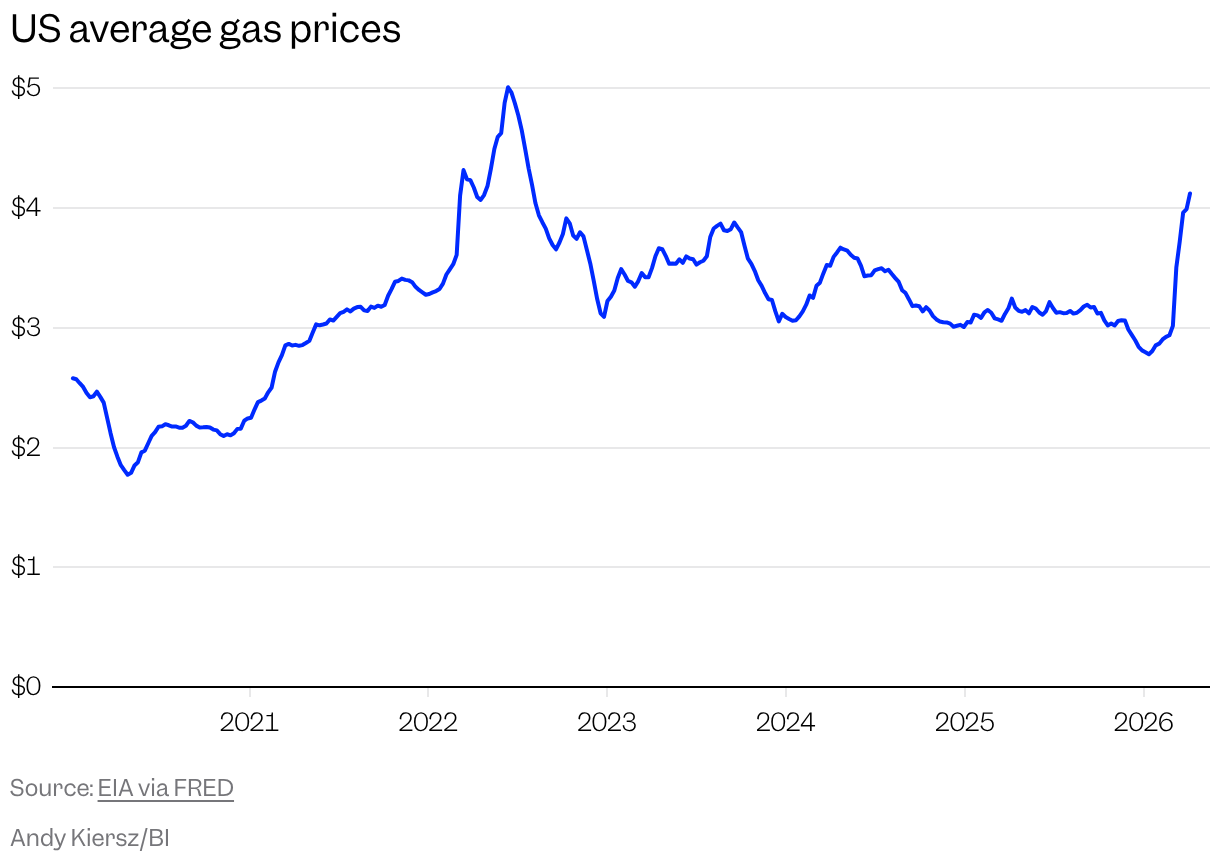
The bad vibes might only continue, especially as President Donald Trump signaled that prices might remain high through the November 2026 midterms and tensions between the US and Iran remain high over the Strait of Hormuz and the roughly 20% of global oil production that passes through it.

“Gas prices are highly visible, highly salient prices that consumers use to gauge their feelings about the economy,” said Alex Jacquez, the chief of policy and advocacy at the left-leaning think tank Groundwork Collaborative. “People have to fill up weekly; they often don’t have much of a choice whether they pay or not.”

Indeed, pump prices are top of mind for Americans as the Iran conflict drags on: 69% of 3,507 Americans surveyed by the Pew Research Center at the end of March said they were very or extremely concerned about higher gas or fuel prices when thinking about US military action in Iran.

That’s already led to changes in how American workers are navigating daily life — rideshare drivers, for instance, are prioritizing the most profitable trips to make their gas expenditures worthwhile. EV owners have taken a victory lap as they plug in. One Business Insider reporter strategically switched to the Costco credit card for gas savings.

Of course, there are plenty of factors that weigh on how Americans view the overall economy, and gas prices alone don’t determine sentiment. For example, the job market has been locked in a low-hire, low-fire “great freeze” for over a year, and the difficult prospects for job seekers are likely weighing on economic opinion as well.

Gas is still likely a looming factor, though. Jacquez said research has shown that “gas prices, consumer sentiment, and political approval all tend to move together, so it’s not surprising to see a sudden rise in gas prices coincide with a crash in consumer sentiment.”

Do you have a story to share about how rising prices and volatility are affecting your economic outlook? Contact these reporters at jkaplan@businessinsider.com and mhoff@businessinsider.com.




Source link

Jack Newsham's face on a gray background.

Pandemic watchdog calls the number of investigations into arts and restaurant bailouts ‘underwhelming’ and ’embarrassing’

A top federal pandemic-aid investigator said the number of investigations into $43 billion in emergency grants to restaurants and entertainment businesses has been “embarrassing” and “underwhelming.”

William Kirk, the new inspector general for the Small Business Administration, urged Congress to give prosecutors more time to bring charges against people for defrauding two lesser-known pandemic aid programs: the $28.6 billion Restaurant Revitalization Fund and the $14.6 billion Shuttered Venue Operators Grant.

“There is no possible way that our office would be able to investigate all of the outstanding referrals and cases that we’ve received in the SVOG and the RRF program,” he said at a Senate hearing on Wednesday. “The scope of the work is such that we would need much more time.”

Business Insider reported in 2023 and 2024 on hundreds of millions of dollars that flowed from SVOG to artists like Lil Wayne, Post Malone, Marshmello, and Nickelback. While those grants may have been legal under the extremely broad language passed by Congress, records showed that some artists spent their taxpayer grants on lavish parties, private jets, and multimillion-dollar bonuses for themselves.

Senator Joni Ernst has pushed to extend the window for bringing charges related to SVOG and RRF fraud. Ernst previously said her Democratic counterpart, Senator Ed Markey, wasn’t letting the bill advance, though Markey’s comments at the hearing suggested the logjam might be breaking.

“I am committed to passing this legislation as part of a comprehensive set of reforms and look forward to working with the chair to advance it, along with other bipartisan priorities,” Markey said. “That said, our efforts to fight against fraud should not be limited to going after small restaurants and theaters, especially when President Trump is letting off fraudsters left and right.”

The bill had been caught up in a larger dispute about other small-business programs that provide research funds to early-stage tech companies. Markey said in a statement that a deal had been reached to extend them for five years.

Kirk, who was sworn in early January, said in prepared testimony that while hundreds of complaints have poured in about potential abuse of the Shuttered Venues program, his office has six open investigations. He said that while his office’s investigators and auditors are “dedicated professionals,” they were focused on other areas of fraud in recent years.

In response to questions from Ernst, who leads the Senate small business committee, about whether Kirk’s office would have time to bring charges before time runs out in April or May, Kirk called the office’s work on those programs “underwhelming.”

“The handful of investigations — quite honestly, it’s an embarrassing number — of investigations we currently have underway, those would probably time out,” he added.

Congress has already extended the statute of limitations to charge some fraud related to the Paycheck Protection Program and Economic Injury Disaster Loans, two larger and better-known programs, tacking on another five years to the normal five-year window to bring charges.

Some Democrats at the hearing pressed Kirk to investigate the activities of the White House’s Department of Government Efficiency at the SBA.

Asked by Senator Jeanne Shaheen if he was concerned about the office’s activities, Kirk said, “Not currently, no.”


Source link

I-thought-Id-nailed-motherhood-Then-baby-number-2-arrived.jpeg

I thought I’d nailed motherhood. Then baby number 2 arrived

When I was a mom of one, I nailed motherhood. I was calm and patient; my child was well-dressed; the car was pristine; the chores were completed; and there was very little shouting. But as a mom of two, I just can’t parent to the same standards. Everything is messier, louder, more rushed, less organized, and good enough, just has to be enough.

Going from one child to two has, without a doubt, been one of, if not the hardest, adjustments of my entire life. One plus one does not equal two in this scenario. As a mom to a 1.5-year-old, a 3.5-year-old, a 16-year-old stepson, and two needy cats, it sometimes feels like I care for a dozen creatures.

I thought I was prepared

When I was pregnant with my second, I wasn’t naive. I didn’t think two would be easy. From the moment I brought my second home from the hospital, and he met my first with a cry that brought my first to tears as well, it has been a pinball game of crying, clinging, grabbing, and fighting.

Each child seemingly has a different, urgent need that requires individual attention and the patience of someone who has had a full night’s sleep. They both want “mommy!” all the time, especially when the other wants me.


Mom with two toddlers

The author says her two kids are always needing her.

Courtesy of the author


Most days, I’ll be lucky to have a sip of water and finger brush my hair into a ponytail before the madness ensues. Once spotted, I’m bum-rushed as they joust for a prime spot on my lap or in my arms. Even with one on each leg with my legs spread as wide as they possibly can, they are still fighting over me, while likely trying to bat each other away. At 40 and 30 pounds each, holding both for more than a moment is back-breaking.

Why is parenting 2 kids so hard?

Countless times since becoming a parent of two, I’ve wondered why I’m not better at this. I’ve always excelled at what I put my energy toward, but this has absolutely shattered me. Most of the time, I’m able to rescue myself from the rabbit hole of feeling like a failure by reminding myself that it feels hard because it IS hard.

Adding a child when you already have one changes every dynamic in your life, including your relationship with your first child, and adds a whole new dynamic: your children’s relationship with each other.

Corners are cut, patience and sleep are limited, and the breaks you used to have when your partner had the other child no longer exist. Oh, did I forget to mention my partner? There’s hardly any time for him. That relationship, the one that is most important in keeping everything afloat, is tested to the absolute limits.

I’m finding joy in the chaos

As I write this, both kids are at day care. It’s my one day a week without them (if they haven’t contracted the latest day care bug), and I’m surrounded by chaos.

There’s a tent in front of me and a play mop on top of what was once our living room table, now a receptacle for apple cores, half-eaten bananas, board books, sippy cups, tissues (some used), and a rotating selection of kitchen utensils.

Amid all the clutter, I see the literal and figurative crumb trails my boys have left: crackers and playdough ground into the carpet, a red fire engine toy on the armchair of the sofa, a wooden spoon deposited in boots as one exited the front door that morning.

Despite the messy, loud, hectic life I now have, I can’t wait to pick them up from day care, even though I know it will be pandemonium from the moment they see me.


Source link