Nvidia CEO Jensen Huang says companies can’t ignore the OpenClaw moment.
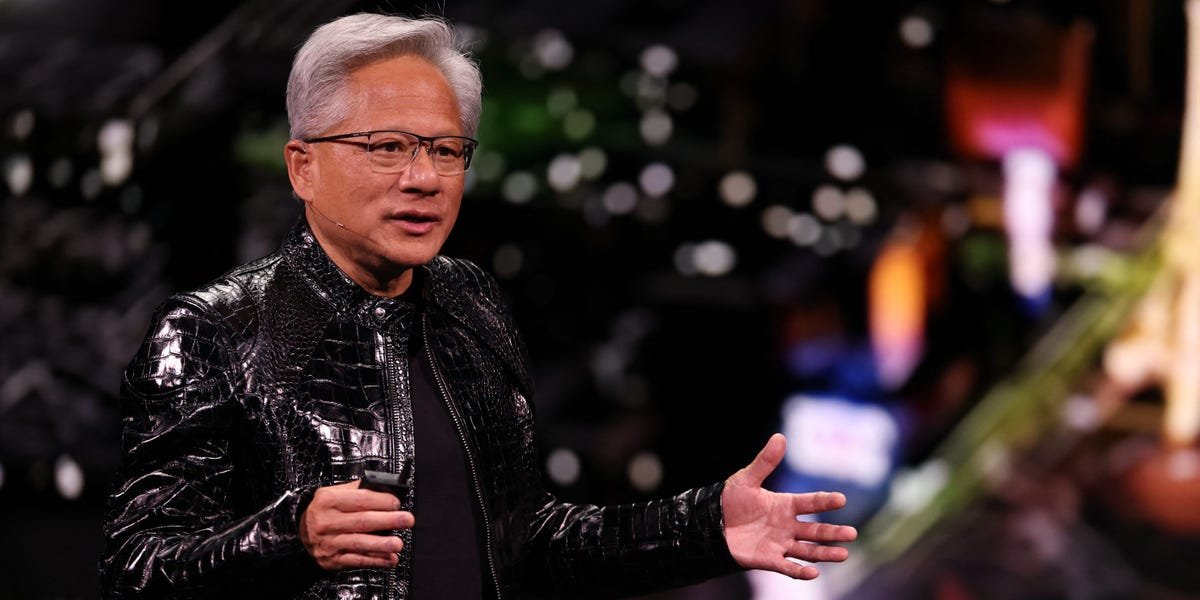
“Every company in the world today needs to have an OpenClaw strategy, an agentic system strategy,” Huang said during Nvidia’s 2026 GTC conference in San Jose on Monday. “This is the new computer.”
Huang offered deep praise for OpenClaw, previously known as Clawdbot and Moltbot, an open-source AI agent that has taken Silicon Valley by storm. Though OpenAI lured away OpenClaw creator Peter Steinberger, the service will live on as an open-source project.
“OpenClaw has made it possible for us to create personal agents,” he said. “The implication is incredible.”
Huang said that OpenClaw “gave the industry exactly what it needed at exactly the time.”
Every time Brent D. Griffiths publishes a story, you’ll get an alert straight to your inbox!
Stay connected to Brent D. Griffiths and get more of their work as it publishes.
OpenClaw will do for AI what Windows did for personal computing, Huang said. He also compared OpenClaw to other influential technologies, such as the Linux operating system, the Kubernetes cloud project, and HTML.
“It made it possible for the entire industry to grab onto this open-source stack and go do something with it,” Huang said.
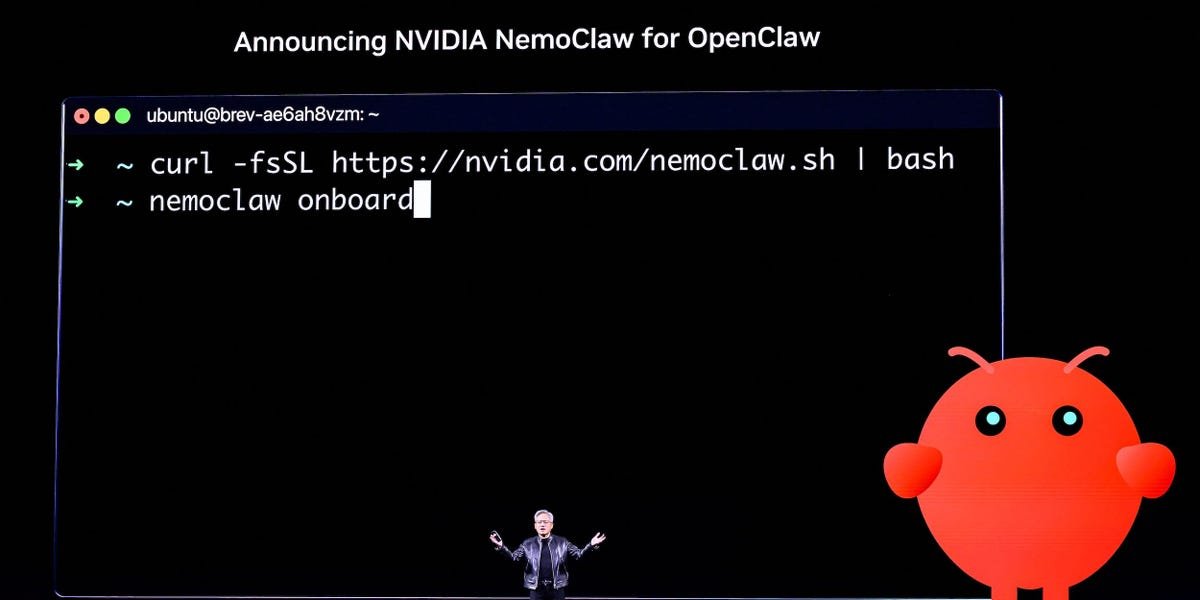
Huang said there’s one big caveat about using OpenClaw that Nvidia has been working to address: security. Nvidia announced its spin on OpenClaw, called NemoClaw, which allows users to add privacy and security controls to their AI agents, or “claws.”
“It has a network guardrail, it has a privacy router, and as a result, we could protect and keep the claws from executing inside our company, and do it safely,” Huang said.
Nvidia is promoting NemoClaw at its conference by hosting a “build-a-claw” event where attendees can develop their own custom-made AI agent.
“OpenClaw brings people closer to AI and helps create a world where everyone has their own agents,” Steinberger said in a statement released by Nvidia. “With Nvidia and the broader ecosystem, we’re building the claws and guardrails that let anyone create powerful, secure AI assistants.”
Huang made a host of other announcements at Nvidia GTC on Monday, including a new inference system that incorporates technology from Groq, an AI chip startup with which Nvidia made a $20 billion deal. He also projected $1 trillion in demand for its Blackwell and Rubin AI chips through 2027.
Nvidia’s annual report, released Wednesday, came in leaner this year.
The chipmaker axed or trimmed sections on climate change and diversity, equity, and inclusion compared with last year’s version.
A 2025 section titled “sustainability and governance,” which delved into clean energy and emission commitments, was absent from Wednesday’s report. That report mentioned sustainability, but in the context of Nvidia’s business sustainability or adherence to sustainability-related laws.
The report published last year read: “These issues are important for our continued business success and reflect the topics of highest concern to Nvidia and our stakeholders.”
Next, a section on human capital was significantly cut. In 2025, the company included subheadings such as “Compensation, Benefits, and Well-Being” and “Diversity, Inclusion, and Belonging at Nvidia.” Neither section was included this year, and the word diversity was not mentioned.
Every time Shubhangi publishes a story, you’ll get an alert straight to your inbox!
Stay connected to Shubhangi and get more of their work as it publishes.
DEI efforts were summarized in one line this year: “We also utilize employee listening systems to gather feedback and maintain an inclusive culture where hiring and promotions are based on merit.”
Last year, President Donald Trump signed an executive order to end diversity programs across the federal government and ordered all federal DEI staffers to be placed on leave while their departments were disbanded.
It was a move that made waves in the private sector as well. Tech companies such as Microsoft, Meta, and Salesforce cut DEI programs. However, some companies, including Costco, have publicly defended their diversity initiatives.
Nvidia did not immediately respond to a request for comment from Business Insider about this year’s changes.
China focus
At 93 pages, Nvidia’s latest annual report was about 40 pages shorter than last year’s. Still, China got moreairtime.
Besides recapping the US government’s chip export restrictions on China, Nvidia wrote that under the current rules, it cannot deliver a competitive product for the Chinese data center market. The company added that this allowed rivals to build larger customer bases worldwide.
“Our lost opportunity and the benefit to our competitors will have a material and adverse impact on our business, operating results, and financial condition,” the report read.
The company said its estimates for the current quarter did not include any expected revenue from sales of data-center chips to China.
On Wednesday, Nvidia reported better-than-expected fiscal year 2026 earnings, owing to strong AI data center demand. It reported $68.1 billion in revenue, a 73% year-over-year increase, and about $43 billion in profits, 94% higher than the same time last year.
The chipmaker’s stock was up slightly after hours.
Meta is doubling down on its relationship with Nvidia in what the AI chip giant called a “multigenerational” deal.
The agreement, announced Tuesday, calls for Meta to build data centers powered by millions of Nvidia’s current and next-generation chips for AI training and inference.
The move underscores how Meta is deepening its reliance on Nvidia, even as the social networking giant develops its own in-house chips and works with competing suppliers like AMD. Reports also suggested Meta has explored using TPUs — chips designed by its rival, Google.
The Nvidia deal could cool speculation around Meta’s purported TPU talks, said Patrick Moorhead, chief analyst at Moor Insights & Strategy — though Big Tech companies often test several suppliers at the same time.
The deal arrives amid increased competition in AI infrastructure. While Nvidia leads the market, rivals including Google, AMD, and Broadcom are working to chip away at its dominance.
Crucially, the partnership will see Meta deploy not only Nvidia’s GPUs, but also CPUs.
CPUs, long dominated by Intel and AMD, are the central processors that work with GPUs inside data centers. They’re used for general computing tasks and are core to essentially all modern computing systems, whereas GPUs are used in specialized cases that require more compute power, such as AI training and graphics in gaming.By supplying both, Nvidia stands to capture even more spend and deepen its role within Meta’s AI stack.
While that increases competitive pressure, Moorhead said the demand for infrastructure has become so high that Nvidia’s rivals will unlikely see outright declines in the near term.
Nvidia has been making its CPU ambitions more explicit, Moorhead said, including marketing its forthcoming Vera CPU as a stand-alone product. This emphasis reflects how CPUs play a larger role as AI workloads move beyond model training and toward inference.
“CPUs tend to be cheaper and a bit more power-efficient for inference,” said Rob Enderle, principal analyst at Enderle Group.
Both Moorhead and Enderle said that Meta’s decision to source both GPUs and CPUs from a single vendor can also reduce complexity, with chief information officers often favoring a “one-throat-to-choke” approach to problem resolution.
In addition to GPUs and CPUs, Meta will use Nvidia’s networking equipment inside data centers as part of the deal, as well as its confidential computing technology to run AI features within WhatsApp.
The companies will also work together to deploy Nvidia’s next-generation Vera CPUs beyond the current Grace CPU model, Nvidia said.
Have a tip? Contact this reporter via email at gweiss@businessinsider.com or Signal at @geoffweiss.25. Use a personal email address, a nonwork WiFi network, and a nonwork device; here’s our guide to sharing information securely.
As Sylendran Arunagiri considered moving from India to the US to pursue a master’s degree, some friends and mentors advised him to delay his move. They warned that the US tech job market had become too challenging.
Arunagiri’s goal was to move to the US in late 2023, begin a master’s program in product management at Carnegie Mellon University, and land a Big Tech internship for the summer of 2024. He hoped this would be a stepping stone toward landing an AI-related role, ideally at Nvidia, his “dream company” because of its central role in the AI technologies he’d long wanted to work on.
However, there were several things working against him. For one, the US tech hiring landscape was already creating headaches for job seekers. Openings had plummeted from highs reached a year earlier, and industry layoffs were increasing competition for available roles.
Additionally, Arunagiri had grown accustomed to the job market in India, where he earned a bachelor’s degree and an MBA from top institutions that he said relied on structured campus placement programs to funnel many students directly into jobs. But from what he’d heard, the US was very different. Job fairs were often more like networking events than recruiting opportunities.
“You’re completely on your own,” said the 30-year-old, who now lives in San Jose.
Every time Jacob publishes a story, you’ll get an alert straight to your inbox!
Stay connected to Jacob and get more of their work as it publishes.
Arunagiri is among the many job seekers who have struggled to navigate a US hiring landscape that’s become more challenging in recent years. Amid economic uncertainty, the early effects of generative AI adoption, and a broader push to streamline operations, US businesses are now hiring at one of the slowest rates since 2013.
Still, some people have managed to break through in a challenging market. Arunagiri shared how he pursued his goal of working at Nvidia — a company he described as his dream employer — and offered his top advice for other job seekers.
Striking out on Nvidia
Many of the tech companies Arunagiri was targeting had conducted summer internship interviews the previous fall, so he began applying before moving to the US. After sending out many applications, he landed an interview with Nvidia in November 2023.
Arunagiri said the interview process went so well that he stopped applying to other internships. But after moving to the US and completing his final interview in February, he learned that he wouldn’t be getting the role — which left him scrambling to find another internship.
“I had to start from scratch, but by then many of the applications had dried out,” he said
Arunagiri was able to land an AI product manager internship based in India at the tech company Informatica. However, that summer, he found it difficult to stop thinking about what went wrong during his interview process with Nvidia — and began setting his sights on eventually landing a full-time role with the company.
A second chance at Nvidia
Upon reflection, Arunagiri suspected that his final Nvidia interview may have doomed him. He said he was lower energy than usual because he was feeling sick that day, and that he’d been hesitant to postpone it out of fear that the opportunity would be filled in the meantime. In hindsight, he said that decision was likely a mistake.
“I came off as a dull candidate, but I’m usually energetic and conversational,” he said. “I should have probably postponed it to a day that I was feeling better.”
Arunagiri decided to reach out to an HR professional from Nvidia to get insight into where he fell short, and they agreed to jump on a call with him. While they didn’t provide specific insights into his candidacy, he said they recommended he try to connect with people at Nvidia in current roles, including hiring managers and interns, to get insight into the kinds of projects they were working on and how he could better align his profile.
He eventually connected with about five Nvidia interns, who he said provided valuable insights. Those conversations helped shape the personal AI-related projects he began pursuing and sharing on LinkedIn in hopes of standing out.
After the summer, Arunagiri dove back into the job search, eager to land a role before he graduated in December 2024. He knew that if he didn’t land a job within 90 days after graduation, his F-1 visa restrictions would force him to return to India.
In September 2024, he submitted a cold application for a technical product marketing role in agentic AI at Nvidia —a role he described as his “dream AI role” at his dream company. He was asked to interview starting in October, and around the same time, he was also invited to interview for a more junior product management role at Microsoft.
Read more about people who’ve found themselves at a corporate crossroads
Advice for other job seekers
In December, with his graduation looming later that month, Arunagiri received offers from Nvidia and Microsoft within days of each other. Given that Nvidia was his dream employer, the role checked a lot of his boxes, and the pay was higher than Microsoft’s, he said the decision was fairly easy — and he accepted Nvidia’s offer. He said that so far, working at Nvidia has been “everything that I’ve dreamed of.”
Arunagiri believes that his LinkedIn presence helped him stand out. During the interview process, he said, the hiring manager told him that he’d reviewed his LinkedIn profile and noticed the projects he’d been working on, including small experiments with new generative AI tools and models he’d shared publicly.
He has a few pieces of advice for job seekers. First, he said, time management is key, particularly because applying for jobs and connecting with people can be time-consuming. Second, he said, never compare your job search journey to anyone else’s, since a variety of factors can influence how it plays out.
Rather than quietly applying and networking, he recommends sharing tangible projects publicly — such as posting about AI tools you’ve explored and linking to projects on LinkedIn or a personal website — so hiring managers can see your work.
“You need to find something that sets you apart from others,” he said.
Jensen Huang says Nvidia would love to invest in a future OpenAI IPO.
Huang said in an interview on CNBC’s “Mad Money” on Tuesday that there was “no drama” between Nvidia and OpenAI CEO Sam Altman, pushing back against recent chatter of tension in the relationship between the two companies.
“The first deal is on,” the Nvidia CEO said, referring to the company’s September deal with OpenAI, under which the company said it planned to invest up to $100 billion in the AI startup.
“And then there’s, of course, an IPO in the future,” he added. “We love to be participating in that as well,” he added.
Huang also described OpenAI as a “once in a generation company” and said Nvidia is “delighted to invest in it.”
Every time Lee Chong Ming publishes a story, you’ll get an alert straight to your inbox!
Stay connected to Lee Chong Ming and get more of their work as it publishes.
His comments come amid reports suggesting internal unease around the deal.
The Wall Street Journal reported on Saturday that the investment had sparked internal concerns at Nvidia, with some executives questioning the deal, according to people familiar with the matter.
Separately, Reuters reported on Tuesday that OpenAI had been unhappy with certain newer Nvidia chips and had looked at alternatives since last year, citing people familiar with the matter.
Huang told reporters in Taipei on Saturday that speculation of any dissatisfaction with OpenAI was “nonsense.”
“We will invest a great deal of money, probably the largest investment we’ve ever made,” he added.
Altman has also pushed back on rumors of tension.
“We love working with NVIDIA and they make the best AI chips in the world,” wrote Altman in a post on X on Tuesday.
“We hope to be a gigantic customer for a very long time. I don’t get where all this insanity is coming from,” he added.
OpenAI is one of the world’s most valuable private AI companies and a major customer for Nvidia’s chips, which power the training and deployment of large language models.
The startup has not announced plans for an IPO, but its fundraising and computing needs have fueled speculation about how it will finance future growth.
“Big Short” investor Michael Burry said in a Substack exchange in January that he was surprised that ChatGPT “kicked off a multi-trillion-dollar infrastructure race.”
“It’s like someone built a prototype robot and every business in the world started investing for a robot future,” he wrote.
An internal Nvidia email chain revealed how senior executives at the chip giant — including founder and CEO Jensen Huang — mobilized in response to customer criticism of a key product launch late last year.
The thread offers a glimpse into how the company responds to public backlash as it expands products designed for individual developers and researchers.
The thread, which Business Insider has seen, centered on the launch of DGX Spark, a desktop AI system designed for developers and researchers to build AI products and work on apps for data science, medicine, and other fields.
While much of Nvidia’s business targets data center customers, Huang underscored Spark’s significance in the thread, calling it the “ultimate developer’s platform — out of the box easy to run all NVIDIA.”
Spark drew criticism soon after its launch, with some citing software stability and performance issues, which garnered coverage in other tech outlets.
An Nvidia spokesperson declined to comment.
Anshel Sag, a Moor Insights & Strategy analyst who has tracked Nvidia launches for 15 years and was an early DGX Spark tester, said the company’s long experience releasing graphics cards in the gaming industry — where products are routinely scrutinized — has made it adept at handling public feedback, with Huang typically keeping a close eye on new releases.
In recent years, the company has become even more reactive, Sag said, due to increased internal resources and “sensitivity about the stock price and how negative sentiment can draw that down.”
Nvidia CEO Jensen Huang steps into the fray
In the fall of last year, AstraZeneca executive director Justin Johnson wrote in a LinkedIn post that while the DGX Spark met performance and speed claims, the software experience was buggy and unstable.
After an Nvidia executive shared Johnson’s post in an internal email thread, Huang entered the fray.
“Jump on x and say you will fix,” he wrote.
A founder’s edition of the DGX Spark on display at a Paris tech show last June.
Chesnot/Getty Images
Subsequently, an Nvidia engineer replied that the company had reached out to Johnson to resolve most of the issues, which were related to a version mismatch of CUDA, Nvidia’s software that allows developers to build AI apps powered by its GPUs.
Johnson responded that he appreciated the outreach and was exploring setting up DGX Spark at the pharmaceutical company, the chain said.
Nvidia staffers ramp up responses
Following Johnson’s criticism, Nvidia staffers saw other unfavorable responses online and set up a social listening campaign to flag complaints from other influential figures, as well as discussions on Nvidia forums and Reddit, the emails said.
Staffers tracked complaints and engaged directly with key critics who raised concerns about DGX Spark’s performance, heating issues, and pricing.
Another incident involved the researcher Christopher Kouzios, who wrote on LinkedIn that he’d purchased DGX Spark to conduct medical research after his daughter died from a rare brain tumor, with the goal of studying cancer risk in his sons.
Kouzios said software incompatibility had rendered the system unusable and that he’d only received an automated acknowledgment 38 hours after filing a support ticket.
After an Nvidia executive flagged the post, team members said they were fixing the bug, according to the emails. The executive later circulated an updated post in which Kouzios lauded Nvidia’s customer support.
“While the situation initially frustrated me, Nvidia’s response time was exceptional,” Kouzios told Business Insider. “In more than 33 years working with large technology companies, I have never seen an organization respond that quickly to public technical feedback.”
It’s often standard for hardware to ship without fully finished software, Sag said, adding that Nvidia tends to be more “high-touch” than other tech companies in fielding complaints — an approach that flows down from an exceptionally “hands-on” CEO.
Nvidia has previously faced some launch hiccups and early criticism for new products, such as its Blackwell rollout, which encountered manufacturing challenges.
While a CEO’s involvement is notable and Nvidia’s backchannel efforts appeared to placate critics, such an approach isn’t without risks, another analyst said.
“C-suite engagement during product controversies has become more common in tech, particularly for founder-led companies,” said Kate Holterhoff, a senior industry analyst at RedMonk. “It can signal authenticity and accountability, but it also carries reputational risk if the response is perceived as defensive or dismissive.”
Have a tip? Contact this reporter via email at gweiss@businessinsider.com or Signal at @geoffweiss.25. Use a personal email address, a nonwork WiFi network, and a nonwork device; here’s our guide to sharing information securely.
Nvidia just scored a win from President Donald Trump.
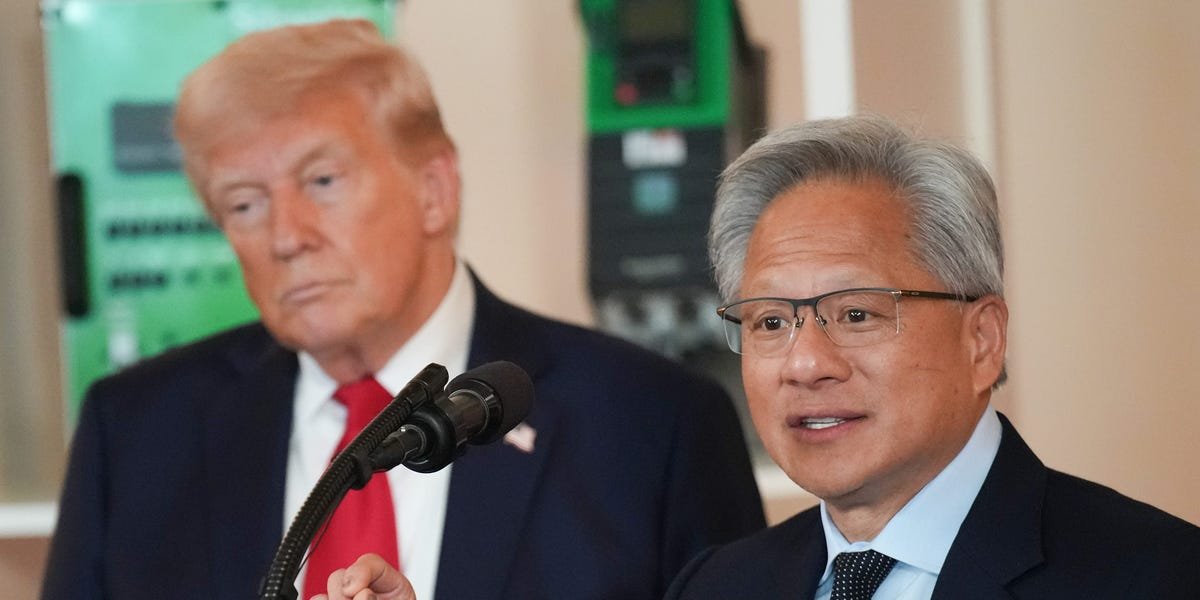
In a post on Truth Social on Monday, Trump said he told Chinese leader Xi Jinping that the US would allow Nvidia to sell its H200 chips to “approved customers” in China.
“This policy will support American Jobs, strengthen US Manufacturing, and benefit American Taxpayers,” Trump said in the post.
Trump said, “$25% will be paid to the United States of America.” He has previously proposed having the US take a cut of chip sales to China.
Nvidia’s stock was up in after-hours trading following Trump’s announcement.
“We applaud President Trump’s decision to allow America’s chip industry to compete to support high paying jobs and manufacturing in America,” a spokesperson for Nvidia said in a statement to Business Insider. “Offering H200 to approved commercial customers, vetted by the Department of Commerce, strikes a thoughtful balance that is great for America.”
Nvidia’s powerful H200 chips have been in high demand as AI models become more powerful.
While Nvidia was already able to sell some of its other chips to China, the US government has limited its ability to sell some powerful chips due to national security concerns. Sales of its H20 chips to China during Q3 were “insignificant,” CFO Colette Kress said on its latest earnings call.
“While we were disappointed in the current state that prevents us from shipping more competitive data center compute products to China, we are committed to continued engagement with the US and China governments and will continue to advocate for America’s ability to compete around the world,” Kress said during the Q3 earnings call.
Nvidia CEO Jensen Huang met with Trump last week to discuss export controls on chips.
“I’ve said repeatedly that we support export control, that we should ensure that American companies have the best and the most and first,” Huang told reporters last week.
Several institutional shareholders of Tesla told Business Insider that Elon Musk’s decision to redirect a shipment of valuable Nvidia chips away from the EV company is further proof the CEO doesn’t deserve a multibillion-dollar pay package.
In May, a group of eight Tesla shareholders wrote a letter urging other investors to vote against Musk’s compensation package. The group is just one faction of a growing number of investors who said they plan to vote against the deal.
This package, now roughly worth $46 billion, was struck down in January by Delaware Chancery Court Chancellor Kathaleen McCormick, who said that the process to reach this “unfair price” for Musk was “deeply flawed.”
Tesla shareholders will vote on June 13 on whether to reinstate Musk’s deal.
But less than two weeks ahead of the shareholder vote, CNBC reported that Musk diverted a $500 million shipment of Nvidia chips, which are essential for powering artificial intelligence technology, away from Tesla and to his social media platform X instead.
The internal memo from Nvidia indicating Musk’s delay of the Nvidia chips procurement was from December, CNBC reported — months before the April earnings call in which the Tesla CEO insisted the automaker is an AI company. He also stated in the call that he would aggressively expand the number of Nvidia chips at Tesla from 35,000 to 85,000 units by the end of 2024.
In response to the CNBC report, Musk said on X that “Tesla had no place to send the Nvidia chips to turn them on, so they would have just sat in a warehouse.”
“The south extension of Giga Texas is almost complete. This will house 50k H100s (Nvidia chips) for FSD training,” Musk added, referring to Tesla’s Full Self-Driving feature — a key component of the company’s promise to deliver autonomous taxis.
But some of the shareholders behind the effort to strike down Musk’s big payday are not convinced.
“The diversion of Nvidia’s processors to X and xAI is just another example of Tesla’s CEO reallocating Tesla’s resources in favor of his other businesses and treating Tesla as though it is his own coffer as a result of the lack of oversight by Tesla’s board,” Tejal Patel, the executive director of SOC Investment Group, wrote in an email to BI.
Patel added: “The key questions are why were these valuable processors ‘just sitting there’ in the first place, and if it was an operational issue, why was that not foreseen by management? Whatever decision-making there was for the processors to go unused by Tesla would have been up to CEO Musk.”
Musk did not respond to a request for comment from Business Insider.
SOC Investment Group is one of the eight shareholders that co-signed a letter urging investors to vote against the ratification of Musk’s stock options package and against the reelection of Musk’s brother, Kimbal, and James Murdoch for seats on Tesla’s board.
The group — made up of pension fund managers, an asset management firm, and a bank — also includes Amalgamated Bank, AkademikerPension, Nordea Asset Management, New York City Comptroller Brad Lander, SHARE, Unison, and United Church Funds.
In a statement to BI, Lander wrote that Musk’s decision to divert Nvidia chips away from Tesla “should be a “red flag to investors.”
“This sudden move adds to the growing concerns about Musk’s commitment to Tesla and highlights his glaring conflicts of interest,” he wrote. “There is a pressing need at Tesla for a genuinely independent board that will ensure Musk prioritizes company interests.”
Matthew Illian, the director of responsible investing for United Church Funds, similarly criticized Musk’s move to delay the shipment of Nvidia chips, stating that it was “further evidence” that the pay package “never achieved its purpose of maintaining the attention of Tesla’s CEO.”
“This is all about Elon building an empire for himself with investor money and we can’t let this happen,” he wrote in an email to BI.
It’s not immediately clear how much Tesla stock the eight shareholders own altogether.
Five of the eight shareholders, including Amalgamated Bank, Unison, Nordea, the New York City Retirement System, and United Church Funds, represent more than 4.9 million shares of Tesla stock.
As of Thursday, those shares are worth more than $878 million.
Spokespersons for SHARE, Nordea, and Unison could not be reached for comment or did not immediately respond for comment.
In addition to the eight shareholders, the California Public Employees’ Retirement System (CalPERS), which owns about 9.5 million shares of Tesla stock, signaled it would vote against Musk’s pay package.
“We do not believe that the compensation is commensurate with the performance of the company,” CalPERS CEO Marcie Frost told CNBC.
A CalPERS spokesperson declined to comment when asked about Musk’s decision to divert the shipment of Nvidia chips.