
Sinéad Baker's face on a grey background

NATO official says members often aren’t buying weapons together, and it’s a mistake

NATO members aren’t regularly buying weapons together, limiting how quickly and cheaply they can build up stockpiles, a senior alliance official said.

Tarja Jaakola, NATO’s assistant secretary general for defense industry, innovation, and armaments, said that allies can acquire weaponry most cost-effectively by jointly purchasing it.

Having multiple countries trying to independently develop similar weaponry means fewer resources per program and higher per-unit costs than working together.

But she said that’s often not what is happening.

“When I talk with the industry, the industry keeps telling me many nations still approach them individually with their individual requirements. And that is something that we should avoid,” she told UK think tank Chatham House.

Instead, “we should look at how much can we collaborate, work together,” Jaakola said. She said shared systems also make it easier for allies to operate together in a war.

She said that countries need to “make sure that we use the taxpayer’s money cost efficiently,” especially given that “the cost escalation within defense systems is higher than in the civilian market.”

She said that allies should be embracing collaboration, co-production, and joint procurement: developing, building, and buying weapons together. NATO is made up of 32 countries, some of which are small. Internal competition for resources and contracts isn’t desirable.

Russia’s invasion of Ukraine has driven worries of wider war across the alliance and a flurry of defense spending. As more money flows into defense, questions are being raised about traditional development and acquisition processes.

The traditional defense development cycles are too slow, and the resulting arsenals are too small. Ukraine is demonstrating that it can build and modify weapons more quickly and cheaply than its partners typically can.

Officials across the alliance have noted the issue and advocated for joint production.

NATO has been increasingly pushing for greater joint production and encouraging allies to take out multinational contracts. The alliance said last year that member states are invited to “make joint procurement the preferred procurement choice.” The European Union, where most of NATO’s members are based, has also changed rules to incentivize joint procurements.

NATO Secretary General Mark Rutte said that joint procurement should reduce costs for alliance members when buying gear.

Many leaders in Europe feel the same. Ursula von der Leyen, the president of the European Commission, said last year that joint procurement would “reduce costs, reduce fragmentation, increase interoperability, and strengthen our defence industrial base.”

“We are living in the most momentous and dangerous of times,” she warned. “The real question in front of us is whether Europe is prepared to act as decisively as the situation dictates. And whether Europe is ready and able to act with the speed and the ambition that is needed.”

Jaakola said that one “very good example” of effective joint production is the interceptor missiles for the US MIM-104 Patriot air defense system. There is increasing co-production for them, including Germany’s establishment of facilities to produce missiles there. But her comments suggest there is much more to be done.

A briefing presented last year to European Parliament members revealed that joint procurement across the union was far below targets, even though it said doing so would allow for better industrial leverage, better interoperability, and annual savings of several billion euros.

Jaakola also said that NATO militaries need to change how they develop weapons. She said Ukraine has shown how weapons can be developed and fielded far faster than in NATO systems.

She said it’s an “important lesson that we need to learn from Ukraine” and that NATO needs to “actually see how we can change our own mindset and our own way of working when we talk about capability development.”


Source link

Bryan Metzger

Read the memo authorizing Senate offices to use ChatGPT, Gemini, and Copilot for official use

  • Senate staff have been approved to use three major AI chatbots for official work.
  • That includes OpenAI’s ChatGPT, Google Gemini, and Microsoft Copilot.
  • Lawmakers and staffers have already been experimenting more with using AI over the last year.

Staffers in the US Senate are now allowed to use three major AI chatbots for official business.

In a memo sent to Senate offices on Monday and obtained by Business Insider, the Senate Sergeant at Arms’ Chief Information Officer approved the use of three major AI chatbots using Senate data: OpenAI’s ChatGPT, Google Gemini, and Microsoft Copilot.

The existence of the memo was first reported by The New York Times.

The memo specifically highlighted Copilot, noting that it’s integrated into the Microsoft 365 tools that Senate staff already use.

The memo said that the tool may be used for “drafting and editing documents, summarizing information, preparing talking points and briefing material, and conducting research and analysis.”

It is not clear why the Senate did not authorize Claude, the AI chatbot developed by Anthropic. A message on an internal Senate IT website, viewed by Business Insider, said that Claude was among several AI tools that are still under evaluation.

The House has already approved the use of ChatGPT, Copilot, Gemini, and Claude for official use, according to the POPVOX Foundation, a nonprofit focused on modernizing Congress.

There’s some indication that Senate staff may have already been using AI tools on the job, but unofficially.

Several senators told Business Insider in late 2025 that they were fine with their staff using AI for tasks like research and drafting talking points, though some offices were still developing their own internal guidelines.

“We certainly don’t discourage it,” Democratic Sen. Chris Murphy of Connecticut said at the time.

Read the full memo sent to Senate staffers on Monday:

SAA CIO Notice
Artificial Intelligence Platforms Approved for Senate Use
The Sergeant at Arms (SAA) office of the Chief Information Officer (CIO) has approved the use of three Generative Artificial Intelligence (AI) platforms with Senate data. Microsoft Copilot Chat is available now for use by all Senate employees at no cost. Google Workspace with Gemini Chat and OpenAI ChatGPT Enterprise also have been approved for use with the assignment of a Senate license.
The SAA will provide each Senate employee one Generative AI license at no cost for either Google Workspace with Gemini Chat or OpenAI ChatGPT Enterprise. More information about licensing for those two platforms will be provided by the CIO in the next thirty days.
ABOUT COPILOT CHAT
Copilot Chat is an AI assistant that is integrated into the Senate’s Microsoft 365 environment. It can help with routine Senate work, including drafting and editing documents, summarizing information, preparing talking points and briefing material, and conducting research and analysis. You can access the Copilot Chat web app here or download the Copilot Chat app on your mobile device. You may also see Copilot offered as a sidebar tool within Microsoft applications like Word and Excel.
Important Note: Copilot Chat does not have access to any Senate data unless that information is explicitly shared within a prompt. Copilot does not search internal drives, shared folders, email, Teams chats, or any other Senate resources on its own. Copilot Chat operates in Microsoft’s secure government cloud and meets federal and Senate cybersecurity requirements. Data shared with Copilot Chat stays within the secure Microsoft 365 Government environment and is protected by the same controls that safeguard other Senate data.
To learn more about Copilot Chat, take the Copilot Chat Training.
Use of artificial intelligence tools is governed by the Senate AI Policy and applicable office-level policies. To learn more about Senate AI initiatives, visit the Artificial Intelligence Webster Page.
If you have questions or need assistance with AI platforms or policies, call 202-224-8377 or email the Technology Experience Partners.
NOTE: You must be logged onto the Senate network to view internal links. If viewing on a mobile phone, links may need to be copied and pasted into the Senate browser. If you have questions or need assistance, please contact CIO Technology Experience Partners (TEP).


Source link

Pentagon-official-details-the-holy-cow-moments-that-sparked-rift.jpeg

Pentagon official details the ‘holy cow’ moments that sparked rift with Anthropic

The Pentagon’s R&D chief said the Department of Defense was “scared” about Anthropic shutting off access to its AI during a critical moment.

During an appearance on the “All-In Podcast” posted on Friday, Undersecretary of Defense for Research and Engineering Emil Michael detailed two pivotal moments that culminated in the Pentagon formally designating Anthropic as a supply chain risk, effectively blacklisting one of the nation’s largest AI companies.

One of those instances, Michael said, was when Anthropic CEO Dario Amodei suggested that the impasse over how the Pentagon could deploy the AI startup’s models could be bridged with a phone call, even if it came during “a decisive moment.”

“I was giving these scenarios, these Golden Dome scenarios, and so on,” Michael said on “All-In Podcast,” describing President Donald Trump’s signature missile defense initiative.

“And he’s like, ‘Just call me if you need another exception.’ And I’m like, “But what if the balloon’s going up at that moment and it’s like a decisive action we have to take? I’m not going to call you to do something. It’s not rational.”

It’s not entirely clear what Anthropic would object to in the hypothetical Michael said he posed, though the implication is that some Golden Dome systems could have autonomous modes that fire weapons.

In the current US missile defense system, AI’s role is to provide rapid situational awareness and recommendations for human operators. AI could rapidly assess whether a detected launch poses a threat and recommend weapons to destroy it. Decisions on whether to listen to the recommendations are then made by air defense commanders.

Elsewhere in the interview, Michael said that part of the impasse with Anthropic is that he “can’t predict for the next 20 years what all the things we might use AI for.”

Michael, who was previously a top executive at Uber, said the department’s concerns about Anthropic began to escalate after the US conducted a targeted raid on Venezuela to capture Venezuelan President Nicolás Maduro. The assault raised major questions about sovereignty, and congressional democrats questioned the decision not to seek approval for the deployment of US forces.

In the wake of the raid, Michael said that an unnamed Anthropic executive called a Palantir executive to ask whether Anthropic’s AI models had been used to carry it out. The Pentagon accesses Anthropic’s AI models through a government cloud that is operated by Amazon Web Services and then run by Palantir, Michael said. (On February 27, President Donald Trump ordered federal agencies to stop using Anthropic’s AI, though that directive came with a six-month phase-out period.)

Michael said Palantir officials were so alarmed by Anthropic’s questions that they alerted him.

“I’m like, ‘Holy shit, what if this software went down, some guardrail kicked up, some refusal happened for the next fight like this one, and we left our people at risk,” Michael said, alluding to the US’s current war against Iran.

As talks grew heated, Michael said he felt like Anthropic turned the discussion “into a PR game” by publicly raising concerns about how the terms the Pentagon sought would not adequately account for potential misuse. Amodei has confirmed that Anthropic was particularly worried about the risks posed by fully autonomous weapons and how powerful AI models could be abused to spy on American citizens.

During the heated back-and-forth, Michael publicly called Amodei a “liar” with “a God-complex.”

On Thursday, the Pentagon said it formally notified Anthropic that it was declaring the company and its products to be a supply chain risk, the first time in history that label had been applied to a US company.

Amodei responded that his AI startup had “productive conversations” with the Pentagon in recent days, but Michael later said that no discussions were ongoing.

Anthropic has suggested it will challenge the designation in court, especially since Defense Secretary Pete Hegseth has said it prevents any defense contractor from doing business with Anthropic.

Asked about why the Pentagon went so far, Michael said the designation was not “punitive.”

“If their model has this policy bias, let’s call it, based on their constitution, their culture, their people, and so on,” he said. “I don’t want Lockheed Martin using their model to design weapons for me.”

Earlier this week, a Lockheed spokesperson said it would follow Trump and the Pentagon’s direction on whether it would continue to use Anthropic’s products. Michael also called out Boeing, describing how the airplane manufacturer could use Anthropic’s AI for non-defense tasks.

“So, Boeing wants to use Anthropic to build commercial jets — have at it,” he said. “Boeing wants to use it to build fighter jets. I can’t have that because I don’t trust what the outputs may be, because they’re so wedded to their own policy preferences.”

While Michael was critical of Anthropic, he praised xAI and Elon Musk for agreeing to the department’s terms, allowing it to deploy AI “for all lawful uses.”

Michael also praised OpenAI and its CEO, Sam Altman, for working with the Pentagon to quickly stand up another AI system capable of operating in classified settings, so the department can phase out Anthropic.

Altman and OpenAI have received significant blowback online for agreeing to work with the Pentagon. Altman publicly urged the department not to label Anthropic a supply chain risk.

“To his credit, I called him and said, ‘I need a solution if this thing goes sideways. I need multiple solutions. I’d like you to be one of them,” Michael said. “And he’s like, ‘Okay, well, what can I do for the country?’ I was like, ‘I need to get you up running as soon as I can.'”


Source link

Photos-show-presidents-official-White-House-portraits-over-the-last.jpeg

Photos show presidents’ official White House portraits over the last 100 years

Updated

  • The White House released a new official portrait of President Donald Trump in June.
  • The dramatically lit photo shows Trump against a dark backdrop with a serious expression.
  • Unlike most contemporary presidential portraits, the background doesn’t include an American flag.

President Donald Trump’s official White House portrait does not feature an American flag in the background — it’s the first presidential photo in over 60 years without one.

Taken by chief White House photographer Daniel Torok, the dramatically lit photo shows Trump against a dark backdrop with a serious expression. The style hearkens back to the past presidential portrait styles of Presidents Franklin D. Roosevelt, Herbert Hoover, and Calvin Coolidge, who also appeared unsmiling against dark backgrounds.

And while there is no flag behind Trump in his new portrait, he is wearing an American flag pin on the lapel of his blue suit, a tradition that began with President George W. Bush’s photo.

A portrait of Trump released earlier last year, which did feature an American flag, was taken during the presidential transition period and “was always meant to serve as a placeholder,” a White House official told Business Insider.

The new photo is one of several aesthetic changes Trump has made to the White House in his second non-consecutive term. In the Entrance Hall, he moved President Barack Obama’s painted White House portrait across the hall and replaced it with a painting depicting his raised fist following an assassination attempt. He has also added numerous gilded gold furnishings to the Oval Office and paved over the lawn in the Rose Garden to create a terrace he said would be better suited for large events.

Take a look at how presidential portraits have changed through the years.

President Calvin Coolidge, 1923

A portrait of President Calvin Coolidge.

Library of Congress

President Herbert Hoover, 1929


President Herbert Hoover's official White House portrait.

A portrait of President Herbert Hoover.

Underwood & Underwood

President Franklin D. Roosevelt, 1933


An official portrait of President Franklin D. Roosevelt.

An official portrait of President Franklin D. Roosevelt.

Elias Goldensky/Library of Congress

President Harry Truman, 1945


President Harry Truman's official White House portrait.

President Harry Truman’s official White House portrait.

Keystone-France/Gamma-Keystone via Getty Images

President Dwight Eisenhower, 1953


President Dwight Eisenhower's official White House portrait.

President Dwight Eisenhower’s official White House portrait.

Keystone-France/Gamma-Keystone via Getty Images

President John F. Kennedy, 1961


John F. Kennedy's official White House portrait.

President John F. Kennedy’s official White House portrait.

Bachrach/Getty Images

President Lyndon B. Johnson, 1963


President Lyndon B. Johnson's official White House portrait.

President Lyndon B. Johnson’s official White House portrait.

Official White House photo

President Richard Nixon, 1969


President Richard Nixon's official White House portrait.

President Richard Nixon’s official White House portrait.

Official White House photo

President Gerald Ford, 1974


President Gerald Ford's official White House portrait.

President Gerald Ford’s official White House portrait.

Official White House photo

President Jimmy Carter, 1977


President Jimmy Carter's official White House portrait.

President Jimmy Carter’s official White House portrait.

Official White House photo by Karl Schumacher

President Ronald Reagan, 1981


President Ronald Reagan's official White House portrait.

President Ronald Reagan’s official White House portrait.

Official White House photo

President George H.W. Bush, 1989


President George H.W. Bush's official White House portrait.

President George H.W. Bush’s official White House portrait.

Official White House photo by David Valdez

President Bill Clinton, 1993


President Bill Clinton's official White House portrait.

President Bill Clinton’s official White House portrait.

Official White House photo

President George W. Bush, 2001


President George W. Bush poses for his official portrait in the Roosevelt Room in a blue tie.

President George W. Bush’s official White House portrait.

Official White House photo by Eric Draper

President Barack Obama, 2009


Barack Obama's official White House portrait.

President Barack Obama’s official White House portrait.

Official White House photo by Pete Souza

President Barack Obama, 2013


President Barack Obama's second official White House portrait.

President Barack Obama’s second official White House portrait.

Official White House photo by Pete Souza

President Donald Trump, 2017


Donald Trump's first White House portrait.

President Donald Trump’s first White House portrait.

Official White House photo by Shealah Craighead

President Joe Biden, 2021


President Joe Biden's official White House portrait.

The official portrait of President Joe Biden, taken in the Library room at the White House.

Official White House photo by Adam Schultz

President Donald Trump, 2025


Donald Trump's presidential portrait.

President Donald Trump’s second official White House portrait.

Official White House photo by Daniel Torok

President Donald Trump, 2025


Donald Trump's new White House portrait.

Donald Trump’s new White House portrait.

Official White House photo by Daniel Torok


Source link

Russias-latest-naval-mission-is-a-flex-to-cover-for.jpeg

Russia’s latest naval mission is a flex to cover for its embarrassing losses in the Black Sea, US official says

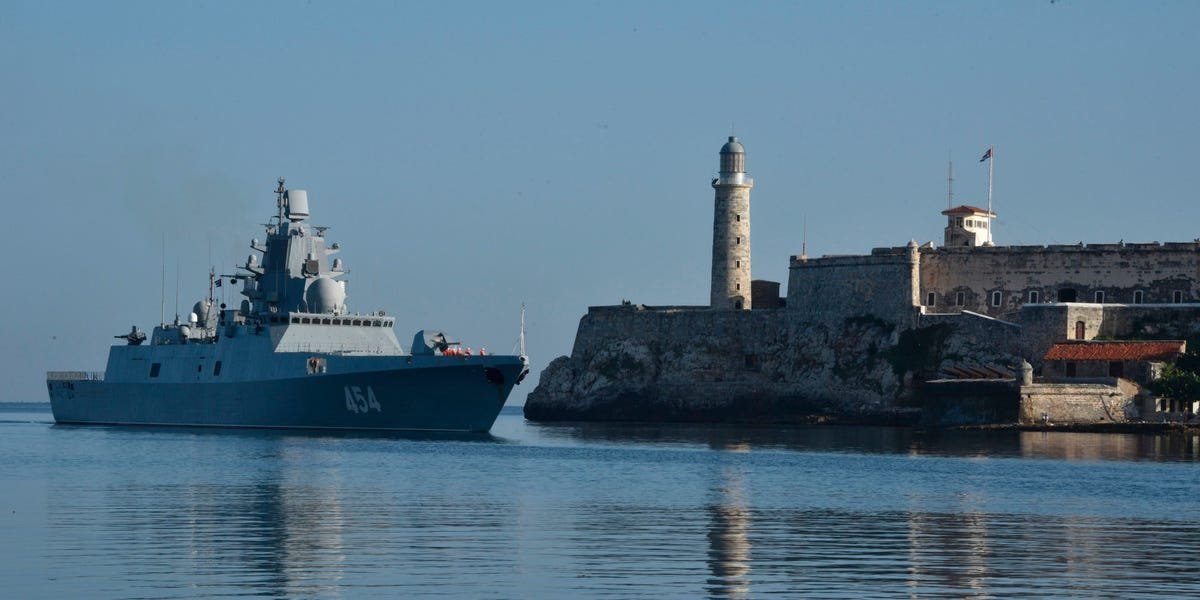
Russia sending warships to Cuba next week is an attempt to show its navy is still a global power after losses in the Black Sea, an unnamed US official told reporters, according to the Associated Press.

On Thursday, Cuba’s Ministry of Foreign Affairs said Russia was deploying four warships to Cuba, including a nuclear-powered submarine, with the vessels expected to be in Havana between June 12 and 17.

“Russia has sailed the Black Sea since 1783 but is now forced to constrain its fleet to port,” UK Defence Minister Grant Shapps wrote. “And even there Putin’s ships are sinking!”

This week, it was reported that Ukraine was using its exploding naval drones to go after smaller Russian vessels after Moscow pulled back its larger warships to reduce their vulnerability to attacks.

Not everyone agreed on Russia’s motive.

The visit of the ships, none of which will carry nuclear missiles, does not represent a threat to the region, the Cuban statement read, but was instead part of the historically cordial relations between the two countries.

But according to the US official, the deployment is an effort by Russia’s navy to flex its muscles on the world stage, after suffering losses in the Black Sea.

“This is about Russia showing that it’s still capable of some level of global power projection,” they said, per Reuters.

Russia’s navy has suffered a series of embarrassing setbacks in the Black Sea, where Ukraine claims to have destroyed a third of its fleet.

Ukraine has used drones, missiles, and other weaponry to take out many Russian warships, and has forced its fleet to seek safer ports further away from Crimea.

In March, the UK’s defense ministry declared Russia’s Black Sea Fleet “functionally inactive” after Ukraine claimed to have struck another two of its vessels.

Russia also shuffled its naval leadership earlier this year.

According to the unnamed US official, while the US expects “heightened” Russian naval and air activity this summer, and more going forward, deployments like those to Cuba incur costs for the Russian navy, which is “struggling to maintain readiness and conduct deployments with an aged fleet.”

In a military assessment on Thursday, the Washington DC-based think tank the Institute for the Study of War said it was likely part of an effort to bring back memories of the Cuban Missile Crisis, and dissuade the US from offering further support to Ukraine.

The deployment also comes after Putin threatened to send long-range weapons to “regions around the world” that want to strike Western targets.

Meanwhile, Russia’s Ministry of Defence said its goal was to keep a Russian naval presence in operationally important areas of the “far ocean zone,” RBC-Russia reported.


Source link