

Ive-always-looked-younger-than-I-am-Its-caused-challenges.jpeg

I’ve always looked younger than I am. It’s caused challenges at work, but embracing it beats trying to seem older.

When I went to meet the department chair as a freshly hired adjunct last April, the front-desk staff said, “A student is here to see you.”

I froze and wondered whether I should correct him.

I’ve always looked younger than my age, and people often assume I’m a student. When I became an adjunct professor at age 30, I realized I had a choice: try to look older, or embrace it.

If you look young in a professional setting, people don’t always say it outright — but you can feel it in the assumptions.

I’ve been waved toward the student check-in line while judging a business-school competition and asked “What are you studying?” at college events when I’m there to guest speak on personal branding.

People kindly explain things to me as if I’m new to the room until I say what I do. Even then, they raise an eyebrow and double-check: “Wait … you’re a professor?”

I smile through it in the moment, but the assumptions still trigger my inner critic. Unspoken advice hangs in the air: Be more serious. Look more professional. Blend in.

Despite the pressure to seem more mature, I chose to embrace my youthful look


Woman standing in classroom

I did make a few changes when I joined the faculty. Just not in the way you might think. 

Julie Zhu


Although there are easy ways to look older and signal authority on the surface — matte foundation, black suits, a more serious personality — the idea of shrinking myself to look the part seemed exhausting.

I own precisely one oversized black linen blazer I never wear. My energy drops whenever I throw it on, like I’ve trapped myself in a costume.

It makes me hyper-aware of myself, which is the last thing you want in a classroom stuffed with students ready and waiting to size you up.

So instead of dulling myself down (or adding that blazer to my regular wardrobe rotation), I decided to get more intentional about how I showed up.

I wanted my look to reflect how I teach: warm, creative, and engaging. I spend a probably unhealthy amount of time keeping up with cultural and marketing trends. I crack a joke here and there, even when I’m the only one who can’t stop laughing.

So I leaned into color and vibrance with purpose — bold blue sweaters, cherry-print dresses, a soft camel cape, and floral prints with a pop of pink — plus a dewy glow on my cheekbones.

These choices weren’t about making a fashion statement. I just wanted to feel comfortable and like myself, even if that meant appearing youthful.

My first class proved that the way you you show up matters more than how old you look


Woman in colorful dress smiling with arms outstretched

A bright, windy day when my hair had its own opinions and I felt fully like myself. 

Julie Zhu


I didn’t realize how much showing up as myself would calm my nerves until I stepped into the classroom.

On my first day teaching as an adjunct professor, I walked in with a red floral dress, burgundy Mary Janes, and a plan.

Sixteen new faces stared back as I asked them to pick a brand, jot down three words associated with it, and turn to a partner to compare notes.

Then it was time to share. Students explained the “why” behind their impressions — a Super Bowl commercial, the smell of a product, a friend’s comment, something their parents used to buy, or a meme they’d seen online.

No longer watching me, they were building on each other’s ideas. That was the point: Marketing lives in what people remember.

In that moment, I stopped worrying about whether I looked like a professor. When I stopped second-guessing my look, I stopped second-guessing myself, which freed me up to focus on the work.

Now, when people ask, “Are you a student?” I smile. Yes, I’m always a student of the world.

Because what really matters isn’t whether I look like a student or a professor. It’s showing up prepared, teaching with clarity, and helping students think more creatively and strategically — so they can do the same when they’re in my shoes one day, burgundy Mary Janes or otherwise.



Source link

Amanda Goh

Sarah McLachlan, 58, says she had to ‘eat a lot of humble pie’ to repair her relationship with her older daughter

Sarah McLachlan, 58, says she had to rethink how she was parenting her daughter to rebuild their bond.

“I would have been softer on her in a different way. I was a hard ass,” McLachlan told Amy Poehler on Tuesday’s episode of “Good Hang with Amy Poehler.”

McLachlan shares two daughters with ex-husband Ashwin Sood: India Ann, born in 2002, and Taja Summer, born in 2007.

“It’s funny because I thought so clearly in my own mind that I was being the antithesis of my mother. And I looked at the way she parented, and I thought, ‘I’m going to do everything completely different,'” McLachlan said. “Then her words come spewing out of your mouth in a moment of anger and frustration, and you’re like, ‘Oh my God, I can’t believe I did that.'”

She said her older daughter would sometimes shut down or lash out when things got hard, and at the time, McLachlan didn’t fully understand what was behind it.

“I looked at that and went, ‘How do I help you with this? How do we move past this, because the world out there is scary and big, and you have to have some grit, and you have to do hard things so that you know you can,'” McLachlan said, describing the tough approach she took with her daughter.

It was only after they went to family counseling that she realized her daughter was experiencing a lot of anxiety.

“The way I was communicating to her was just making her feel shitty about herself instead of building her up, which was completely the opposite of what I thought I was doing,” McLachlan said.

“I had to eat a lot of humble pie and take stock and go, ‘OK, look, I want a relationship with my kid. So, I need to learn how to communicate differently with her,'” she said.

Through the process, she said her daughter also learned how to take responsibility for her own reactions.

“It was a long process, but it was beautiful and powerful. And we have such an open, loving relationship now because of that,” McLachlan said.

This isn’t the first time McLachlan has spoken about her relationship with her firstborn. In August, she told Variety that the chapter of their relationship inspired the second single, “Gravity,” on her latest album, released last year.

“It feels really sweet to be able to sing this song and know that we’re in such a better place, having come through this really challenging time together,” she said.

In September, McLachlan told People that therapy gave her a “safe environment” to connect with her daughter.

“What I realized is the way I was communicating my love to her, she was not hearing it, not feeling it,” McLachlan said. “I was not reaching her. And for me as a parent, that’s devastating because you just want to take your kid in your arms and hold them and keep them in.”

India Sood did not respond to a request for comment from Business Insider.


Source link

Melia Russell smiles

Docusign’s former CEO took a risk jumping into an older corner of legal tech. The numbers suggest it’s working.

For years, the software that companies use to draft, sign, and store contracts was legal tech’s center of gravity. Then ChatGPT arrived.

Budgets and attention snapped to agents and copilots, and legal pundits started declaring the contract software category a ticking time bomb.

Ironclad, one of the contract-lifecycle management (CLM) companies that rode the boom, says the obituary is premature.

The company told Business Insider it has crossed $200 million in annual recurring revenue, up from $150 million last May, and its customers include OpenAI, Salesforce, L’Oreal, and Mastercard. Founded in 2014, Ironclad has raised $333 million from investors including Sequoia Capital, Accel, and Bond.

“I mean, not surprisingly, we’re pretty bullish on CLM,” Ironclad CEO Daniel Springer said on a call.

He’s swaggering in a moment when the category is routinely declared dead. Springer bet his career on it. Early last year, he was a free agent, having stepped down as CEO of Docusign in 2022. He said he spoke to 40 companies before taking the Ironclad job in April. Since then, Springer’s been recruiting heavily, pulling in chief technology officer Sunita Verma, who spent 17 years at Google, and longtime Microsoft engineer Herman Man as Ironclad’s new chief product officer.

Springer said he’s heard the “CLM is dead” debate so many times that he compares it to the endless calls for email’s demise. Ironclad’s view is that the need for companies to contract with each other isn’t going away. What is changing, Verma told Business Insider, is how the work gets done: away from rigid workflow software and toward agentic systems that can do chunks of work on their own.

That shift has turned contract lifecycle management into a high-stakes catch-up game. The same platforms that once won clients by organizing contracts now have to show they can automate what legal teams do inside them. In November, Ironclad released a fleet of virtual assistants that it said can handle tasks such as intake, negotiation, and extracting information buried in contracts. Springer said a third of recent new customers also bought its agentic add-on, Jurist.

In that world, Ironclad isn’t just competing with other CLM vendors like Agiloft and Sirion. It’s facing a swarm of startups built on large language models, including Ivo and Spellbook, that promise to handle pieces of contract review. Even the foundational model makers are moving closer to legal workflows. OpenAI has publicly written about building a contract review tool for its own teams. More recently, Anthropic rolled out a legal plug-in that it says can speed up in-house tasks.

Ironclad eyes dealmaking

Springer said Ironclad is open to doing deals this year as it tries to capture more of the market. Some close competitors are for sale, he said, and he’s looked and passed. He added that he isn’t eager to buy another CLM platform, arguing that many older products “aren’t the platforms of the future.”

Instead, he said Ironclad would consider acquisitions that bring a crack team in-house, especially technical talent building something original that might struggle to break into large enterprise accounts on its own. Industry watchers expect more consolidation this year as buyers tire of single-use tools, and more founders start looking for distribution (or a soft landing) inside larger platforms.

Even so, Springer doesn’t think the CLM category is done spawning new entrants. He expects founders will keep building contract software — even if they try to dress it up in new language for the AI era.

“Maybe they won’t call themselves CLM,” he said. “But I will bet you dollars to doughnuts they will call themselves CLM, because that’s what the customer knows.”

Have a tip? Contact this reporter via email at mrussell@businessinsider.com or Signal at @MeliaRussell.01. Use a personal email address and a non-work device; here’s our guide to sharing information securely.


Source link

As-my-teens-get-older-theyre-fiercely-embracing-our-holiday.jpeg

As my teens get older, they’re fiercely embracing our holiday traditions again. I love it.

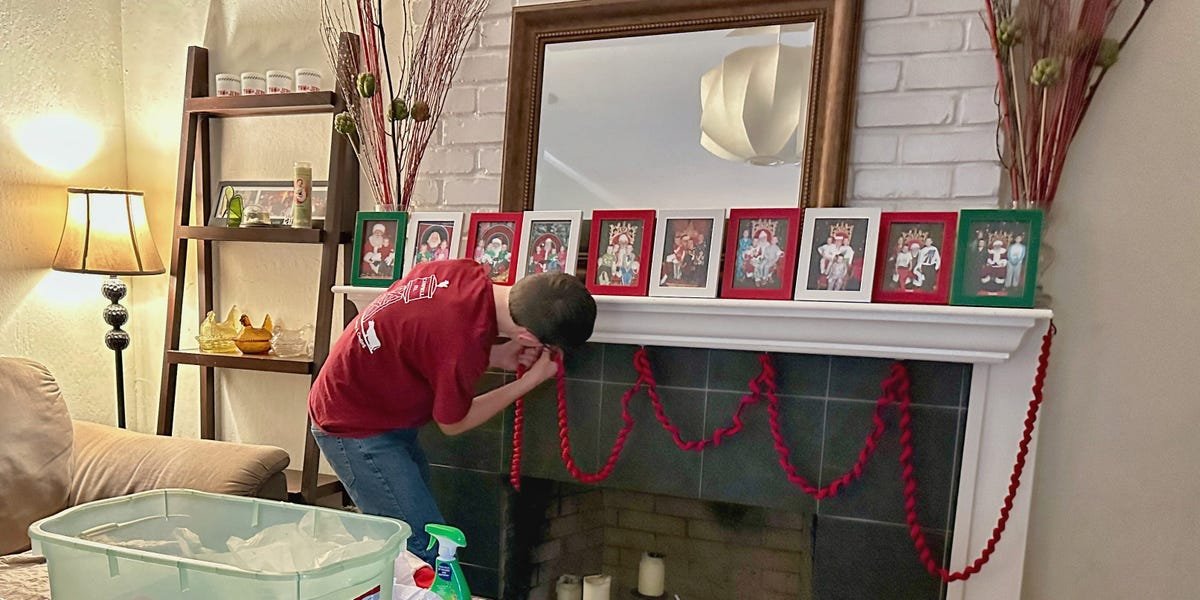
As a mom of three teens, ages 14 to 18, I’ve had my share of years as the bringer of holiday magic. While I never welcomed the Elf on the Shelf into our home (no regrets), I did pretty much every other holiday tradition, including festive train rides and mall photos with Santa.

In the years when my kids were young, the weekends between Thanksgiving and New Year’s were packed with holiday activities, leaving me exhausted and counting the days until they went back to school in January. The elation of Santa’s arrival was paired with too-early wakeups and too many presents to assemble late at night. I loved seeing the joy in their eyes when they opened that LEGO set or butterfly-growing kit, but man, it was exhausting.

Then came the tween years, which had me begging for someone — anyone — to join me on our annual drive through the neighborhood to look for the best holiday lights. These were the years when everything seemed like forced family fun, and I had to resort to heavy bribery (or light threats) to get anyone to come along.


The author poses next to a Christmas tree with her husband and their three children.

The author said her kids stopped enjoying holiday traditions they once loved when they became tweens. Now that they’re older, they’re starting to enjoy them in new ways.

Courtesy of Kate Loweth


My teens have come back around

It was only in the last year or so that I’ve seen a change in my kids. It started with my 18-year-old daughter planning a trip to the pumpkin patch with her high school friends. I had resigned myself to grocery-store pumpkins the last few years, as nobody seemed excited to make the effort to visit the pumpkin patch (and I wasn’t paying pumpkin-patch prices for grumpy kids). When my daughter mentioned that she and a few friends were going to the pumpkin patch on a Friday night, I was surprised but secretly excited, because who doesn’t love wholesome teen activities?

Then, when I wasn’t immediately busy decorating our house for Christmas after Thanksgiving, my 14-year-old son took it upon himself to hang the stockings and decorate the tree. My middle kid put up the outdoor Christmas lights without any adult prompting or assistance. Then, after skipping the nearby drive-thru lights experience for many years, the kids asked if we’d be going this year. Immediate yes.


The author's son stands on a ladder while hanging holiday lights on the family home.

The author said her middle child took it upon himself to hang holiday lights on the family home.

Courtesy of Kate Loweth


Passing on the holiday magic

These festive activities, which once felt optional and even embarrassing to my kids, now seem to matter to them once again. While there’s nothing like those early years with kids who are all in on Santa and his holiday magic, I’m finding a different kind of joy in this stage. I love watching my teenagers take it upon themselves to fill our house with the holiday spirit, not because I asked them to, but because they wanted to.

For years, I carried the responsibility of creating holiday magic. Now I see that letting go made room for something better. As my kids inch closer to leaving the nest, I love seeing them bring new life to our family traditions.


Source link