

A-Bigfoot-documentary-premiered-at-SXSW-Was-it-fake-news.jpeg

A Bigfoot documentary premiered at SXSW. Was it ‘fake news?’ An online community is tearing itself apart.

A new documentary doesn’t disprove Bigfoot — he or she could still be out there! — but it aims to upend the biggest piece of evidence that Bigfoot believers have held onto for 60 years.

Now, some of those true believers are becoming skeptics, bringing modern “fake news”-type arguments to social media, or suggesting newly discovered evidence could be an AI-generated hoax.

The Patterson-Gimlin film is instantly recognizable. Under a minute long, the grainy 1967 film shows a tall, furry creature walking on two legs through the Northern California woods. The creature turns slightly, looking over its shoulder, and then walks on. This is the most iconic footage of Bigfoot, and for decades has been the best “proof” that a large, undiscovered hominid species roams the Pacific Northwest, partly because the film has been stubbornly complicated to fully disprove (unless, of course, you simply assume Bigfoot isn’t real to begin with).

“Capturing Bigfoot,” which premiered at SXSW this month, has unearthed a piece of long-lost footage — an apparent “dry run” rehearsal of the famous film where it’s more clearly a man in a furry suit. This new footage strongly suggests that the famous Patterson-Gimlin film was a hoax.

For the Bigfoot online community, the documentary is hitting like a nuclear bomb.

In 2022, “Chasing Bigfoot” director Marq Evans, who teaches film at Olympic College in Washington, was approached by a colleague. She had a piece of old film that had belonged to her deceased father, and she wanted Evans to help her find someone to process and transfer it. Her father had worked in a film processing lab in the 1960s and was socially connected to Patterson and Gimlin.

The new footage shows a different man in a fur suit, along with Bob Gimlin on horseback, shot in a forest that looks more like Washington state, where they lived, instead of Northern California. Based on markings on the film, it was filmed a year prior to the more famous film, perhaps as some sort of rehearsal or dry run of what they’d eventually show to the public.

“I never thought this would happen in our lifetime, what Marq Evans has come up with in the documentary,” said Joshua Kitakaze, a longtime Bigfoot fan who is active in a Facebook group for Bigfoot researchers. Kitakaze stopped believing in Bigfoot years ago, but is still fascinated by the myth and culture around it.

“For many of us who were believers, whether or not you are now, it just can’t be understated that the film was the pillar, that was the cross of this religion,” Kitakaze told Business Insider. “It was the No. 1 thing.”

“I do know that I am internally coping,” wrote someone on the r/Bigfoot subreddit. “The [Patterson-Gimlin] Footage has been the most credible and clear-cut source of proof we have (had). With the supposed claim that it was just a hoax all along, I’ve found myself struggling to accept that possibility.”

Because “Chasing Bigfoot” hasn’t been widely released yet, almost none of the hardcore Bigfoot fans have seen the movie or the new footage from 1966. This is creating a confusing situation where people who are used to poring over visual evidence to prove or disprove something are forced to rely on secondhand descriptions of the film.

Evans is aware of the controversy playing out online and the skepticism among some people who haven’t seen the film — including people who think that the new footage was made with AI. “It’s almost like when ‘fake news’ became a thing, then it was just like everything’s fake news, and people, I don’t know what to believe,” Evans told Business Insider. “I think we’re in that same boat now with AI, that because something could be AI, anything could be dismissed as AI.”

Eric Palacios, who has a YouTube channel devoted to investigating Bigfoot and other cryptids, lives in Austin and went to see “Chasing Bigfoot” at the SXSW screening. Immediately after, he posted a video about his reaction — shocked. He had gone into the film believing that the Patterson-Gimlin Film held up to scrutiny, but after seeing the documentary, he changed his mind.

As one of the few people in the community who has seen the movie, Palacios’s description of it has carried a lot of weight — and made him a target for criticism and harassment from true believers.

“I don’t know if it’s changed my feelings on the existence [of Bigfoot]. It’s changed my feeling on the community 100%. I’ll tell you that much,” Palacios told Business Insider. “I was kind of disgusted the way some of these people were acting — people that you’ve seen on television, on documentaries, talking about the Patterson footage and other stuff.”

But Palacios still holds onto some belief.

“To me, I still think there’s a possibility of something being out there. What it is, I can’t say, but I mean, there’s a million reports, eyewitness reports, and everything,” Palacios said. “And I mean, if one of them is true, then it’s true. That’s the way I look at it.”


Source link

I-inherited-a-storage-unit-from-a-family-friend-It.jpeg

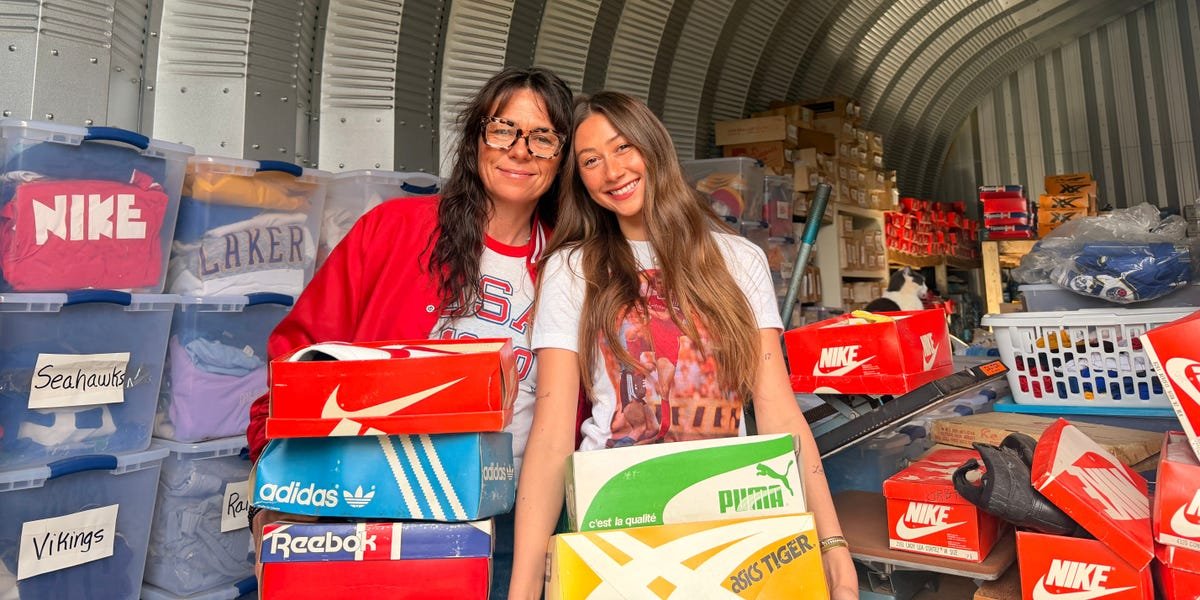
I inherited a storage unit from a family friend. It was full of vintage clothes, which I now sell online.

This as-told-to essay is based on a conversation with Scottlynn Krause, the co-owner of CS80 Vintage. It has been edited for length and clarity.

My best friend is Hannah, and her grandpa, Franz, owned a sporting goods store in the ’60s, ’70s, and ’80s. When he went out of business, he boxed up his stock, and the unused items sat in a storage unit from 1990 until 2021.

In the summer of 2021, Hannah’s mom called my mom, who is an organizer for hoarders, asking for help with the storage unit. She didn’t know what to do with the stuff, and knew my mom had experience in that realm.

We did not expect to inherit his pristine ’80s sportswear inventory

Hannah and her family said to do what we needed to do to get rid of it and take it off the property. We had 16 days to figure out what to do, because they wanted to list the house. We did not buy the inventory. It was a trade for removing it.

Originally, my mom wanted to turn everything in three months and be done with it. We were not a vintage-loving family back then, but we decided to try to sell it online. At first, it was my mom doing it all, but it was overwhelming. So I jumped in. I had (and still have) a full-time job in retail, so I feel like I see what happens with trends. Vintage had picked up, so it felt right.

The storage unit had thousands of items from well-known brands

It’s really hard to put a number on how many items were in the storage unit. It was 10,000 pairs of shoes, 25,000 hats, 2,500 pairs of baseball pants, all in 1,000 square feet, all from a single store.

The brands Franz had were Nike, Adidas, Puma, Converse, Playboy, Pony, Champion, Wilson, and more. Teams were covered in the NFL, NBA, NHL, and collegiate sports.

It was such a large inventory; we weren’t sure how to tackle it. It’s all been very word-of-mouth. We had our first sale at a flea market in early 2022. We currently sell privately on social media and on our website, which went live in December 2025.

On the website, we do 25 items per drop, and do two drops a week, on Wednesdays and Sundays. It’s first-come, first-served. Not all merchandise is on the website; it’s about a tenth of what we have. So we’re really selective with the drops because everything is so rare and special.

We store our inventory in an off-site warehouse. My mom and I go regularly to pull pieces, and it feels like a discovery every time. We never know what we are going to find. We then bring it to our studio, and I measure, photograph, and upload it to our website. My mom and I print the shipping labels, carefully pack each order, and ship everything ourselves, mostly early in the morning or late at night, squeezed in around our day jobs.

We’ve seen some really amazing items

Most of our items are one-of-a-kind, making them special. We might have one item in multiple sizes, but we don’t have four large sizes of that item, for example. Starter jackets are our most sought-after item. And our sports fans are die-hard, so people are freaking out about certain items. I didn’t grow up during this time period. It’s been so special to see the DMs we get, like “I had this shirt when I was a kid, do you have it?”

We’ve sold unique pieces, like a Run-DMC collection still in its original packaging and a rare pair of 1980s Adidas boxing shoes reminiscent of the Rocky Balboa/Freddie Mercury era. A van load of clothing from our collection was used on set for a “Stranger Things” x Target commercial.

We’ve been having a blast doing it

My mom and dad met in a sporting goods store. He’s a professional volleyball referee. My mom works as an organizer and is a photographer. I work in retail. All the pieces came together for us, giving us this gift. It was like winning the lotto.

Hannah’s family loves watching it happen. I will send her pictures of stuff all the time. They are excited to see that his stuff is moving, going places, and getting a second life.

Our goal is to continue Franz’s legacy by slowly placing these pieces with people who genuinely appreciate the memories, craftsmanship, and spirit of the 1980s. We’re exploring ways to carry that energy forward, too. We eventually want to create our own products using our deadstock blanks to keep the 80s aesthetic and story alive for the new generation.


Source link

Polymarket-takes-down-nuclear-detonation-bet-after-online-backlash.jpeg

Polymarket takes down nuclear detonation bet after online backlash

  • Polymarket was allowing traders to wager on whether a nuclear weapon would detonate this year.
  • That stirred backlash online, particularly after suspicious trading in the wake of the Iran strikes.
  • The market has now been taken down.

If you were looking to make money on nuclear detonations, you now have one less avenue to pursue.

Overnight, Polymarket took down a market that allowed users to trade on where a nuclear weapon would detonate by March 31, June 30, or simply before 2027.

Traders who bet yes on any of those timelines would be paid out if there were a nuclear detonation anywhere on Earth, including in an offensive use, a test, or even an accidental detonation.

The market had over $650,000 in total trading volume as of Tuesday, according to an archived snapshot of the site. A message on the webpage now reads: “This event has been archived.”

It’s not yet clear why Polymarket took down the site, or whether users who put money into the market will get refunds. An earlier version of the market, which covered 2025, resolved without incident last year.

A spokesperson for Polymarket did not respond to a request for comment.

The suspension came after several users on X expressed outrage about the existence of the market, particularly amid a raft of suspicious trades on the platform in the wake of the killing of Iranian Supreme Leader Ali Khamenei.

This isn’t the first time Polymarket has come under public scrutiny for hosting markets related to armed conflict.

After an anonymous Polymarket trader made over $400,000 on a suspiciously well-timed bet on Venezuelan President Nicolás Maduro’s political future, a lawmaker introduced a bill to ban prediction market insider trading by government officials.


Source link

Business Insider Video Thumbnail

How to buy gold, silver, and other precious metals from Costco online and in-store

Two dozen eggs, a gallon of milk, 30 rolls of toilet paper — and one ounce of 24 karat gold.

While that might be one of the more expensive grocery runs a Costco shopper might make, it is one that could realistically happen.

Costco sells hundreds of millions of dollars’ worth of gold and silver each month. There are two ways to buy bars and coins from the wholesale club: online and in-store at certain warehouses. Here’s what that looks like.

The first step — step zero, if you will — is to get a Costco membership, since precious metals are exclusively available to members. The basic Gold Star membership gives you access, but if you’re planning to spend several thousand dollars on gold and silver, it might make sense to spring for the executive upgrade.

For the additional $65, executive members get 2% rewards on most purchases, including precious metals. At the recent price of about $4,480, the reward on a one-ounce gold bar or coin would be around $89, which is more than the price of an upgrade. (Executive members can also shop early at the warehouse, but that’s another story.)

Equipped with a membership, the options to buy precious metals depend largely on the availability of supply.

How to buy gold and silver from Costco online

Gold, silver, and platinum are listed on Costco.com on a precious metals page in the jewelry and watches category. (The items were previously listed under sports memorabilia and collectibles, which made them a bit harder for the casual buyer to track down.)


Costco.com's precious metals offerings on October 13, 2025.

Costco.com’s precious metals offerings on October 13, 2025.

Costco


When products are priced at or near the commodity market’s “spot” price, they can sell out extremely quickly.

Silver also tends to sell out quickly and follows a similar pricing pattern. In fact, silver’s market rally of more than 130% year-to-date as of Tuesday morning has outpaced gold’s nearly 70% increase. Plus, silver’s lower unit price — it’s at an all-time high of $69 per ounce — means more options for shoppers who are curious about buying metals but don’t want to fork over the price of a well-used car just yet.

Costco has responded to fluctuations in demand by limiting the quantities of a particular item a member is allowed to purchase in one transaction and over a 24-hour period.

Once an online purchase is completed, Costco estimates about three to five days for delivery, typically via UPS or FedEx. Same-day grocery orders must be placed separately, via Instacart.

Comments on the CostcoPM subreddit indicate that some packages can take longer to deliver, especially around periods of high demand and near the end of the week.

How to buy gold and silver at a Costco warehouse

Precious metals are also occasionally available at some warehouses — if you know where to look.

Sometimes it’s easier to spot: the store will put a large sign near the entrance encouraging arriving shoppers to check out seasonal or specialty bars. Some stores will let you know what they have in stock if you call ahead.

At other times, a sample of the available inventory will be displayed in the warehouse’s jewelry case near the electronics section.

Still, it’s not as simple as tossing a bar into your cart and proceeding to checkout. The jewelry case also has a stack of paper forms that shoppers must fill out with the item SKU and the quantity they wish to purchase.


A Costco merchandise pickup slip appears in the jewelry section of a warehouse in Wisconsin.

A merchandise pickup slip is used to buy precious metals at a Costco warehouse.

Dominick Reuter/Business Insider


Shoppers then bring the completed slip to the front office, where an employee will retrieve the order and assist with payment. Voila — they now own a small slab of expensive metal. Don’t lose it.

3 things Costco shoppers should know before buying gold or silver

There are three last things Costco shoppers should note.

Although Costco stands behind everything it sells, precious metals are excluded from the company’s unusually generous return policy. It also will not adjust the price of gold, silver, or platinum after purchase. Once the deal is done, that’s it.

The second thing is that it generally does not make mathematical sense to finance gold or silver purchases with credit card debt or other interest-bearing payment options.

While some metals buyers use credit cards in order to take advantage of rewards schemes, it’s widely understood that any balance should be promptly paid off with cash, since interest charges can offset any card points or increase in the metal’s value.

Lastly, some gold and silver buyers have found that selling metals can be harder than buying them (at least at the prices they would prefer). Coin shops are not likely to offer the full spot price for gold or silver, since they need to leave room to make a profit when they sell the metal.

Metals dealers and advisors generally recommend planning to hold onto physical precious metals for the long term. Selling without a strategy can have unexpected costs.


Source link