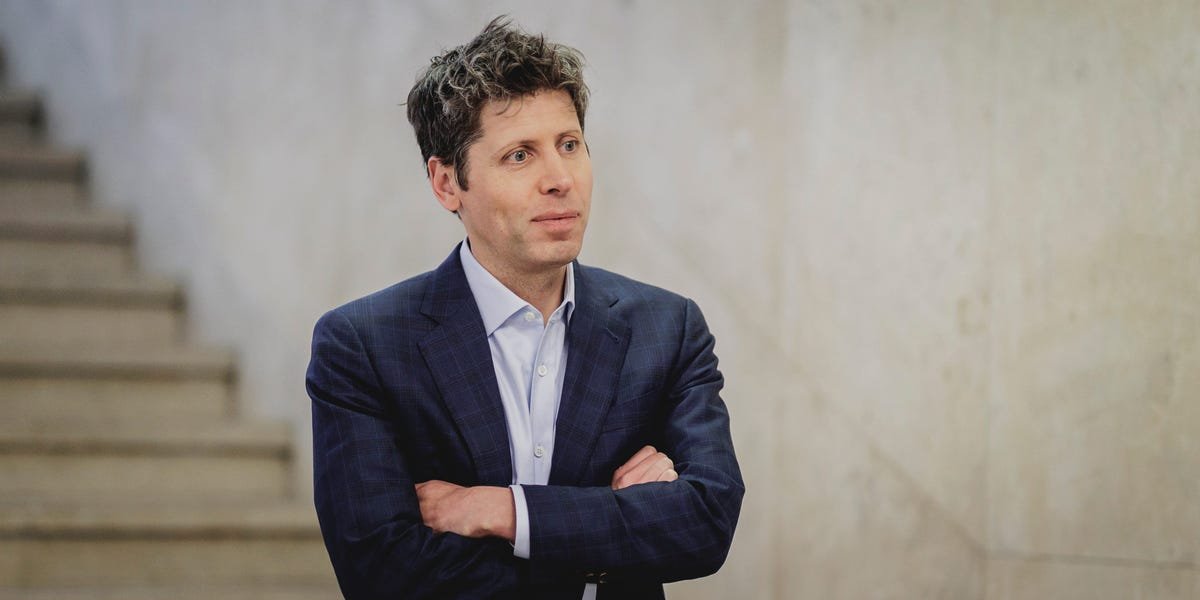
Sam Altman.

Sam Altman said OpenAI was planning to ‘dramatically slow down’ its pace of hiring


Florian Gaertner/Photothek via Getty Images

  • Sam Altman said that AI would “dramatically slow down” how quickly OpenAI hires.
  • Altman said the company will “hire more slowly but keep hiring.”
  • Altman’s comments came after a year when job growth stalled and hit young job seekers hard.

Sam Altman is addressing AI’s impact on the workforce, including on OpenAI’s hiring practices.

During a live-streamed town hall event on Monday, catered mainly toward developers, the OpenAI CEO said that AI has changed how quickly the company expands its head count, but the company is not in a hiring freeze and is nowhere close to doing away with human employees entirely.

“We are planning to dramatically slow down how quickly we grow because we think we’ll be able to do so much more with fewer people,” said Altman in response to a participant who asked if AI has changed OpenAI’s interview process of potential candidates.

“What I think we shouldn’t do, and what I hope other companies won’t do either, is hire super aggressively, then realize all of a sudden AI can do a lot of stuff, and you need fewer people, and have to have some sort of very uncomfortable conversation,” Altman added. “So I think the right approach for us will be to hire more slowly but keep hiring.”

Altman’s comments come amid the “Great Freeze” and concerns that job creation in America has lost momentum. The unemployment rate in November 2025 climbed to its highest level since 2021, while job openings have fallen 37% from their peak in 2022, according to data from the Bureau of Labor Statistics.

Business Insider previously reported that, while in 2022 there were roughly two job openings for every unemployed worker, by September 2025 that ratio had fallen to one. Workers who have been jobless for at least 27 weeks also now make up about a quarter of all unemployed Americans.

Based on data from the US Census Bureau, young workers have been hit especially hard by the hiring slowdown. The unemployment rate for Americans ages 20 to 24 reached 9.2% in August and September, the highest level since the recovery from the pandemic recession.


Source link

OpenAI-could-generate-25-billion-in-annual-ad-revenue-by.jpeg

OpenAI could generate $25 billion in annual ad revenue by 2030, and that should worry Google, top tech analyst says

Advertising could become a $25 billion business for OpenAI — and pose a threat to Google, according to new estimates on Monday from a top tech analyst.

Evercore ISI’s Mark Mahaney sees the startup generating that level of annual ad revenue by 2030 if it executes well on rolling out this new business.

OpenAI said on Friday that free and Go users of ChatGPT would start seeing ads “in the coming weeks.” OpenAI also laid out its advertising principles, such as clearly labeling them and not sharing user conversations with advertisers.

“A path to generating several billion dollars in ad revenue in 2026, going to $25B+ by 2030, seems reasonable,” Mahaney wrote in a note to investors.

That’s based on the likely scale of ChatGPT by that time, the proven monetization of high-intent performance marketing platforms, and the current size of this market, the analyst added.

OpenAI’s revenue is growing fast already. CFO Sarah Friar said in a recent blog post that the startup’s annualized revenue topped $20 billion in 2025, up from $2 billion in 2023. However, there are big question marks over OpenAI’s losses and whether it can become profitable in the future.

Advertising could be one way for OpenAI to boost its top and bottom lines.

Mahaney noted that Google’s Search and YouTube businesses likely generated close to $300 billion in ad revenue in 2025, with Meta generating an additional $180 billion. These are highly profitable operations, with operating profit margins of 40%, according to the analyst.

ChatGPT has almost 1 billion weekly average users, many of whom share valuable details with the chatbot, such as what they want and need. Advertisers are willing to pay up for access to this treasure trove. This is the type of intent-based information that forms the backbone of the massive digital ad businesses run by Google and Meta.

OpenAI has said that initial test ads will appear at the bottom of ChatGPT answers and be relevant to the user’s conversation with the chatbot. That approach might not be too intrusive for users, while still being attractive to advertisers, Mahaney said.

“OpenAI’s move directly challenges this core revenue stream by offering an alternative, highly engaging platform for users to discover products and services,” Mahaney wrote. “If ChatGPT can successfully integrate ads that are helpful rather than intrusive, it could siphon off valuable commercial queries that traditionally go to Google.”

The analyst also warned that if OpenAI can develop a “conversational” ad format, where users research and discuss potential purchases within ChatGPT, that could prompt advertisers to shift some of their marketing budgets because this is “high-intent engagement.”

Even if ChatGPT goes all-in on ads, though, don’t expect the chatbot to take Google’s share of the market overnight, Mahaney added.

OpenAI will still have to compete with the tech ecosystem that Google has spent years creating, such as its Chrome web browser, as well as web users’ habit of Googling stuff when they need an answer, Mahaney wrote.


Source link

Screen Shot 2020 09 04 at 6.22.07 PM

OpenAI will focus on ‘practical adoption’ of AI in 2026, CFO says

OpenAI is going on all in on “practical adoption” of artificial intelligence in 2026, according to its CFO.

“The priority is closing the gap between what AI now makes possible and how people, companies, and countries are using it day to day,” Sarah Friar wrote in a recent blog post.

“The opportunity is large and immediate, especially in health, science, and enterprise, where better intelligence translates directly into better outcomes,” she added.

There are signs the startup is already taking advantage of these opportunities. Data from Ramp showed that business spending on OpenAI models surged to a record in December, outpacing rivals Anthropic and Google.

Still, some investors and analysts are concerned about OpenAI’s huge financial commitments and whether the startup will generate enough revenue to make a profit in future years. For example, OpenAI has announced roughly $1.4 trillion in infrastructure deals, such as data centers, in the past year or so.

One potential source of new revenue is advertising, something that OpenAI said on Friday it would start testing. CEO Sam Altman once labeled ads a “last resort,” although the move has been expected for months now.

Friar addressed concern about OpenAI’s finances in her recent blog, noting that revenue has grown in sync with compute availability.

OpenAI’s compute expanded from 0.2 gigawatts in 2023 to about 1.9 GW last year. Meanwhile, annualized revenue grew from $2 billion to more than $20 billion in the same period, Friar disclosed.

That represents “never-before-seen growth at such scale,” Friar wrote. “And we firmly believe that more compute in these periods would have led to faster customer adoption and monetization,” she added.

This did little to quell the critics.

On Monday, tech blogger Paul Kedrosky reacted to Friar’s blog post by saying: “Amusing reading from OpenAI CFO bragging that they are successfully selling dollars for $0.70 in huge volume.”


Source link

OpenAI-is-turning-to-the-court-of-public-opinion-in.jpeg

OpenAI is turning to the court of public opinion in its battle with Elon Musk

OpenAI is turning to the court of public opinion as it wages a legal battle with Elon Musk.

While Musk and OpenAI prepare to head to a high-stakes jury trial in April, the two are duking it out online over what exactly happened when Musk split ways with the AI startup he helped cofound.

Musk has been using recently unsealed court documents to attack his rival in posts on his social media platform, X. On Friday, OpenAI published a blog titled “The truth Elon left out.”

The blog, which provided commentary alongside excerpts from several court documents, alleges that Musk wanted “full control” of OpenAI, “since he’d been burned by not having it in the past,” and that OpenAI’s leadership was surprised when Musk suggested having his kids control AGI or artificial general intelligence during conversations about succession planning.

The statements are aimed at the heart of Musk’s lawsuit against OpenAI.

Musk is suing OpenAI’s key leaders, including CEO Sam Altman and President Greg Brockman, over allegations that the AI company misled him by shifting away from its core mission to remain a nonprofit. Musk said he donated $38 million to OpenAI when it was a nonprofit.

The startup, since its 2015 founding, operated as a nonprofit-controlled organization with a for-profit operating arm. It completed its transition to a for-profit public benefit corporation in October 2025.

Representatives for Musk and OpenAI did not immediately respond to requests for comment from Business Insider.

Last Tuesday, more than 100 documents related to the suit were unsealed, including diary entries from Brockman, which were obtained during the discovery process.

In one of the entries that was highlighted, Brockman appeared to write about his misgivings about pushing Musk out of OpenAI and committing to a nonprofit-only entity.

“Cannot say that we are committed to the non-profit,” the entry from the court documents said. “Don’t want to say that we’re committed. If three months later we’re doing b-corp then it was a lie.”

It was Brockman’s diary entries that US District Judge Yvonne Gonzalez Rogers cited in a recent ruling, in which she determined Musk had enough evidence that he’d been misled to take the case to trial.


Source link

Image of Lakshmi Varanasi

An OpenAI researcher turned venture capitalist says investors are 3 to 5 years behind the latest AI studies

There is a yearslong lag in the AI hype cycle, according to one former AI researcher turned venture capitalist.

Jenny Xiao, who cofounded Leonis Capital in 2021 after a stint at OpenAI, said the current investment excitement around AI is far behind the actual research.

“There is a massive disconnect between what researchers are seeing and what investors are seeing,” Xiao said on the Fortune Magazine podcast this week.

What’s being discussed at the biggest AI conferences is as much as 3 to 5 years behind what researchers are thinking about, Xiao said.

“We are so behind the technical frontier, and that’s the gap I really want to bridge,” she added.

Xiao, who dropped out of a Ph.D. program in economics and AI to take a researcher role at OpenAI, founded Leonis Capital to bridge the worlds of venture capital and deep academic AI research.

“With AI, there needs to be a new generation of founders. There needs to be a new generation of VCs,” she said.

It’s also the first time investors need to be able to provide financial support to both the market and the technology, she added. Unlike SaaS companies, which were built on a “stable tech stack,” AI is moving fast. To keep up, Xiao said investors are going to need to be as technical as the founders.

If she has one piece of advice for investors who haven’t gone deep into the technical side, it’s that they should know “AI progress isn’t linear,” she said.

They should know AI progress happens in “lumps,” she said. So, questions about why AI progress is slowing down or speeding up aren’t the best way to characterize the rate of development.

“It’s neither of those two extremes,” she said. “It’s somewhere in between.”

Leonis Capital did not immediately respond to a request for comment from Business Insider.


Source link

This-case-is-going-to-trial-Judge-rejects-Sam-Altmans.jpeg

‘This case is going to trial’: Judge rejects Sam Altman’s efforts to toss Elon Musk’s OpenAI lawsuit

It looks like Sam Altman and Elon Musk are headed for a courtroom showdown.

During a hearing on Wednesday, a California judge said she plans to reject Altman’s lawyers’ last-ditch efforts to end Musk’s case against OpenAI and its CEO.

“This case is going to trial,” US District Judge Yvonne Gonzalez Rogers said at a hearing to consider whether the evidence was sufficient to warrant a jury trial.

“I think there’s plenty of evidence,” she said, referring to Musk’s case. “It’s circumstantial, but that’s how these things work.”

In his lawsuit filed in 2024, Musk accused OpenAI of misleading him in its decision to abandon its original nonprofit mission and structure in favor of a profit-oriented model, including through its partnership with Microsoft.

Musk says he donated $38 million to the maker of ChatGPT over the years to support its mission to develop AI for the benefit of humankind. The Tesla CEO is seeking monetary damages, as well as a judgment to void Microsoft’s licensing agreement with OpenAI.

At a hearing on Wednesday, an Oakland federal court judge said she felt there was enough evidence that Musk may have been deceived to allow the case to move forward to a jury. A trial is scheduled for March.

“There were assurances made, and promises made, that the structure would be maintained,” she said. “There was lots of information that was not shared.”

The judge added that she also felt “there are strong arguments by the defense.”

“I think the jury is going to get to decide,” she said.

OpenAI lawyers have denied Musk’s allegations, saying Musk was aware of the company’s for-profit plans as early as 2018. OpenAI has also pointed out that it is still controlled by OpenAI’s nonprofit arm.

“Mr Musk’s lawsuit continues to be baseless and a part of his ongoing pattern of harassment, and we look forward to demonstrating this at trial,” a spokesperson for OpenAI told Business Insider. “We remain focused on empowering the OpenAI Foundation, which is already one of the best resourced nonprofits ever.”

A spokesperson for Musk did not immediately respond to a request for comment.

Musk has filed multiple lawsuits against OpenAI. Most recently, his AI company, xAI, sued OpenAI in September, accusing it of stealing trade secrets and targeting its employees for recruitment. At the time, an OpenAI spokesperson told Business that the lawsuit is “the latest chapter in Mr. Musk’s ongoing harassment.”

Musk helped found OpenAI in 2015, but left the company in 2018. At the time he said his work with OpenAI could present a conflict of interest with Tesla’s AI ambitions.

Since, Musk has repeatedly criticized Altman and OpenAI, including the company’s structure. Musk later went on to launch his own AI company, xAI, in 2023.


Source link

OpenAI-wants-a-new-head-of-preparedness-but-heres-why.jpeg

OpenAI wants a new head of preparedness, but here’s why the $555,000 role could be hard to fill

Recruiting a new head of preparedness may be trickier for OpenAI than you might think.

The ChatGPT maker recently generated buzz online when it said the position — which pays $555,000 a year plus equity — is up for grabs. Yet some tech-industry observers say finding someone who’s qualified and willing to take it on poses a challenge.

Whoever lands it will be tasked with balancing safety concerns and the demands of CEO Sam Altman, who has shown a penchant for releasing products at an exceptionally fast clip. This year, OpenAI rolled out its Sora 2 video app, Instant Checkout for ChatGPT, new AI models, developer tools, and more advanced agent capabilities.

The head of preparedness role is “close to an impossible job,” because at times the person in it will likely need to tell Altman to slow down or that certain goals shouldn’t be met, said Maura Grossman, a research professor at the University of Waterloo’s School of Computer Science. They’ll be “rolling a rock up a steep hill,” she said.

Altman himself has even described the position as intense.

“This will be a stressful job, and you’ll jump into the deep end pretty much immediately,” he recently wrote on X.

Still, it could be a dream come true for the right individual. OpenAI has had a major impact on people’s lives, and the more than half a million dollars in base pay is in line with what AI talent can expect to earn these days.

Who might be qualified for the job

The posting for the position doesn’t list common requirements such as a college degree or a minimum number of years of work experience.

OpenAI said a person “might thrive” in the role if they have led technical teams; are comfortable making clear, high-stakes technical judgments under uncertainty; can align diverse stakeholders around safety decisions; and have deep technical expertise in machine learning, AI safety, evaluation, security, or adjacent risk domains.

OpenAI’s former head of preparedness, Aleksander Madry, moved into a new role in July 2024. He left a vacancy within the company’s Safety Systems team, which builds evaluations, safety frameworks, and safeguards for its AI models.

Madry has a background in academia, but a seasoned tech-industry executive would be a better fit going forward, said Richard Lachman, a professor of digital media at Toronto Metropolitan University. Academic types, he said, tend to be more cautious and risk-averse.

Lachman expects OpenAI to seek out someone who can protect the company’s public image regarding safety, while allowing it to continue innovating quickly and driving growth. “This is not quite a ‘yes person,’ but somebody who’s going to be on brand,” he said.

OpenAI’s approach to safety has raised concerns internally, prompting some prominent early employees, including a former head of its safety team, to resign. The company has also been sued by some people who allege it reinforces delusions and drives other harmful behavior.

In October, OpenAI acknowledged that some ChatGPT users have exhibited possible signs of mental health problems. The company said it was working with mental health experts to improve how the chatbot responds to those who show signs of psychosis or mania, self-harm or suicide, or emotional attachment.


Source link

Sam-Altman-says-OpenAI-has-gone-code-red-multiple-times.jpeg

Sam Altman says OpenAI has gone ‘code red’ multiple times — and they’ll do it again

“Code red” isn’t a one-off at OpenAI.

CEO Sam Altman said on an episode of the “Big Technology Podcast” published Thursday that the company has entered emergency mode multiple times in response to competitive threats — and expects to continue doing so as rivals close in.

“It’s good to be paranoid and act quickly when a potential competitive threat emerges,” Altman said.

“My guess is we’ll be doing these once maybe twice a year for a long time, and that’s part of really just making sure that we win in our space,” he added.

Altman said that OpenAI had gone “code red” earlier this year when China’s DeepSeek emerged. DeepSeek shocked the tech industry in January when it said its AI model matches top competitors like ChatGPT’s o1 at a fraction of the cost.

OpenAI entered “code red” earlier this month, about two weeks after Google released its latest AI chatbot, Gemini 3. The model drew widespread praise after its release in November, with Google touting it as its most advanced model to date. Altman reportedly told staff in an internal Slack memo that OpenAI would prioritize ChatGPT while pushing back other product plans.

Altman said in the podcast episode that Google’s Gemini 3 did not have “the impact we were worried it might.”

“But it did — in the same way that Deepseek did — identify some weaknesses in our product offering strategy, and we’re addressing those very quickly,” he added.

Since OpenAI entered “code red,” the company has moved quickly to ship new upgrades and features.

Last week, it rolled out a more advanced AI model aimed at improving ChatGPT’s performance across professional work, coding, and scientific tasks. OpenAI also unveiled a new image-generation model earlier this week.

Altman said the company will not be in code red “that much longer.”

“Historically, these have been kind of like six- or eight-week things for us,” he added.

The state of “code red” has also been a precedent for other tech companies. In 2022, Google declared an internal “code red” after ChatGPT’s debut. The search giant was lagging in consumer AI, despite having funded much of the research that made the AI boom possible.


Source link

The-history-of-Elon-Musk-and-Sam-Altmans-relationship-and.jpeg

The history of Elon Musk and Sam Altman’s relationship and feuds, which date back to the early days of OpenAI

SpaceX is planning a secondary share sale, according to an internal message to employees seen by multiple outlets, which would value the company at $800 billion, reclaiming the top spot among the world’s most valuable private companies from OpenAI.

OpenAI executed its own secondary share sale in October, valuing the company at $500 billion.

The letter to employees also says SpaceX is exploring an initial public offering to “raise a significant amount of capital,” The Wall Street Journal and other outlets reported. It would be the largest IPO in history.

“The thinking is that if we execute brilliantly and the markets cooperate, a public offering could raise a significant amount of capital,” SpaceX Chief Financial Officer Bret Johnsen told staff in the December 12 message.

Musk also hinted at an IPO earlier this week.

After journalist Eric Berger published an op-ed arguing that SpaceX is likely to go public soon, Musk replied, “as usual, Eric is accurate.”

The company is aiming to raise more than $25 billion through an initial public offering, a move that could push its valuation above $1 trillion, Reuters reported.


Source link

What-smart-people-are-saying-about-Disneys-licensing-deal-with.jpeg

What smart people are saying about Disney’s licensing deal with OpenAI

It’s likely just a matter of time before we see the wisened duo of Rafiki and Jiminy Cricket weilding lightsabers on the icy plains of Arendelle.

That’s courtesy of artificial intelligence, of course, and a new deal between Disney and OpenAI.

OpenAI said Thursday it had struck a licensing agreement to use Disney’s characters and other intellectual property. Disney will also invest $1 billion in OpenAI and will purchase ChatGPT Enterprise for its employees.

It’s a major shift for Disney, which has historically been deeply protective of its intellectual property. And it’s a big win for OpenAI, which is on a quest for more content to feed its AI models.

For users, the deal will enable them to recreate Disney characters on Sora, OpenAI’s short-form video generation app, and to create images of Disney characters using ChatGPT.

Beyond the limitless possibilities for creative content, the deal reveals a lot about Disney’s strategy in the AI age and the impact of artificial intelligence on the future of entertainment.

Here’s what some smart people in media, tech, and business are saying about the deal.

Nick Cicero, entrepreneur and digital strategist

For Nick Cicero, the founder of Delmondo, a social media video analytics company that was acquired by Conviva in 2018, Disney’s deal with OpenAI is less about AI and more about revenue.

Cicero argued in an X post on Thursday that Disney was aiming to solve two “existential” problems: creators using unauthorized Disney content and kids watching YouTube instead of Disney+.

“Sora gives Disney its first scalable way to pull creator-made content into its own premium ecosystem — brand-safe, trackable, legal, and ready for CTV monetization,” he said, referring to the practice of delivering targeted advertising to internet-connected televisions.

“This move isn’t about tech,” he added. “It’s about revenue physics.”

Peter Csathy, media consultant

Chatbots like ChatGPT rely on data to power their outputs, and when it comes to collecting that data, AI companies are insatiable.

The drive to collect data often pits AI companies against content creators. Numerous media companies have sued OpenAI, Anthropic, Perplexity, and other leading AI outfits for using their copyrighted content without permission. Other media companies, like Business Insider’s parent company, Axel Springer, have struck deals with AI companies to license their content.

Peter Csathy, a longtime media consultant and analyst, said Disney’s deal with OpenAI is a “watershed” moment for AI and media licensing.

“Now THIS is a generative AI use that makes sense to me and I support,” Csathy wrote on LinkedIn. “Fully licensed characters, thereby respecting copyright and embracing partnership with the creative community (rather than theft of IP). New revenue streams for IP rights-holders. And overall delight by fans of those beloved characters.”

Caroline Giegerich, AI and marketing strategist

There are just so many cease-and-desist letters a media lawyer can send.

Carline Giegerich, a vice president at the Interactive Advertising Bureau who once led emerging tech at HBO, says Disney’s deal with OpenAI feels like a “can’t beat ’em, join ’em” moment.

“When I was at HBO from ’05 – ’09, I marveled at the sheer volume of cease and desists from the legal team when mobile video was up and coming,” she wrote on LinkedIn. “I thought it seemed difficult to fight against the entire internet, and it turns out it was. And AI presents a similar challenge.”

She also said the deal presents a valuable marketing opportunity for Disney.

“Important to note that a selection of these fan-created videos will be available to stream on Disney+. What that means to me is that Disney sees this also as a marketing and content opportunity, which it is,” she said.

James Miller, head of business development at Amazon

Disney’s pivot from aggressively defending its IP at every turn to giving it over to the world’s leading AI startup might be strategic for another reason.

James Miller, the head of business development at Amazon for media, entertainment, and Amazon Creators, said he suspects it’s a matter of “controlling the inevitable.”

Any IP eventually enters the public domain. In 2024, the copyright for Mickey Mouse himself — at least the sans white gloves version of the 1930s — expired, allowing anyone to use his likeness. Winnie the Pooh, Snow White, Cinderella, and a handful of other Disney characters also entered the public domain at the same time.

“By officially licensing these characters now, Disney does three things,” Miller wrote on LinkedIn. “1. Monetizes the AI trend rather than just fighting it in court. 2. Sets the quality standard for how their characters appear in AI video (likely drowning out lower-quality unauthorized versions). 3. Captures data on how fans want to use their IP before they lose exclusive rights.”

Karl Haller, partner and Consumer Center of Competency leader at IBM

One consumer expert said that Disney might have gotten the short end of the stick in this partnership.

“Looks like OpenAI used the #jedimindwarp on The Walt Disney Company, not the other way around,” Karl Haller, an IBM partner and the leader of the firm’s Consumer Center of Competency, said in a post on LinkedIn.

He said he was “more than a bit surprised” to see that Disney is letting OpenAI license its IP for Sora and other AI tools, with some of the videos being made available to stream on Disney+.

“And what does Disney receive for this? Negative $1 billion,” he wrote. “Rather than receiving a heftly license fee, Disney is instead investing $1B in OpenAI and receiving warrants to buy more in the future.”

Simon Pullman, entertainment co-chair at Pryor Cashman

One entertainment lawyer pointed out that the deal comes with a lot of unanswered questions.

“This is a fairly stunning story all round with many questions,” Simon Pullman, a partner at law firm Pryor Cashman, wrote on LinkedIn on Thursday.

“Will audiences want/accept ‘AI UGC’ on Disney Plus,” he wrote, referring to user-generated content. “Will it be possible for Disney to unring the bell after three years and not extend the license? How will they protect against misuse and brand damage?”

Mike Walsh, technological change consultant and author

Disney’s $1 billion bet on AI is the right move for the media giant, according to Mike Walsh, the CEO of consulting firm Tomorrow.

“By partnering with OpenAI while suing Midjourney and warning Google, Disney is drawing a clear line,” Walsh wrote on LinkedIn on Thursday. “Remix culture isn’t going away, but it will be licensed, governed, and designed on its terms.”

He added that Disney has always survived new media eras with this strategy.

“The future of entertainment belongs to companies that shape participation instead of fighting it,” he wrote.


Source link