
Supreme-Court-strikes-down-swath-of-Trumps-tariffs-—-but.jpeg

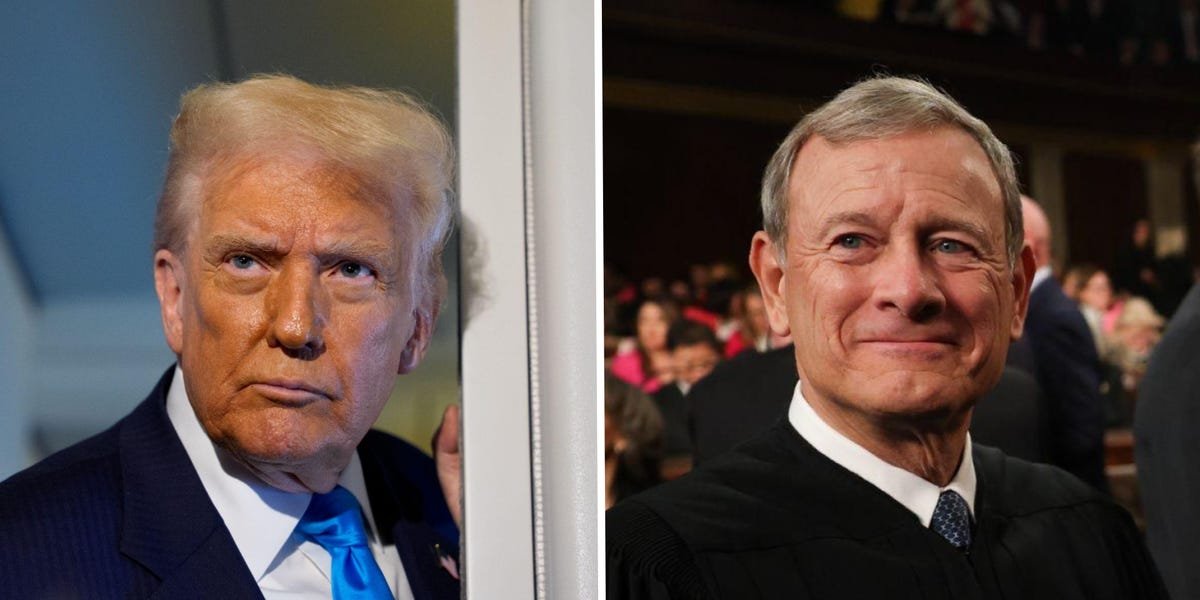
Supreme Court strikes down swath of Trump’s tariffs — but he has other options

The Supreme court struck down a chunk of President Donald Trump’s sweeping tariff policy on Friday, finding a new limit to the expansive presidential powers he has sought.

The 6-3 decision centered on the tariffs Trump justified under the International Emergency Economic Powers Act, a national security law that allows the president to regulate economic activity during emergencies.

Those IEEPA-justified tariffs have been one of Trump’s most powerful weapons in his efforts to renegotiate trade agreements around the globe. They include Trump’s so-called “Liberation Day” tariffs, announced in April, which are at least 10% on nearly every country in the world.

The Trump administration’s use of the law went too far, wrote Chief Justice John Roberts in the majority opinion. Trump would need a distinct law from Congress “to justify his extraordinary assertion of the power to impose tariffs,” he wrote.

“What common sense suggests, congressional practice confirms,” he wrote. “When Congress has delegated its tariff powers, it has done so in explicit terms, and subject to strict limits.”

The Supreme Court’s decision comes as the United States trade deficit is shrinking, largely due to the Trump administration’s tariffs, which are taxes on imported goods. It shrank to $29.4 billion in October, the lowest figure since 2009, according to recently published Commerce Department data.

Two groups of businesses filed lawsuits challenging Trump’s authority to impose tariffs through IEEPA. The Supreme Court combined their cases and put it on the fast track, holding oral arguments at the beginning of its November term.

IEEPA, a Carter-era law, gives presidents the power to “regulate” importation in times of emergency. The Trump administration claimed that it included the ability to impose tariffs — a position no other president has taken.

Lawyers representing the businesses argued that Congress has been clear about taxation and tariff powers in other laws, and would have been clear if IEEPA were meant to confer those powers to the president.

During oral arguments, most judges expressed skepticism about the Trump administration’s arguments. Justice Neil Gorsuch, whom Trump appointed to the bench in his first term, said taxes were “part of the spark of the American Revolution” and should get careful treatment.

“The power to reach into the pockets of the American people is just different,” Gorsuch said. “And it’s been different since the founding.”

The Supreme Court’s ruling does not affect the tariffs that Trump has imposed using other laws, and Trump still has the power to issue additional tariffs using those laws.

But his administration has favored IEEPA because of its perceived flexibility. The other laws that allow presidents to impose tariffs without explicit Congressional approval have limits — including built-in expiration dates and caps on the amount taxed. They also make it more difficult to target particular countries, rather than certain industries.

This is a breaking story. Please check back for updates.


Source link

Jury-hears-how-Netflix-director-lost-a-fortune-on-options.jpeg

Jury hears how Netflix director lost a fortune on options trades — days after streamer sent him $11M for ‘visionary’ show

Director Carl Eric Rinsch made so many failed, seven-figure option bets after Netflix wired him $11 million that his broker at Wells Fargo tried — and failed — to stop him, a New York fraud jury heard on Tuesday.

“I can afford to lose the money,” Rinsch said, according to testimony by his former Wells Fargo advisor, Ronald See.

And when the brokerage hit the brakes — limiting him to $250,000 per transaction — the show developer was undaunted.

On March 30, 2019, just three weeks after receiving the $11 million, Rinsch instructed See, of Wells Fargo Advisors, to wire his remaining $8.5 million to Citibank so he could establish a new brokerage account with Charles Schwab.

“They won’t put restrictions on me there,” Rinsch wrote See in a letter shown to jurors.

Rinsch, 48, is on trial in federal court in Manhattan, fighting charges that he had no right to use the $11 million Netflix sent him on anything other than “White Horse,” the 120-minute TV series he’d already spent $44 million of Netflix’s money on. (Rinsch ultimately never finished a single episode of the clones-versus-humans sci-fi thriller.)

Defense lawyers counter that the $11 million was actually Rinsch’s contractually-promised payment for having completed principal photography, and was his money to spend as he pleased.

Either way, testimony on Tuesday by two of Rinsch’s former financial advisors showed that he was eager to spend the cash prosecutors say the director had quickly moved into his Wells Fargo account.

The streamer wired Rinsch the $11 million on March 6, 2020, as the COVID-19 pandemic halted film production worldwide.

Over the next three weeks, he then lost some $5.8 million, almost all of it on highly risky options trades involving Gilead Sciences, which was developing COVID-19 treatment drugs. (See would earn a $22,000 fee on these losses, the defense pointed out on cross-examination.)

The director was off to the races again as soon as he switched to Charles Schwab, according to testimony.

“I could send $3 mm personal to get started,” he wrote to his new financial advisor, Adam Checchi, who also testified on Tuesday.

“I understood that to mean three million from his personal funds,” Checchi said under questioning by a federal prosecutor.

Checchi told jurors that Rinsch would soon lose almost $6 million more, mostly on failed, highly risky bets that Gilead’s stock would rise and that the S&P 500 would decline.

“I’m not a broad, diversify kind of guy,” Rinsch explained in a late March 2020 email, adding that he pursues “aggressive” option trading “fully expecting to lose it all.”

Earlier in the day, former Netflix executive Peter Friedlander, who on Monday called Rinch’s project “visionary,” completed a second day of testimony.

On overhead screens, defense attorney Benjamin Zeman showed Friedlander — and the jury — emails from August 2019, in which Rinsch begged for “immediate support” with casting in Brazil.

“Show is set to collapse,” Rinsch wrote.

The defense is blaming the implosion of White Horse on Netflix’s decision to pull support for the project in September 2020.

In the email chain projected throughout the courtroom on Tuesday, Zeman attempted to show jurors that a year earlier, Friedlander was already cold toward the show developer’s requests for help.

“His own delays in decisions have caused this,” Friedlander wrote in forwarding Rinsch’s email to Mike Posey, an original series vice president, and others, including production executive Shelley Stevens and Rahul Bansal, an original series director.

Rinsch would continue asking for support — and money — for another six months before Netflix forwarded the $11 million payment at the center of the trial. The project was ultimately written off by Netflix as a tax loss eight months later, in November 2020.

Rinsch’s trial is expected to continue through next week. He faces up to 90 years in prison if convicted of wire fraud, money laundering, and engaging in unlawful monetary transactions.


Source link