After years of delays and missed deadlines, Tesla’s full self-driving tech has finally launched in Europe — and owners are celebrating.
Last week, the RDW, the Netherlands auto regulator, approved the driver-assist system that Tesla says allows its EVs to drive themselves almost anywhere under human supervision.
It marked the culmination of a long campaign that saw Tesla navigate what Elon Musk described as a “layer cake of bureaucracy.” Until now, European owners have been stuck with a more limited version of Tesla’s driver-assist software that can’t handle intersections or change lanes on its own.
For Tesla’s European fans, some of whom have been waiting nearly a decade to get access to FSD, the excitement of taking the tech for a spin for the first time was high.
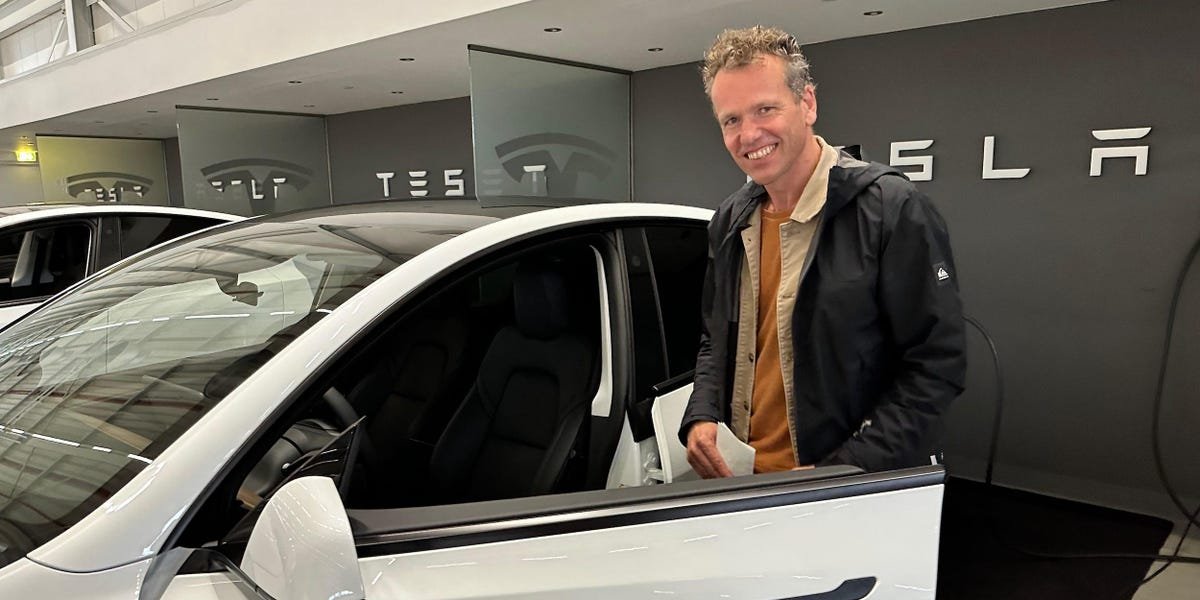
“It’s like stepping into the future. It’s amazing,” said Tim de Kraker, a venture developer from Zutphen in the Netherlands, who used his FSD first test-drive to take his son to school.
Navigating the tight streets of Amsterdam and other Dutch cities — where bike lanes, tram routes, and pedestrian crossings interweave into a tangled web that can flummox experienced human drivers — poses perhaps the toughest challenge yet for FSD.
Keizersgracht, Brouwersgracht, Prinsengracht and Bloemenmarkt! FSD did it all today in the busiest parts of Amsterdam. It was extremely impressive. We had to overtake once, but given the complexity of the situation, that was quite reasonable (perhaps it could have gotten itself… pic.twitter.com/0EBJatjoKl
— Thijs van Schadewijk (@tvanschadewijk) April 14, 2026
While all four drivers Business Insider spoke to said they encountered no safety issues or major interventions, some said FSD was still getting used to the local quirks of Dutch roads, such as complex roundabouts, which are rare in the US but ubiquitous in Europe.
Patrick Sannes, a Model Y owner who lives near the city of Gouda in the Netherlands, said that when he encountered a roundabout while FSD was driving him home from work on Monday, the software became confused by roadworks on the side of the road — and failed to exit the roundabout.
“I did three turns on the roundabout, and then I decided to drive off myself,” he said.
Sannes said his FSD-equipped Tesla has otherwise handled roundabouts, country lanes, and highway driving almost flawlessly, with only a few minor interventions due to overly hesitant driving.
Having waited seven years for FSD to launch in Europe, he said he was thrilled to finally surrender the wheel to the AI driver.
“It’s worth the wait, but I would’ve loved it to be faster,” Sannes said.
Alex Nichiporchik, CEO at video game developer tinyBuild and a Tesla owner for 10 years, told Business Insider that he had been impressed with FSD so far — even if the technology occasionally struggled with roundabouts, and had a tendency to frustrate other drivers by always giving way to bicycles, regardless of whether they have right of way or not.
Here’s @teslaeurope FSD taking on the worst Dutch car city: Hilversum.
Had 2 semi interventions: didn’t disengage but had to make it go manually:
1. Nav was pointing straight but the car chose a right-only lane, forced a lane change indicator and gas and it readjusted
2.… pic.twitter.com/CYs3h2gfF8
— Alex Nichiporchik (@aNichiporchik) April 13, 2026
“I’d say that in the US right now, FSD drives much better than I do. But here you can tell that it’s still learning,” Nichiporchik, who lives in the Netherlands and the US, said.
Unlike their US counterparts, European FSD owners downloading the software for the first time are asked to watch a video and complete a two-question quiz before they can begin using it.
This quiz — which asks drivers to identify when FSD is active and confirm they are responsible for supervising it — is likely a response to European regulations that require manufacturers to educate consumers about the limits of driver-assist tech.
Nichiporchik also said that instead of speed profiles such as sloth, chill, hurry, and “Mad Max,” the European version of FSD instead allows drivers to set a maximum speed that specifies how far over the limit they want it to drive.
“The rules here are much stricter than in the US, especially where I live in Florida,” Nichiporchik said, adding he thought having FSD in Europe would be “life-changing.”
Speaking over the phone while being driven by FSD, entrepreneur and founder Thijs van Schadewijk told Business Insider he had immediately put the software to the test by driving through the busiest parts of Amsterdam.
“There were tourists walking around your car, bicycles and cars everywhere,” he said.
Thijs van Schadewijk
Van Schadewijk’s Model Y handled the congested canal-side streets with ease, he said, bar one moment where he had to take over after it tried to reverse out of a busy intersection.
“I’m very excited that we now have it. And this is the worst version of FSD we will ever have,” he said.
Some Tesla owners miss out
Even as many Tesla owners celebrate FSD’s long-overdue arrival, some are missing out.
The rollout appears to be limited to Tesla owners with more recent versions of the company’s hardware — known as Hardware 4 — with vehicles built before 2023 not receiving the update.
In the US, Tesla vehicles with pre-2023 hardware — known as Hardware 3 — can only access a more limited version of FSD.
Musk previously acknowledged it’s possible that these older vehicles may not have the hardware to handle fully “unsupervised FSD,” and said Tesla would provide physical upgrades to all Hardware 3 owners if that is the case.
Mischa Sigtermans, an executive at Amsterdam-based Ryde Ventures who bought his Model 3 in 2019, feels like he’s waited long enough.
After FSD began rolling out in the Netherlands without Hardware 3 support, he started a website to gather European Tesla owners to explore potential legal action over what he says are the company’s broken promises.
“At some point, I lost trust in Tesla,” Sigtermans told Business Insider.
Tesla did not respond to a request for comment.
Mischa Sigtermans
The Model 3 owner, who bought FSD in 2019, said that Tesla’s marketing material at the time explicitly stated that his vehicle’s hardware would be capable of supporting Full Self-Driving in the future.
Speaking on Wednesday, Sigtermans said he now had around 500 verified Tesla owners sign up to potentially participate in the collective claim via the website. That number has now grown to around 1,900, per a tracker on Sigtermans’ site.
“You can’t keep this up for seven years. I would rather hear them say something like, ‘yeah, we can’t make this promise’ and communicate about it,” he said.
Tesla owners in Europe can transfer FSD from one vehicle to another, according to the company’s website. Tesla removed this option in the US in March.
Sigtermans said he shouldn’t have to buy a new car to access software he paid 6,800 euros ($8,050) for years ago, and pointed to Musk’s history of making overly optimistic promises on Tesla’s FSD rollout.
“It’s just the promise of this specific car that they made that they can’t deliver. And it’s honestly not my problem to get a new car to get FSD working. That’s their promise and their problem,” he said.