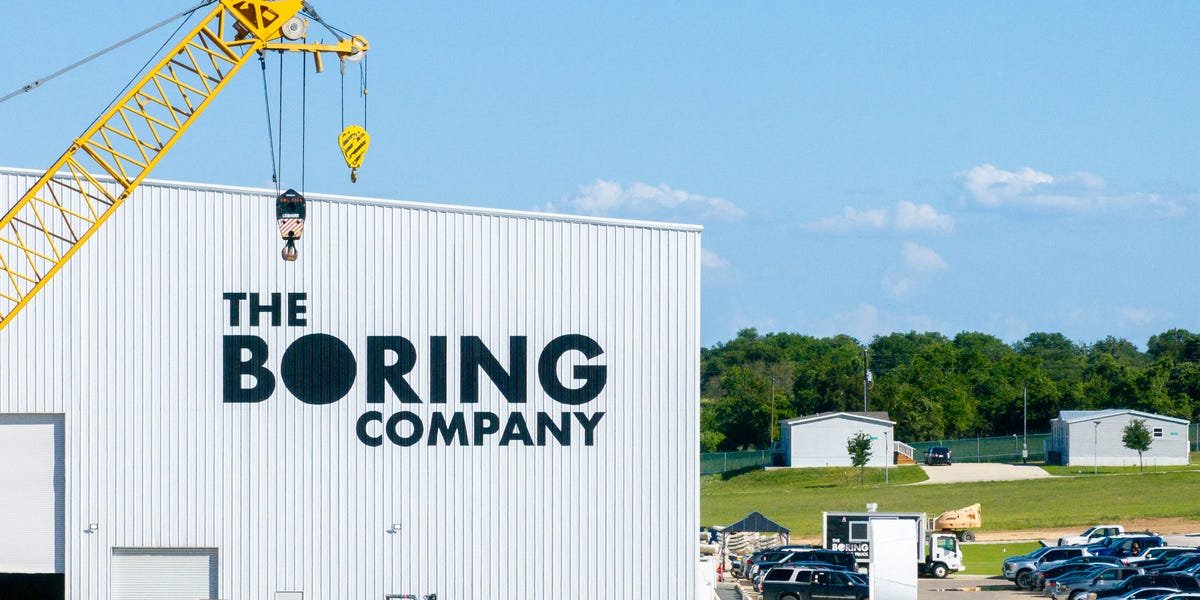
Mayer Mizrachi, the 38-year-old mayor of Panama City, wants Elon Musk to build him a pedestrian tunnel under the Panama Canal. And Musk’s Boring Company recently announced it just might.
Panama City this week was named one of 16 finalists — the only one outside the United States — in the company’s Tunnel Vision challenge, which offers the winning municipality a free tunnel that can be used for freight, pedestrians, water, utilities or Loop — the electric, underground system that uses Tesla vehicles to transport people.
Mizrachi’s idea is a 0.6 mile pedestrian tunnel under the Panama Canal, which would give city residents a chance to “live” its history and take advantage of the vital maritime trade route that is critical to the global economy. More recently, the canal has been the subject of geopolitical tensions as President Donald Trump threatened to take control of the waterway because, he said, the US was being ripped off by high fees and that it had come under Chinese influence. In February 2025, Panama withdrew from China’s Belt and Road initiative.
The winner will be announced on March 23. Of the 16 finalists, half were in Tennessee or Texas, where the Boring Company is headquartered and where Mizrachi recently went to make his pitch. The project, if chosen, has the potential to tie together Mizrachi, the former DOGE leader, and the Panama Canal that Trump once fixated on seizing.
Mizrachi, the youngest mayor in the city’s history, founded Criptext, a secure email platform, and, like Trump, has styled himself as an outsider. Like Musk, he came to office looking to cut government in the name of efficiency and insists he has succeeded.
In an interview with POLITICO, which is, along with Business Insider, part of the Axel Springer Global Reporters Network, Mizrachi said the tunnel proposal began as a last-minute response to a Boring Company social media post and ballooned from there.
This interview has been edited for length and clarity.
How did the tunnel idea begin, and what exactly was your pitch to The Boring Company?
Mizrachi: I merely just ran into a tweet by the Boring Company in January, and they had this tunnel vision challenge, and they were offering a free tunnel up to a mile long anywhere around the world to the best idea. I did a visit in January to the existing tunnel that’s being built for a subway station in Panama City, and I said, “What if we built a pedestrian tunnel crossing the canal with parks on either side? You can tell the story of how the canal was built and the history of the country, and the biodiversity.”
City planners started working on a proposal, and they kind of really brought the plane in for a landing with a beautiful proposal, and we submitted that on the last minute of the last day.
What did you learn in Texas about how The Boring Company would approach this project?
Mizrachi: We met with Jim Fitzgerald, the VP for global, and we kind of took a 101 on how a Boring Company project works. Tunnels are freaking expensive. But it turns out that the way that they do it makes it actually feasible, and it’s quite a wonder the way that they have put this together.
And as I told Jim, I said, “Listen, I know this is very preliminary, and here are many other projects that they’re considering, but you know, it would be quite a marvel that 100 years ago, you know, the US built the canal, and then 100 years later, that they would build a tunnel that crosses the canal in a modern marvel of engineering in the way that they do it.”
They reuse their tunneling machines. Whereas typically, the tunneling machines are built specifically for a given project, and then they get buried with the project.
Brandon Bell/Getty Images
What would this tunnel mean for Panama, especially at a moment when the canal is caught up in broader geopolitical tensions?
Mizrachi: First of all, Panamanians, we’re really proud of the canal, its management, its history, but we seldom get to live it. So it’s like the rest of the world uses the canal. But you know, Panamanians, we don’t live the canal. You could go to the Miraflores Locks, and you go to the tourist center. You can maybe see a ship, but we don’t really live it.
So the vision here is you create a public space where you integrate families, tourists, and they can cross the canal themselves with an underground tunnel that’s 0.6 miles, the distance. It’s quite short, and I can only imagine it being almost an educational experience, where you can have screens, very thin screens, because the space is not that big, but thin screens that are showing the story, the history of how the canal was built, the biodiversity of Panama, and then stats on the canal, the impact that it has on world trade, etc. It started as an idea, but it’s shaping up. And I think it goes above my pay grade. I spoke to the president [of Panama] about this. This needs to be handled by a task force designated by the president in representation with the entire country.
Why do you think Panama City could beat out American cities for this project?
Mizrachi: Well, there’s one very unique thing about this. They don’t have a canal. The Boring Company has never bored underwater, much less crossing a canal. And I think it’s part of the value proposition to show themselves as engineers, how far they can go with their mindset, with their methodology and their ingenuity.
Also it’s a pedestrian tunnel. So it’s not a loop tunnel that is managed and operated by the Boring Company. So if you think of Vegas, they operate the Loop itself. So, here, it’s a lot more hands off. They build a tunnel, and they don’t have to have an active operation.
AaronP/Bauer-Griffin/GC Images
You’ve drawn comparisons between your work and DOGE-style cost cutting in Washington. How do you describe your governing approach?
Mizrachi: I mean, honestly, I still consider myself an outsider. I am not subscribed to any political party, and I still very much employ the mindset of the tech entrepreneurial efficiency and try things before you scale things, which is uncommon in politics.
As soon as I came into office in July 2024, I realized people’s money was being wasted on a scale that I was just shocked to see. So we were able to reduce the size of City Hall personnel by 50% so it used to have 6,500 people. We reduced it to about 3,500 people. And by all counts, City Hall is operating faster and better with more impact, tangible, visible impact, with less people. And also, we reduced the budget by about 32%, so we did the biggest budget reduction in the history of the city as well.
This story originally ran in POLITICO’s West Wing Playbook and appears on Business Insider through the Axel Springer Global Reporters Network. The network publishes major stories from the Axel Springer network of publications, a worldwide group of news outlets that includes Business Insider.