Traveling-taught-me-to-let-some-parenting-rules-slide-even.jpeg

Traveling taught me to let some parenting rules slide, even when we’re at home

I love showing my kids the world and learning alongside them. It’s one of my greatest joys as a parent, and the ability to do so is a privilege I don’t take for granted. So far, I’ve taken my children to 26 countries across six continents.

Over time, traveling with my kids has changed the way I parent, whether we’re at home or thousands of miles away. Here are six ways traveling has influenced the way I parent.

I realize how little my kids actually need

I used to be obsessed with getting my children the right type of toys to promote learning and development. I wondered if they had enough layers for playing in the snow and the best shoes for climbing at the playground. Through traveling, I saw firsthand how little children really need to be happy and thrive.

In Marrakesh, my son played soccer in the winding streets of the ancient medina with kids wearing worn, off-brand Crocs. They barely stayed on their feet, but the game went on, full of laughter. In India, I saw children in threadbare clothing happily playing with no special toys required.

I realized that, despite my incredible fortune to be able to get my children nearly whatever I wanted, they would be fine with the basics. I now know that my entire family is better off free from the pressures of always chasing more things and wanting more.

I’m not as hung up on what my children eat

Travel often involves unexpected cultural differences that require my family to adapt on the fly — especially when it comes to food. For breakfast in South Korea, we found ourselves with bowls of soup rather than cereal. In Egypt, we ate spaghetti mixed with lentils, rice, and chickpeas instead of meatballs. In Japan, our pizza came topped with honey.

Traveling has taught me that many of the food rules I once accepted as gospel are really arbitrary cultural practices. I no longer care if my children want grilled cheese for breakfast. If they want to experiment in the kitchen and mix items that don’t seem to go together, like putting jelly on samosas, I let them try it. I still care about nutrition, but I’m a lot less hung up on what they eat and when.


The author poses with two of her children.

The author says that traveling internationally with her children helped her realize that her kids need fewer things to be content.

Courtesy of Jamie Davis Smith.


I’m more flexible with my children

I used to be hung up on strict bedtimes and mealtimes. While traveling, I witnessed parents around the world following very different rules than I did.

In Europe, I saw children out to dinner at 10:00 at night with even later bedtimes. These children were happy and thriving. I realized that the sky wouldn’t fall if I allowed my kids to stay up past their bedtime or if we didn’t eat lunch exactly at noon. Letting go of strict schedules has been incredibly freeing.

More on traveling with kids

I handle stress better

When it comes to travel, changes in plans are par for the course. Trains get canceled. Attractions may be sold out. Kids still get sick, even far from home. Traveling with my children has forced me to keep a level head as I navigate these challenges.

At home, I put these lessons into practice. If I have to deal with a last-minute change in plans because my son gets the flu or a playdate is called off, it’s no longer a big deal. When I am on the verge of panic, I remember the time I discovered the train I had planned on taking out of Venice wasn’t running. It could have been a catastrophe, but with some creative thinking, I got us to our next destination on time.

Once, I was told (incorrectly) that my son needed emergency surgery in Jamaica. I had to make sure he was well cared for in a country with a vastly different medical system than the one I am used to. He recovered in a couple of days with minimal intervention. Having the experience of navigating complex issues in countries where I don’t speak the language and must deal with cultural and administrative differences makes everyday problems easier to handle.


The author's children hike along the water.

The author says that she’s learned to let traditional schedules go and embrace being in the moment.

Courtesy of Jamie Davis Smith.


I make more time for fun with my children

My role as a parent is often purely managerial. I drive my children to various activities and pick them up from school. I make their doctor’s appointments and feed them dinner.

When we travel, many of these responsibilities vanish. My children and I spend more time having fun and enjoying each other’s company. We play endless rounds of Uno and laugh at inside jokes. It can be challenging to find time to create joy amid the relentless pressures of everyday life. However, traveling has shown me that doing so is essential to building a strong, lasting relationship with them. It also helps provide moments of respite from the daily grind.

I look for new experiences closer to home

If it were up to me, I would travel full-time. However, I need to work, and my children need to attend school, so that’s not feasible. Instead, I look for more interesting experiences closer to home. I’ve learned that it’s possible to experience something new and joyful just about anywhere.

Even when I can’t travel, I try to act like a tourist in my hometown. I seek out new hikes, museum exhibits, plays, and events every month. This keeps life interesting, even when work and school schedules keep us closer to home.



Source link

I-work-at-a-coworking-space-that-has-an-on-site.jpeg

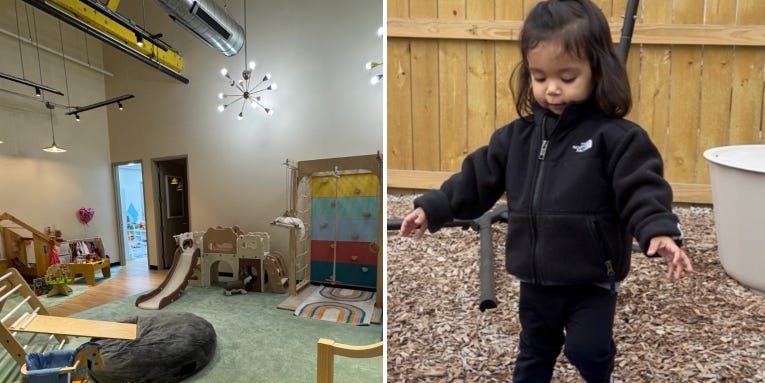
I work at a coworking space that has an on-site preschool. It’s completely changed my life and my parenting.

I wish I had known about coworking spaces with attached childcare/preschools much sooner in my parenting journey. This community helped me solve a problem I had been stressing over for two years.

I’m a Chicago mom, an on-air contributor on “The Fred Show,” a nationally syndicated morning radio show, and the founder of The Mami Collective, a media platform for ambitious mothers. My workdays aren’t traditional, and they certainly don’t fit into a 9-5 schedule.

My mornings typically start at 4 a.m., and once the show ends at 10 a.m., the rest of my morning is packed with meetings, recordings, and deadlines. Once that’s wrapped up, it’s time to head home to relieve my mother-in-law or sister-in-law of childcare duties. My husband is a fireman for the city of Chicago and has a side gig, so I’ve become the primary caretaker of our 2-year-old daughter every day after work.

For a long time, childcare was the hardest piece to align with our reality. But when I came across a day care and preschool located inside a coworking space, everything shifted.

Traditional day care never worked for my family’s situation

Traditional day care assumes you can arrive by a specific time in the morning. They typically give you a window, and if you miss it, then you’re out of luck.

This kind of set-up works for families with predictable schedules. It doesn’t work when your mornings are spent inside a radio station or when your workday starts earlier than most schools open.

I also didn’t feel fully ready or comfortable dropping my 2-year-old off at day care, where she would spend most of the day without me.

A coworking space with a day care was the answer I needed

What makes this model work for us is flexibility. Because of my morning radio schedule, we don’t rush for the 8 a.m. drop-off. Instead, we arrive after lunchtime and nap (2 p.m. to be exact).

My daughter joins the other kids for the afternoon, where she learns within the Montessori curriculum, plays, and socializes until closing at 5 p.m.

The best part of this all? I get to be there on-site, five feet away from her classroom: working, taking Zoom calls, editing audio, or answering e-mails. That alone changed my life.

I no longer feel like my career and my childcare are working against each other. As a business owner, this setup gives me something I barely had before: carved-out time to get work done while my child is cared for in a structured, enriching environment.


a corowrking space with couches

The author works out of a coworking space.

Courtesy of Paulina Roe


I’m not squeezing work into nap windows or evenings. I’m not trying to build my business in fragments. When she’s in school, I’m working, fully present, focused, and calm.

There’s no anxiety around clock-watching. If a meeting runs long or someone is running late to our scheduled podcast recording, the entire day doesn’t get off track. This proximity creates a sense of stability I didn’t realize I was missing.

For my daughter, the benefits are just as meaningful

My child has consistency, peers (yay to friends her age), and caregivers who are fully focused on her development. Her day isn’t shaped by my stress or unpredictability. She gets the social and emotional structure of preschool without any disruption.

At home, socialization was a large missing component for her, so I’m grateful she has this opportunity now.

This isn’t about working while parenting at the same time. I’m not popping in and out of her classroom or blurring boundaries. If anything, I’ve found that this model reinforces them. When she’s in school, I’m getting work done. When we’re together, I’m fully present with her.

I live an unusual life, so I needed an unusual solution

I’ve come to realize that many childcare systems are still designed around a workforce that no longer exists: predictable hours, long commutes, and a default parent with endless availability.

My life just isn’t built like that. And I know I’m not alone.

Coworking preschools are not for every family. They don’t replace traditional childcare or solve every systemic issue. But for parents like me, other remote workers, entrepreneurs, and creatives, and people whose work is flexible but demanding, they provide an amazing option.

I didn’t become a better mother by trying harder. I didn’t become a better business owner by optimizing my calendar. Once my childcare reflected my reality, I showed up calmer, more focused, and present.

This isn’t childcare as a treat. It’s childcare that finally meets working parents where we are. My only regret is that I didn’t find it sooner.


Source link

Ive-raised-my-3-kids-across-Switzerland-Australia-and-the.jpeg

I’ve raised my 3 kids across Switzerland, Australia, and the US — each culture has taught me valuable parenting lessons

  • Raising kids across 3 countries — the US, Australia, Switzerland — changed how I approach parenting.
  • It opened my eyes to how different cultures empower children to reach their full potential.
  • My kids learned early independence in Switzerland and the power of preparation in Australia.

Parenting my children across Australia, Switzerland, and the US showed me how deeply culture shapes the way we raise our children.

In Australia, I didn’t fully recognize how much my parenting was influenced by my suburban Sydney lifestyle until we moved abroad.

When my family moved to Switzerland, I noticed the way the Swiss promote child autonomy, empowering their kids from a young age — and when I adopted that mindset, my children thrived.

After moving to the United States, I learned a different parenting lesson about the true value of community and strong support networks, which strengthened my children’s sense of belonging.

Each country offered unique perspectives on parenting, but they taught me the same thing: Raising children isn’t about choosing one philosophy.

Instead, it’s about treating my experiences as a “cultural buffet,” trying new methods, keeping what works, and leaving the rest behind.

In Switzerland, independence is promoted from an early age.

In Switzerland, independence is a big deal for kids.

Naomi Tsvirko

When I first moved to Switzerland from Australia, I was stunned to see 5-year-olds in high-visibility vests walking to school alone, without adult supervision.

When I asked my Swiss neighbor about this, she shrugged and said, “Children can do amazing things when you let them.”

I started to give my children more responsibility and even let them walk to the local park and bakery without me. I realized they were ready, and they loved the freedom.

Living there also taught me the importance of letting children be a little uncomfortable.


Kids standing on stones next to woman near water

We no longer hesitate to play in the rain or a bit of snow.

Naomi Tsvirko

I remember dropping my kids off at a school playground early one rainy morning in Switzerland. The teacher stood outside, wearing her raincoat, calmly watching the children play in the rain.

In Australia, rainy days were usually spent indoors, but in Switzerland, life continues outdoors in almost any weather.

At first, my son looked up at me, unsure whether to join in. His teacher encouraged him to play, and before long, he was running around like everyone else.

That was when I really understood that common saying: “There’s no such thing as bad weather, only ill-prepared people.” Swiss parents approach tough situations not by avoiding discomfort, but by preparing children to handle it.

Australia showed me it’s important to prepare children for the road rather than trying to control it.


Kids smiling with woman in front of purple hydrangeas

My kids learned a lot in Australia.

Naomi Tsvirko

In Australia, helicopter parenting is widely frowned upon. When I worked as a teacher, I quickly learned that parents who hovered over their children didn’t just limit independence, they undermined confidence.

One of the hardest parts of parenting has been learning to step back and let my children take age-appropriate risks, trusting that they can handle them.

That parenting lesson was cemented when my 3-year-old daughter identified a venomous redback spider in our bathroom. She closed the door and informed me right away.

Her preschool had taught her how to recognize dangerous Australian spiders and what to do when they encountered them. It wasn’t fear-mongering, but survival training — a reminder that we can’t control the road ahead, but we can prepare our children to navigate it.

I also learned that being laid-back can help kids build confidence.


Kids smiling wearing leis

Australians can seem laid-back, but that’s not the same as apathy.

Naomi Tsvirko

Australians are laid-back by nature, but that doesn’t translate to apathy when it comes to parenting.

We care deeply for our children, but we’re also aware that even subtle parental anxiety can be picked up by them.

When my son was 2 years old, he started swimming lessons. His teacher gently asked me not to sit too close to the pool as she noticed that he kept looking at my face before trying anything new.

She was right. I seemed nervous, and he was even hesitant to put his head underwater.

I realized that I had to control my reactions when my children faced new challenges, otherwise my anxiety would become theirs, turning curiosity into fear instead of confidence.

Our time in the US has shown me how much competition builds confidence.


Family in NY rangers jerseys standing next to subway train

My kids have gotten more comfortable with competing in sports.

Naomi Tsvirko

For many years, I avoided entering my children in competitions because I didn’t want them to feel pressured to be the best at something.

However, after moving to the United States, my perspective shifted. Doing well in a competitive environment built my kids’ confidence, and losing helped build resilience.

My two older children first learned to play ice hockey in Switzerland, but it wasn’t until we moved to the US that they were exposed to higher-level competition. I’m grateful for their hockey coaches who mentored them and challenged my own assumptions about competition along the way.

Later, my daughter was able to represent our country at an international level. What surprised me the most wasn’t the achievement itself, but how much confidence she gained simply from being comfortable with competition.


Source link

Im-an-American-raising-my-child-in-Denmark-Kids-here.jpeg

I’m an American raising my child in Denmark. Kids here are trusted to take risks — and parenting feels easier.

Growing up, I knew two things: I wanted to be a mother and to live abroad one day.

Both came true when I met my Danish husband while traveling solo almost a decade ago. Not long after, I moved from New York City to Copenhagen, which was ranked first in the Happy City Index for 2025.

We had our Danish-American son, Aksel, just over three years ago, and today we live in central Copenhagen. I now experience Danish society more fully through the reality of raising him here.

Having Aksel made me understand why Denmark earns its praise. Here, parents are encouraged to trust children’s independence and rely on community support. In the US, parenting is more often shaped by caution and a stronger emphasis on individual responsibility.

My son goes on adventures at day care

This may be my favorite example of that trust: one afternoon, when Aksel was about a year old, I picked him up from vuggestue (day care) and learned his class had gone on a field trip earlier that day. I didn’t sign a permission slip, nor did I receive an email.

Since then, I’ve been surprised by updates to Denmark’s parent-teacher app, Aula. I’ll receive photos of Aksel riding the Metro or exploring Rosenborg Castle during school hours, all without my prior knowledge.

Growing up in the Connecticut suburbs, that would have been unthinkable. I remember even a trip to the town center (just a five-minute walk from my high school) required signed permission slips and repeated reminders to parents.

This is because a stronger suing culture in the US often means safety concerns extend beyond protection to liability. Denmark operates on a different premise, with little fear of lawsuits by parents and a general trust in educators and parents to exercise judgment.

Public life in Denmark is child-centric

That child-first mentality extends into public life. When Aksel was an infant, I used to refer to Copenhagen’s mall as the “milk stop” because there were always proper family rooms for feeding and changing (including in men’s bathrooms!). Restaurants often include play areas, and even formal dining establishments have offered Aksel a highchair.

In contrast, when traveling with Aksel in the US, I always feel as if I’m somehow disrupting adult systems. For example, I remember meticulously planning subway routes in Manhattan because so few stations are stroller-friendly.

In Denmark, public spaces actively accommodate families, reducing stress by meeting children’s needs without explanation. Accessibility features like ramps built into staircases are standard, and the idea of “play” is prioritized. Copenhagen is even designed so that anyone can walk to a beach or park in 15 minutes.

That same thinking shows up in everyday transportation. Like many parents here, I take Aksel to daycare on a cargo bike (the Danish equivalent of the “soccer mom van”) because Denmark invests in supporting it.

Childcare is affordable and accessible

When I signed Aksel up for public day care, I was surprised by how straightforward and accessible the process was, thanks to a centralized system supported by government subsidies that make quality childcare affordable.

There is far less stay-at-home parenting in Denmark because childcare is treated as a public good, something families are expected to need rather than justify. In fact, Denmark leads the European Union in the share of children attending formal childcare each week.

And in this family-first society, even parents in corporate roles usually pick up their kids by 4 p.m. on weekdays, a sharp contrast to the late work hours typical in the US. Here, work simply isn’t given the same priority as family, which, as a “workaholic American,” I’m learning to adjust to.

Children are trusted to take risks

My mom group describes Danish playgrounds as coming “with a side of danger.” This is because risky play is more valued in Denmark than in the US. In day care, kids routinely use tools, work with fire, and learn by doing, because the belief is that resilience is built through experience, not by avoiding discomfort.

At first, this approach was uncomfortable for me because I was used to the American “helicopter mom” mentality. Over time, I realized what seemed like a lack of parental control in Denmark was actually just an expression of trust in educators, institutions, and, of course, children themselves.

Parenting here feels collective

A friend once told me that parenting in the US often feels like defensive driving: constantly anticipating risks and advocating for your child.

That’s a marked contrast to Denmark, where I don’t feel compelled to stay on alert all the time. Whether Aksel’s on an unannounced school field trip or learning to bike at a staffed playground (while I watch from a distance), trusting his safety is the norm, not the exception.

Denmark isn’t perfect, and parenting as an expat has its unique challenges. Still, raising my son in this trust-based, child-centered society has given us what every parent seeks: a genuine sense of community and support.


Source link

Im-parenting-my-kids-differently-from-how-I-was-raised.jpeg

I’m parenting my kids differently from how I was raised. I don’t want them to fear me, but instead trust me.

Growing up, the grandparents who raised me were a generation removed from me, and because of it, I never felt like I could go to them with real issues or problems.

I hid the deep and dark stuff because children were to be seen and not heard. We did not talk about the big things like sex or drugs. Instead, the warnings were direct and often frightening. They went something like this, “Do not do drugs or you’ll die.” The pregnancy mantra was similar: “Do not have sex or you’ll get pregnant.”

Alongside the lack of communication was a heavy dose of fear and threats. I suppose their own parents passed down less-than-stellar communication skills and used threats in an effort to protect.

I was terrified of my grandparents

I remember coming home after having a few drinks at a high school party. “You can do this one step at a time. Say hello and walk (in a straight line) to your room,” I whispered to myself as I climbed the steep front steps leading to our second-floor apartment. There was no getting caught, or I would die, or at least endure endless punishments preventing me from going to said parties until I was an adult capable of making my own decisions.

Not only did I not know how to talk to my grandparents, but I was also terrified of them.

Sometimes, this lack of communication led to unwise decisions. I didn’t feel like I had an adult I could call if I’d done something I wasn’t supposed to do. If I did something foolish, I was on my own. It wasn’t safe, and I’d watched more than one friend get seriously injured (either physically or mentally) when they made a typical teen choice and felt they didn’t have an adult they could trust to help them.

I wanted my kids to trust me

With my own kids, I wanted to keep the lines of communication open, which became especially important as my children navigated middle school and high school. These years of adolescence included poor decision-making and a desperate struggle between being a kid and trying to grow up.

I talked openly with them about drugs, sex, and drinking. No subject was off limits. They knew they could tell me anything. Keeping our communication open and honest showed them a level of trust that other parents found difficult to understand. I often had my kids’ friends telling me things they couldn’t say to their parents. I tried to listen without judgment. I knew it was a fine line between discipline and acceptance. I also knew no matter what, keeping my kids safe was my first and most important job as a parent.

As my second set of kids head into the muddy waters of middle school and high school, these discussions are again at the forefront. “If you drink, I’ll be more upset if you get in a car with someone who’s been drinking or if you decide to drive than I will because of the drinking,” I recently told my high school daughter. Realistically, while I don’t openly condone underage drinking, I know it is, more often than not, a part of the teen years. “Call me,” I said, “and I’ll come get you.

I try to stay open-minded

While there were many things I did not accept, I also did my best to remain open-minded. It was sometimes difficult to parent this way. My kids did and continue to do things I often don’t agree with. I looked at these as teaching opportunities, rather than seeing them as moments to punish. Viewing things this way has helped me foster and maintain very close relationships with my kids. It is something others have commented on, including a social worker I visited with my son. “No matter what is going on,” she said, “you two seem to have a really tight and open relationship.” It remains one of the best compliments I’ve received as a parent.

There was another side to those comments, though. Parenthood is often filled with judgment and criticism. When my son dropped out of school, and my teens struggled with typical teen things like drinking, drug use, and sex, I remember hearing a neighbor refer to me as a loosey goosey parent. The neighbor in question didn’t understand my relationship with my kids. They didn’t share my parenting philosophy. Really, they didn’t have to. While the comment initially bothered me, I knew I was parenting in the only way I could. I parented in a way that I wasn’t parented, but wished that I had been.

As my two oldest kids hit adulthood and my youngest two become teenagers, I’m not sorry for being loosey goosey. I would do it the same way all over again. In fact, I am. I have no regrets. I hope the neighbor who judged me feels the same way when their kids go through the tough teen years.


Source link

I-left-a-mom-group-over-parenting-decisions-I-dont.jpeg

I left a mom group over parenting decisions. I don’t regret it.

I should have sensed the judgment the minute I arrived at the first playdate with four kids in tow and another on the way. Instead, I was thrilled to finally find my “village” that I’d heard so much about — a group of moms who met a few times a month at nearby play spaces and coffee shops to commiserate and encourage each other.

I even brushed off the first comment I was met with, which, in hindsight, should have been a warning sign. “Wow, are they all yours?” It wasn’t the first or last time someone had a “witty” one-liner about my family size, which was completely on purpose and by choice, if they must know. My kids jumped into the playground with the others, and I settled in to find my new besties.


Mom and daughter

The author felt her parenting style didn’t match that of her moms’ group.

Courtesy of the author


The thing about mom groups, though, is that they often aren’t obviously terrible. In fact, they check all the boxes — moms at similar ages, stages, and struggles, getting together for camaraderie and community. We all had similar jogger set mom uniforms and extra-strong lattes on hand, hidden in the pockets of diaper bags to make it past “no food or drink” signs at indoor parks (no? Just me?).

But they aren’t always necessarily a good fit. All the feelings from this almost-perfect mom group I was once a part of resurfaced when Ashley Tisdale wrote an essay in The Cut, talking openly about how her mom group turned toxic.

I’m a free-range parent

My first feelings that I was “different” came when two of the younger kids had a small collision at the bottom of a slide. They tripped, fussed a bit, and in my parenting world, were ready to get back up and carry on. I’m used to being around people with widely differing parenting styles, but not used to being judged for mine.

I felt like my free-range parenting was judged by other moms who were more helicopter parents. The mom of the other kid who collided picked the child up, brushed them up, and performed a full check-up. Meanwhile, my own child popped up, whined a little, and ran off.


Boy in park

The author needed a safe space to vent and felt like the group she found was not it.

Courtesy of the author


Band-Aids and tissues were coming out to counteract tears, and a full-scale breakdown of the situation, complete with apologies and moment-by-moment recaps, had commenced. I enjoyed my coffee and didn’t give it much thought. I hadn’t noticed yet that my parenting style was a mismatch. To be clear, this is just my perception.

I needed a place to vent and feel safe

Slowly but surely, questions about my family size began to infiltrate conversations. I was used to one-liners from grannies at the grocery about having my hands full, but it felt like an onslaught.

It was the same thing with my career. After the group learned I was a working mom, running my own business full-time, I started to feel like an outsider. People spoke a lot about the negative sides of daycare, and the perks of being able to be a full-time mom, Their comments made it seem they weren’t interested in a different perspective, nor was there a question about why I work (because I want to) or about the immense benefits my kids have gotten through day care. I felt like there was an assumption that I was stuck in this terrible world of working motherhood against my will, with no way out.

Over time, I felt like the circus spectacle, and felt I had to have all the i’s dotted and t’s crossed on parenting topics, to show the naysayers that I was doing just fine with many kids, rather than finding a soft landing place to vent and share.

Parenting can be so isolating

I was lonely and desperate, so I clung to my mom group. The alternative was too scary. Nobody to hang out with on a boring Saturday or text when things get tough. It’s not just me — two-thirds of parents find the role isolating and lonely. But one day, I realized the abyss was better than the alternative.

This was the day they moved all the get-togethers to 10 a.m. on weekdays. They knew exactly where I’d be at 10 a.m. every weekday — working.

Although I haven’t found a similar style group, I realized that instead of looking for a whole village of besties, my village was already around me. It just didn’t look like 10 moms with lattes at play group. Instead, it involves the trainer who asks if my kid is over his third bout of strep, or my mom’s friend who texts me with some press-on nails she likes that would look good on me.

My real friends don’t demand we have precisely only 1.5 children, helicopter around our babies, or only wear pink on Wednesdays.


Source link

kelly burch

While I led my company through a $150 million acquisition, my husband handled the parenting. Here’s how we make it work in our house.

This as-told-to essay is based on a conversation with Tiffany Haynes, host of the Between Builds podcast and Substack. It has been edited for length and clarity.

I was entirely on my own when I was 19. While I was enrolled in college, I worked full-time at night in the call center of a fintech company, Jack Henry & Associates. It was a gritty, hands-on role, but an exciting time to be with the company, which was growing quickly.

I didn’t have a typical college experience. I worked a lot so I could pay for my car and home. At work, I put my hand up any chance I could. I was never the smartest person, but I worked really hard and was always willing to figure out problems. Even if I’d never done something, I would figure it out. I couldn’t afford to fail, personally or professionally.

That served me well. I gained a reputation as someone who could execute tasks with a high degree of excellence, while also operating with empathy. By the time I left Jack Henry in 2022, after 20 years, I had become a vice president.

My husband handled childcare while I worked in NYC

At that point, I was a wife, mom of five, and had been a foster mother to seven children. I live in Missouri, but my reputation was so strong that the team at Fingercheck, a New York-based HR platform, approached me about scaling the company with a goal of acquisition.

I started traveling a lot, and spending two weeks in Brooklyn at a time, with a week at home in between. My husband handled childcare, loading up the kids and bringing them to the school that they attended, where he was the superintendent.

Over three years, I helped scale Fingercheck. In October 2024, it was acquired for $150 million.


Tiffany Haynes wearing a white zip-up sweater and standing in a field.

Tiffany Haynes wants her kids to know the value of hard work.


Photo credit: Teresa’s PHOTOWORKS


After the acquisition, my husband and I founded a school

I stayed at Fingercheck until this July to help with the transition. After that, the plan was to take time to reorient myself and rest.

Yet, life had other plans. The school my husband led was affiliated with a local church. It grew so much that the church could no longer handle it, and this summer, we had a choice to make: let 100 kids find a new school community, or open our own.

It was a whirlwind four months, but we did it. I call myself the quiet cofounder of the school, and I’m not involved in day-to-day operations. Now, I’m doing some advising work and have a podcast called Between Builds. I’m also taking some time for myself to be whole, rather than hurried.


Tiffany Haynes and her husband

Tiffany Haynes and her husband connect every day over coffee.


Photo credit: Teresa’s PHOTOWORKS


We connect almost daily over coffee

My husband doesn’t take a salary — his work is our way of giving back. When he left his paying job 13 years ago to enter education, I became the breadwinner. We’ve had a lot of practice respecting one another’s domains.

The work I did with Fingercheck in New York was very fast-paced, urban, and growth-focused. The work he does here in Missouri is rural, quiet, and focused on community. It’s two different ends of the spectrum.

We appreciate each other’s different skill sets. I support the school, because he loves the school and I love him. He handled the family when I needed to travel for work, even if he didn’t fully understand the fintech world. We connect almost every morning over coffee, before the kids are up, and talk about how we can support each other. We aimed to do that even when I was working full-time, but it’s easier in the months since I left Fingercheck.

I want my kids to understand the joy that comes from hard work

I grew up poor, and I understand how privileged my family is today. We have more than enough, so we aim to give not only money but time. I try to be the advocate I never had growing up, both to my own kids and the children we foster. I’ve done a lot of work to process my own trauma from a difficult childhood, and I want my children to have a foundation of emotional intelligence and health.

I also want them to understand that it takes a lot of hard work and consistency to be excellent. They see YouTube influencers talking about making millions, and I worry that creates a short-sighted view of worth ethic and personal meaning.

I hope my kids understand the joy you get from doing hard things. I want a space where they can sit with frustrations and build resilience; I know that will serve them well in life.


Source link