Ive-worked-on-cruise-ships-for-years-Here-are-6.jpeg

I’ve worked on cruise ships for years. Here are 6 things passengers should pack and 5 they shouldn’t.

After about a decade of working on cruise ships, I’ve helped a lot of passengers navigate tricky situations at sea and in ports.

I’ve also learned that many people, especially first-time cruisers, don’t know how or what to pack for this unique traveling experience.

Fortunately, I’ve become quite efficient at packing for trips at sea.

Whether you’re bringing a 50-pound suitcase or just one backpack, here are a few things you should and shouldn’t bring on your cruise.

Protect yourself from the sun with headgear and lots of sunscreen


Brown sun hat on handle of white suitcase

The sun can be very strong in some destinations. 

Nakayama Toshio/EyeEm/Getty Images


Bringing UV protection may seem obvious, but the sun in most cruise-friendly places can be very harsh and may have you burning in no time.

At sea, the sun can also feel a lot stronger than what you may be used to — especially on Caribbean trips.

I’ve seen the tops of many heads get red an hour into a tour or pool day. So, make a conscious decision to protect your head with hats or scarves throughout your trip.

Pack lots of sunscreen, too. Otherwise, you’ll have to buy it on board or in a port, where it’ll likely be a lot more expensive.

Motion-sickness pills can come in handy

Even if you don’t think you’ll get seasick, it doesn’t hurt to prepare.

Cruises usually have motion-sickness or anti-nausea medications on board, but after too much partying and some swaying seas at 2 a.m., you’ll be happy to have your own stash in your stateroom.

Make sure you pack appropriate attire if you want to participate in your ship’s formal night


someone putting nude-colored pointed high heels on their feet

Pack any formal shoes and accessories you may need. 

Ladanifer/Shutterstock


Always check your cruise itinerary for themed events and formal nights — most sailings have at least one of the latter.

Participating is often optional, but I’ve seen so many disappointed and underprepared cruisers who didn’t realize a fancy event was happening until they were at sea.

If you plan to attend a formal night, be sure to pack a lovely gown or suit and the proper dress shoes and accessories to go with it.

Lanyards with a cardholder can make it easy to keep track of your key

When you step onto the ship, your room key becomes an important companion. It’s typically how you pay for everything on board, open your door, and sign on and off the boat in ports.

They’re small and easy to lose, so make your life easier by bringing a lanyard with a key holder. Even if you don’t wear it, this lanyard can help you quickly find your card in a big purse or beach bag.

Walking shoes are important on land and at sea


Woman wearing jeans and red sneakers on rocky beach

You’ll likely have to do a lot of walking on the ship. 

ICHAUVEL/Getty Images


When people imagine cruise footwear, they usually picture sandals. However, some ships nowadays are massive, and walking back and forth can add up to a good number of steps.

So, make sure you pack at least one comfortable pair of sneakers. (Some more adventurous shore excursions even require them.)

If you pack wine, don’t forget to bring a corkscrew 

On most cruise ships, you can bring a limited amount of wine on board, though the number of bottles varies by cruise line.

However, once it’s on board, you’ll typically be charged a corkage fee to open it. Save yourself the money by bringing a corkscrew to do it yourself.

On the other hand, super-high heels aren’t worth the risk


person wearing green high heels with red bottoms

High heels can be tricky on a swaying ship. 

Dominique Charriau/Getty Images


I’m not saying don’t bring heels — I want you to look fabulous on vacation — but excessively high shoes on a swaying ship can lead to injury. I speak from personal experience.

If you’re packing heels, go for a chunkier style that’s easier to balance on and less likely to get stuck between deck slats.

Don’t bother trying to pack alcohol in shampoo bottles

It’s a common ruse for cruisers to attempt to sneak alcohol onto a ship in inconspicuous containers, like empty shampoo or mouthwash bottles.

Besides the soapy taste the booze takes on, security is trained to look out for these tricks and will confiscate the liquor.

Skip the irons and steamers, too

While heated hair appliances are OK, clothing irons and handheld streamers are forbidden on most cruises since they can be a fire hazard.

If you pack one of these, your bag can be flagged and items confiscated by security until you depart from the cruise.

Fortunately, hair irons can help get out small wrinkles in clothes in a pinch. Anti-wrinkle spray can also come in handy (and it’s often sold in travel-sized bottles), and some ships also offer professional pressing services.

Use the beach towels provided to you instead of lugging your own on board


Two yellow beach towels laid out on the sand

Oftentimes, a cruise line provides lots of clean towels. 

Michael Edwards/Getty Images


Save space in your luggage by leaving out towels, which can be bulky and difficult to clean at sea.

Fortunately, you’ll be just fine getting them on board. Every ship I’ve been on has had multiple stations where guests can grab fresh towels for a pool or beach day. Oftentimes, they’re replenished throughout the day.

It’s probably not worth bringing a drone, either

Many cruise lines allow travelers to pack drones. However, there can be a lot of strict guidelines around using them.

For one, it’s very likely you won’t be allowed to fly your drone on the ship, so that million-dollar shot of the vessel at sea isn’t happening.

You can potentially use your drone when you get off the ship, but keep in mind that many ports don’t allow people to fly them without special authorization or permits, either.

So, unless you plan to do a lot of prep and paperwork, you may want to save space in your suitcase and leave it at home.

This story was originally published in 2022 and most recently updated on March 31, 2026.


Source link

Photos-show-chaos-at-airports-as-passengers-are-left-stranded.jpeg

Photos show chaos at airports as passengers are left stranded due to canceled flights

  • Airports across the Middle East have suspended all flight operations until further notice, leaving many stranded.
  • The US and Israel launched strikes against Iran on Saturday, with Iran launching retaliatory strikes across the region.
  • One Emirates passenger told Business Insider he was stuck on a plane for five hours without food before everyone was deplaned.

Travelers are in limbo as airport departure boards flip to red after air strikes in Iran resulted in closed airspace and triggered mass flight cancellations.

The heart of the chaos is in the Middle East, where airports in Dubai, Doha, and Abu Dhabi serve as megahubs for global connecting traffic. Data from the aviation analytics firm Cirium shows their home airlines — Emirates, Qatar Airways, and Etihad Airways — carry a combined 90,000 transit passengers a day.

That figure does not include the thousands of travelers whose final destination is the Middle East.

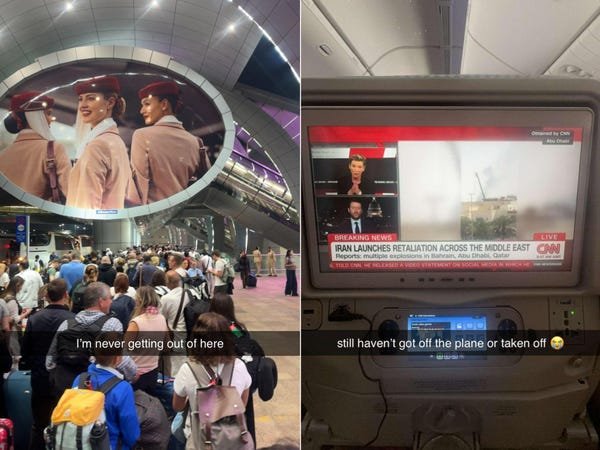
Emirates passenger Jaiveer Cheema, who was set to fly back home to the US on Saturday, told Business Insider that he was stuck on his plane for five hours with no food before everyone was deplaned and shuffled into the crowded terminal at Dubai International.

“The next several hours at the airport were chaos as no one knew what to do,” he said. “We spoke to several security guards and Emirates employees, and they all gave us different answers.”

Cheema said they stood in line after line until they eventually got a hotel voucher and took a bus to the lodging. He was still waiting for a room 90 minutes after arriving — it’s after midnight in Dubai; nearly 20 hours after he initially showed up for his 9 a.m. flight.

While many passengers are stranded within the region’s closed airspace, shuttered until further notice, the disruption has rippled far beyond it.

Flights to the affected region from places like London and the US have been canceled outright or diverted mid-journey — leaving travelers far from home in crowded airport terminals and uncertain when they will be able to depart.

Airlines have told passengers on social media to expect long wait times at airports and on customer-service phone lines as they try to manage the abrupt disruptions.

The sheer number of displaced people and planes on Saturday alone is expected to snowball worldwide if airports are unable to restart operations soon.

Passengers in Dubai were funneled into long snaking lines.

Jaiveer Cheema is one of the thousands of people stranded in limbo.

Courtesy of Jaiveer Cheema

Cheema spent hours in line but managed to secure a hotel voucher — though he had yet to secure a room when talking with Business Insider. He said he did not have answers from Emirates on what’s next.

An Emirates spokesperson did not immediately respond to a request for comment from Business Insider.

Passengers at Beirut Rafic Hariri International Airport in Lebanon are stranded.


Stranded passengers at Rafik Hariri International Airport

Passengers are stranded at Beirut Rafic Hariri International Airport on Saturday.

Anadolu/Anadolu via Getty Images

Airlines are pivoting their operations in response to the strikes. Lufthansa Group said it is suspending flights to Beirut, Tel Aviv, Amman, Erbil, and Tehran until March 7.

Airlines are suspending flights across the region, including Lebanon.


Cancelled flights at the Rafik Hariri International Airport on February 28.

Flight operations at the Beirut Rafic Hariri International Airport in Lebanon on Saturday.

Anadolu/Anadolu via Getty Images

In a statement shared on the Lufthansa Group’s website, the company said it would also suspend flights in additional areas.

“The following airspaces will also not be used until March 7: Israel, Lebanon, Jordan, Iraq, Qatar, and Iran,” the aviation corporation said. “In addition, Lufthansa Group airlines will suspend flights to and from Dubai and Abu Dhabi, Riad, and Dammam until March 1. Furthermore, the airspace of the United Arab Emirates will not be used until March 1.”

International flights at Tribhuvan International Airport in Nepal were disrupted.


Stranded passengers at Tribhuvan International Airport in Nepal.

Passengers waiting at Tribhuvan International Airport in Nepal on Saturday.

Navesh Chitrakar/REUTERS

The Tribhuvan International Airport shared a passenger advisory on Saturday, saying international flights “may be subject to delay, rescheduling, or cancellations” due to airspace restrictions.

Passengers flying with major airlines were told to check their flight status.


Passengers stranded at Tribhuvan International Airport in Nepal on February 28

Passengers at Tribhuvan International Airport in Nepal on Saturday.

Navesh Chitrakar/REUTERS

The Tribhuvan International Airport told passengers flying with major airlines — including Qatar Airways and Turkish Airlines — to coordinate with those companies to navigate travel issues.

Qatar’s airspace closure caused flight disruptions at Hamad International Airport.


Passengers at the Hamad International Airport in Qatar on February 28.

Passengers at the Hamad International Airport in Qatar on Saturday.

Stringer/REUTERS

Qatar’s Hamad International Airport said all aircraft movement has been temporarily suspended due to the country’s closed airspace.

“Our priority is always the safety of our passengers and employees. We are working closely with government stakeholders and airline partners to look after passengers that have been impacted,” the airport wrote in an advisory.

In London, flights to the countries Middle East were canceled.


A check-in counter for Emirates at London Gatwick Airport shows cancelled flights on February 28.

The Emirates check-in counter at London Gatwick Airport shows that flights are cancelled on Saturday.

Ben Stansall / AFP

Flights heading to the Middle East were also canceled at the London Gatwick Airport in England on Saturday.

London Gatwick Airport told some passengers to expect travel interruptions.


Passenger at London Gatwick Airport on February 28.

Passengers at London Gatwick Airport on Saturday.

Ben Stansall / AFP

A London Gatwick Airport spokesperson told Sky News it’s “expecting disruption to our Qatar and Emirates flights.”

Are you a stranded traveler with a story to share? Contact the reporters at ledmonds@insider.com and trains@insider.com along with your preferred contact information.


Source link

A headshot of Insider's Pete Syme

600 airline passengers faced the weirdest sleepover ever, when snow left them stuck on planes overnight

Hundreds of people spent a snowy and freezing night trapped on board parked airplanes last Thursday.

Six flights, with around 600 passengers total, were unable to take off before Munich Airport’s 1 a.m. curfew due to the bad weather, the airport said in a Monday statement.

The airport police department has prepared a report on the incident, which is set to be submitted to the public prosecutor on Tuesday, Sven Otto, chief inspector for the Upper Bavaria North Police, told Business Insider.

He added that no complaints have yet been filed with the police by affected passengers.

Around 100 flights were canceled in Munich on Thursday, and temperatures dropped to 30 degrees Fahrenheit. There were long lines to de-ice planes, while runways were periodically closed at short notice to clear the heavy snowfall, the airport said.

Munich, Europe’s 10th-busiest airport, typically shuts at midnight, but it received a permit that day to operate an hour later.

When the six flights couldn’t depart on time, there was no space left to park at the terminal due to all the cancellations, the airport said.

However, the passengers couldn’t be transported to the terminal because “bus service was severely restricted” due to “the late hour and communication problems,” it added.

Five of the flights were operated by Germany’s Lufthansa Group, and another by Air Arabia, a budget airline based in the UAE, according to the airport.

It said that airlines “provided the passengers with the best possible care on the aircraft.” Although those on board spoke of their distress.

“There was no food or drink for us. There were no blankets for us either,” Søren Thieme, who was on one of the Lufthansa planes, told Ekstra Bladet, a Danish newspaper that first reported the incident.

He said passengers on the canceled flight to Copenhagen asked if they could enter the airport, but they were told it was forbidden, and that all the bus drivers had gone home.

“We’re simply trapped here, along with the staff, too,” he told the newspaper.

Lufthansa and Air Arabia did not immediately respond to a request for comment sent by Business Insider.

Munich Airport said it “apologized expressly” to the affected passengers.

“Our top priority is always the safety and satisfaction of our passengers, and these incidents do not meet our standards.”


Source link

Taylor Rains

Jet2 barred 2 passengers after an in-flight brawl — and it’s coming for their wallets

“Nothing beats a Jet2 holiday” — except when it ends in a midair brawl.

The British budget carrier has issued lifetime bans to two passengers after a flight from Turkey to England diverted to Belgium on Thursday following a fight on board, the airline told multiple news outlets.

It’s unclear what caused the altercation, but videos circulating on social media show passengers screaming and pushing as cabin crew and others attempted to break it up. The plane later continued to the UK after police removed the two passengers.

Jet2 said in a statement that the pair exhibited “appalling behavior” and that it would “vigorously pursue them” to recoup the costs of the diversion.

Diversions aren’t cheap: they can cost airlines tens of thousands of dollars in fuel, labor, and airport fees. Any hotel and transportation costs also add up.

“As a family-friendly airline, we take a zero-tolerance approach to disruptive passenger behaviour, and we are very sorry that other customers and our colleagues on board had to experience this too,” the airline said.

Jet2 has a history of chasing down unruly passengers. In 2019, the airline barred a disruptive traveler and billed her about $115,000 after she attempted to open an exit door midair, prompting a diversion escorted by military jets. In 2022, two brothers who fought on board another Jet2 flight forced a diversion and were later charged about $68,000 and issued lifetime bans.

Other airlines have taken similar approaches, seeking reimbursement from passengers whose behavior disrupted flights.

Budget competitor Ryanair, for example, last year filed a lawsuit seeking about $18,000 from a passenger it described as disruptive after a diversion to Portugal in April 2024 left 160 people needing overnight accommodation.

Unruly passenger incidents surged during the pandemic, when mask mandates fueled confrontations between travelers and airline staff.

Data from the Federal Aviation Administration shows there were nearly 6,000 reports on US airlines in 2021 — up about 500% from roughly 1,000 the year before.

Reports fell to about 2,500 in 2022 and further to roughly 1,600 in 2025, though they still remain well above pre-pandemic levels. There have been 126 reports so far in 2026.

The FAA maintains a zero-tolerance policy and has issued more than $20 million in civil fines since 2020 (these are separate from the money airlines can collect through lawsuits).

In more extreme cases — such as physical assaults on crew — passengers have faced criminal prosecution, including by the Federal Bureau of Investigation, resulting in larger fines and jail time.


Source link

A headshot of Insider's Pete Syme

Jet fuel shortage in Cuba forces airlines to cancel flights and send empty planes to pick up passengers

Cuba has warned airlines that it has no jet fuel, forcing some carriers to cancel flights, add refueling stops, or carry extra fuel.

Cuban aviation authorities issued a monthlong advisory on Monday that said jet fuel is unavailable at all of the country’s international airports.

The country relies heavily on Venezuela for much of its jet fuel, but supplies have been hit by US sanctions that have constrained Venezuelan oil exports. President Donald Trump has also threatened tariffs on countries that sell oil or petroleum products to Cuba.

Because of this, the country is running out of jet fuel, and therefore, airlines cannot refuel their planes on the island.

From the US, American Airlines, Delta Air Lines, and Southwest Airlines all operate direct flights to Cuba.

American and Delta said they are operating as usual. In a statement to Business Insider, Southwest said that it was requiring any aircraft flying there to also carry enough fuel to reach its next destination.

Some Canadian airlines are canceling flights entirely.

Air Canada, which had operated 32 flights a week to and from Cuba before, said it would suspend service to the country on Monday.

It will send empty planes to pick up some 3,000 customers who have already traveled to the island. These flights will be loaded with extra fuel, although the airline said refueling stops on the return leg may also be necessary.

Canadian airlines WestJet and Air Transat also said they would operate empty aircraft to help their customers. Air Transat said it would suspend flights to Cuba until at least April 30.

Several international airlines serve Cuba, and many of them are still operating flights. However, some of these will have to stop to refuel elsewhere.

Air Europa, a Spanish airline, said its flights from Havana to Madrid would stop in Santo Domingo, in the Dominican Republic, about two hours away.

“We apologise for any inconvenience this situation, which is beyond Air Europa’s control, may cause you,” it said in a travel alert.

Iberia, the Spanish flag carrier, Air France, and Turkish Airlines also fly to Cuba. They did not immediately respond to requests for comment, although it seems likely the distance would necessitate a refuelling stop.


Source link

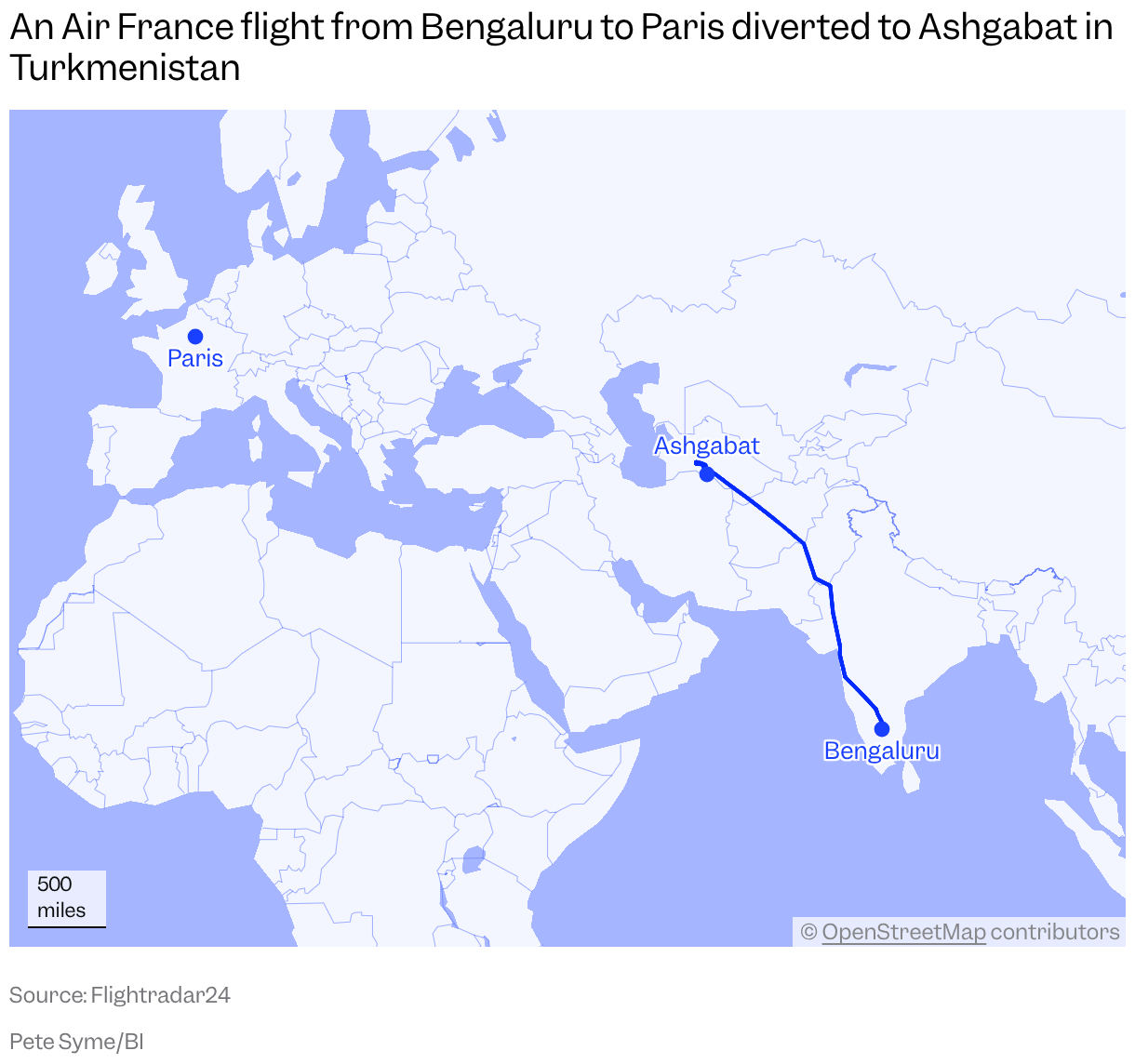
A map of the western hemisphere showing the flight path of Air France 191 which departed Bengaluru and diverted to Ashgabat.

Passengers flying to Paris spent 21 hours stranded in the remote nation of Turkmenistan

Air France passengers were delayed by nearly two days after they were diverted to Turkmenistan.

Monday’s Flight 191 was already running 21 hours late when it departed Bengaluru, India, shortly after 11 p.m., according to data from Flightradar24. It was supposed to land in Paris about 10 hours later.

However, four hours into the journey, the Boeing 777 started descending. It made a U-turn to land in Ashgabat, the capital of Turkmenistan, a sparsely populated nation in Central Asia.

Registered as F-GSPI, the jet is 26 years old. The cause of the diversion has not been confirmed, though The Independent reported that the plane suffered an engine issue.

Passengers then had to wait nearly another whole day to continue their journey to Paris. Turkmenistan is ruled by what Human Rights Watch has described as a totalitarian, hereditary government and is one of the world’s most politically secluded countries.

Air France did not respond to a request for comment sent by Business Insider.

Given that the flight departed from India, there were a number of Indian nationals on board, who were hosted by the nation’s consulate in Turkmenistan. It is unclear where the majority of the passengers on the flight stayed during their time in Ashgabat.

Ultimately, a new aircraft was dispatched to collect the passengers. Flight-tracking data shows another Air France Boeing 777 left Paris on Tuesday morning and arrived in Ashgabat after a five-hour flight.

It spent about three hours on the ground before departing Turkmenistan shortly after 1 a.m. That’s nearly 22 hours after the passengers first arrived there.

The plane then landed in the French capital at 3:23 a.m. on Wednesday. Along with the departure delay, that’s 43 hours later than passengers initially expected to get there.

Flight-tracking data appears to show that the original plane is still on the ground in Ashgabat as of Thursday morning, three days after it landed there.

This wasn’t the first time that Air France has sent a plane to rescue stranded passengers.

In May 2024, one of its Boeing 787s was flying from Paris to Seattle when a burning smell was detected in the cabin.

The pilots declared an emergency and diverted to Iqaluit, the capital of Canada’s Nunavut territory. A different flight was canceled so a Boeing 777 could take the passengers to New York.


Source link

A map of the Caribbean with icons on each airport that had flights canceled on January 3, 2026, adjusted for size based on the number

Maps show the scale of the Caribbean air travel chaos — and how airlines are adding extra flights to rescue passengers

Almost 1,000 flights to and from the Caribbean were canceled on Saturday after the US raid on Venezuela.

The Federal Aviation Administration banned commercial aircraft from flying over Venezuelan airspace before expanding restrictions to much of the Caribbean.

Puerto Rico was the most affected, with 400 flights canceled to or from the main airport in San Juan.

There were also over 140 cancellations in the US Virgin Islands, and 91 in Aruba, which is only about 20 miles off the Venezuelan coast.

Using data from FlightAware, Business Insider put together this map to show the scale of the disruption. You can hover over an icon to see the number of cancellations at the airport.

After airspace restrictions ended early Sunday, airlines added dozens of extra flights to help passengers get where they needed to go.

The region is a particularly popular destination for vacationers seeking some winter sun over the New Year holiday.

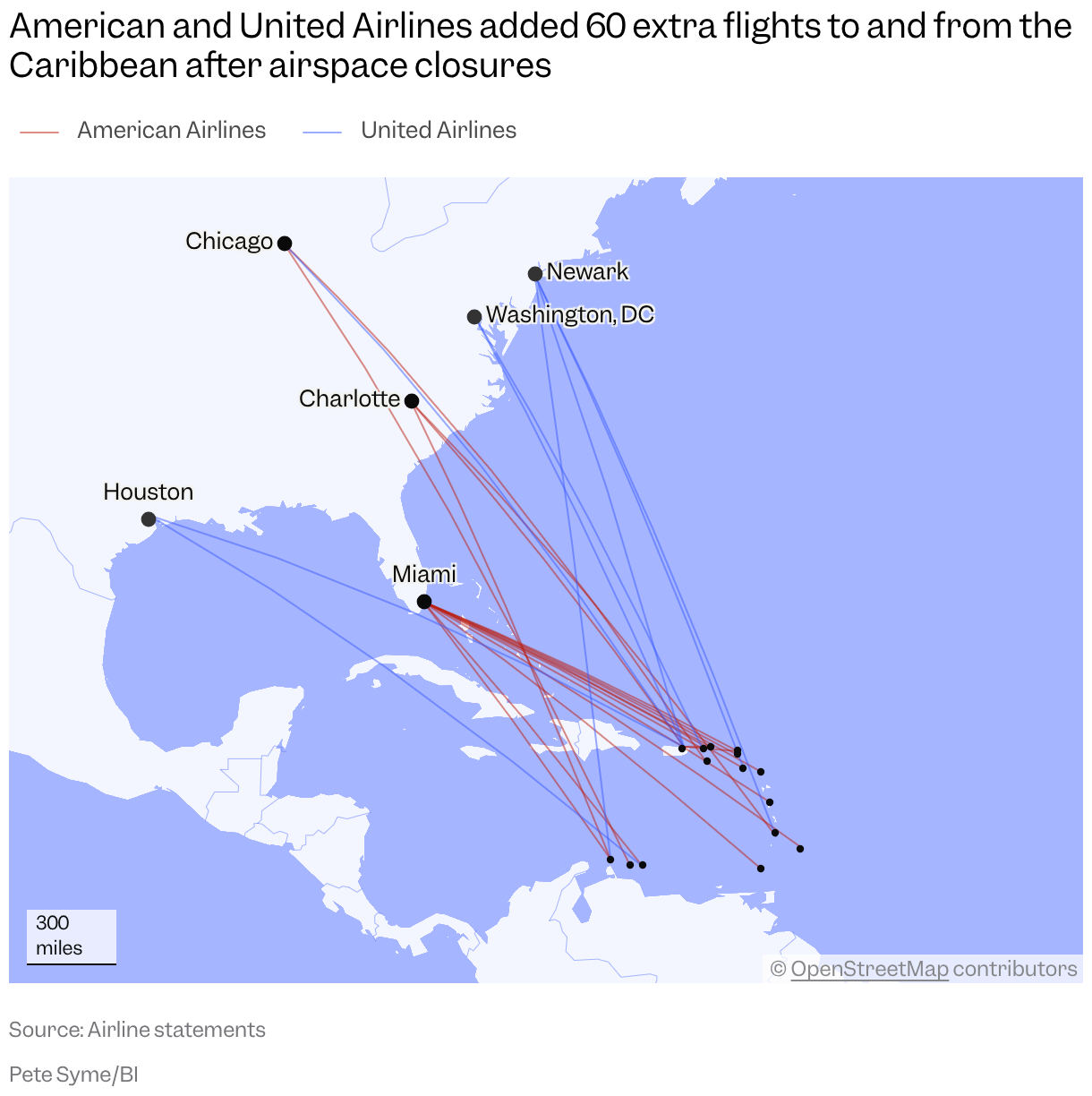
American Airlines added 43 extra flights on Sunday and Monday, with room for 7,000 passengers.

For the first time in over a decade, it operated interisland flights in the eastern Caribbean on Monday. Namely, to Puerto Rico from Anguilla and the British Virgin Islands.

American’s expanded schedule included deploying a Boeing 777-300, the largest model in its fleet, to ferry passengers between Miami and Puerto Rico.

United Airlines listed 17 additional flights scheduled for Sunday and Monday, to and from its hubs in Houston, Newark, and Washington, DC.

Delta Air Lines said that it has added space for 2,600 people on Monday. It didn’t immediately provide details of the extra flights it has scheduled.

Airlines have waived change fees and fare differences for passengers flying to or from the Caribbean, to rebook for flights later in the month.

Have you been affected by the travel disruption in the Caribbean? Reach out to this reporter at psyme@businessinsider.com or via Signal at syme.99


Source link