Alice Tecotzky

Visa is winning the AI race in payments, but the question is whether it will pay off

Visa is winning the AI race in the payments industry, according to a brand new ranking — but no company is revealing quite how much the technology is paying off.

A brand-new index from Evident, a company that tracks AI in finance, lists Visa as no. 1 among 12 global payments companies. Mastercard and PayPal follow in second and third place. Fintech giants like Stripe and Block rank fifth and sixth on the index, demonstrating how quickly newer players have built serious AI firepower.

“With relatively nascent industry players like Stripe and Block performing well — and showing their AI potential reflected in their valuations — the Index leaders cannot afford to drop off the pace,” Alexandra Mousavizadeh, co-founder and co-CEO, said in a press release.

Payment companies — which move money around between banks, businesses, and consumers — run on technology. Evident’s new industry ranking, released Wednesday exclusively to Business Insider, reveals how the companies we interact with every day are using AI, from deciding whether a transaction goes through to detecting fraud.

Whether ranked No. 1 or dead last, all of the companies have at least one thing in common: none have published their achieved or projected ROI across all their AI efforts. By comparison, 10 of the 50 banks that Evident tracks already share those figures.

“The absence of ROI disclosure — or any group targets for AI ROI — is increasingly conspicuous,” Annabel Ayles, co-founder and co-CEO of Evident, said. To justify their expenses, the market will “sooner or later demand clearer evidence of value.”

Together, the dozen companies documented almost 100 AI use cases over the past two years, but the top three punch above their weight — they were responsible for more than half of the use cases recorded in the index. Visa and Mastercard are particularly advanced in using AI for fraud detection and cybersecurity.

Visa, in its 2025 annual report, acknowledged AI competition, noting that some competitors will beef up their products and others will offer employees AI tools.

“If we do not continue to invest in developing and supporting our AI-based initiatives, we may fall behind technological developments,” the report said.

Visa has invested more than $3.5 billion in AI and data over the past decade and employs more than 2,500 technologists working on innovations, including over 300 AI models in production, chief data officer Andres Vives told Business Insider in a statement.

Top firms staffing up aggressively

The index doesn’t focus on specific use cases; instead, it evaluates companies on four criteria: talent, innovation, leadership, and transparency.

Talent has the biggest impact on each company’s ranking, and the report found that the payments industry overall is investing heavily in AI and data hiring. Compared to other financial institutions, the index found that they have 30% more AI-focused workers, even though they generally have smaller workforces. Among the 12 ranked companies and their more than 335,000 employees, an average 6.5% are focused on AI, Mousavizadeh told Business Insider. That 6.5% figure, she added, is the highest concentration of AI talent Evident has found across the sectors it tracks.

PayPal alone accounts for 18% of the AI talent among the indexed companies and employs more than 4,000 AI workers. Stripe and Block also stand out for their density of AI employees, who make up more than 10% of their total workforce.

Payments companies aren’t alone, of course, in focusing on AI talent — technologists specializing in AI are among the most in-demand jobs in the broader financial sector.

The gap in ROI transparency

Leaders at bulge-bracket banks are already facing questions about when they will see AI investments pay off—analysts, for example, pressed JPMorgan leaders on the merits of the bank’s massive technology spending during a recent earnings call. Jamie Dimon, the bank’s CEO, acknowledged tech competition from fintechs on that call, and again from payments companies during the investor conference in February, name-dropping Stripe and PayPal.

For now, AI’s benefits at payments companies are often baked into existing performance measures, such as lower transaction costs, according to the index.

But there are still demands to stay competitive. Evident found that agentic capabilities will likely play a bigger role as companies move from using AI for “defensive necessity to strategic advantage.” (Both PayPal and Mastercard teased AI agents in recent earnings calls, and Visa mentioned the potential of agentic commerce during its fourth-quarter earnings call.)

Overall, Evident found that the payments companies that moved fastest on AI are furthest along in their journeys, and the next competitive milestone may be in financial transparency: the first one to publish comprehensive ROI measures will become another type of “first-mover.”


Here’s the full ranking:


Source link

Polly Thompson

Dell is rolling out a new sales pay structure. Some employees worry it’ll slash their income.

Dell has kicked off its new financial year with a shakeup to how sales staff get paid.

Under the new structure, Dell is increasing rewards for high performers but scaling back earnings for sellers who fall short of their full quota, according to an internal presentation viewed by Business Insider. The tech giant is also tightening the periods over which it measures sales progress to a quarterly basis, rather than twice a year.

The presentation was shared with sales employees in a town hall meeting on February 3, led by Kyle Leciejewski, Dell’s senior vice president of North America sales.

The changes affect sales staff across both of Dell’s key divisions: the Infrastructure Solutions Group (ISG), which sells data center hardware and other AI-related solutions, and the Client Solutions Group (CSG), which sells PC hardware.

The change at Dell mirrors a shift happening across much of Big Tech, where companies have been leaning into a hardcore culture that elevates high performers, penalizes those who miss the mark, and disregards long-held views of workplace loyalty.

The move is “designed to reward you for driving profitable growth, expanding our footprint, and winning market share for Dell,” the company told staff in the presentation.

“We are always assessing our business to remain competitive and ensure we are set up to deliver the best innovation, value, and service to our customers and partners,” Dell told Business Insider.

No commission under 60% of sales targets

Dell sales employees are paid through a mix of guaranteed base salary and a commission-based payment, known as their “target incentive.” The presentation used an example of an employee paid on a 60/40 mix, meaning 60% of their compensation was the salary, and the rest was the target incentive.

Under the previous salary structure, sellers who achieved between 0 and 100% of their sales target received the corresponding portion of their target incentive, according to the presentation. If they hit 80% of their goal, they got 80% of the payout; if they hit 50% of the goal, they got 50% of the payout.

The target incentive doubled for those who hit 100% to 200% of their targets.

Under the new changes, sellers who come in below 60% of their target get no commission.

For those who achieve between 60% and 100% of target, here’s the new pay structure:

  • At 70% of goal, employee gets 25% of target incentive
  • At 80% of goal, employee gets 50% of target incentive
  • At 90% of goal, employee gets 75% of target incentive
  • At 100% of goal, employee gets 100% target incentive

For top performers, the incentives just got better.

Sales workers who hit between 100% and 150% of their targets will now receive commissions worth three times the agreed target incentive portion of their salary, the presentation shows. That marks a 50% increase on what they’d previously received.

Quarterly targets

Dell is also moving sales teams to quarterly targets, according to the presentation.

Small and medium business teams already worked to quarterly targets, but now enterprise, large enterprise, DTS, AI Select, and Dell’s telecom business will move from a twice-yearly compensation plan to quarterly quotas.

According to the presentation, the decision to move to quarterly targets is linked to the company’s upcoming modernization push. As Business Insider first reported, Dell is overhauling its internal systems on May 3 to help streamline internal operations for the AI future — an initiative it is calling One Dell Way.

Dell could adjust the quota cadence in the second half of the financial year, the presentation said: “We will revisit the quota cadence and take the learnings from Q1 and Q2 to inform the decision about 2H.”

Some employees fear pay cuts

Five Dell sales employees who spoke to Business Insider about the pay structure changes said the adjustments were causing frustration and fear among some employees that their take-home pay could drop.

A data center sales rep told Business Insider that for the last three years, they had consistently hit 70% to 80% of their quota, so they were looking at a 20% reduction in their take-home pay unless they could sell more.

All five employees said that hitting 100% of a target would become harder in the new quarterly timeframe. Their reasons included that quotas had risen over the last two years, industry supply chain shortages were slowing sales cycles, and, in certain divisions, such as federal accounts, lead times were long.

Low morale

Employee dissatisfaction at Dell has been growing companywide in recent years amid layoffs and RTO mandates. The company’s employee satisfaction score — known as the employee net promoter score, or eNPS, has declined by almost 50% in two years.

In 2024, Dell’s sales teams received a 5-day RTO mandate months before the rest of the company, and last December, Business Insider reported that leaders were cracking down on attendance.

Sales staff are also dealing with tougher selling conditions amid an industry-wide shortage of memory chips. Along with most competitors, Dell raised prices on many of its products in December.

“Global memory and storage supply are tightening fast,” Dell warned its go-to-market team members in an email viewed by Business Insider. The company told its sellers to “move decisively” ahead of the price increases to “protect value for our customers and for Dell.”

On the back of the AI boom, ISG sales have been strong — revenue was up 29% in Dell’s last full financial year — but annual revenue has fallen for three consecutive years in the CSG division. In July 2025, Dell’s COO and vice chair Jeff Clarke stepped in to handle day-to-day leadership of CSG.

In a memo about One Dell Way last month, Clarke told Dell staffers to get ready for big changes.

“This is the biggest transformation in company history,” Clarke said. “I know there will be challenges, and that’s OK—we’re here to support you and work through this together.”

Have a tip? Contact this reporter via email at pthompson@businessinsider.com or Signal at Polly_Thompson.89. Use a personal email address, a nonwork WiFi network, and a nonwork device; here’s our guide to sharing information securely.


Source link

Chong Ming Lee, Junior News Reporter at Business Insider's Singapore bureau.

Anthropic says it will pay 100% of the grid upgrade costs tied to its AI data centers

Anthropic says it’s going to foot the bill for electricity price increases tied to its data centers.

“We will pay for 100% of the grid upgrades needed to interconnect our data centers,” Anthropic said in a blog post published Wednesday, adding that it will absorb costs that might otherwise be passed on to American households.

Anthropic said it will secure additional power to avoid pushing up electricity prices and invest in “grid optimization tools” designed to reduce strain and keep prices low.

“The country needs to build new data centers quickly to maintain its competitiveness on AI and national security,” Anthropic said. “But AI companies shouldn’t leave American ratepayers to pick up the tab.”

Anthropic’s pledge comes months after the company said it is investing $50 billion in AI infrastructure in the US, beginning with data centers in Texas and New York.

Tech giants are pouring staggering sums into AI infrastructure as they race to expand data center capacity, a buildout that has drawn scrutiny over rising electricity costs.

In November, Meta said it would invest $600 billion in the US “to support AI technology, infrastructure, and workforce expansion.” Apple said in August it would add another $100 billion to its US infrastructure spending, bringing its total investment to $600 billion.

Meanwhile, utility bills are climbing. Electric and gas utilities sought $31 billion in rate increases from state regulators last year, more than double the $15 billion requested the year before, according to a study published last month by PowerLines, a nonprofit that advocates for utility customers. Many utilities have cited power demand from data centers as the key factor for rate increases.

President Donald Trump has urged Big Tech to prevent data centers from pushing up electricity costs.

“I never want Americans to pay higher Electricity bills because of Data Centers,” Trump wrote last month in a post on Truth Social.

The “big technology companies who build them,” the president said, “must pay their own way.”

Microsoft last month introduced similar measures, saying it would pay utility rates high enough to cover the cost of its data centers’ electricity use and reduce the impact of its data center expansion on local residents.


Source link

Instagrams-top-exec-grilled-about-his-pay-at-social-media.jpeg

Instagram’s top exec grilled about his pay at social media addiction trial

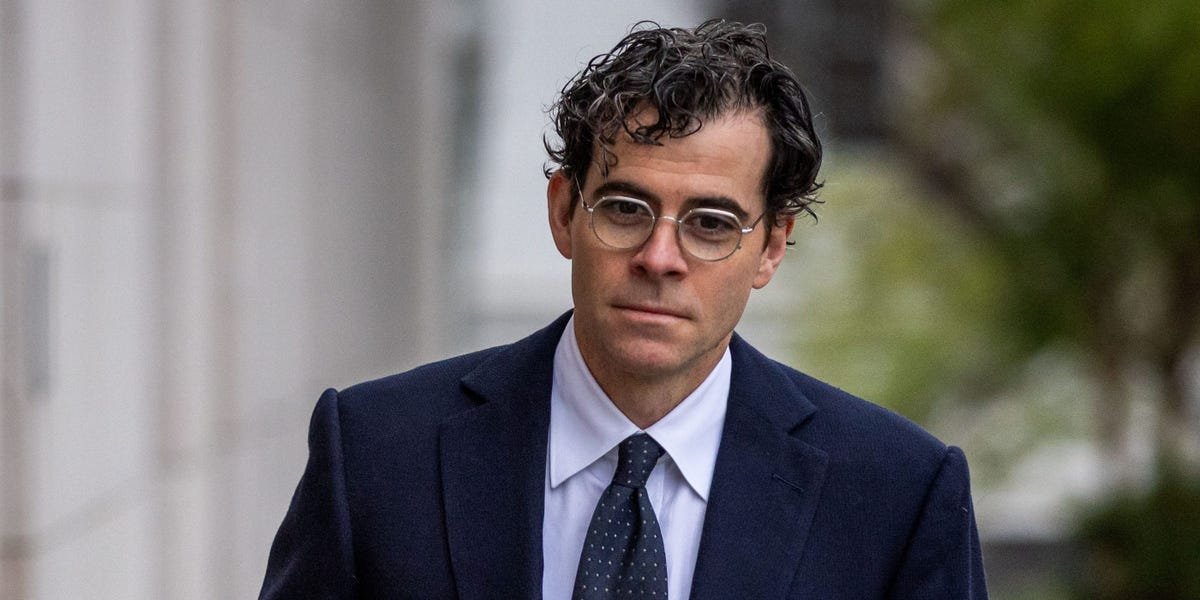
Adam Mosseri’s multimillion-dollar pay package took center stage on Wednesday as lawyers sought to link Meta’s profits to platforms that addict children.

As the first of several tech executives to testify in a social media addiction trial playing out in Los Angeles state court, the head of Instagram said he is paid roughly $900,000 a year and receives annual performance-based bonuses that can be as high as half of his salary.

Like many executives of publicly traded social media companies, Mosseri, who’s been head of Meta’s Instagram since 2018, also earns stock-based compensation.

From the witness stand, Mosseri said that his stock-based pay varies year to year but that it has been in the “tens of millions of dollars.” Some years, he said, he believes it’s been over $20 million.

Mosseri made the comments while being questioned in Los Angeles Superior Court over a lawsuit that argues Meta and YouTube knowingly engineered their platforms to addict and cause harm to kids. Snap and TikTok were also named in the lawsuit but settled before trial for undisclosed amounts.

Mark Lanier, the attorney representing the plaintiff, pressed Mosseri on how the company determined its policy on cosmetic filters, such as filters that alter users’ appearances, which was a key topic in court on Wednesday. He brought up Mosseri’s compensation again while asking whether banning filters could have hurt Mosseri’s bottom line by limiting the company’s growth.

“I was never worried about this affecting our stock price,” Mosseri said in court.

Meta declined to comment about Mosseri’s compensation.

The lawsuit centers on a 20-year-old woman, identified by the initials KGM, who says her use of social media throughout her childhood negatively affected her mental health, contributing to depression and suicidal thoughts.

The case is considered a bellwether trial that could indicate how other similar lawsuits related to social media addiction might play out.

“We strongly disagree with these allegations and are confident the evidence will show our longstanding commitment to supporting young people,” Stephanie Otway, a Meta spokesperson, told Business Insider. Otway said the company has been making ” meaningful changes—like introducing Teen Accounts with built-in protections and providing parents with tools to manage their teens’ experiences.”


Source link

Lloyd Lee

Savannah Guthrie says family ‘will pay’ for their mother’s return in video plea to possible kidnapper

Savannah Guthrie has made a direct plea to her mother’s potential abductor: “We will pay.”

In a new, 20-second video posted on her Instagram account on Saturday, Guthrie said her family had received someone’s “message” and were begging for the return of her mother, Nancy Guthrie, 84, who has been reported missing since Sunday.

“We received your message, and we understand,” Guthrie said, sitting between her two siblings in the video. “We beg you now to return our mother to us so that we can celebrate with her. This is the only way we will have peace. This is very valuable to us, and we will pay.”

Guthrie did not identify a specific individual. It’s also unclear what message Guthrie was referring to.

The Pima County Sheriff’s Department and the FBI said in a statement on Friday that they were aware of a new message regarding Nancy Guthrie.

“Investigators are actively inspecting the information provided in the message for its authenticity,” the sheriff’s department wrote.

A spokesperson for the Pima County Sheriff’s Department did not immediately respond to a request for comment. An FBI spokesperson said the agency did not have further information to provide.

There have been reports of multiple ransom notes. Federal officials arrested a California man on Thursday, accusing him of sending a fake ransom note to the Guthrie family.

Officials have not identified a suspect but have said that the incident may have involved a kidnapping or abduction.

Guthrie’s mother was last seen at her home located just outside Tucson.

Authorities said blood confirmed to belong to the elder Guthrie was found on the porch, and the doorbell camera had been disconnected, leaving investigators without crucial evidence.

Her daughter, a veteran news anchor of nearly three decades, said that her mother’s health is “fragile” and requires daily medication.

“We are ready to talk. However, we live in a world where voices and images are easily manipulated,” the younger Guthrie said in a video posted on Wednesday. “We need to know, without a doubt, that she is alive, and that you have her. We want to hear from you, and we are ready to listen. Please, reach out to us.”


Source link

Im-a-millionaire-living-in-California-Im-happy-to-pay.jpeg

I’m a millionaire living in California. I’m happy to pay higher taxes since I have more wealth — it just makes sense.

This as-told-to essay is based on a conversation with Scott Ellis, a 55-year-old millionaire who lives in Silicon Valley, about California’s proposed 5% billionaire wealth tax. Ellis is a member of Patriotic Millionaires, a collection of wealthy Americans who advocate for a fair tax system, a livable wage, and equal access to political power. The following has been edited for length and clarity.

I never thought I’d live in California. I grew up in Colorado, went to college in Boston, and lived in Texas. I came out here for business school because I wanted to be at Stanford, and because you could play golf during the winter.

Now I love it here. It has nothing to do with taxes; taxes have never been anywhere on our list of criteria for deciding where to live. I want to live where my family is and love the weather, the jobs, and the dynamism.

Taxes are the price that we pay to live in a civil society. We have to do this together. There are examples all around the world of the power of effective government, and just like anything else, government needs to be funded. We should make it effective and efficient.

I’m proud to pay the taxes I pay. I should pay taxes that are higher than other people because I have more wealth than other people — that makes sense.

My wife and I achieved financial success in our careers

A lot of our financial success has been due to my wife’s success, as well as mine at the beginning of our careers.

I went to Harvard undergrad, worked at McKinsey for three years, and then went to Stanford. I then worked at Hewlett-Packard for almost eight years.

In 2007, my wife was a VP at Yahoo and we had two small kids. I looked at my boss’s job, and at the CEO’s job, and decided I didn’t ever want those roles. I thought, “Uh-oh, I’m on this ladder, and it’s not really where I want to go.”

Ultimately, my wife and I decided that I would step back and be the stay-at-home parent. My wife continued her career, and she’s been very successful in consumer internet at Yahoo, Google, and Pinterest.

I developed an interest in social issues in college

I studied poverty, urban America, housing, transportation, and sociology in college, and started thinking more about questions like: What does fairness look like? What does justice look like? What would it look like to build a great society?

I got busy pursuing my career, meeting my wife, and raising our kids, but as time passed and we progressed in our careers, I got back into thinking about how we help others around us. I did a bunch of volunteer work in different contexts, eventually becoming the COO and then the CSO of a nonprofit called New Teacher Center, which does intensive mentoring programs for new teachers.

Since 2012, I’ve started and run several nonprofits in the education space, and advised almost 200 individuals and organizations on things like strategy, finance, operations, and culture.

I’m also really focused on addressing excessive wealth and its impact on society and thinking about a future vision for American democracy, which is how I came to Patriotic Millionaires, an organization of wealthy Americans who advocate for higher taxes on wealthy people like ourselves, a higher minimum wage, and a broader distribution of political power across our society.

I’ve been struck by the massive accumulation of wealth

In recent years, I’ve been struck by the massive accumulation of wealth enabled by the consumer internet space, globalization, and the structure of the finance industry. It’s different from what it used to be in the ’80s and ’90s; this is a whole new ballgame.

More recently, I’ve been looking around Silicon Valley at all these people who are so incredibly wealthy, talented, and successful, and realizing how few of them are thinking about choosing to build a better society together.

They’re excited about starting new companies and raising new funds, but these are all people who have more money than they could ever spend, and their next goal is to generate even more money, mainly for people who already have more money than they could ever spend.

Meanwhile, 10% of our society is in poverty. It really feels unfair and wrong, and we can do better.

People don’t need more than $30 million

The proposed billionaire wealth tax in California doesn’t impact me and my family directly. People may think, “You’re happy to raise taxes on other people.”

But we need to start with a different conversation, about how much wealth is enough, how much wealth is too much, and what is financial success?

I believe that if you have $30 million in wealth, congratulations, you won capitalism. If you do the analysis of reasonable investment returns and inflation, you can buy a really nice first house, a nice second house, your kids’ college is paid for, your end-of-life expenses are covered, and you have a very, very luxurious ongoing existence.

So much of success in life is luck. Yes, people absolutely get educated and work hard. But it’s been found that the wealthier people are, the more they tend to attribute their wealth to how good they are and how hard they worked.

I look at single moms working three jobs, working the night shift — a heck of a lot of people who have less than $190,000 [the median household wealth] in wealth are working very hard.

Once you get beyond $30 million — and almost no one ever gets there — you get to a point where your life is so good, you really can’t materially improve your life anymore. We should implement a very aggressive annual 50% tax on all household wealth over $30 million. Excessive wealth turns into excessive power through huge campaign donations, which threatens and undermines democracy and capitalism.

The wealth tax is a step in the right direction — but not enough

I’m absolutely delighted that we’re moving in this direction, but I believe changes to wealth taxes need to happen at the federal level.

When wealthy folks bring up moving out of California, it’s a distraction. All of a sudden, instead of us talking about the fact that millions of people are going to be either losing healthcare or paying much more for healthcare, we’re worried about the 200 really rich people who might move.

People move all the time. Companies move all the time for all kinds of reasons — it’s just part of business. These conversations happen all the time — like, “Oh my gosh, there won’t be any more companies in Silicon Valley.” Well, 20 years later, look around. There are still some companies here; it’s just fine.

It’s 65 degrees and sunny here. The CEO of Nvidia recently said they’ll be staying in California because that’s where the talent is. We’ve got the Golden Gate Bridge, Hollywood, Tahoe, the Redwoods, the beach, and great weather. I’m really not worried that people aren’t going to want to live in California.

I love it here. My wife and I are thinking about living in different cities for maybe a month at a time, but I have no plans to go anywhere else. Although I definitely love Colorado — I still have my Denver Broncos coasters and will be cheering for my Broncos — I’m from Silicon Valley now, and that’s where I’m going to stay.


Source link

Madeline berg on grey background

Trump wants to cap defense CEO pay. Here’s how much they make now.

President Donald Trump is targeting the bank accounts of defense contractor CEOs.

On Wednesday, Trump signed an executive order outlining new rules for defense contractors that would ban stock buybacks and dividends “until such time as they are able to produce a superior product, on time and on budget” — as well as limit executive compensation.

The order stipulates that in future contracts, if the Secretary of War were unsatisfied with a company’s performance, executive base salaries would be capped at current levels. Future contracts would also ensure compensation “not be tied to short-term financial metrics” and instead be “linked to an on-time delivery, increased production, and all necessary facilitation of investments and operating improvements.”

The goal, per the executive order, is to increase the speed of innovation at defense companies, rather than focus on corporate profits.

Trump also took aim at the leaders of defense contractors in a series of posts on Truth Social on Wednesday.

“Executive Pay Packages in the Defense Industry are exorbitant and unjustifiable given how slowly these Companies are delivering vital Equipment to our Military,” Trump wrote. “Salaries, Stock Options, and every other form of Compensation are far too high for these Executives.”

He proposed that no executive should earn “in excess of $5 million” until their production speed and maintenance improve, though the executive order did not cap pay at that exact amount.

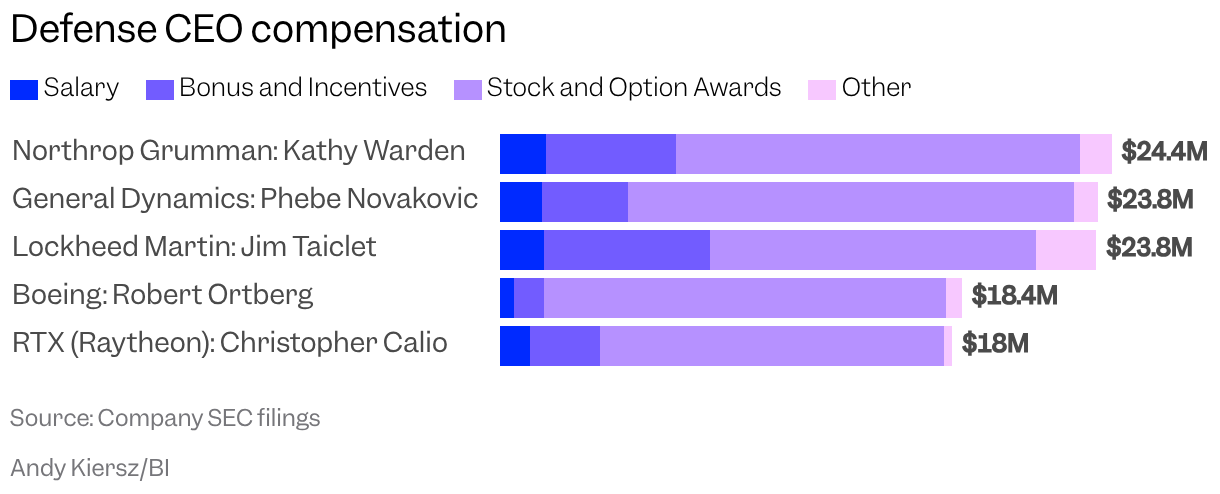
The leaders of the big five defense contractors — Lockheed Martin, RTX (formerly known as Raytheon), Northrop Grumman, Boeing, and General Dynamics — each earned more than $18 million in total compensation in 2024, the most recent year for which data is available. Their total income was a combination of salary, incentives, stock options, and other forms of compensation, including the value of security services and changes in the value of pension funds.

While exceeding the $5 million cap proposed by Trump by magnitudes, the CEOs’ compensation pales in comparison to that of some other business leaders.

Dozens of CEOs earned more than them in 2024. James Robert Anderson, who runs materials manufacturer Coherent, had a pay package of more than $100 million last year. The CEOs of Starbucks, GE, and Microsoft each made more than $75 million.

Executive pay and stock transactions are part of Trump’s larger plans for the military. On Wednesday evening, he said on Truth Social that America’s military budget should be increased to $1.5 trillion in 2027, up from the record 2026 defense budget of $901 billion.

That sent defense stocks climbing on Thursday morning, gaining back what they’d lost following the signing of the executive order.

In a statement to Business Insider regarding the order, a spokesperson for Lockheed Martin said the company “shares President Trump’s and the Department of War’s focus on speed, accountability, and results, and will continue to invest and innovate at scale to ensure our warfighters maintain a decisive advantage and are never sent into a fair fight.”

Boeing and General Dynamics declined to comment, and Northrop Grumman and RTX did not immediately respond to requests for comment.


Source link

19-states-just-raised-their-minimum-wage-See-which-states.jpeg

19 states just raised their minimum wage. See which states pay the most.

Minimum wage is up in 19 states starting January 1, affecting over 8 million workers.

Washington, D.C., has the highest minimum wage in the US at $17.95 per hour, while 20 states still either mandate $7.25 or default to the federal line.

Business Insider listed the minimum wage in each state, from highest to lowest. We bolded the states where wages increased starting January 1, 2026.

$17.00/hour or more

Washington, D.C.: $17.95

Washington: $17.13 (increased from $16.66)

New York: $17 (increased from $16.50)

*The minimum wage applies only in New York City, Nassau County, Suffolk County, and Westchester County.

$16/hour — $17/hour

Connecticut: $16.94 (increased from $16.35)

California: $16.90 (increased from $16.50)

Hawaii: $16.00 (increased from $14)

Oregon: $16.30 or $15.05 or $14.05

*The standard minimum wage in Oregon is $15.05 per hour. The minimum wage in the Portland metro area is $16.30 per hour, and the minimum wage in nonurban counties is $14.05 per hour.

New York: $16.00 (increased from $15.50)

*The minimum wage outside New York City, Nassau County, Suffolk County, and Westchester County.

Rhode Island: $16.00 (increased from $15)

$15/hour — $16/hour

New Jersey: $15.92 (increased from $15.49)

*The minimum wage for employers who employ fewer than six people and employees engaged in seasonal employment in New Jersey is $15.23 per hour.

Colorado: $15.16 (increased from $14.81)

Arizona: $15.15 (increased from $14.70)

Maine: $15.10 (increased from $14.65)

Delaware: $15.00

Illinois: $15.00

Massachusetts: $15.00

Maryland: $15.00

Missouri: $15.00 (increased from $13.75)

Nebraska: $15.00 (increased from $13.50)

$10/hour — $15/hour

Vermont: $14.42 (increased from $14.01)

Florida: $14.00

Michigan: $13.73 (increased from $12.48)

Alaska: $13.00

Virginia: $12.77 (increased from $12.41)

New Mexico: $12.00

Nevada: $12.00

South Dakota: $11.85 (increased from $11.50)

Minnesota: $11.41 (increased from $11.13)

Ohio: $11.00 (increased from $10.70)

*Ohio employers with annual gross receipts under $405,000 must pay no less than $7.25 per hour.

Arkansas: $11.00

Montana: $10.85 (increased from $10.55)

*A Montana business not covered by the federal Fair Labor Standards Act whose gross annual sales are $110,000 or less may pay $4.00 per hour.

$7.25/hour – $10/hour

West Virginia: $8.75

Iowa: $7.25

Idaho: $7.25

Indiana: $7.25

Kansas: $7.25

Kentucky: $7.25

North Carolina: $7.25

North Dakota: $7.25

New Hampshire: $7.25

Oklahoma: $7.25

Pennsylvania: $7.25

Texas: $7.25

Utah: $7.25

Wisconsin: $7.25

No minimum wage or under $7.25/hour

Alabama

Georgia

Louisiana

Mississippi

South Carolina

Tennessee

Wyoming


Source link

Will-Amazon-and-Walmarts-push-for-30-minute-delivery-actually-pay.jpeg

Will Amazon and Walmart’s push for 30-minute delivery actually pay off? We debate.

The ultrafast delivery wars are heating up.

Amazon said last week that it’s testing a 30-minute delivery option in Seattle and Philadelphia, while Walmart said it managed to fulfill a Black Friday order in 10 minutes and is expanding its drone service to the Atlanta area.

The race is on to get online orders to shoppers’ doorsteps as fast as possible, but we can’t help but wonder as companies pour money into the infrastructure to support it: Is 30-minute delivery overhyped or under-appreciated?

Business Insider’s senior retail reporters Alex Bitter, who primarily covers gig work apps and groceries, and Dominick Reuter, who mainly covers big box stores, sat down to hash it out.

Dominick: I’d say 30-minute delivery is the future. Are you saying it’s an already-failed past?

Alex: The fundamentals are not there. Unless there’s some massive other piece that we’re not seeing, I don’t get why Amazon is doing this.

Dominick: I definitely think it only works as part of a larger strategy where this service builds and strengthens customer relationships. It does not fly on its own.

Alex: A few years ago, we saw some startups try to do something very similar. You had companies like Gorillas — a German grocery delivery concept — pop up to deliver items in 15 minutes.

It was the same pitch: Is there an ingredient or two that you forgot for dinner tonight? No problem. We’ll deliver it to your door, fast.

Now, though, many of those startups either no longer exist or have scaled back significantly. Getir, an ultrafast delivery company from Turkey, left the US. Gopuff is still around and raising money, though reportedly at a lower valuation than it did during the height of the pandemic.

Grocery is already one of the lowest-margin categories in retail. With delivery this fast, you’re making it even less profitable.

To be fair, Amazon has a lot more money and experience than those startups did. But that does not change the fundamental truth that this is a challenging business model.

Dominick: Scale is everything here — the biggest players have a shot at making this successful. Even though it didn’t work out for the startups, their very existence shows the consumer demand for fast service.

But it takes such an astonishing volume of inventory to support that speed of fulfillment. Companies like Amazon or Walmart already have that inventory, which eliminates one of the biggest hurdles to making 30-minute delivery work.

It’s working in China, it’s working in India, and it’s gaining momentum in other global markets. The big challenge in the US is suburbia, but that’s solvable.

Although I will say 15 minutes is wildly unrealistic.

Alex: When we reported on the ultrafast delivery startups a few years ago, an analyst told me that a 30-minute delivery promise is more reasonable than a 15-minute one.

But Amazon already has fairly fast delivery. Not 30 minutes, obviously, but you can get orders from Amazon Fresh or Whole Foods in as little as a few hours.

Also, this is yet another grocery offering for Amazon. It feels like it has too many now. Consider Whole Foods Daily Shop, a small-format grocery store that’s designed for the same kind of fill-in trips that Amazon seems to be targeting with its 30-minute delivery option.

Dominick: When it comes to adding more stores and fulfillment centers, that’s exactly what Amazon needs to be doing, and it needs to get people going to those brick-and-mortar stores and counting on Amazon-exclusive products.

Walmart and Target are proving that having lots of physical locations can get you way closer to making these ultrafast deliveries successful. Walmart has 4,600 stores, Target has 2,000 — that counts for a whole lot.

There are 25,000 Amazon drop boxes, but those obviously can’t contain what’s in a typical Supercenter. Amazon is working on it, though.

Alex: Maybe this is Amazon figuring out how it can compete with Walmart — and Albertsons and Kroger, for that matter — without having the same store footprint. This also puts it in more direct competition with Uber Eats, DoorDash, and Instacart.

Many US consumers live in smaller towns or suburbs. I don’t think 30-minute delivery works well in those areas. People drive themselves to stores — something the retailers love because it’s cheaper for them than making deliveries.

Amazon is not yet in a lot of those areas, like it is in the densest cities in America.

I could see this 30-minute idea working in Manhattan, though people in such densely populated urban areas already have lots of options for a quick grocery run (bodegas, anyone?).

Amazon has been trying for years to boost its market share in grocery. I’m not sure this is it.

Dominick: The last thing I’ll say is I see ultrafast delivery as a key complement to the marketplace strategy that Amazon and Walmart are leaning on.

When customers need something now, that lets the company serve up an ad or some other exposure to the marketplace for a later purchase.

If Amazon and Walmart can get you to check their app first to get that missing ingredient, they could also sell you on some higher-margin product that might take a couple of days to arrive.

Alex: You need toothpaste, onions, and eggs right now, but that Christmas gift you’ve been meaning to buy can come this weekend.

Dominick: That, I think, is the reason it’s going to be these two giants driving this shift: you need to be very big to offer 30-minute delivery in the first place, and then you need to be very big to see any benefit from it as well.


Source link

Prepare-to-pay-45-at-airport-security-if-you-dont.jpeg

Prepare to pay $45 at airport security if you don’t have a REAL ID

  • The TSA announced a $45 fee for travelers without acceptable ID at airport security checkpoints.
  • The alternative identity verification system, TSA Confirm.ID is set to be implemented on February 1.
  • It’s unclear how TSA Confirm.ID will work, but it’s intended as an option for flyers without a REAL ID.

The Transportation Security Administration has taken a page from the budget airline playbook.

The agency said Monday it is implementing a new alternative identity verification system, TSA Confirm.ID, that would charge travelers $45 at security checkpoints if they show up without a REAL ID or another acceptable government-issued ID, such as a passport or permanent resident card.

The new fee option is set to begin on February 1. The TSA said the fee would cover a 10-day travel period. Details about how the fee and identity verification would work were not yet available. The TSA did not immediately respond to a request for comment.

“TSA urges all travelers who do not have a REAL ID to pay the fee online before traveling,” according to a press release about TSA Confirm.ID and the new fee. “For passengers who arrive at the airport without paying the fee, information about how to pay for the TSA Confirm.ID option will be available at marked locations at or near the checkpoint in most airports. Travelers who undergo TSA Confirm.ID processing at an airport should expect delays.”

The TSA had previously proposed an $18 fee that would cover the costs for a biometric kiosk system designed to verify a traveler’s identity more quickly than the current manual process.

Under that proposal, the TSA said the new technology would be less time and resource-intensive than the current process when a flyer lacks these IDs, which involves providing personal information or answering detailed questions to match flyers to government databases.

“This notice serves as a next step in the process in REAL ID compliance, which was signed into law more than 20 years ago,” a TSA spokesperson previously told Business Insider about the $18 fee proposal.

Congress passed the REAL ID Act of 2005 in response to the 9/11 attacks, but it just rolled out in 2025.

In May, the TSA began requiring travelers to present a REAL ID or another government-approved identification to pass through airport security checkpoints.

The TSA says 94% of flyers already use REAL ID or another acceptable form of identification.

The agency is encouraging travelers who do not have a REAL ID to schedule an appointment with their local DMV to update their ID as soon as possible. A REAL ID card shows a star inside a circle in the upper right corner.


Source link