
This-company-incentivized-office-attendance-by-paying-workers-up-to.jpeg

This company incentivized office attendance by paying workers up to $2,000 more per quarter

These days remote work is hard to come by — and at some firms, employees now risk losing equity or promotions if they don’t show up in person.

Superhuman, however, is offering extra benefits to those who show up IRL more often, rather than penalizing those who don’t.

The company — which offers a suite of AI productivity tools, including Grammarly — rolled out a system in January to reward workers who come to the office. The move followed an attempt at mandating two days in person for its engineering teams.

Superhuman has over 1,500 employees globally, and its chief people officer, Kenny Mendes, said the company has seen a 57% increase in daily attendance across all of its offices since rolling out its “Ways of Working Program,” a tiered opt-in model that lets team members choose from two- to five-day in-office plans.


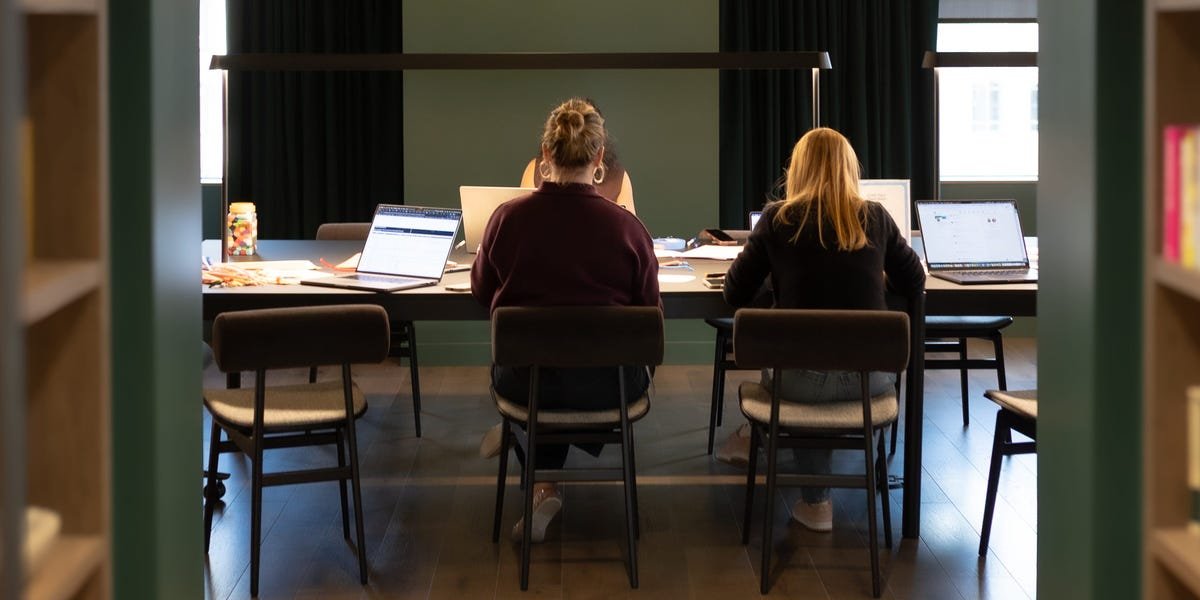
Superhuman's office in San Francisco, green room

Superhuman provides a sliding scale of perks, including commuter support, grocery stipends, childcare, meal delivery, and cleaning services. 

Superhuman


Spend more time in the office, and you get more perks, including commuter benefits and wellness stipends, which can be put toward things like childcare expenses, gym memberships, grocery delivery, and cleaning services. Those in the US who opt to work two days per week in the office get $500 per quarter in wellness stipends, and those who work five days a week get up to $2,000 quarterly.

“If you look at that as a percentage of salary relative to the impact it has on that employee — being more productive, being more engaged, solving problems faster — it’s a no-brainer spend from a company standpoint,” Mendes told Business Insider.

Initially, the company targeted its engineering, product, and design teams for a return to the office. However, interest spread across departments, and now 75% of employees near a hub have opted into a plan, with a third of those choosing to come in four or five days a week. The company has eight hubs across North America and Europe, Mendes said.

A ‘failed’ RTO attempt

When Mendes joined the company after it acquired Coda in January 2025, he said there was a push to unify policies across the combined organizations — and he was, for better or worse, handed the “RTO baton.” The CPO said there was visible “negative energy and sentiment” about the company’s two-day return-to-office mandate for engineers last April.

It wasn’t particularly effective either.

“It failed,” Mendes said. “Six months later, we were seeing low compliance, empty offices, and team members telling us point blank that coming in wasn’t worth it because no one else was there.”


Superhuman office space in San Francisco

Superhuman’s CPO said the company’s attempt at RTO last April “failed.” 

Superhuman


Mendes said the situation was frustrating to management, given that 70% of its staff lived within commuting distance to its hubs across North America and Europe. He said the RTO plan felt like filling people into an airport.

“You’re looking around and you’re like, “Yeah, I’m sitting next to this person. I really don’t want to talk to them. I just trying to get out of here as quickly as possible,'” Mendes said.

Reframing in-person work

That led Mendes to seek advice from behavioral scientist Jon Levy. Mendes said Levy led him to shift his focus to making the office so enticing that people want to come in, rather than requiring them to.

“We were pulling teeth to get people in two days a week,” Mendes said. “But could we get them to choose to come in five?”

Mendes said the new policy isn’t just about offering financial incentives. He said communication was key in the process for it to land effectively.

The effort began with Mendes and Levy hosting a fireside chat to discuss how the workplace has evolved and what the company needs moving forward, he said. Leadership emphasized that team effectiveness depends on trust and connection — and that in-person time plays a key role in that.

The company then asked teams why they were reluctant to come in. Many workers reported practical barriers, like parking costs and desk setups. Mendes said the idea wasn’t to pay people to come in — because then people naturally approach it as a cost analysis to determine whether their time is worth it. The goal, Mendes said, was to identify and eliminate friction points so coming into the office wouldn’t feel like a hassle.

The company also made other tweaks to cultivate a more social atmosphere, such as changing the desk tops from five to four feet to increase office density. It also offers daily lunch and social hours.


Superhuman's San Francisco office

Superhuman offers daily lunch and social hours to employees. 

Pixels by Mila LLC


A key question during the rollout was whether employees would stick to their chosen schedules, Mendes said. So far, the CPO said that attendance has been strong, with employees showing up 85% of the time they committed to.

“I’ve been really shocked at how well it’s working,” Mendes said.


Source link

Im-stuck-in-Dubai-after-our-flight-was-canceled-Im.jpeg

I’m stuck in Dubai after our flight was canceled. I’m paying more than $650 a night for a hotel.

This as-told-to essay is based on a conversation with Kunal Trehan, a luxury interior designer. It has been edited for length and clarity.

We arrived in Dubai on February 20th to expand our business into the UAE, fully expecting to fly home to the UK on February 28th at 10:20 p.m. local time.

On Saturday, the day we intended to leave, we decided to chill by the beach connected to our hotel. Around midday, we heard what sounded like an explosion — a very faint but deep sound. My partner and I assumed it was demolition until an hour later, when people started messaging me on WhatsApp asking if I was OK. I couldn’t understand what they were worried about.


Two men posing for photo inside a car

Kunal Trehan and his partner are stuck in Dubai after the airport closed.

Courtesy of Kunal Trehan


I quickly opened the Qatar Airways app and saw that our flight had been canceled. I started to freak out a bit, wondering if something was going on and how we would escape.

We heard more explosions

As we sat on the beach, still trying to figure out what was happening and what to do next, we could hear more explosions and see accompanying clouds of smoke in the distance. We rushed inside, with me telling my pragmatic self to stay calm and not to panic.

In the evening, more explosions could be heard. We could see the orange light of missiles racing across the sky. We didn’t know where they were being launched from or who was launching them.

I was getting increasingly nervous after looking at the news and social media online. Hotel staff told guests to come inside from their balconies and close their room curtains. Everyone obeyed.

By this point, the sky had become a large plume of smoke over the Fairmont hotel. In the lobby, people were notably panicked. It felt quite claustrophobic, unsettling.

We got emergency alerts on our phones

At midnight, my partner and I got ready to head to sleep when we heard yet another explosion. We opened our curtains, and it looked as if a missile was headed right towards us. Our phones started alarming with the emergency government message to take shelter. “What the hell do we do?” I asked my partner.


Emergency alert

Kunal Trehan received emergency alerts on his phone.

Courtesy of Kunal Trehan


Hotel staff knocked, told us to gather our passports and valuables, and to make our way to the basement. The basement was a concrete-floored area. People were perched on the ground, the elderly in chairs. The staff was doing what they could to calm people and make them as comfortable as possible, providing pillows and blankets.

Even the staff, many of whom are locals, were alarmed. They’ve told us that they haven’t experienced this before. We’ve tried to calm others, to make sure they’re OK.

For three hours, we stayed in the basement, but eventually made our way back to the room as my sciatica was flaring up. We had two hours of sleep in our room before we were woken by another explosion around 9 a.m. on Sunday.

We are advised to stay inside the hotel

The hotel has continued to advise people to stay inside — although we know we aren’t directly being attacked, we are caught in the crossfire of a war, and who knows what could fall from the sky. We’ve followed the advice given to us and done what we can to stay safe.


People sheltering in hotel

Kunal Trehan had to take shelter in the hotel’s basement.

Courtesy of Kunal Trehan


We’ve asked to move hotel rooms to a first-floor room. If our hotel gets hit, we’d rather be able to get outside quickly. My partner and I keep reminding each other that, for right now, we are relatively safe.

But whereas yesterday, I felt a sense of purpose in helping others, today, I’m feeling very flat. We are incredibly fortunate, yet completely out of control, and have no idea when we will be able to get home.

We are paying $670 a night at the hotel

Fortunately, we have the funds to continue paying for our hotel room, which is about $670 a night, and to eat and buy necessities. Our meal tonight — just mains and water — came to about $120. We haven’t been told that any of this will be reimbursed by our travel insurance company.


Man taking selfie at Dubai hotel

Kunal Trehan and his partner moved to a first-floor room in case they need to evacuate.

Courtesy of Kunal Trehan


Over and over, my partner and I speak of how lucky we are. Lucky that we are safe. Lucky that we have money to stay here. Lucky that we didn’t attempt to go to the airport. And yet, we are still so worried. So many emotions — from fear to gratitude.

Our friends and family are so worried for us — we have had hundreds of messages asking how we are. No matter how much we tell them we are safe, their worry continues, and we can hear it in their message and voice notes.

We are hoping to fly out on Thursday, but nothing is set in stone. Just another thing out of our control for now.


Source link

American-Eagles-bet-on-Sydney-Sweeney-and-Aeries-anti-AI-pledge.jpeg

American Eagle’s bet on Sydney Sweeney and Aerie’s anti-AI pledge are paying off big time

American Eagle’s marketing campaigns are giving the company a meaningful boost.

The retailer has launched a number of campaigns this year that have been at the center of viral moments online.

It looks like they’re paying off financially. Its stock has been up this year, and its total revenue was $1.4 billion for the third quarter that ended November 1, roughly 6% higher year-over-year.

American Eagle raised forward-looking guidance for the fourth quarter, and its stock rose at least 10% after hours on Tuesday.

The boost was driven by its intimates and loungewear brand, Aerie, which saw comparable sales rise by 11%. While other retailers are spending big on AI products for consumers, Aerie is making a promise not to use the technology.

Its pledge not to use AI in its ads, shared in an Instagram post, garnered tens of thousands of likes, making it the brand’s most popular post in the past year as of October, Metricool, which tracks social media engagement, told Business Insider in October.

Its success is also due in part to the star power it tapped into with Sydney Sweeney and Travis Kelce being featured in campaigns that gained traction on social media.

Sweeney’s “Great Jeans” partnership in July drew criticism online from some who said the campaign had a negative message that promoted “regressive” beauty standards. American Eagle tripled down on the campaign.

“Sydney Sweeney sells great jeans. She is a winner, and in just six weeks, the campaign has generated unprecedented new customer acquisition,” chief marketing officer Craig Brommers said in September.

In August, American Eagle released a clothing line in collaboration with NFL star Travis Kelce and his Tru Kolors brand, one day after he announced his engagement to Taylor Swift.

The two campaigns combined made up 44 billion impressions, as it attracted more customers “than ever before.”

“American Eagle launched its largest, most impactful advertising campaigns ever, which are delivering results by collaborating with high-profile partners who are defining culture,” president and executive creative director Jen Foyle said on the Tuesday call.

The brand is not done forming an all-star cast of celerity partners. The most recent campaign is with Martha Stewart, and American Eagle is betting it’ll be a hit with Gen Z customers.

“Martha Stewart resonates with Gen Z. That’s a perfect example of what we’re up to,” Foyle said.


Source link