Dario-Amodei-says-Anthropic-is-having-productive-conversations-with-the.jpeg

Dario Amodei says Anthropic is having ‘productive conversations’ with the Pentagon despite blacklist

Anthropic CEO Dario Amodei isn’t walking away from the table with the Pentagon, even as his company could sue the Defense Department.

“I would like to reiterate that we had been having productive conversations with the Department of War over the last several days, both about ways we could serve the Department that adhere to our two narrow exceptions, and ways for us to ensure a smooth transition if that is not possible,” Amodei wrote in a lengthy statement published on Thursday night.

Amodei’s statement came after the Pentagon confirmed that it formally notified Anthropic that “the company and its products are deemed a supply chain risk, effective immediately.” It means that Anthropic is effectively blacklisted after Amodei and the company refused to acquiesce to the department’s demands.

For all of the talk of reconciliation, Amodei said Anthropic is prepared to sue the Pentagon over the designation. In particular, Defense Secretary Pete Hegseth has said that the effective blacklisting means that any company that has defense contracts cannot do business with Anthropic.

“The language used by the Department of War in the letter (even supposing it was legally sound) matches our statement on Friday that the vast majority of our customers are unaffected by a supply chain risk designation,” Amodei wrote of the letter the Pentagon sent Anthropic.

Microsoft, which offers Anthropic models to its customers, said it will continue to work with the AI startup

“Our lawyers have studied the designation and have concluded that Anthropic products, including Claude, can remain available to our customers — other than the Department of War — through platforms such as M365, GitHub, and Microsoft’s AI Foundry and that we can continue to work with Anthropic on non-defense related projects,” a Microsoft spokesperson said in a statement to Business Insider.

The fight with the Pentagon has sparked interest in Anthropic, making Claude the top free app in major US app stores. Still, the standoff carries risks for the AI startup given its focus on enterprise business.

Amodei said that Anthropic continues to disagree with the Pentagon’s position on the sweeping nature of the ban.

“With respect to our customers, it plainly applies only to the use of Claude by customers as a direct part of contracts with the Department of War, not all use of Claude by customers who have such contracts,” he wrote.

Amodei also offered a public apology after The Information reported that he wrote harshly critical comments about the White House in a private memo to staff after talks with the Pentagon fell apart on Friday. In the memo, Amodei wrote that the administration didn’t like his company because he hadn’t “given dictator-style praise to Trump.”

“It was a difficult day for the company, and I apologize for the tone of the post. It does not reflect my careful or considered views,” Amodei wrote on Thursday. “It was also written six days ago, and is an out-of-date assessment of the current situation.”

Claude has shot up in popularity since Friday, but Amodei’s statement makes clear that the AI company wants to de-escalate the situation.

“Anthropic has much more in common with the Department of War than we have differences,” he wrote.




Source link

I-was-at-a-QuitGPT-protest-and-the-discontent-extends.jpeg

I was at a QuitGPT protest, and the discontent extends far beyond OpenAI’s Pentagon deal

Some people are angry with OpenAI, and it’s about more than just the company’s deal with the Pentagon.

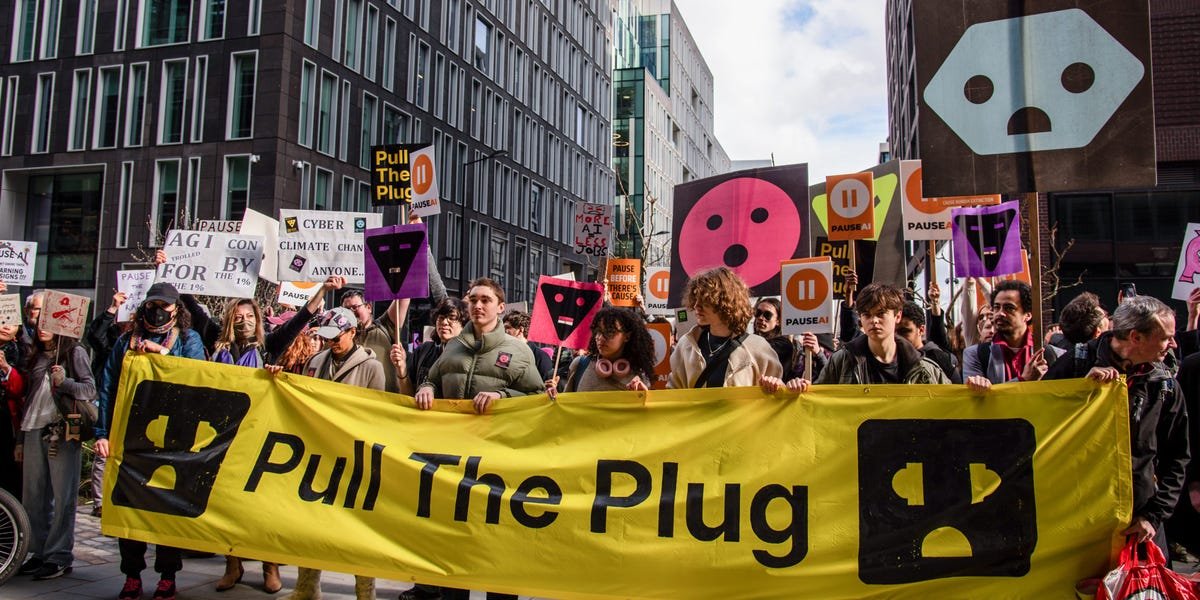
On Tuesday evening, I visited the OpenAI headquarters in Mission Bay, San Francisco, and I was met with a relatively small but energetic and diverse group of protesters, each with very different demands. This protest was part of the nascent QuitGPT movement; between 40 and 50 people attended, holding signs and chalking hundreds of slogans on the sidewalk.

OpenAI triggered widespread backlash when it signed a contract with the Pentagon on Friday, hours after President Donald Trump ordered federal agencies to halt use of Anthropic’s Claude. The negotiation between the Pentagon and Anthropic had broken down because the OpenAI rival sought contractual guarantees against mass surveillance and fully autonomous weapons, its CEO said in a statement.

The backlash against OpenAI sparked a wave of support for Anthropic, including Katy Perry, who publicly endorsed and subscribed to Claude AI. Calls to abandon ChatGPT in favor of Claude spread rapidly across social media, and the momentum showed up in the download charts. Claude shot to No. 1 in the App Store on February 28, up from sixth place.


A protester writes a message against artificial intelligence outside of Open AI headquarters in San Francisco.

Aside from OpenAI’s deal with the Pentagon, protesters have a laundry list of other grievances, including how resource-intensive data centers are and AI’s erosion of human creativity.

Manuel Orbegozo for BI


OpenAI CEO Sam Altman posted an internal memo to X on Monday and said the company is revising its contract with the Pentagon to add explicit protections, including a prohibition on surveilling US persons and nationals and a bar on use by intelligence agencies such as the NSA without a separate contract modification. Altman also acknowledged the rushed rollout in his memo, admitting the company “got things wrong” and that the deal “looked opportunistic and sloppy.” The Pentagon did not respond to Business Insider’s questions about the amended deal.

I talked to six at Tuesday’s protest, who were skeptical of the revised deal, but there were also broader concerns about AI’s rapid rise and the tech industry.

Many attendees were there for climate concerns


Protesters demonstrate against Open AI outside of their headquarters in San Francisco.

Many protesters said they were there over concerns that data center will exacerbate the climate crisis.

Manuel Orbegozo for BI


Wearing a shirt that reads “we have a right to good jobs and a livable future,” Perrin Milliken told me that she has always been a climate advocate and is here to oppose data centers, which she said are an act that puts the need for AI before human needs.

“AI is taking water from communities, polluting communities, and it is also increasing communities’ electricity bills,” Milliken said.

“They’re not even paying for it — we are,” Milliken added of tech companies.

“I want water to drink, not AI to think,” reads a sign held up by a protester.

Tech companies are becoming symbols of wealth inequality


Bill Lo collects the signs he made for the protest against Open AI which took place outside of their headquarters in San Francisco.

Many protest signs target wealth inequality and call tech billionaires “oligarchs.”

Manuel Orbegozo for BI


Sarah Gao, who took to the stage to speak, expressed disapproval of billionaires and the resources they take up.

“Sam Altman lives in a super villain’s mansion here in San Francisco,” Guo told the crowd, which immediately booed. “In a city that struggles with affordable housing, his sprawling compound features an underground to house luxury cars, an art gallery, a stand-alone spa cottage, and occupies an entire city block.”

“Sam and his billionaire buddies helped Trump with his disastrous budget bills that stole trillions of dollars from everyday Americans just to line their pockets,” Guo added.

Behind Guo, signs that call the tech industry “big trouble for humanity” and the billionaire CEOs “oligarchs” stood tall.

Some are rejecting AI entirely on principle


Megan Matson poses for a portrait after a protest against Open AI took place outside of their headquarters in San Francisco.

Meghan Matson said she refuses to participate in using AI and has always felt like AI is “bad news.”

Manuel Orbegozo for BI


When I spoke to Meghan Matson, she told me that she has completely rejected using AI and felt like it was “bad news” from the start.

“I know that AI is participating with me, but I’m not participating with AI,” said Matson.

“As soon as I saw it start showing up in visuals and imagery, I could see exactly where it heads,” Matson added. “It destroys journalism, it destroys art, it destroys the expression of our common humanity.”

“Stop AI stealing art, writing, electricity, water, jobs,” reads a large chalk writing on the street in front of the OpenAI office.

At least one participant was a tech worker unhappy with how their work is used


A protester impersonating a robot lies on the ground after demonstrating against Open AI outside of their headquarters in San Francisco.

The 26-year-old who works in the tech industry loves AI, but doesn’t approve of OpenAI’s Pentagon deal.

Manuel Orbegozo for BI


“I’m an active AI user. I love AI, and I use it every day, to write, to program, to learn,” said a 26-year-old who works in the tech industry who declined to be named.

“What I don’t want is for the technologies that my friends and I build to be used to undermine the freedom we value,” he added.

He told me that he made the robot mask yesterday with a cardboard box, black duct tape, and LED lights.

“I spent $12 on this,” he said of his robot mask. “I bet a lot more people are gonna pay attention to this than OpenAI’s next million-dollar ad.”


Source link

Heres-what-current-and-former-OpenAI-employees-are-saying-about.jpeg

Here’s what current and former OpenAI employees are saying about the company’s Pentagon deal

  • OpenAI employees are publicly discussing the company’s agreement with the Department of Defense.
  • Some have called for more clarity; others say the contract includes strong protections
  • Sam Altman said OpenAI is working with the Pentagon to amend its contract after backlash.

OpenAI employees are airing their views about the company’s deal with the Pentagon.

In posts on X over the weekend, current and former staff weighed in on whether OpenAI compromised its safety principles in negotiations with the US Department of Defense — and how the agreement compares to rival Anthropic’s stance.

Last week, Sam Altman confirmed OpenAI’s deal to give the Department of Defense access to its AI models. The agreement came after Anthropic refused to accept government terms that could have allowed its model, Claude, to be deployed for mass domestic surveillance or autonomous lethal weapons.

OpenAI said in a blog post on Saturday that its contract with the Defense Department is “better” and includes more safety guardrails than Anthropic’s original contract.

On Monday evening, following concerns around the deal, Altman said on X that OpenAI is working with the Pentagon to “make some additions in our agreement.”

Here’s what OpenAI staff have to say:

Boaz Barak

Boaz Barak, a member of OpenAI’s technical staff who works on alignment and is also a Harvard computer science professor, pushed back against the idea that OpenAI had weakened safeguards.

In a post on X on Sunday, Barak said there is a narrative that Anthropic had a “wonderful contract” blocking the US government from using it for mass domestic surveillance or autonomous lethal weapons, and that OpenAI’s deal would now unleash those risks.

“It is wrong to present the OAI contract as if it is the same deal than Anthropic rejected, or even as if it is less protective of the red lines than the deal Anthropic already had in place before,” he wrote.

“Obviously I don’t know all details of what Anthropic had before, but based on what I know, it is quite likely that the contract OAI signed gives more guarantees of no usage of models for mass domestic surveillance or autonomous lethal weapons than Anthropic ever had,” he added.

In another X post on Monday, Barak said: “The red line of not using AI to do domestic mass surveillance is not Anthropic’s red line – it should be all of ours.”

Miles Brundage

Miles Brundage, OpenAI’s former head of policy research, said in a post on X on Saturday that “in light of what external lawyers and the Pentagon are saying, OpenAI employees’ default assumption here should unfortunately be that OpenAI caved + framed it as not caving, and screwed Anthropic while framing it as helping them.”

“To be clear, OAI is a complex org, and I think many people involved in this worked hard for what they consider a fair outcome. Some others I do not trust at all, particularly as it relates to dealings with government and politics,” he added.

He later clarified on Sunday in a reply to his post that he “probably should not have said ‘caved’ in the first tweet.”

“OpenAI may very well have gotten what they wanted and, at the same time, this could have weakened Anthropic’s bargaining position since Anthropic cared about a detail OAI didn’t, and been caving from their POV,” he said.

Clive Chan

Clive Chan, a member of technical staff at OpenAI, said in a post on X on Sunday that he believes the company’s contract includes guarantees against the use of its models for mass domestic surveillance or autonomous lethal weapons. He added that he is “advocating internally to release more information” about the agreement.

“If we later learn this is not the case, then I will advocate internally to terminate the contract,” he added.

In a reply to his post, Chan acknowledged that there are likely limits on what can be publicly disclosed about defense contracts. Still, he said the company should have anticipated public concerns and prepared clearer answers in advance.

Following the publication of OpenAI’s blog post, Chan said on Sunday on X that the post “covers most” of his concerns. “Thanks to the team for being super thoughtful about the approach to this,” he added.

Mohammad Bavarian

Mohammad Bavarian, a research scientist at OpenAI, said in an X post on Monday that he doesn’t think there is an “un-crossable gap between what Anthropic wants and DoW’s demands,” adding that “with cooler heads it should be possible to cross the divide.”

The Pentagon’s designation of Anthropic as a supply chain risk is “unfair, unwise, and an extreme overreaction,” Bavarian wrote on Monday.

“Designating an organization which has contributed so much to pushing AI forward and with so much integrity does not serve the country or humanity well,” he added.

Noam Brown

Noam Brown, a researcher at OpenAI, said in an X post on Tuesday that the original language in the company’s agreement with the Department of War left “legitimate questions unanswered” — particularly around new ways AI could potentially enable lawful surveillance.

After OpenAI updated its blog post on Monday evening, Brown said “the language is now updated to address this,” but he strongly believes that “the world should not have to rely on trust in AI labs or intelligence agencies for their safety and security.”

Brown added that deployment to the NSA and other Department of War intelligence agencies would be paused to allow time to address the potential loopholes “through the democratic process before deployment.”

“I know that legislation can sometimes be slow, but I’m afraid of a slippery slope where we become accustomed to circumventing the democratic process for important policy decisions,” he wrote.


Source link

Sam-Altman-says-OpenAI-will-tweak-its-Pentagon-deal-after.jpeg

Sam Altman says OpenAI will tweak its Pentagon deal after surveillance backlash

OpenAI said it is amending its contract with the Pentagon.

After public concerns that OpenAI’s new deal with the Pentagon would allow the government to use its AI for mass surveillance, CEO Sam Altman posted an internal memo to X on Monday evening, saying that the company is working with the Pentagon to “make some additions in our agreement.”

“Consistent with applicable laws, including the Fourth Amendment to the United States Constitution, National Security Act of 1947, FISA Act of 1978, the AI system shall not be intentionally used for domestic surveillance of US persons and nationals,” Altman wrote on X.

“The Department also affirmed that our services will not be used by Department of War intelligence agencies (for example, the NSA). Any services to those agencies would require a follow-on modification to our contract,” Altman added.

Altman’s memo came after OpenAI struck a deal with the Pentagon on Friday to deploy its AI models on classified military networks. The contract stepped into a standoff between the Pentagon and Anthropic and happened just a day before the US struck Iran.

In his note, Altman said that he got things “wrong,” saying the company should not have “rushed” to seal the deal.

“The issues are super complex, and demand clear communication,” he said. “We were genuinely trying to de-escalate things and avoid a much worse outcome, but I think it just looked opportunistic and sloppy.”

Hours before the OpenAI deal was announced, President Donald Trump ordered federal agencies to halt use of Anthropic’s Claude system, following a breakdown in talks over the military use of AI. Anthropic had specific red lines: explicit contractual bans on mass domestic surveillance and fully autonomous weapons, which are systems capable of killing without human oversight.

As of Friday, nearly 500 OpenAI and Google employees signed on to an open letter in support of Anthropic’s decision.

The OpenAI deal soon triggered backlash and concerns that OpenAI’s tools would be used for domestic surveillance or for lethal autonomous weapons, claims which Altman immediately disputed. Protests took place in front of the OpenAI office in San Francisco and London, and QuitGPT, an advocacy group against OpenAI, has launched a boycott and organized a protest scheduled for Tuesday.

Anthropic did not immediately respond to a request for comments.


Source link

5-big-takeaways-from-Sam-Altmans-Saturday-night-AMA-on.jpeg

5 big takeaways from Sam Altman’s Saturday night AMA on OpenAI’s Pentagon deal

  • Sam Altman went on X on Saturday night and told users to ask him anything about OpenAI’s Pentagon deal.
  • Altman on Friday night announced that OpenAI will work with the Pentagon and let it use its AI models.
  • Here are five big takeaways from Altman’s AMA session.

Sam Altman hopped onto X on Saturday night and told users to ask him anything about OpenAI’s agreement with the Pentagon.

Altman, late on Friday, announced that his company had finalized a deal with the Department of War to use its AI models. OpenAI’s deal came after Anthropic refused an ultimatum regarding the terms of use of its frontier model, Claude, for deployment in mass domestic surveillance and fully autonomous weapons.

Here are 5 big takeaways from Altman’s AMA.

The OpenAI-Pentagon deal was ‘rushed,’ and Altman knows the ‘optics’ don’t look good

The Pentagon deal was done quickly in “an attempt to de-escalate the situation,” Altman wrote on X.

He added in a separate post that the deal had been “rushed.”

Still, the “optics don’t look good” for OpenAI, he wrote.

“If we are right and this does lead to a de-escalation between the DoW and the industry, we will look like geniuses, and a company that took on a lot of pain to do things to help the industry,” he wrote.

“If not, we will continue to be characterized as rushed and uncareful,” he wrote.

Altman added that he sees “promising signs” for where this will all land for OpenAI.

OpenAI took the Pentagon deal because it ‘got comfortable’ with the ‘contract language’

Altman was asked why the Department of War went with OpenAI over Anthropic. He said he wouldn’t speak for his competitor, but did speculate on why OpenAI got the contract inked first.

“First, I saw reporting that they were extremely close on a deal, and for much of the time both sides really wanted to reach one,” Altman wrote. “I have seen what happens in tense negotiations when things get stressed and deteriorate super fast, and I could believe that was a large part of what happened here.”

He added that OpenAI and the Department of War “got comfortable with the contractual language” as well.

“I think Anthropic may have wanted more operational control than we did,” he added.

OpenAI has 3 redlines, but it’s open to changing them as tech evolves

Altman said that OpenAI has “three redlines.” But those redlines could change — and there could be more of them put in place — as the technology evolves, and “new risks” come into play.

“But a really important point: we are not elected. We have a democratic process where we do elect our leaders,” Altman wrote. “We have expertise with the technology and understand its limitations, but I think you should be terrified of a private company deciding on what is and isn’t ethical in the most important areas.”

“Seems fine for us to decide how ChatGPT should respond to a controversial question,” he added. “But I really don’t want us to decide what to do if a nuke is coming towards the US.”

Altman says Anthropic is on a ‘dangerous’ path

Altman said OpenAI had been talking to the Department of War for “many months” about non-classified work, before “things shifted into high gear on the classified side.”

“We found the DoW to be flexible on what we needed, and we want to support them in their very important mission,” he wrote.

“I think the current path things are on is dangerous for Anthropic, healthy competition, and the US,” Altman wrote on X as well. “We negotiated to make sure similar terms would be offered to all other AI labs.”

He also asked for “some empathy” for the Department of War, given its “extremely important mission.”

And, in Altman’s words:

Our industry tells them “The technology we are building is going to be the high order bit in geopolitical conflict. China is rushing ahead. You are very behind.”

And then we say

“But we won’t help you, and we think you are kind of evil.”

I don’t think I’d react great in that situation.

I do not believe unelected leaders of private companies should have as much power as our democratically elected government. But I do think we need to help them.

Altman says AI can help counter big security threats on two fronts

Altman says AI could come in useful on two fronts. Firstly, the US’s “ability to defend against major cyber attacks,” particularly, an attack that might take down the country’s electrical grid.

Secondly, biosecurity is an area where AI could help.

“I do not think we are currently set up well enough to detect and respond to a novel pandemic threat,” Altman said.


Source link

Image of Lakshmi Varanasi

Claude hits No. 1 on App Store as ChatGPT users defect in show of support for Anthropic’s Pentagon stance

While OpenAI locks down Washington, Anthropic is locking down users and rocketing to the top of the App Store.

Anthropic has been sidelined in Washington following a public dispute with the Department of Defense over how its AI models would be deployed. President Donald Trump ordered federal agencies to phase out its technology.

Meanwhile, OpenAI has secured new ground, with CEO Sam Altman announcing in a Friday night post on X that it had reached an agreement with the Department of War to deploy AI models in its classified network.

OpenAI’s agreement has left some loyal ChatGPT users uneasy about OpenAI’s ambitions, prompting online debates about the ethical implications — and some saying they were defecting to its rival Claude.

As of 6:38 p.m. ET on Saturday, Claude ranked number one among the most downloaded productivity apps on Apple’s App Store, trailing ChatGPT.


A screencap of the app store

BI


Converts have taken to social media to share screenshots documenting their switch.

Pop musician Katy Perry wrote that she was “done” on X, alongside a screenshot of Claude’s pricing page, with a red heart around the $20-per-month “Pro” plan.

Another X user, Adam Lyttle, wrote “Made the switch,” alongside a screenshot of his email inbox with a receipt from Anthropic and cancellation confirmation from OpenAI.

On Reddit’s ChatGPT subreddit, dozens of users say they’ve deleted their accounts and are urging others to do the same.

“Cancel ChatGPT” has become a common refrain online, while some users have taken a more personal tone, saying Altman’s move “crossed the line.”

The agreement hasn’t polarized all AI users, however.

In one Reddit thread, several commenters said the news does not affect their choice of AI model, arguing that Anthropic’s work with Palantir raises similar concerns. In November 2024, Anthropic, Palantir, and Amazon Web Services struck an agreement to provide US intelligence and defense agencies access to Claude models.

After Secretary of War Pete Hegseth said he would designate Anthropic as a “supply chain risk to national security,” Anthropic said it would “challenge any supply chain risk designation in court.”

In his Friday post, Altman said the Department of War had agreed with two of OpenAI’s safety principles.

“Two of our most important safety principles are prohibitions on domestic mass surveillance and human responsibility for the use of force, including for autonomous weapon systems,” Altman wrote on X. “The DoW agrees with these principles, reflects them in law and policy, and we put them into our agreement.”

By Saturday afternoon, OpenAI published a more detailed description of its contract with the DoW, including the specific language it used surrounding the use of its models for surveillance and autonomous weapons.

On the topic of autonomous weapons, OpenAI said:

The AI System will not be used to independently direct autonomous weapons in any case where law, regulation, or Department policy requires human control, nor will it be used to assume other high-stakes decisions that require approval by a human decisionmaker under the same authorities.

On the topic of mass surveillance, OpenAI said:

The AI System shall not be used for unconstrained monitoring of U.S. persons’ private information as consistent with these authorities.

While some chatbot users suggested it’s all fair in business, war, and federal procurement, others suggested the Pentagon’s stance may have handed Anthropic a public relations win.

X user Tae Kim joked that Hegseth might need a new title: “Secretary Hegseth Chief of Claude Marketing.”


Source link

Kelsey Baker, Military and Defense Reporting Fellow

It’s not just Harvard. The Pentagon is barring troops from attending more Ivy League schools and other top universities.

Secretary of Defense Pete Hegseth said Friday that the Pentagon is formally cutting ties with Ivy League schools and other top universities, barring all active-duty troops seeking graduate-level education from attending specific institutions.

Military attendance at select schools will be canceled starting this coming academic year, Hegseth said in an X post, accusing schools of indoctrinating service members with an unexplained “woke” ideology.

It is not clear how this change will affect active-duty students already in the middle of multi-year programs.

The military’s professional military education system has “been poisoned from within by a class of so-called elite universities who’ve abused their privilege and access,” Hegesth said, and have instead become “factories of anti-American resentment and military disdain.”

Elite schools, such as Princeton, Yale, Columbia, and the Massachusetts Institute of Technology, have “taken our best and brightest, the men and women who pledged their lives to this nation, and subjected them to a curriculum of contempt,” the secretary said. “They’ve replaced the study of victory and pragmatic realism with the promotion of wokeness and weakness. They’ve traded true intellectual rigor for radical dogma, sacrificed. Seek free expression for the suffocating confines of leftist ideology.”

The Pentagon did not respond to Business Insider’s request for specific details on Hegseth’s allegations. BI also requested a full list of schools affected by the Friday announcement, which was not provided.


US service members fly above the Pentagon in northern Virginia.

The Pentagon is scrutinizing its partnerships with institutions of higher learning.

DoD photo by U.S. Navy Petty Officer 2nd Class Alexander Kubitza


If a senior officer selected for graduate school is already a top performer, it’s unrealistic to think a one- or two-year program would fundamentally change them, said Dan Maurer, a retired Army lieutenant colonel and associate law professor at Ohio Northern University who called the thought of such a sudden personal philosophical change “far-fetched.”

He also said it’s valuable to have troops and civilians exposed to one another, as it helps bridge the ever-widening gap between American civilians and their military.

Hegseth made the announcement on X on Friday afternoon, just hours after using the platform to announce that the military’s relationship with Scouting America (formerly Boy Scouts) will hinge on the nonprofit’s acceptance of Pentagon requests to change the program, including halting DEI efforts and barring transgender youth from openly participating in Scouts.

These universities teach service members “to despise the very nation they swore to defend,” and enforce a “creed of globalist submission,” he said in the most recent announcement.

A list of 33 schools undergoing DoD review emerged online last week after an Army JAG notified active-duty troops and prospective students that certain schools may no longer be available to them and advised troops to “have a backup plan.”

That leaked guidance noted that Harvard was “fully off limits,” a reflection of the Pentagon’s previous decision to sever ties with Harvard University. Hegseth, who has a master’s degree from Harvard, accused it of being “one of the red-hot centers of Hate America activism.” Other schools were marked as risks.

One prospective student on active duty who hopes to attend one of the schools previously marked for review by the Pentagon told Business Insider the latest announcement from Hegseth has deflated them and may contribute to their decision to leave the military early. They spoke on the condition of anonymity due to concerns about professional repercussions.

A new review is forthcoming for “senior service” schools and internal war colleges, the secretary said, “ensuring they are once again bastions of strategic thought wholly dedicated to the singular mission of developing the most lethal and effective leaders and war fighters the world has ever known.”

He did not specify which institutions the review could include, though schools like the National Defense University and each service’s war college could be targeted.


Source link

The-US-militarys-drone-defense-confusion-is-leaving-its-bases-vulnerable.jpeg

The US military’s drone-defense confusion is leaving its bases vulnerable, Pentagon watchdog finds

A Pentagon watchdog report is warning that gaps in Pentagon policy are leaving some US military bases vulnerable to drone threats.

The report, released Tuesday by the Pentagon’s Inspector General, said that the military lacks consistent guidance for defending sensitive “covered assets” US-based sites legally authorized to use certain counter-drone defenses — against offensive uncrewed aircraft, a problem exacerbated by jumbled, contradictory policies across the services.

While the Defense Department has issued multiple counter-UAS policies — rules governing how the military can detect, disrupt, or disable uncrewed aerial systems — those directives are not standardized, leaving some base leaders unaware that their installations qualify as “covered assets.” The term refers to locations within the US that deal with sensitive missions like nuclear deterrence, missile defense, presidential protection, air defense, and “high yield” explosives.

That lack of awareness derived from confusing policy risks leaving bases exposed to uncrewed threats, a growing concern.

The Inspector General report examines 10 military installations where drone incursions have occurred. The watchdog assessment found multiple examples of “covered assets” left uncovered due to unclear policies.

The Air Force base in Arizona where most F-35 pilots are trained, for instance, is not authorized to defend against UAS incursions because pilot training does not qualify as a “covered” activity under Pentagon policy, despite the Air Force describing the F-35 as “an indispensable tool in future homeland defense.”

Another Air Force facility in California that manufactures aircraft repair parts, conducts aircraft maintenance, and makes the Global Hawk, an ultra-advanced large surveillance drone that costs more than the F-35A, has also been left vulnerable, and the site experienced a series of drone incursions in 2024, the report said.

“Air Force officials told us that the government-owned, contractor-operated facility was denied coverage during the active incursions,” in 2024, the IG report says.

The problem extends beyond determining whether a site is covered. The process for obtaining counter-drone systems — and securing rapid legal approval to use them when needed — is complex and slow, reflecting legal restrictions on using electronic jamming or force inside the US, the report found.


A contractor hand-launches a drone at a counter-UAV training site in California in January 2020.

A contractor hand-launches a drone at a counter-UAV training site in California in January 2020.

PFC Gower Liu/US Army


The growing counter-drone problem

Concerns about drone threats to military installations have grown in recent years as small, inexpensive commercial drones have become dramatically more popular and easy to use. Such systems lower the barrier to entry on surveillance and precision strike from the state level to non-state actors and can create challenges for security personnel who are often constrained in their response options, or improperly trained and equipped to react.

In 2024, multiple bases within the US and abroad experienced strings of drone incursions, events that can involve one or more unmanned aircraft entering restricted airspace or operating close enough to installations to trigger alarms, even when the drones are not linked to foreign adversaries.

“In recent years, adversary unmanned systems have evolved rapidly,” a Department of Defense counter-drone strategy released in the final months of the Biden administration said. “These cheap systems are increasingly changing the battlefield, threatening US installations, and wounding or killing our troops.”

Efforts to address the drone problem have been in the works for years, though a Center for New American Security report released last September said the military’s efforts were “hindered by insufficient scale and urgency.”

Some units have received counter-drone tools such as portable “flyaway kits” — deployable systems meant to be moved quickly between sites — and the “Dronebuster,” a handheld electronic-warfare device that emits a signal to disrupt or disable an offending drone. The Army secretary recently questioned the latter system’s effectiveness, underscoring broader uncertainty about how best to defend US bases from the growing drone threat.

The US military is trying to catch up with the threat, to develop defenses as fast or faster than drone technology is currently developing, driven in large part by the drone-dominant Ukraine war. As he announced the creation of Joint Interagency Task Force 401 last August, Secretary of Defense Pete Hegseth said “there’s no doubt that the threats we face today from hostile drones grow by the day.”

“The challenge for airspace management is how to deter or defeat such incursions without endangering the surrounding civilian communities or legitimate air traffic. That rules out everything kinetic,” Mark Cancian, a defense expert and retired US Marine Corps colonel, told Business Insider in late 2024 during a series of incursions.

“This has become a huge problem for both military and civilian airfields and will get worse and drone usage proliferates further,” he said.


Source link

The-Pentagon-says-China-has-fielded-a-new-long-range-missile.jpeg

The Pentagon says China has fielded a new long-range missile. Here’s why the DF-27 is unusual.

China appears to have fielded a new intercontinental ballistic missile, the DF-27, which can range the continental US and, unlike other ICBMs, serve a mix of missions, including targeting ships, a new Pentagon report says.

The Department of Defense’s annual report on the Chinese military, the latest of which came out last week, is the first public assessment that the missile is operational. The missile is said to have a land-attack and anti-ship role.

The latter role is unusual for an intercontinental-range ballistic missile, as is its conventional strike role documented in the new Pentagon report. ICBMs are primarily for nuclear strike.

The latest report offers little on the new missile beyond a map showing China’s “fielded conventional strike.” The DF-27, identified as an ICBM with a range of 5,000 to 8,000 km, shorter than some other systems built for strategic nuclear strike, is a new addition to that map showing Chinese missile ranges.

That range completely covers Hawaii and Alaska, and it also extends into parts of the continental US. The exact reach might vary depending on the launch site, but broadly, the weapon puts naval forces and US military installations across the Pacific at risk in a new way.

A “long-range” DF-27 missile was first mentioned in the 2021 Pentagon report. It said that indications on the range hinted at either an intercontinental- or intermediate-range missile. That uncertainty persisted until the 2025 report identified it as an ICBM.

The 2024 Pentagon report notably offered the most detail, stating that the DF-27 had been “deployed” to the Rocket Force. It added that this weapon likely has an option for an HGV, a hypersonic glide vehicle, “as well as conventional land-attack, conventional antiship, and nuclear capabilities.” The 2025 report, however, did not put the weapon under “fielded nuclear capabilities.”

According to the Missile Defense Advocacy Alliance, the DF-27 carries potentially significant strategic implications.

In an early assessment of the Chinese missile published two years ago, the group cited a leaked intelligence briefing indicating the missile was tested in February 2023 and warned that it could give China another means to hold targets at risk beyond the second island chain, with a high likelihood of being able to penetrate US ballistic-missile defenses and the potential to serve as a “carrier killer.”

China has not publicly commented on the DF-27, though local media have at times approached the topic indirectly.


A map showing estimated ranges of Chinese missiles outside of the mainland and towards other regions.

The estimated ranges of Chinese missiles across the region and towards the US.

US Department of Defense


Fielding the new DF-27 makes China the first to have an operational, conventionally armed ICBM. The US and Russia have not fielded similar capabilities; however, both have been pursuing new intermediate-range capabilities since the collapse of the Intermediate-Range Nuclear Forces Treaty, which the US walked away from in 2019 after accusing Russia of non-compliance.

The DF-27 is the latest example of China’s efforts to develop and field varied, flexible strike options for a potential conflict. The missile branch of its military, called the People’s Liberation Army’s Rocket Force, has grown exponentially, and Chinese military doctrine emphasizes the need for it to possess the ability to quickly, precisely, and, in some cases, preemptively strike targets.

With the new DF-27 ICBM, “China became the first to field an analogous capability: a conventional ICBM—with an ASBM variant—that can conduct rapid, long-range precision strikes out to intercontinental distances, including against its ‘strong enemy’s’ homeland and its naval forces at sea,” Andrew Erickson, a professor at the US Naval War College’s China Maritime Studies Inistitute, wrote last week.

Since the Pentagon’s annual reports cover only developments from the previous year, the newest one doesn’t include other notable missile developments in China from this year. An important development in September was Beijing’s reveal of the DF-61 and DF-31BJ, both ICBMs, at a military parade.

It’s unclear whether those missiles are operational, but even if they’re still in development, the implications of the presentation in the Chinese capital are that these missiles will eventually be additions to China’s already sizable land-based ICBM arsenal.


Source link

New-Pentagon-maps-show-the-reach-of-Chinas-expanding-missile.jpeg

New Pentagon maps show the reach of China’s expanding missile force

China’s missile arsenal is expanding rapidly, and new maps and data from the Pentagon show its size and reach.

China’s missile branch, known as the People’s Liberation Army Rocket Force, has seen substantial growth in recent years as Beijing builds new platforms for conventional and nuclear strike. Its capabilities threaten US, allied, and partner forces.

The latest Pentagon report on China’s military offers estimates for the number of launchers and missiles in the Chinese arsenal, including the country’s intercontinental ballistic missiles, key parts of its nuclear deterrent.

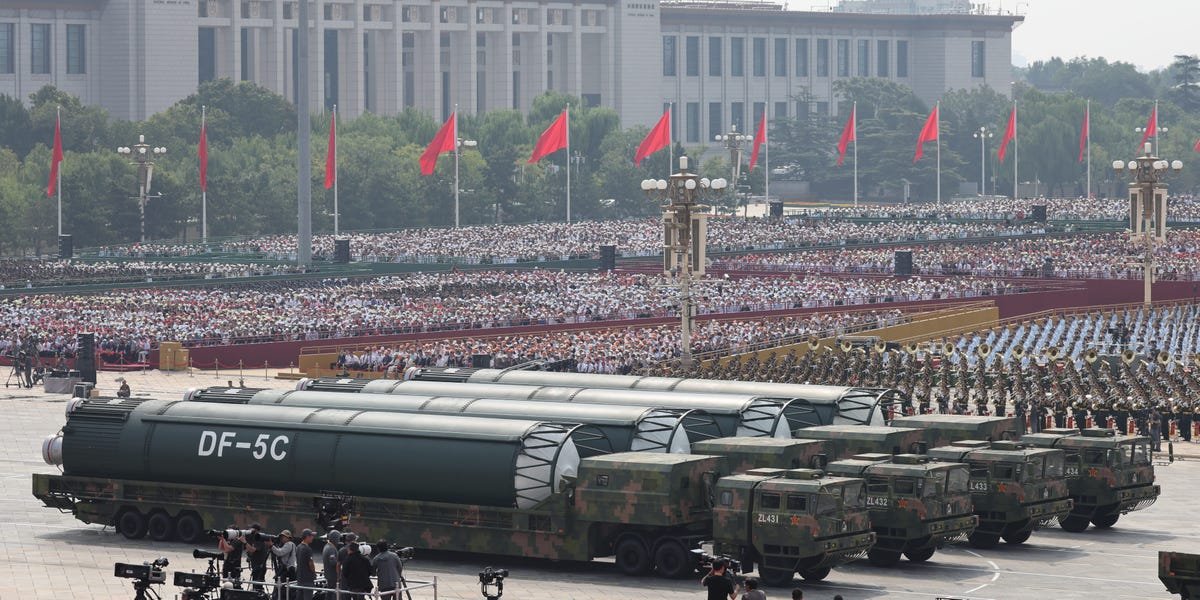
Chinese ICBMs include missiles like the DF-5 and DF-41. The Pentagon estimates China has 550 ICBM launchers and 400 missiles with estimated ranges beyond 5,500 km, the threshold for classification as an ICBM.


A chart showing the estimated ranges, missile numbers, and launcher numbers based on each system and class of China's missiles.

Estimated numbers of missiles and launchers for Chinese missiles, specifically ground-launched cruise missiles (GLCMs), short-range ballistic missiles (SRBMs), medium-range ballistic missiles (MRBMs), intermediate-range ballistic missiles (IRBMs), and ICBMs.

US Department of Defense


For China’s medium-range ballistic missiles, such as China’s DF-21s or hypersonic DF-17, the Pentagon assesses that China has 300 launchers for 1,300 missiles with ranges between 1,000 and 3,000 km. The report also documented increases in the number of launchers and missiles for some notable systems. China’s intermediate-range ballistic missiles, like the DF-26 missile, jumped from 250 launchers in last year’s report to 300 this year, and the number of IRBMs total went from 500 to 550.

These figures illustrate how heavily Beijing has invested in a powerful, diverse missile arsenal. The Pentagon highlighted in its report that the Rocket Force could play an important role in a Chinese invasion of Taiwan or other regional conflict.

According to the latest report, China’s rocket force “is prepared to conduct missile attacks against high-value targets, including Taiwan’s C2 [command and control] facilities, air bases, and radar sites” as well as deter or delay the US or its allies and partners from coming to Taiwan’s aid.

The Pentagon said that the Rocket Force has continued to rehearse strikes in recent military exercises, including 2024 drills simulating an invasion or blockade of Taiwan.


A map showing missile ranges in the Taiwan Strait.

The estimated ranges of Chinese missiles relevant to a Taiwan fight.

US Department of Defense


One map in the report shows the estimated reach of Chinese missiles that could be particularly relevant in a fight over Taiwan, weapons such as ship- and shore-launched surface-to-air missiles for knocking out hostile aircraft, as well as anti-ship cruise missiles fired from naval platforms like Chinese destroyers and land-based close- and short-range ballistic missiles.

Another Pentagon map shows the estimated reach of China’s conventional strike missiles, including the DF-17 and DF-21 MRBMs, the DF-26 IRBM, and the newly fielded DF-27 ICBM, which, like the DF-26 and some DF-21s, has an anti-ship role in addition to land attack.

Many of these systems can reach across the first island chain, which includes Japan, Taiwan, and the Philippines, while longer-range missiles extend toward the second island chain and beyond.

The DF-26 is concerning for US planners. The weapon, nicknamed the “Guam Express,” can be armed with either conventional or nuclear warheads and reach US installations on Guam. It can target US aircraft carriers and other surface ships as well.

Bombers, like China’s H-6, carrying CJ-20 cruise missiles could threaten parts of Alaska. And then the ICBMs can range significantly further. The DF-27 can, for instance, range parts of the continental United States.


A map showing estimated ranges of Chinese missiles outside of the mainland and towards other regions.

The estimated ranges of Chinese missiles with regional reach.

US Department of Defense


The Department of Defense report also looks at China’s nuclear strike options, such as land-based ICBMs and submarine-launched ballistic missiles.

China test-launched an ICBM, specifically a DF-31B missile, in September 2024, firing it from a position on Hainan Island into the Pacific. The test was the first beyond the country’s borders since the 1980s and allowed China to verify ICBM performance. The Department of Defense suspects weapons tests like these may become more regular.

This year, at a military parade in Beijing, China unveiled new, previously unseen ICBMs, shocking China watchers. Those weapons, including the new DF-61 and DF-31BJ, are not included in the Pentagon’s assessments.

China also continues to bolster its nuclear warhead count, estimated at over 600 warheads. Although 2024 saw a slower rate of production than previous years, the Pentagon still assesses that the Chinese military is on its way to 1,000 warheads by 2030, only a fraction of the US and Russian stockpiles.


A map showing the estimated ranges of China's missiles from Asia over the North Pole.

The estimated ranges of Chinese nuclear missiles.

US Department of Defense


A Pentagon map estimating the ranges of Chinese missiles available for nuclear strike indicates that three — the DF-5, DF-41, and DF-31 — all have the continental US well within range, while the submarine-launched JL-3 missile can hit most of it from waters near China. On a submarine positioned farther out, more targets could be within striking distance.

Despite these continued advancements, questions remain on the differences in quality and capabilities of Chinese weapons and training compared to the US. The Pentagon also believes China is still navigating the impacts of a vast anti-corruption campaign in the military that has particularly targeted PLARF officials.

The campaign could be detrimental if driven by political agendas, or it could deliver long-term improvements if it addresses actual problems within the force. At this point, it’s unclear how the changes will affect it.


Source link