

Thibault

A top researcher says a new divide is emerging in AI use — and most people are on the losing side

Are you using AI to think — or letting it think for you?

Vivienne Ming, chief scientist at the Possibility Institute, a metascience research group, and founder of Socos Labs, an AI and education firm, says the tech is splitting people into two groups: a small minority who use it to think better, and a much larger majority who use it to think less.

“The overwhelming trend is substitution,” Ming said in a recent interview with Business Insider in London. Instead of using AI to deepen their reasoning, most people are outsourcing it, she said.

That distinction is what Ming describes as a growing cognitive divide between people who use AI to enhance their thinking and those who rely on it to think for them.

As AI tools become embedded across workplaces, from coding to writing and analysis, a growing number of AI researchers have warned that overreliance on the technology could dull cognitive and independent thinking skills.

The risks are already emerging: when Anthropic’s Claude went down earlier this month, some developers said they struggled to keep working, as tasks that had become routine suddenly felt harder without AI.

‘Productive friction’

To test AI’s impact on cognitive skills, Ming said she ran an experiment from late summer through fall of 2025. She created teams of three, including 39 students from UC Berkeley and 33 others from the San Francisco Bay Area, to use Polymarket data to predict real-world events, either working alone or with AI systems.

The results, she said, showed roughly 90% to 95% of participants fell into two groups: those who relied on AI to generate answers for them, and those who used it to validate their own assumptions.

The remaining minority — around 5% to 10% — took a different approach, which Ming calls the “cyborgs.”

Rather than relying on AI for answers, they used it as a collaborator, exploring ideas, challenging assumptions, and pushing the problem forward, while the AI brought in data and counterarguments.

The process created what Ming described as “productive friction.”

“They would challenge the AI,” she said, and ask, “Don’t tell me why I’m right — tell me why I’m wrong.”

‘Hybrid intelligence’

This dynamic is what Ming calls “hybrid intelligence” — not simply humans plus machines, but a distinct form of intelligence that emerges from how the two interact.

In her research, she found that the best human-AI collaboration wasn’t driven by more advanced large language models but by human traits such as curiosity, intellectual humility, perspective-taking, and the ability to reason under uncertainty.

Her concern is that most current uses of AI push people in the opposite direction.

Ming compares it to GPS: a tool that makes your life easier in the short term but can degrade cognitive abilities over time if overused.

“If you’re using it to think for you,” Ming said of AI models, “this is your long-term cognitive health. So yes, 100% skill erasure.”

The implications extend beyond individuals. Workplaces increasingly reward speed and efficiency — conditions that encourage employees to accept AI-generated outputs rather than interrogate them.

That, Ming warned, could lead to a world of competent but indistinguishable work, or what she called “AI slop.”

“The answer you’re getting out of your phone is the exact same answer everyone else is getting,” she said. “Even if it’s right, it brings you no value.”



Source link

Jack Newsham's face on a gray background.

Polymarket let people bet on when Iran would strike Israel. A journalist who covered the war got death threats.

An Israeli journalist said Polymarket users tried to bribe him and threatened to kill him after he reported that an Iranian missile had struck Israel earlier this month.

Polymarket later condemned the harassment and said the conduct violated its rules.

“We’ve banned the accounts for all involved & will pass their info to the relevant authorities,” the company wrote on X.

Emanuel Fabian, a military correspondent for The Times of Israel, wrote this week that the harassment began with emails pressing him to revise a blog post saying a missile hit an area roughly 500 meters from homes in Beit Shemesh, a small city in central Israel.

The initial outreach, written in Hebrew, was polite, Fabian wrote. “Regarding your Times of Israel report that described today’s launch as an ‘impact’ — Beit Shemesh Municipality and MDA (Magen David Adom) later corrected their reports to clarify that what fell was an interceptor fragment, not a full missile,” the first email said, referring to an Israeli emergency-response service.

Follow-up messages from others were more insistent. “I have an urgent request regarding the accuracy of your report on the missile attack on March 10. I would really appreciate a response if possible,” read one.

Fabian wrote that he stood by the reporting, citing Israeli military information and video of a large explosion that, in his view, was inconsistent with interceptor debris.

What followed, he said, was a pressure campaign that spilled across email, X, Discord, WhatsApp, and backchannel outreach through another journalist.

Fabian described repeated requests to change the wording of his report, which he believed was intended to influence the resolution of a Polymarket market tied to whether Iran struck Israel on that date. He said some messages — which didn’t explicitly mention Polymarket, but came from Polymarket users or seemed bizarrely hung up on his blog post — escalated into explicit threats.

“If you do not correct this by 01:00 Israel time today, March 15, you are bringing upon yourself damage you have never imagined you would suffer,” read one.

Fabian wrote that he went to the police and provided evidence.

Polymarklet didn’t answer questions from the Times of Israel about the details of the investigation. Representatives for Polymarket didn’t immediately respond to Business Insider’s request for comment.

Advocates for prediction markets have said they encourage honesty by requiring users to put their money where their mouth is. Shayne Coplan, Polymarket’s founder, has said that people in the Middle East can use military-strike markets to decide whether they want to sleep near a bomb shelter.

The nitty-gritty details of contracts and how they are resolved can lead to contentious arguments. People on Polymarket who wagered on whether Iran would strike Israel by March 10 still haven’t gotten paid, as the contract appears to remain in dispute. Polymarket, which is legally based in Panama, uses a complex, crypto-based process to resolve disagreements.

Fabian isn’t the first person to say they were targeted by prediction market users. The NCAA has cited concerns with prediction markets, reporting that 36% of Division I men’s basketball players said they had been harassed by “someone with a betting interest.”

In January, the organization called for a pause on college sports-related betting prediction market betting until the Commodity Futures Trading Commission, which regulates the platforms, “implements appropriate regulations.”

Polymarket was valued at $9 billion last year and is seeking a $20 billion valuation in talks with investors, The Wall Street Journal reported earlier this month. The company and its competitor, Kalshi, have poured millions of dollars into marketing online, on TV, and in real life, even giving people free groceries in New York City.

The largest chunk of activity on both platforms is betting on sports in a manner that competes with companies like DraftKings, BetMGM, and other traditional sportsbooks. The second-biggest category is speculating on cryptocurrency prices.

Business Insider has previously reported that Polymarket has drawn scrutiny from US lawmakers over concerns about manipulation, insider trading, and the difficulty of investigating crypto-based bets.

Sen. Chris Murphy and Rep. Greg Casar announced Tuesday that they will introduce the “Bets Off Act,” which would ban certain prediction market trades, including terrorism, war, and assassinations.

The attacks on Iran are only one of several geopolitical flashpoints that have been accompanied by concern about the prospect of people with insider information cashing in. One Polymarket user made several hundred thousand dollars correctly betting on the US operation to remove Venezuela’s leader, Nicolas Maduro.


Source link

Jason Guerrasio

Werner Herzog says he improvised his iconic ‘Parks and Rec’ cameo: ‘People peed their pants’

  • Werner Herzog made a cameo in a 2015 episode of “Parks and Recreation” as a man selling his house.
  • He told Business Insider his funniest line was improvised.
  • “People peed their pants,” Herzog said.

Werner Herzog isn’t just an acclaimed filmmaker and author — he also has a knack for popping up in your favorite TV shows.

He’s lent his iconic voice to several characters on “The Simpsons,” and he memorably appeared in the flesh on season one of “The Mandalorian” as “The Client,” who hires Mando to track down the very adorable Baby Yoda.

But Herzog himself is very fond of his 2015 cameo on “Parks and Recreation” because the creators were receptive to his spontaneous input.

The filmmaker appears in the season seven premiere episode titled “2017.” In it, April (Aubrey Plaza) and Andy (Chris Pratt) go house hunting and come across the eccentric home of Keg Jeggings (Herzog), who tells them the house features three bomb shelters, a fireman’s pole, and a staircase to nowhere. Jeggings explains that the home was originally a holding cell for people who had gone insane from working at the Pawnee Doll Head Factory. Oh, and Jeggings says it’s haunted.


Werner Herzog Aubrey Plaza and Chris Pratt in Parks and REc

Werner Herzog, Aubrey Plaza, and Chris Pratt in “Parks and Recreation.”

NBC


April and Andy don’t need any more convincing. They decide to buy the house on the spot, then make out on top of a table in front of Jeggings to celebrate.

Herzog recalled the best part of filming the show, which he admitted he’s never seen. “When we were done shooting, I said to the team, ‘I would like to add something to the text. Can I speak right into the camera?'” Herzog recalled to Business Insider.

“And I said straight to the audience: ‘I’ve lived in this home for 47 years, but I’m selling it now because I want to move to Orlando, Florida, to be close to Disney World.'”

Herzog said his ad lib was a major hit.

“People peed their pants.”

Werner Herzog’s latest documentary, “Ghost Elephants,” is now streaming on Hulu and Disney+.


Source link

Tinder-wants-you-to-meet-people-offline-Its-CEO-tells.jpeg

Tinder wants you to meet people offline. Its CEO tells us it’s responding to ‘changing consumer tastes.’

Tinder wants you to get offline. No, really.

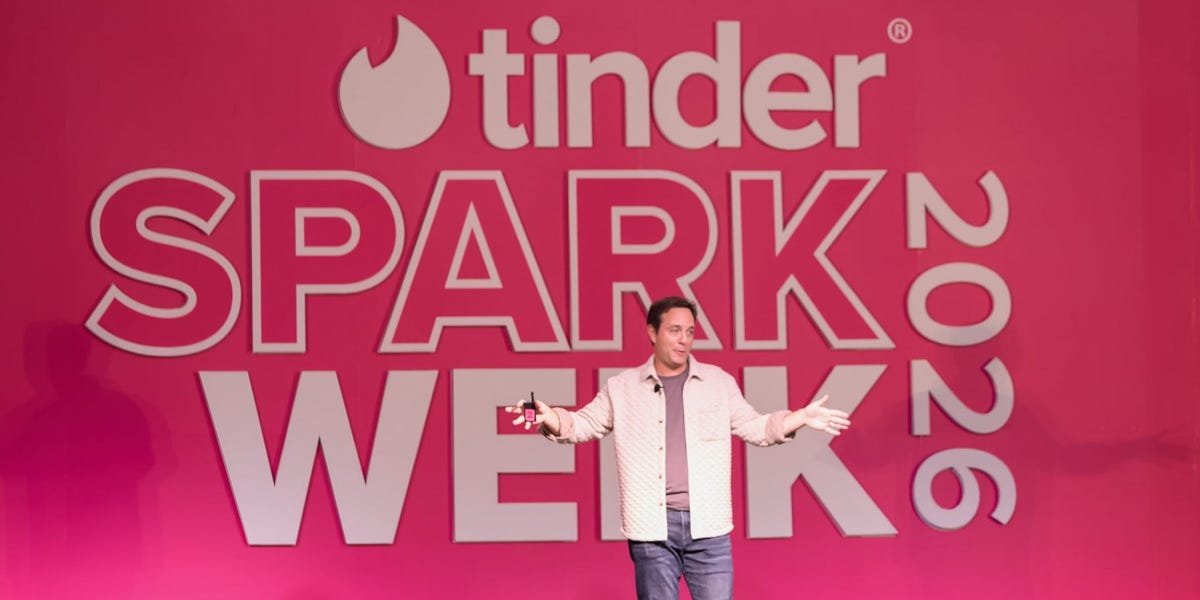
The world’s biggest dating app announced a variety of new features for 2026 at its product conference, Tinder Sparks. There will be ways to match based on music taste and astrology, to enhance photos with AI — and to skip out on the back-and-forth of online dating entirely.

The new “Events” tab, which is testing in Los Angeles this month, will connect users to in-person dating events. In an exclusive interview, CEO Spencer Rascoff said that IRL dating is the “perfect solution” for Gen Z daters.

“Events are fun, they’re low-pressure, they’re social, they’re safe,” Rascoff told Business Insider. “They’re bringing Tinder into the physical world in a way that is consistent with our users’ lifestyles.”

The Events tab is placed squarely next to the swiping tab — a sign, Rascoff said, of how important it is to the company. Users can browse listings with attendee counts and blurred photos. Once the user registers, the photos will unblur, and they can see some of the faces that will be in attendance.

It’s a fairly notable about-face for a company that once centered around the endless possibilities of “Swipe Right.” Indeed, many users have been tiring of the apps entirely; you may have heard of “swipe fatigue.”

“If you run a consumer internet company, you have to stay attentive to changing consumer tastes,” Rascoff said. “We can’t put our heads in the sand and stay wedded to past practice.”


Tinder's Events tab is pictured.

Tinder is testing an in-person dating feature in Los Angeles.

Tinder


Rascoff hopes that events will help bring in those worried by or frustrated with online dating. He compared it to Airbnb’s experiences market. That company uses luxury houses and villas to get people to reconsider “alternative accommodations” and, hopefully, return to their core product.

Since Rascoff’s takeover in 2025, he’s attempted to steer the app clear of its hookup reputation.

“I think IRL events have the potential to drive reconsideration of Tinder from people who have formed an opinion,” Rascoff said. He described an anti-Tinder user who downloads for the events, and eventually uses it as an “alibi” to start swiping.

Other upcoming features include specialty swiping modes for music and astrology.

Rascoff shared stories of two recent job interviews he held with Gen Z candidates. One responded to a question about why they were leaving their current company with, “I’m a Gemini.” Another responded to why they went into this field with, “because I’m a Taurus.”


Tinder's Astrology Mode is pictured.

Tinder lets users match by their astrological sign.

Tinder


Early testing shows that these modes are driving more engagement. One in 10 users under 22 have adopted Music Mode, and there was a 20% increase in Likes sent by women on astrology profiles.

While Rascoff is married, he still has a Tinder profile for product testing. He’s personally a Scorpio, and planned to list the Rolling Stones.

Then there’s AI, the looming question over all the dating app companies. Everyone is embracing it in some form, but the question of how much has proved controversial.

Tinder announced at the conference an expansion of its AI matchmaking program, Chemistry, as well as a camera roll scan for profile creation and photo enhancements, both powered by the tech.


Tinder's Chemistry feature is pictured.

Tinder’s matchmaking feature, Chemistry, is powered by AI.

Tinder


But Rascoff is quick to cut through the flashier features — there’s also video speed-dating and profile stickers — and point out safety. One of the biggest threats to online dating is bots, scammers, and crypto shills.

Tinder is now making its Face Check technology mandatory worldwide (excluding some markets, such as the EU and UK) and further rolling out its safety nudges for potentially inappropriate messages.

“We don’t talk about it enough,” Rascoff said. “We’ve raised the bar on trust and safety.”


Source link

My-partner-and-I-live-in-less-than-70-square.jpeg

My partner and I live in less than 70 square feet. Despite what some people assume, it’s great for our relationship.

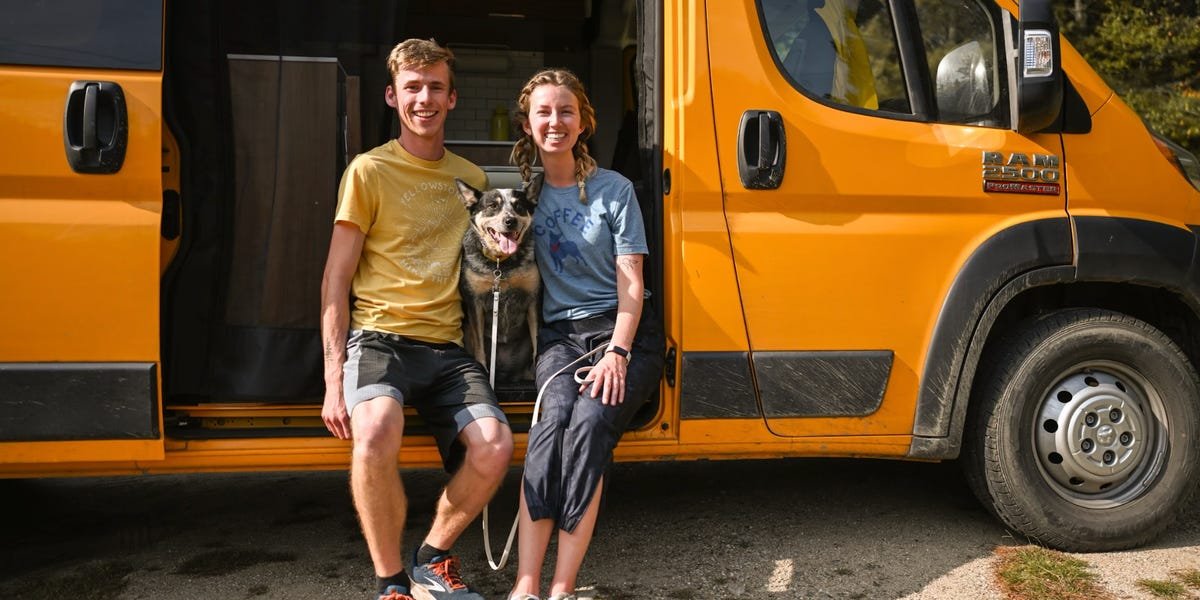
“And you still like each other?” is one of the most common questions my partner, Sean, and I get when we tell someone we’re entering our fourth year calling a small camper van home.

People usually ask it in a joking tone. We all chuckle, but there’s true curiosity underneath. Can a couple really spend all this time together — crammed in a tiny space with no privacy, plenty of unusual road-life challenges, and a dog in our van— without gasping for air?

Turns out, we can. Although people often guess that too much proximity wears romance down, the opposite feels true for us.

Sharing so many new experiences deepens our connection


A shot of the writer and her boyfriend's legs and feet as they overlook a canyon at sunset.

We get to share new experiences almost every day.

Haley Young


You know how on reality dating shows, producers put couples in intense situations to heighten their emotions? Skydiving, maybe, or some outlandishly beautiful hike on an island the contestants know they’ll never see again.

Because these once-in-a-lifetime experiences are so exciting, they foster almost instant intimacy. Living in a van provides deep bonding opportunities like these on most days of the week.

As Sean and I travel, we connect over our shared adventures — from watching North America’s earliest sunrise in Newfoundland to cold-dipping in Glacier National Park to simply laughing in disbelief at the highway’s strangest billboards.

My partner and I have to face challenges as a team


The writer's partner working on an electrical issue with their van at nighttime.

As a couple living on the road, we have to work together on some unusual problems.

Haley Young


Unlike contestants on reality dating shows, we’re in charge of all these “date” logistics ourselves. That’s a good thing!

Whether we’re getting our house unstuck from a ditch on a middle-of-nowhere mountain road, finding an appropriate place to empty our composting toilet, or debating where to park overnight after an exhausting day hike, uniting around obstacles big and small gives us a satisfying relationship rush. We remind each other that we’re in this together.

We’re also unable to hide from conflict. Because there’s no room — and I mean this literally — to let problems pile up, we deal with disagreements more quickly and thoroughly than when we lived in a larger stationary house.

Van life demands that we approach interpersonal challenges the same way we face external issues on the road: right away, as a team.

Plus, all this time in the same space means that when we grow, we grow together. We’re often all we have on the road, so I appreciate how naturally we stay central in each other’s lives.

The biggest cons of couple van life are mostly annoyances


The interior of the couple's van with fall foliage in the background.

One of the biggest challenges we face is a lack of privacy.

Haley Young


We’ve had no choice but to get used to an utter lack of privacy. Some days, Sean and I are only apart for a few minutes in total.

Although the not-so-glamorous reality of such extreme proximity has deepened our trust and confidence in each other overall, I’d be lying if I said we never get on each other’s nerves.

Let me tell you: You do not want your headphones to break while living with someone else in less than 70 square feet.

We also have to juggle mundane but necessary planning for things like video-call acoustics when we both have work meetings at the same time. Sometimes I dream about a separate, always-quiet home office.

Finally, because we’re usually pretty attached at the hip, it can feel more difficult to do things without each other. This struggle is both emotional and practical.

Take one time last spring, for example, when Sean met a coworker for lunch. I stayed home … except “home,” in this case, was inside our van in the restaurant’s parking lot. Yeah, it felt a little weird.

We’re closer than before, literally and figuratively


The writer and her boyfriend standing in front of a glacier on a boat.

Despite some challenges, I feel lucky to explore the world with my favorite person.

Haley Young


For us, the greatest risk of living in a small space isn’t finding ourselves at each other’s throats, but becoming codependent.

Because constant travel means we don’t see family and friends as regularly as we’d like, we can sometimes go weeks acting as load-bearing support in each other’s social lives.

That doesn’t usually feel like a problem, though. Most of all, I feel lucky to spend all day, every day with my favorite person.


Source link

Theron Mohamed — Profile Picture

8 of the world’s 10 richest people have seen their wealth drop this year as AI jitters grow

All but two of the world’s 10 wealthiest people have seen their fortunes shrink this year as jitters mount over the AI boom and the broader run-up in stocks.

Alphabet’s Larry Page and Sergey Brin, Amazon’s Jeff Bezos, Meta’s Mark Zuckerberg, Oracle’s Larry Ellison, LVMH’s Bernard Arnault, Nvidia’s Jensen Huang, and Berkshire Hathaway’s Warren Buffett are all in the red for 2026 so far, per the Bloomberg Billionaires Index.

Ellison has seen his personal wealth slump by an unrivaled $47 billion to $200 billion as of Tuesday’s close, reflecting a 23% plunge in Oracle stock year to date.

Investors have grown more skeptical about the database giant’s AI infrastructure buildout, particularly as big names such as Michael Burry of “The Big Short” have warned the strategy won’t pay off.

However, Oracle’s shares were trading 10% higher in Wednesday’s premarket after the company’s earnings report on Tuesday signaled strong AI demand.

Bezos’ fortune has shrunk by $15 billion this year to $239 billion, reflecting a 7% drop in Amazon stock as Wall Street frets over the immense cost of its AI buildout.

The online retail and cloud services giant has projected it will spend $200 billion on microchips, data centers, and other AI equipment this year.

Lower down the rich list, Microsoft’s former CEO, Steve Ballmer, has seen $25 billion wiped off his net worth this year, reducing it to $143 billion at Tuesday’s close.

The enterprise software giant’s shares have slumped 16% this year as traders increasingly worry AI tools could displace the company’s Office suite.

Outside of tech, Arnault has seen around $42 billion wiped off his net worth this year, reducing it to about $166 billion at Tuesday’s close. That reflects a 22% plunge in LVMH stock so far this year, courtesy of cooling growth and the risk that the Iran conflict disrupts international trade and travel for a prolonged period.

Elon Musk and Jim Walton are the only members of the top 10 to have grown their net worths this year as of Tuesday’s close.

Musk has added an unmatched $44 billion to his personal wealth this year, lifting it to $664 billion. The gain reflects the soaring value of his stakes in SpaceX and xAI, which has more than offset the hit from an 11% drop in Tesla’s stock price this year.

Walton, an heir to the Walmart fortune, has added $12 billion to his net worth this year, thanks to a 12% jump in the retailer’s shares. That’s been fueled by Wall Street buzz over the growth of Walmart’s online business and the potential payoff from its AI investments.

His siblings, Alice and Rob, have also added around $12 billion to their respective fortunes. All three siblings rank among the top 10 wealth gainers this year.


Source link