
Jeffrey-Epsteins-personal-lawyer-says-he-took-out-huge-cash.jpeg

Jeffrey Epstein’s personal lawyer says he took out huge cash withdrawals because he had trouble getting a credit card

Speaking under oath before members of Congress on Thursday, Jeffrey Epstein’s personal lawyer attempted to explain some of the now-dead financier’s large cash withdrawals.

In his prepared remarks, Darren Indyke told members of the House Oversight Committee that Epstein required large amounts of cash to run his many households, from New York to the US Virgin Islands.

“He and his staff required cash to pay for a wide variety of expenses including maintenance, repairs and daily household needs for his residential properties in New York, Florida, New Mexico, Paris and the USVI, as well as meals, gifts, gratuities and fuel for his private aircraft,” Indyke said in his opening statement, a copy of which was obtained by Business Insider.

Indyke also said Epstein had trouble getting approved for a credit card after JPMorgan Chase severed ties with the convicted sex offender in 2013.

“It is undisputed that during this time period Mr. Epstein had difficulty accessing credit cards from major banks,” Indyke said, referring to cash withdrawals he made for Epstein between 2013 and 2017.

The Epstein files made public by the Justice Department include documents with credit card charges from that time period. They also include credit reports showing he had credit card accounts open between 2011 and 2017 and a credit score above 750.

A representative for Deutsche Bank declined to comment. An attorney for Indyke didn’t respond to a request for comment.

Epstein died in jail in 2019 while awaiting trial on federal sex-trafficking charges in New York.

In 2008, Epstein pleaded guilty to lesser sex crimes in Florida after numerous young women, some of them teenagers, told the authorities that he paid them several hundred dollars in cash for “massages” that turned into sexual abuse.

Lawyers representing Epstein’s accusers in civil lawsuits against banks that maintained Epstein’s accounts have pointed to the large cash withdrawals from Epstein’s accounts following his 2008 conviction. They argued that, given the news reports about Epstein’s payments to women, the banks should have flagged cash withdrawals that they say allowed Epstein to continue his sex-trafficking operation.

JPMorgan Chase — which cut ties with Epstein after employees repeatedly raised concerns over the cash withdrawals — settled a class-action lawsuit from Epstein victims for $290 million. Deutsche Bank, where Epstein moved his accounts after JPMorgan severed ties, separately settled a lawsuit for $75 million.

Indyke said he never tried to circumvent the banks’ policies on cash withdrawals and that he never believed the money was used for “improper purposes.”

“For a person in Mr. Epstein’s financial position — with five multimillion-dollar residences staffed by dozens of employees and with an extensive travel itinerary — it did not strike me as unusual that Mr. Epstein’s business, household and personal needs required large amounts of cash on a regular basis,” he said.

Other people working for Epstein also had access to his accounts and withdrew cash from his accounts, including accountants Richard Kahn, who testified before the House Oversight Committee last week, and Harry Beller.

Indyke said in his statement that Epstein appeared “extremely contrite” after his 2008 conviction and regretted believing in him. He said he wasn’t personally aware of any sexual abuse until after Epstein’s death.

“He led two entirely separate lives, his professional one and the other, a private, personal one that caused many others to suffer,” Indyke said. “That I did not know what my client did in his private life may be difficult for some to believe, but it is true.”




Source link

Amanda Krause headshot

I spent $61,000 building a personal pub in my backyard. There are 3 mistakes I wish I hadn’t made.

This as-told-to essay is based on a conversation with Stephen Hutyra, a 42-year-old program analyst living in the small town of West, Texas. It’s been edited for length and clarity.

In November 2020, I was inspired to build a pub in my backyard after seeing a Facebook post.

We have a saying that everything is bigger and better in Texas, so I wanted our pub to be bigger and better than the one I saw in the pictures online.

I spent three years and $61,000 building the space we call The Thirsty Goat on half an acre of land. A construction team built the structure, and I finished the work with my family’s help.

My family, friends, and I find ourselves sitting out here in the middle of the week until midnight, or until 2 or 3 a.m. on the weekends. We’ve thoroughly enjoyed it since finishing back in August, but we’re only just starting to see how much we’ll use it.

Still, there are a few things I wish I’d done differently.


Inside the pub Stephen Hutyra built in his backyard.

Inside The Thirsty Goat pub.

Stephen Hutyra


I should’ve connected a hot-water heater

The main mistake I made is something that my wife reminds me of all the time: I didn’t hook up hot water to the bathroom or the bar.

There’s only cold water coming out of both sinks.

I didn’t think I’d have the space for a hot-water heater, but I probably could have gotten one of those little tankless ones and put it on the outside.

It wouldn’t have taken much to add that on, and it’s been very cold washing hands and dishes in the winter, so I regret not doing that.


The bathroom inside Stephen Hutyra's backyard pub.

The bathroom inside The Thirsty Goat.

Stephen Hutyra


Unfortunately, I didn’t install a dishwasher either

It’s another thing my wife reminds me of all the time. I should have planned to install a small dishwasher below the cabinet that sits behind the bar.

I either have to wash dishes with cold water in the bar sink or load dirty glassware into a tub I haul into the house to wash in the dishwasher.

Having a dishwasher would really come in handy to load dirty dishes and cutlery throughout the day and night. But with the compact floor plan I mapped out, I just didn’t have the room.


The cabinets and sink in Stephen Hutyra's backyard pub.

The countertop area of the pub.

Stephen Hutyra


A little extra space behind the bar would have been nice

Initially, I only planned to put one mini fridge behind the bar. After I installed it, though, I measured the space left and realized I had enough room for a second fridge.

Having two has really made a big impact. I frequently use the second to store juices, lemons, limes, and other items for mixed drinks.

If I didn’t have the fridge, I’d probably have to use a small cooler with ice packs.

What I didn’t realize, though, is that because the countertop edge extends into that corner, the door to the second mini fridge can only open about halfway.

If I had installed shelves there as I initially planned, there wouldn’t be an issue.


The two mini fridges inside Stephen Hutyra's backyard pub.

The second fridge behind the bar can’t fully open.

Stephen Hutyra


Thankfully, there’s room for other appliances on top.

A microwave, coffee maker, and ice maker have taken about 40% of the empty counter space I had built behind the bar. The ice machine saves space, the microwave is good for guests to quickly reheat items, and adding Keurig single-serve coffee has been nice as well.

We no longer have to walk back into the house to make a cup of coffee in the mornings when we’re enjoying the pub.

I’ve had to adjust to a smaller workspace, but it’s worked out.


Source link

Sam-Altman-says-OpenClaw-creator-Peter-Steinberger-is-joining-OpenAI.jpeg

Sam Altman says OpenClaw creator Peter Steinberger is joining OpenAI to build next-gen personal agents

  • Sam Altman says OpenClaw creator Peter Steinberger is joining OpenAI.
  • OpenClaw is a viral AI agent launched last month.
  • Altman said Steinberger will build “next generation” AI agents at OpenAI.

OpenAI just scored a win in the AI talent wars.

Sam Altman said Sunday on X that Peter Steinberger, the creator of OpenClaw, the viral AI agent powering the agent-only social network Moltbook, is joining OpenAI.

Altman said Steinberger would build the “next generation” of personal AI agents at the company.

“He is a genius with a lot of amazing ideas about the future of very smart agents interacting with each other to do very useful things for people,” Altman said about Steinberger. “We expect this will quickly become core to our product offerings.”

Altman added that OpenClaw, which was for a brief moment in time known as Moltbot and then Clawdbot before Anthropic took notice, will live on as an open-source project supported by OpenAI.

“The future is going to be extremely multi-agent and it’s important to us to support open source as part of that,” he wrote.

Steinberger, previously best known for founding the PDF processing company PSPDFKit, came out of retirement to launch OpenClaw in late 2025.

He is likely to bring a new perspective to OpenAI’s race to develop artificial general intelligence. Steinberger said he believes AGI is best as a specialized form of intelligence rather than a generalized one.

“What can one human being actually achieve? Do you think one human being could make an iPhone or one human being could go to space?” Steinberger said on a Y Combinator podcast in February. “As a group we specialize, as a larger society we specialize even more.”


Source link

How-AI-is-helping-these-solopreneurs-build-more-personal-membership.jpeg

How AI is helping these solopreneurs build more personal membership communities — with less work

A community is a dedicated space where customers connect with each other for ongoing support, learning, and shared identity. For companies, it’s a way to build loyalty, gather real-time insight, and deliver deeper value beyond a product or service.

What sets a community apart from a static knowledge base is the personalized support members receive. While that level of service used to come at a high operational cost, AI makes it easier and more impactful for three solopreneurs who spoke with Business Insider about running their own membership communities.


Gabriela Fiorentino

Gabriela Fiorentino is the founder of Nest Earth.

Joel Arbaje for BI


“I can be even more present inside of my community,” said Gabriela Fiorentino, founder of Nest Earth, a community that helps parents integrate sustainable choices into family life. “It’s like having an assistant without having to pay for the assistant,” she added.

Here’s how three solopreneurs running communities use AI to reduce cognitive and operational load so they can create stronger member experiences.

This article is part of The AI-Powered Solopreneur series. Read more.

AI streamlines personalized offerings

Clara Ma, founder of Ask a Chief of Staff, a community serving executives in chief of staff roles, loves meeting with members one-on-one to answer their personal questions, but only has limited time to do so.

Before, she often found herself on calls repeating generic information that was already available within the community. Now, she asks members to share their questions ahead of calls, then uses the integrated AI in Slack—where her community connects and has conversations—to ask what resources already exist related to those questions.


Clara Ma

Clara Ma is the founder of Ask a Chief of Staff.

Isa Zapata for BI


“I can pull up three to five resources immediately and say, ‘Let’s look at this first, and then if your question still isn’t answered or you want to personalize the chat a little bit more to you, I can do that better because we’re on the same page about what is already available to you,'” Ma said.

She also used Slack Workflows to help her build out an automated process for member onboarding. Based on whether they’re an aspiring chief of staff, a current chief of staff, or a mentor within the community, they get a slightly different and personalized message welcoming them into the community and giving them some next steps on how to engage. This creates a curated experience from day one without a heavy manual lift for Ma. Onboarding tasks now take about an hour per week as opposed to a couple of hours per day before AI, she said.


Lis Best

Lis Best is the founder of Girls Club Collective.

Michaela Vatcheva for BI


For Lis Best—founder of Girls Club Collective, a community for impact leaders and entrepreneurs—the biggest value in using AI has been more mental capacity to dedicate to what matters most to her.

“I can use my creative brainpower more on facilitation and on one-on-one member support and less on rewriting an email sequence for the 12th time,” she said.

For instance, she has recently used ChatGPT to help her improve the website positioning and suggest email sequences for potential new members, reducing her time spent on growing her community so she can spend more time engaging with it.

AI offers research-backed strategy suggestions

Beyond one-on-one interactions, community-based businesses also offer broader programming like workshops, expert sessions, and connection opportunities. Ideally, these offerings reflect what members actually want—and AI makes it far easier for solopreneurs to identify those needs at scale.

Before AI, Ma used to rely on intuition or hours of manual work to understand member preferences, reading months of community Slack conversations and trying to mentally catalog themes. Now, AI synthesizes data from member conversations, newsletter open rates, and workshop engagement to inform decisions about which events or member offerings to prioritize.

“It unlocks a lot more information a lot faster so that we can make better decisions,” Ma said. “I used to hem and haw about what programming we should do. Now I have the data, and I can have a conversation with AI to spitball different strategies and topics that I think our members are going to react well to instead of going off gut feeling.”


Clara Ma

Clara Ma uses AI to help her spitball different strategies.

Isa Zapata for BI


Best loves that AI gives her the confidence to table ideas that have been on her “maybe” list or that a handful of members have requested. Uploading information from member surveys and member interviews transcribed with the Otter AI notetaker, she can ask ChatGPT to synthesize what offerings are most in demand—and which are not worth spending energy on from a data perspective.

“As a person, I think, ‘I know the four people who are asking for this, so should I do it anyway?'” Best said. AI’s more neutral perspective helps her put those personal feelings aside and choose programming that will benefit the most members.


Gabriela Florentino

Gabriela Florentino used AI to help her find new ways to monetize her community.

Joel Arbaje for BI


Fiorentino also uses AI to support broader strategy research. For instance, when trying to brainstorm new ways to monetize, she turned to AI, asking what options were available and what was working for other communities.

For example, she’s launched a new membership tier where service providers can access more visibility and potential clients through her community. She’s also planning to launch a marketplace of eco-friendly products later this year.

AI creates more time for human touchpoints


Lis Best

Lis Best values AI’s neutral perspective.

Michaela Vatcheva for BI


In case it’s not clear, the goal for these solopreneurs is to use AI to maximize human potential, not replace it.

“I always say AI is for automation, not to replace the human,” said Ma, who coaches her small team of contractors to try automating any task that they do more than five times with AI. This ensures she’s using her limited budget only on things that require human touch, not things that a machine can handle.

And with that extra time, they can work to maximize the potential of their members. “Any time we get back, we try to funnel back into the community in some sort of human touchpoint so that our members really feel taken care of and supported,” Ma shared. “AI is never going to replace the human aspect, which is what makes community so worth it in the first place.”


Source link

Aditi Bharade

Why Starbucks is letting Brian Niccol use the company plane for more personal travel

Starbucks is getting CEO Brian Niccol to use the company jet for all his travels — and removing his quarter-million travel budget cap.

In a Monday filing, the Seattle-based coffee chain said that it was changing its agreement on how much Niccol could use the company’s private jet for his personal travel. And the main reason for this change is to ensure Niccol’s safety.

Before September, Niccol’s use of the Starbucks plane for non-work reasons was subject to an annual cap of $250,000, and if he exceeded that amount, he had to reimburse the company, the Monday filing wrote.

But after September, the board removed the $250,000 annual cap and replaced it with a “more frequent quarterly review of Mr. Niccol’s personal flights by the chair of the Compensation Committee,” per the filing. Starbucks has not imposed a new maximum spending limit.

“This change was driven by the security study’s recommendation that Mr. Niccol use Company aircraft for all air travel, including personal travel, and the Company’s ongoing monitoring of Mr. Niccol’s security situation,” the filing wrote.

A Starbucks spokesperson said the company’s board recently decided to enhance security measures for Niccol, following a review of threats and risks to the chief executive.

Following the review, the board has made it a requirement to use private aircraft for all his travels, the spokesperson added.

Last year, Starbucks was hiring for a pilot to fly its private Gulfstream jets. In the job listing, the company said it would pay the pilot a salary between $207,000 and $360,300.

The filing also wrote that Niccol was paid about $31 million in compensation in 2025, a drop from the $95.8 million he was paid in 2024. His 2024 compensation was boosted by $90.2 million in stock awards he received as part of his signing contract.

Niccol started at the company in September 2024, moving over from Chipotle. He has helmed the chain’s “Back to Starbucks” turnaround plan, an effort to turn around several quarters of poor results because of a declining customer experience.

His offer letter in August 2024 showed that Starbucks had permitted him to use the company jet to commute from his home in California to the company’s headquarters in Seattle. In July last year, Business Insider learnt that Starbucks had set up a satellite office close to Niccol’s residence in Newport Beach.


Source link

Im-a-personal-trainer-and-mom-of-4-Here-are.jpeg

I’m a personal trainer and mom of 4. Here are my 10 go-to meals and snacks to make in an air fryer.

  • I’m a personal trainer and mom of four, and I love using my air fryer to make meals and snacks.
  • Homemade tortilla chips and stuffed peppers are some of my favorite things to make in an air fryer.
  • I also use my air fryer to make baked apples, breakfast bowls, and kale chips. 

My health-centered, active family focuses on nutrient-dense foods that provide us with energy.

We don’t shy away from less nutritious foods (everything in moderation), but most of our meals are centered on lean protein, whole grains, fruits, vegetables, dairy, and healthy fats.

On top of that, I also face the ever-pressing need to appease all four of my kids. Making nutritious foods that appeal to everyone’s palate can be challenging, but using an air fryer helps.

I love that air fryers help create that crunchy, fried appeal without adding a ton of fat to a dish. Though fats can be nutritious, they are better consumed in proportion to the carbs and protein in your meal.

Plus, my air fryer doubles as another cooking tool when the stove or oven is in use, and my kids can use it to make food on their own without having to navigate burners and dials.

Here are some of my favorite air-fryer meals and snacks.

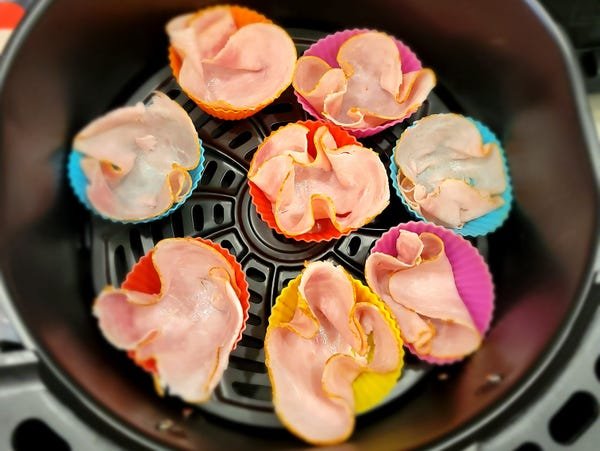
Ham-and-egg cups are an easy breakfast.

I make these breakfast bites in silicone cups.

Rachel MacPherson

Breakfast cups are nothing new in our house, but they require less time and effort to make because of the air fryer.

Plus, we can make them in small batches to suit each person’s tastes — and my kids have no problem creating their personalized mini egg cups.

The number of cups you can make at once may depend on the basket size of your air fryer. Usually, I can make eight at a time using silicone baking cups.

The ham-and-egg cups take about 15 minutes to make.


ham cheese in silicone wrapper in air fryer

You can easily customize the ham-and-egg cups.

Rachel MacPherson

Preheat your air fryer to 300°F.

Line each baking cup with a slice of ham or prosciutto for a fancier option. Mix eggs with salt, pepper, and any additional seasonings of your choice, such as Worcestershire sauce and red-pepper flakes.

Carefully place the ham-lined cups into the air fryer and pour the egg mixture into each. Add any veggies you prefer, such as chopped asparagus or cooked spinach. Sprinkle on a cheese of your choice. 

Let the egg cups cook for about 15 minutes. Serve hot, or let them cool slightly and store in the fridge to reheat later.

I like making breakfast bowls with air-fried veggies.


asparagus and tomatoes on foil in air fryer

You can use any vegetables you have on hand.

Rachel MacPherson

It can be challenging to have a vegetable-packed breakfast, but it’s a great way to better ensure you’ll get enough nutrients throughout your day.

With the air fryer, I can easily cook fresh produce in the morning. I like to use asparagus and tomatoes, pairing them with eggs that I’ve poached or “boiled” in the air fryer.

This produce-filled breakfast takes about 12 minutes to make and pairs well with toast.


asparagus tomato egg breakfast bowl

I like to use toast to sop up any juices.

Rachel MacPherson

Line your air fryer with foil and preheat it to 300°F.

Clean and snap asparagus, chopping it into bite-sized pieces. Add cherry or grape tomatoes to a bowl with asparagus, spritz with olive oil, and season with salt and pepper.

Place the produce in the preheated air fryer for 10 to 12 minutes. If you prefer crunchy asparagus, leave it out until the last four to six minutes, and then place it on top of the tomatoes to finish cooking.

Serve with eggs and some toast for mopping up all the yummy juices.

I make chicken Parmesan without frying my cutlets in a ton of oil.


breaded chicken breasts on a piece of parchment paper

I bread my chicken (not pictured) before I cook it.

Candice Bell/Shutterstock

Chicken Parmesan is one of my favorite comfort foods, and the air fryer helps me make it without having to pan-fry my protein in oil.

For two 8-ounce chicken breasts, you’ll need about ¼ cup of Parmesan cheese and 1 cup of breadcrumbs. You’ll also need two eggs, marinara sauce, and mozzarella for topping.

Air-fryer chicken Parmesan pairs well with pasta.


homemade chicken parmesan

My chicken Parmesan is usually served with pasta.

Nancy Salmon/Shutterstock

First, pound the chicken breasts until they are a uniform thickness, about 1/2 inch. Then set your air fryer to 360°F.

Combine the Parmesan and breadcrumbs in one dish and add any desired seasonings, such as garlic powder, salt, pepper, oregano, and red-pepper flakes. Whisk your eggs in a separate bowl. Coat each piece of chicken in egg, then in the crumb mixture.

Place the breasts in the preheated air fryer and cook for six minutes. Flip and top with marinara sauce and mozzarella. Cook an additional four minutes or so until the internal temperature of the chicken reaches 165°F.

We like to serve the cutlets on top of pasta with more marinara sauce.

Seasoned pumpkin seeds are a great snack.


pumpkin seeds with seasoning in bowl

Making your own seasoned nuts and seeds in the air fryer is game-changing.

Rachel MacPherson

We buy a lot of seeds in bulk, so switching up the flavor profile helps turn them into coveted snacks. We especially enjoy using seeds from squash, such as pumpkins, for this recipe.

Cumin, salt, cayenne pepper, garlic powder, and smoked paprika are all excellent choices for seasoning seeds, though you can experiment with other flavors you enjoy.

You can season the seeds to be sweet or savory.


pumpkin seeds in air fryer

Sometimes, I use cumin, garlic powder, and onion powder.

Rachel MacPherson

Toss your seeds with a bit of olive oil and salt. Place them in the air fryer at 320°F, periodically opening the machine to shake the seeds to ensure even cooking.

Cook for about 15 minutes or until the seeds are crispy. Then, toss the seeds in a bowl with a bit of oil and your preferred seasonings.

Baked apples are a favorite of ours, and they’re easily adaptable to most dietary preferences.


apples with cinnamon on them in an air fryer

We use our air fryer for more than just savory foods.

Rachel MacPherson

One of my family’s favorite air-fryer desserts is a fruity crumble that we usually make with apples.

After all, baking fruit is a delicious way to bring out its natural sugars and create a deeply comforting dessert that’s both nutritious and satisfying.

You can make this dessert in under 30 minutes.


baked apple crumble

You can pair the baked apples with whipped cream.

Rachel MacPherson

Simply combine 1 or 2 tablespoons of a fat, such as butter or coconut oil, with the same amount of oats, chopped nuts, and shredded coconut.

Add a sweetener, such as monk fruit, brown sugar, honey, or maple syrup, and some warming spices like cinnamon and nutmeg.

Cut the apples in half and top them with spoonfuls of the mixture you’ve created. Cook them in a preheated air fryer at 350°F for 20 minutes.

Top with vanilla frozen yogurt, ice cream, or whipped cream.

This recipe can also be made with bananas or pears, though you may need to adjust the cooking time accordingly.

Polenta pizzas are an excellent snack, mini meal, or appetizer that can be dressed up or down.


polenta rounds in air fryer

I use polenta rounds as my base for the mini pizzas.

Rachel MacPherson

My kids love the idea of mini pizzas — and if you use fresh mozzarella, basil, and a balsamic reduction, you’ve got a fancy-ish hors d’oeuvre.

For the base, I slice up a tube of precooked polenta. From there, you can use whichever sauces, cheeses, and extra toppings you’d like.

These rounds can be customized with any toppings.


polenta topped with cheese and sauce in air fryer

I often make my own marinara sauce.

Rachel MacPherson

Preheat your air fryer to 400°F, then spritz the basket with olive oil. 

Create 1-inch-thick polenta slices, and place them in the air fryer, topping them with another spritz of oil.

Sprinkle with salt and pepper. After five minutes, top the polenta with marinara sauce and your choice of cheese, as well as any other cooked toppings you desire.

Cook for another five minutes, then plate with fresh basil and balsamic glaze, if desired.

Pro tip: You can make a quick marinara using tomato sauce, a splash of balsamic and/or Worcestershire sauce, oregano, basil, garlic powder, salt, and pepper. Heat this in the microwave (lightly covered) to blend the flavors.

I make my own tortilla chips in the air fryer.


tortilla slices in air fryer

You can use corn tortillas to make chips.

Rachel MacPherson

We make a lot of tacos with corn tortillas, but they go stale quickly. To avoid food waste while creating a tasty snack, we turn them into chips in our air fryer.

The chips can be ready in under 10 minutes.


tortilla chips homemade

I use a strainer to cool chips so they don’t get soggy.

Rachel MacPherson

Preheat your air fryer to 350°F. Cut small corn tortillas into quarters, spray with olive oil, and season with salt.

Place your pieces in the air-fryer basket, ensuring they’re not overlapping. Cook in batches for five to seven minutes at a time, flipping each chip halfway through.

Use a strainer to cool your batches of chips so they don’t get soggy.

I use leftover produce to make a rich air-fryer salsa.


salsa ingredients in air fryer

“Roasting” the vegetables adds flavor.

Rachel MacPherson

Fresh salsa is incredible, but roasted salsa is an easy way of using up bits and pieces to create a deep, rich dip for your air-fried tortilla chips.

The best part is you can adjust the heat, garlic, and seasonings to your preferences.

To make the salsa, I use an air fryer and a food processor.


salsa in bowl

I usually add cumin and cayenne pepper to my salsa.

Rachel MacPherson

Preheat your air fryer to 400°F.

Add garlic cloves, hot peppers of choice, tomatoes, and onion to the preheated air-fryer basket and spritz with olive oil. Sprinkle with salt.

You may want to remove the stems and seeds from your peppers before cooking them. Leave garlic cloves in their skin, as they will roast and become deliciously mushy and caramelized.

Cook everything for about 15 minutes, or until your veggies look slightly charred. Then, pulse your ingredients in a food processor to your desired chunkiness.

Add cilantro and fresh lime juice, then season with salt and pepper to taste. Cumin and cayenne pepper make excellent additions.

For a protein-packed dish, I stuff peppers with tuna salad.


tuna stuffed peppers with shredded cheese  in air fryer

I can usually fit two whole peppers in my air fryer.

Rachel MacPherson

Tuna salad is the star of many protein-packed dishes in our house. It’s quick and requires no thawing or cooking.

However, sandwiches can become boring after a while. When we crave something warm, we stuff tuna into bell peppers.

You can also easily customize these stuffed peppers.


tuna stuffed peppers

You can customize this recipe however you want.

Rachel MacPherson

Preheat your air fryer to 360°F.

Cut your bell pepper in half and remove the seeds. Then, top each pepper slice with your favorite tuna salad — we make ours with mayo, Greek yogurt, green onions, diced pickles, and hot peppers.

Cook for 10 minutes, and then sprinkle with mozzarella or your favorite cheese. Cook for another two or three minutes until the cheese melts and bubbles.

Lastly, we love to snack on air-fried kale chips.


cooked kale in air fryer

You can season kale chips however you want.

Rachel MacPherson

This is another crunchy and quick savory snack that provides a ton of nutrients in a snap. 

Strip the leaves off the stems from a bunch of kale and rip them into pieces. Place them in a bowl and spritz with olive oil, then sprinkle with sea salt.

Massage the kale until it turns softer and becomes a brighter green. Place in the air fryer preheated to 370°F and cook for about five minutes.

Remove the leaves when they appear crispy and have a slight color. Season the kale chips as desired. We use garlic powder, salt, and pepper.

This story was originally published in 2021, and most recently updated on January 2, 2025.


Source link