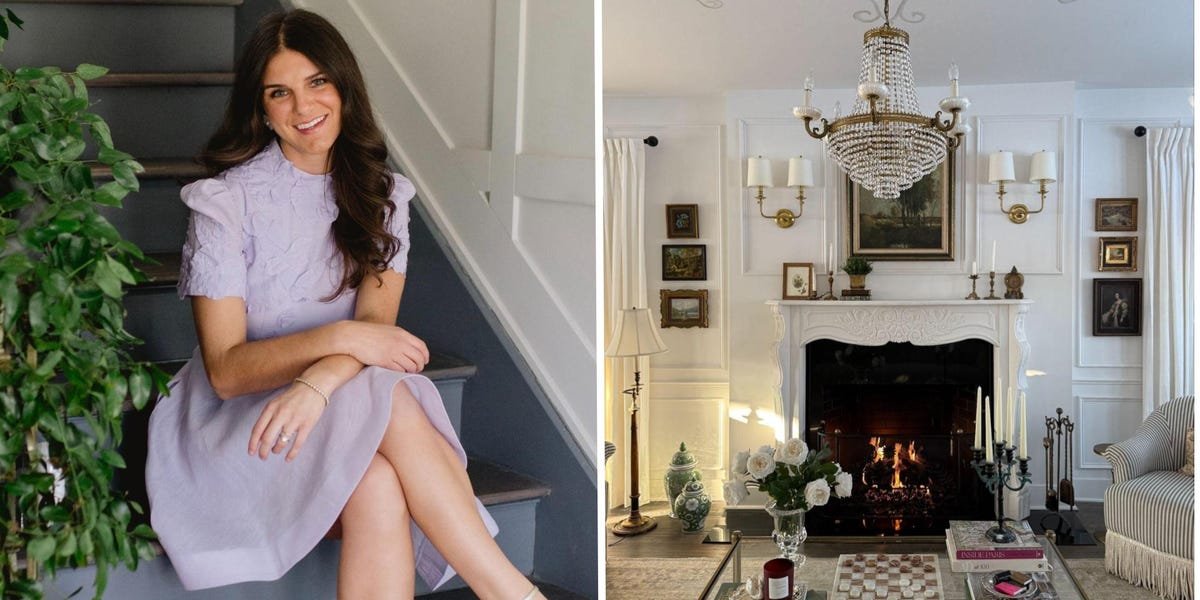
In the fall of 2023, Taylor and her family were living in a condo that they loved. They knew they would buy a bigger property someday, but they weren’t in a rush. Then the algorithmic fates stepped in when Taylor spotted a historic home on Zillow that was a little over 3,500 square feet and built in the 1920s.
“It wasn’t too far from where we were in Detroit,” she told Business Insider of the house. “It’s in a historic neighborhood in the city.”
Since the four-bedroom house was nearby, Taylor and her husband decided to take a look, driving by it before setting up an actual tour. For Taylor, it was love at first sight.
“The moment we drove up, I just had a good gut feeling about it,” she said. She fell even more in love when they saw the interior layout.
Taylor and her husband put in an offer, and soon, the house was theirs.
This story is available exclusively to Business Insider
subscribers. Become an Insider
and start reading now. Have an account? .
The US and Israel launched Operation Epic Fury against Iran on Saturday.
Iran’s retaliation involved strikes across six Gulf nations.
Photos taken during and after the strikes showed damage to a luxury hotel in Dubai and other spots.
The attacks launched by the US and Israel on Iran escalated on Saturday, with retaliatory strikes hitting nations across the Gulf.
Hours into what the Trump administration is calling Operation Epic Fury, Iran responded with attacks on more than six countries, from Dubai to Bahrain. Iran said it targeted bases that host US forces in the Middle East.
Satellite pictures also show extensive damage to Iranian Supreme Leader Khamenei’s residence. Khamenei was killed on Saturday, though it is still unclear if he was at the Tehran compound when it was struck.
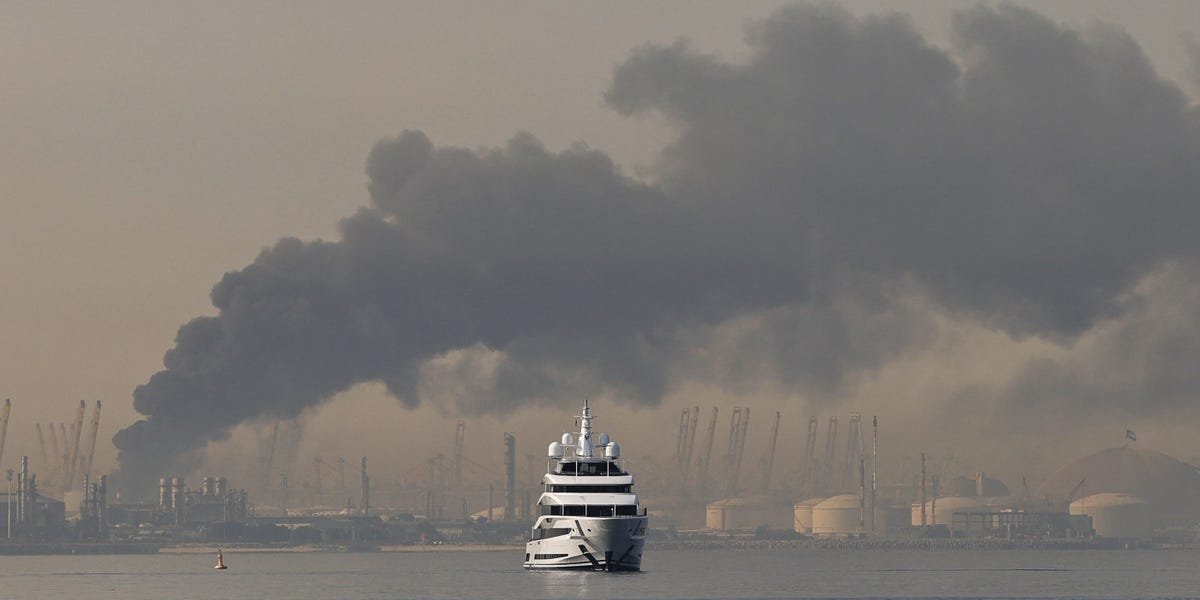
Intercepted missiles were seen streaking across the sky in Dubai, a tourist hotspot, and their debris appeared to spark fires and other issues. Fairmont’s famous luxury property on the Palm was hit.
Chaos was also abound at airports, amid mass flight cancellations as planes scrambled to clear the airspace over Iran.
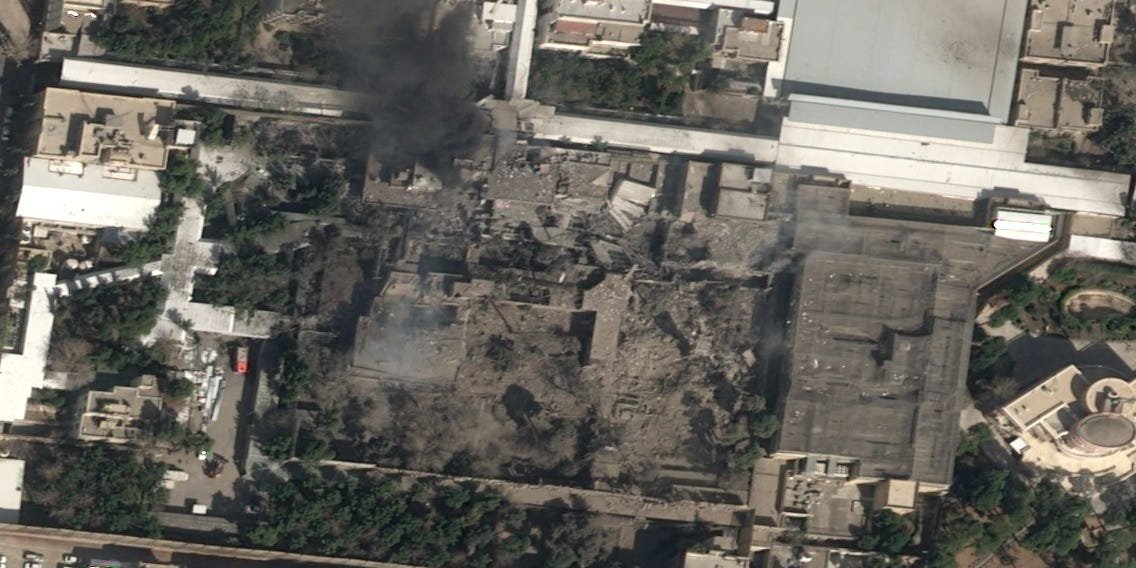
Satellite images captured after Saturday’s US and Israeli strikes on Tehran show that the residence of Iran’s supreme leader, Ayatollah Ali Khamenei, sustained severe damage.
The photos, provided to Business Insider by Airbus, show several collapsed buildings inside a compound in Tehran, which is known to be one of Khamenei’s main residences.
It’s unclear if the Iranian leader was present at the time of the strikes, though the US, Israel, and Iran all said that he was killed on Saturday.
It’s also not yet clear if it was Israel or the US that carried out this particular strike. Representatives for the Pentagon and Israel Defense Forces declined to comment on the hit when asked by Business Insider.
A cropped photo of the Leadership House in Tehran after the Saturday strikes.
Pléiades Neo (c) Airbus DS 2026
One of the heavily damaged buildings in the compound, at the bottom left of the image, is the House of Leadership, which is known as Khamenei’s office and principal place of residence.
In the images, smoke appears to be rising from its roof. Much of the compound has been obliterated, with felled trees and several more smoking buildings.
The large structure to the right of the compound is the Imam Khomeini Hussainia, a place of worship used by Iranian leaders for religious ceremonies and political speeches.
It’s unclear whether this larger building was also attacked, but what looks like debris can be seen on its roof.
A satellite image taken a year earlier shows the complex included at least six buildings, all of which are now damaged by the strikes.
This image from February 28, 2025, shows the complex a year before the strike.
Screenshot/Google Earth
A wider-angle view from another satellite image taken on Saturday appears to show that the strike was largely confined to Khamenei’s compound, which is located in the heart of the Iranian capital.
Smoke rises from Khamenei’s residence in a wider shot of the compound.
Pléiades Neo (c) Airbus DS 2026
The compound’s neighboring buildings appear to be intact.
This Google Earth image was taken on February 28 in 2025.
Screenshot/Google Earth
In a video address after the attacks began, President Donald Trump told Iranians to “take over your government.”
“It will be yours to take. This will be, probably, your only chance for generations,” Trump said.
The US and Israel began their attacks on Saturday morning local time, hitting Tehran and several other Iranian cities in what has been one of the largest strike campaigns in recent years.
The full outcomes of these strikes are still being assessed, and much remains unclear about Tel Aviv and Washington’s exact objectives behind the attacks.
Meanwhile, Iran has responded by firing dozens of ballistic missiles and drones at its neighbors, saying it is targeting US military bases.
Khamenei had been in power in Iran for almost 40 years as a powerful religious leader in Shia Islam, becoming the country’s ultimate authority in government and the military.
It remains to be seen how his death will impact the fate of Iran’s military, society, and government structure.
February 28, 2026: This story was updated to reflect the death of Khamenei, as confirmed by the US, Israel, and Iran.
This story is available exclusively to Business Insider
subscribers. Become an Insider
and start reading now. Have an account? .
Airports across the Middle East have suspended all flight operations until further notice, leaving many stranded.
The US and Israel launched strikes against Iran on Saturday, with Iran launching retaliatory strikes across the region.
One Emirates passenger told Business Insider he was stuck on a plane for five hours without food before everyone was deplaned.
Travelers are in limbo as airport departure boards flip to red after air strikes in Iran resulted in closed airspace and triggered mass flight cancellations.
The heart of the chaos is in the Middle East, where airports in Dubai, Doha, and Abu Dhabi serve as megahubs for global connecting traffic. Data from the aviation analytics firm Cirium shows their home airlines — Emirates, Qatar Airways, and Etihad Airways — carry a combined 90,000 transit passengers a day.
That figure does not include the thousands of travelers whose final destination is the Middle East.
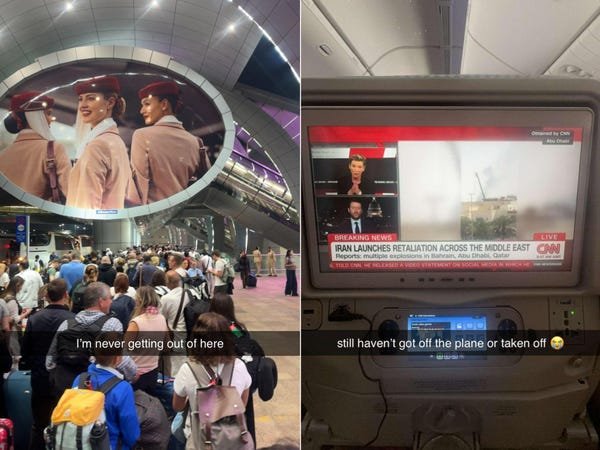
Emirates passenger Jaiveer Cheema, who was set to fly back home to the US on Saturday, told Business Insider that he was stuck on his plane for five hours with no food before everyone was deplaned and shuffled into the crowded terminal at Dubai International.
“The next several hours at the airport were chaos as no one knew what to do,” he said. “We spoke to several security guards and Emirates employees, and they all gave us different answers.”
Cheema said they stood in line after line until they eventually got a hotel voucher and took a bus to the lodging. He was still waiting for a room 90 minutes after arriving — it’s after midnight in Dubai; nearly 20 hours after he initially showed up for his 9 a.m. flight.
While many passengers are stranded within the region’s closed airspace, shuttered until further notice, the disruption has rippled far beyond it.
Flights to the affected region from places like London and the US have been canceled outright or diverted mid-journey — leaving travelers far from home in crowded airport terminals and uncertain when they will be able to depart.
Airlines have told passengers on social media to expect long wait times at airports and on customer-service phone lines as they try to manage the abrupt disruptions.
The sheer number of displaced people and planes on Saturday alone is expected to snowball worldwide if airports are unable to restart operations soon.
Passengers in Dubai were funneled into long snaking lines.
Jaiveer Cheema is one of the thousands of people stranded in limbo. Courtesy of Jaiveer Cheema
Cheema spent hours in line but managed to secure a hotel voucher — though he had yet to secure a room when talking with Business Insider. He said he did not have answers from Emirates on what’s next.
An Emirates spokesperson did not immediately respond to a request for comment from Business Insider.
Passengers at Beirut Rafic Hariri International Airport in Lebanon are stranded.
Passengers are stranded at Beirut Rafic Hariri International Airport on Saturday. Anadolu/Anadolu via Getty Images
Airlines are pivoting their operations in response to the strikes. Lufthansa Group said it is suspending flights to Beirut, Tel Aviv, Amman, Erbil, and Tehran until March 7.
Airlines are suspending flights across the region, including Lebanon.
Flight operations at the Beirut Rafic Hariri International Airport in Lebanon on Saturday. Anadolu/Anadolu via Getty Images
In a statement shared on the Lufthansa Group’s website, the company said it would also suspend flights in additional areas.
“The following airspaces will also not be used until March 7: Israel, Lebanon, Jordan, Iraq, Qatar, and Iran,” the aviation corporation said. “In addition, Lufthansa Group airlines will suspend flights to and from Dubai and Abu Dhabi, Riad, and Dammam until March 1. Furthermore, the airspace of the United Arab Emirates will not be used until March 1.”
International flights at Tribhuvan International Airport in Nepal were disrupted.
Passengers waiting at Tribhuvan International Airport in Nepal on Saturday. Navesh Chitrakar/REUTERS
The Tribhuvan International Airport shared a passenger advisory on Saturday, saying international flights “may be subject to delay, rescheduling, or cancellations” due to airspace restrictions.
Passengers flying with major airlines were told to check their flight status.
Passengers at Tribhuvan International Airport in Nepal on Saturday. Navesh Chitrakar/REUTERS
The Tribhuvan International Airport told passengers flying with major airlines — including Qatar Airways and Turkish Airlines — to coordinate with those companies to navigate travel issues.
Qatar’s airspace closure caused flight disruptions at Hamad International Airport.
Passengers at the Hamad International Airport in Qatar on Saturday. Stringer/REUTERS
Qatar’s Hamad International Airport said all aircraft movement has been temporarily suspended due to the country’s closed airspace.
“Our priority is always the safety of our passengers and employees. We are working closely with government stakeholders and airline partners to look after passengers that have been impacted,” the airport wrote in an advisory.
In London, flights to the countries Middle East were canceled.
The Emirates check-in counter at London Gatwick Airport shows that flights are cancelled on Saturday. Ben Stansall / AFP
Flights heading to the Middle East were also canceled at the London Gatwick Airport in England on Saturday.
London Gatwick Airport told some passengers to expect travel interruptions.
Passengers at London Gatwick Airport on Saturday. Ben Stansall / AFP
A London Gatwick Airport spokesperson told Sky News it’s “expecting disruption to our Qatar and Emirates flights.”
Are you a stranded traveler with a story to share? Contact the reporters at ledmonds@insider.com and trains@insider.com along with your preferred contact information.
This as-told-to essay is based on a conversation with Denny Balmaceda. It has been edited for length and clarity.
In February, I boarded my plane that would fly from Newark Airport in Jersey City to San Francisco. My business-class seat had been booked by a clothing brand I had been working for at the time. My seat on row 11 was a window seat with my own little nook, a treat for me, who usually flies in the economy seats.
As I settled in, neatly arranging my things in the compartment above my head and around my seat, a woman I didn’t recognize kindly asked if I would mind switching seats with her so she could sit next to her husband.
I quickly said, “Sure.” I know that in economy, this kind of question can produce mixed feelings, because if you’ve booked a window seat, you’re not going to want to switch to a middle seat. But in business class, all the seats are good, so I didn’t mind.
I hadn’t realized who her husband was
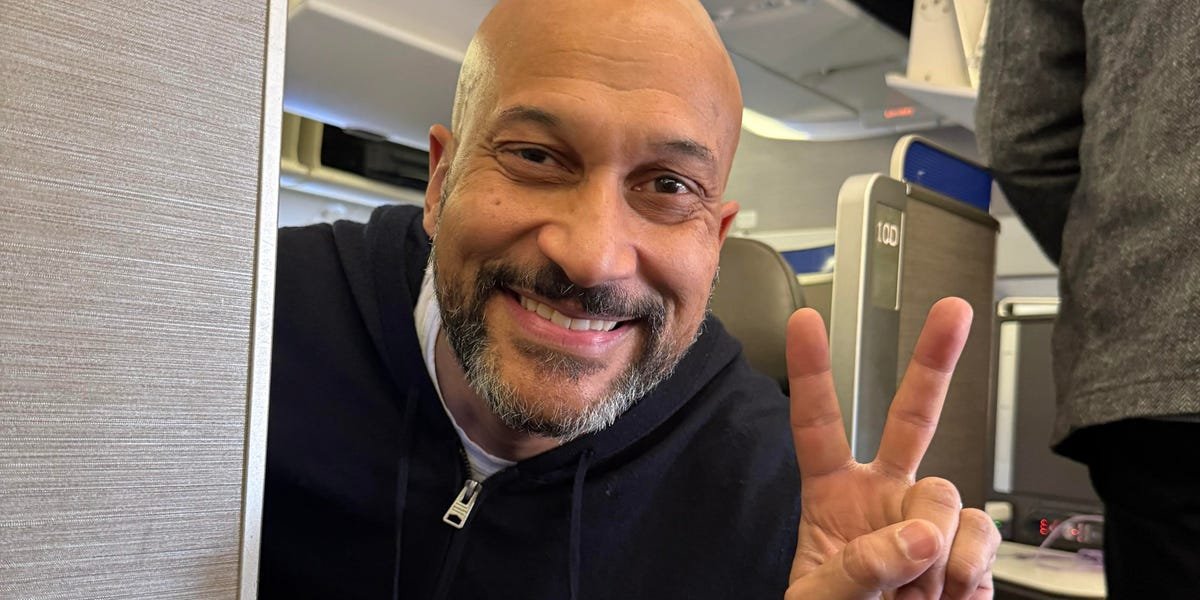
Just as I responded to her request, I looked up and saw Keegan-Michael Key. I was switching seats with his wife, so she could sit next to him. She continued, explaining she thought she had booked them to sit next to each other.
I took her seat in row 10, and she took mine in row 11.
So not only did I get to travel in business class — already a lot of fun for me — I also got to travel in front of a celebrity that I absolutely love. He’s literally one of my favourite actors.
Denny Balmaceda sat right in front of Keegan-Michael Key on a plane.
Courtesy of Denny Balmaceda
His wife leaned over and said Key would be happy to take a photo with me. He did, and he was so nice. Throughout the flight, he was the same with everyone who came up to him — a real gentleman.
He was so nice
Every single person who came up to him got his time and never once seemed annoyed. He talked to everyone and let people take photos with him.
When his wife needed help with anything, he helped.
And as the flight came to an end, I asked if he could grab my bag, and he didn’t flinch — he was fine with it.
There was no sense that he thought he was above anyone on that plane. He was just a real person who happened to be a celebrity.
Working in the fashion industry, I know there are both celebrities who are rude and those who just have bad days. I know that sometimes, people just want to be themselves without the fame. They just want to travel on planes and not be recognized. But he didn’t fit into any of these categories.
After the flight landed and before we went our separate ways, I took a couple of photos of us together to show my wife.
It was a one-in-a-million chance that I’d switch seats with someone famous, and I was very happy and surprised to get to experience it.
At the start of his Congressional deposition Friday, Bill Clinton addressed the trove of photos of himself with Jeffrey Epstein released by the Justice Department last year.
In opening remarks posted on social media, the former President said he didn’t have any knowledge of Epstein’s sex trafficking operation — despite anyone’s “interpretation of those 20-year-old photos.”
“I had no idea of the crimes Epstein was committing,” Clinton said of the convicted sex offender, who died in jail in 2019 while awaiting trial on sex-trafficking charges. “No matter how many photos you show me.”
Clinton posted the remarks ahead of his closed-door deposition in Chappaqua, New York, before members of the House Oversight Committee, which has been investigating Epstein’s connections to powerful people.
In December, in response to the Epstein Files Transparency Act, the Justice Department released several photos showing Clinton with Epstein and Ghislaine Maxwell, who is now serving a 20-year prison sentence for trafficking girls to Epstein for sex. The photos show Clinton and Maxwell swimming together in a pool, along with a woman whose face is redacted. They also show Clinton in what appears to be Epstein’s private jet with a female, whose face is redacted, on his lap.
The photos also show Bill and Hillary Clinton at parties and dinners with Epstein.
A photo of former President Bill Clinton, Ghislaine Maxwell, and an unidentified woman was included in the Justice Department’s Epstein files.
Department of Justice
The former president has long maintained he had no knowledge of Epstein’s sexual abuse. Epstein occasionally visited the White House while Clinton was president, and Clinton has said he traveled internationally with Epstein on his private jet four times between 2002 and 2003, following his presidency, for Clinton Foundation initiatives. There’s no indication the two were still in contact by the time Epstein pleaded guilty to soliciting prostitution from a minor in Florida in 2008.
“As someone who grew up in a home with domestic abuse, not only would I not have flown on his plane if I had any inkling of what he was doing — I would have turned him in myself and led the call for justice for his crimes, not sweetheart deals,” Clinton said in the opening statement of his deposition.
Maxwell appeared to have her own relationship with the Clintons.
Epstein files previously released by the House Oversight Committee include a photo of “Margaritaville” singer Jimmy Buffett, his wife, Bill Clinton, Ghislaine Maxwell, and Jeffrey Epstein.
House Oversight Committee
She worked to obtain funding for the Clinton Global Initiative, records released by the Justice Department show. Maxwell also said in an interview with Justice Department Deputy Attorney General Todd Blanche last year that she was closer to Clinton than Epstein was.
“President Clinton was my friend, not Epstein’s friend,” she said.
“President Clinton liked me, and we got along terribly well. But I never saw that warmth, or however you want to characterize it, with Mr. Epstein — so I didn’t see that,” Maxwell said in her interview. “I didn’t see President Clinton being interested in Epstein. He was just a rich guy with a plane.”
Bill Clinton’s deposition on Friday follows Hillary Clinton’s on Thursday. She said she didn’t think she ever met Epstein. She has said she met Maxwell on “a few occasions” in social settings.
Republicans on the House Oversight Committee said they would publicly release videos of the depositions of Bill and Hillary Clinton, as they did with a deposition of Les Wexner, the billionaire founder of L Brands, who previously hired Epstein as a financial fixer.
Clinton’s deposition marks the first time a former president has been compelled to testify to Congress pursuant to a subpoena.
Democrats on the committee say Clinton’s deposition marks a precedent that should require President Donald Trump, who has also been photographed with Epstein, to testify before the committee.
If you are a survivor of sexual assault, you can call the National Sexual Assault Hotline (1-800-656-4673) or visit its website to receive confidential support.
This story is available exclusively to Business Insider
subscribers. Become an Insider
and start reading now. Have an account? .
“Love Story” follows the doomed love story of JFK Jr. and Carolyn Bessette-Kennedy.
The show recreates several of Bessette-Kennedy’s iconic looks and timeless style.
The show’s costume designer was replaced after initial backlash to how star Sarah Pidgeon was styled.
The iconic style of Carolyn Bessette-Kennedy has been often imitated but never replicated — until now.
“Love Story,” which is produced by Ryan Murphy for FX, chronicles the fated relationship between John F. Kennedy Jr. and Carolyn Bessette-Kennedy, who died in a plane crash off the coast of Martha’s Vineyard in July 1999.
The series has drawn praise for its striking casting — with Sarah Pidgeon bearing an uncanny resemblance to Carolyn Bessette-Kennedy and Paul Anthony Kelly closely capturing the look of John F. Kennedy Jr. — as well as for its thoughtful costume design, which carefully recreates and honors Bessette-Kennedy’s real-life style.
Here’s a look at how the show recreated and paid homage to Carolyn Bessette-Kennedy’s style.
The series recreated an early Carolyn Bessette-Kennedy look down to the leather loafers.
Jenny Landy and Carolyn Bessette-Kennedy in New York City in 1995; Sarah Pidgeon filming “Love Story” in New York City. Patrick McMullan/Patrick McMullan/Getty Images; TheStewartofNY/GC Images
In this scene, before she meets John F. Kennedy Jr. for the first time, Carolyn (played by Sarah Pidgeon) wears a simple black turtleneck, flared black capri pants, and black leather loafers.
In both the show and real life, Bessette-Kennedy worked as a showroom assistant for Calvin Klein before rising the ranks to become head of publicity for the fashion house.
Despite marrying into American royalty, Bessette-Kennedy knew how to perfect a casual look.
JFK Jr. and Carolyn Bessette in New York City, and Paul Anthony Kelly and Sarah Pidgeon are seen on the set of “Love Story.” Mitchell Gerber/Corbis/VCG via Getty Images; Jose Perez/Bauer-Griffin/GC Images/Getty Images
She was often seen wearing loose Levi’s 517 jeans, her hair slicked back into a bun, with a simple monochromatic coat over the top.
When it came to recreating the New York City icon’s style, the series didn’t always nail it. Early leaked images from the set were criticized online for being too modern, fast-fashion-looking, and different from Kennedy-Bessette’s more upscale style.
In response to the backlash, the show brought in a new costume designer, Rudy Mance, who dedicated himself to making the costumes as accurate as possible.
“I get it. I’m protective of [John and Carolyn] as well. We all just wanted to be as precise and accurate as possible,” Mance told Variety.
Mance said he and his team studied for months throughout filming, comparing old paparazzi photos of the couple with the new looks he was creating for the show and pulling in as many archival and vintage pieces as possible to accurately recreate the look.
Part of Bessette-Kennedy’s enduring appeal was her dedication to a minimalist, understated style that felt polished yet effortlessly cool.
Carolyn Bessette-Kennedy in New York City; Sarah Pidgeon on the set of “Love Story.” Lawrence Schwartzwald/Sygma/Getty Images; Jose Perez/Bauer-Griffin/GC Images/Getty Images
“There’s so much mystery about Carolyn. My familiarity with her was through paparazzi images,” lead actor Sarah Pidgeon told Vogue.
Mance said that recreating Kennedy’s style before she was thrust into the public eye was the most challenging.
“Everybody knows what they wore from 1996 to 1999, but we were telling the story of how they met,” he said, according to Glamour.
Her formal looks remained simple but added a sexy edge, a balance “Love Story” tried to recreate.
Carolyn Bessette-Kennedy and JFK Jr. in 1998; Sarah Pidgeon in “Love Story.” Steve Eichner/Penske Media/Getty Images; FX Networks
Bessette-Kennedy often looked effortlessly sexy when she stepped out on red carpets, like in the strapless black Yohji Yamamoto gown photographed above. Pidgeon wears a similar dress for her meet-cute with Kelly in episode one of the series.
It was delicate work for Pidgeon to strike the same balance, especially when fans reacted strongly to early images of her in the role. However, the actor told Vogue she was ultimately grateful for the public feedback about her portrayal.
“The online conversations at the beginning of the process served as a reminder of how important it was to get our portrayal of Carolyn correct. She grew even more important to me,” Pidgeon told Vogue. “People really, really love Carolyn, and my priority every single day on set was doing justice to her legacy.”
And even when they were recreating simple outfits, the “Love Story” team ensured the fit was similar to what Carolyn would have worn.
Carolyn Bessette-Kennedy poses for a picture at a gala in 1999; Sarah Pidgeon in “Love Story.” Evan Agostini/Liaison/Getty Images; FX Networks
Although Bessette-Kennedy’s simple outfits could be recreated with off-brand designers — like the white blouse and floor-length black skirt by Yohji Yamamoto that she wore in 1999 — Mance was dedicated to finding archival pieces. Pidgeon was wearing true recreations of Bessette-Kennedy’s looks whenever possible.
He also ensured the pieces would fit Pidgeon similarly to how they fit Bessette-Kennedy, as Pidgeon told Vogue.
“We found her Prada and Valentino coats, and fitted some Levi’s so that they looked exactly how they fit Carolyn,” Pidgeon told Vogue.
By recreating the magic of Bessette-Kennedy’s wardrobe, the “Love Story” team offered a window into her world.
Carolyn Bessette-Kennedy in 1999; Sarah Pidgeon on the set of “Love Story.” Justin Ide/Getty Images; Jose Perez/Bauer-Griffin/GC Images/Getty Images
Kennedy’s clothes were always going to play a central part in her on-screen portrayal since style was so critical to her identity. However, Pidgeon said she hoped the clothes she wears offer a jumping-off point for the total woman she hopes to portray.
“She is known as this minimalist fashion icon, but I learned that she was also vivacious, funny, and had a wildness about her,” she told Vogue.
This story is available exclusively to Business Insider
subscribers. Become an Insider
and start reading now. Have an account? .
Thanks to the postwar Baby Boom and other factors, families in the ’50s began moving to the suburbs.
Levittown in Long Island, New York, is widely recognized as the first modern American suburb.
Each home looked the same — they were all built in the Cape Cod-style and cost around $7,000.
As World War II came to an end, families looked for ways to start over. Emboldened by the GI Bill’s provisions for home loans, they moved out of the cities in drovesfor newly developed suburban communities.
Levittown in Long Island, New York, was one of the first to introduce the idea of a pre-planned, mass-produced uniform suburban community, The New York Times reported. Families started moving there on October 1, 1947.
Though the community welcomed an influx of families, non-white prospects weren’t allowed. Notably, African Americans didn’t see the same benefits from the GI Bill, and it would take some years before racial and ethnic minorities broadly shifted to the suburbs.
Here’s what it was like to live in America’s first modern suburb in the 1950s.
Before the 1950s, people mostly lived in cities to be close to factory jobs.
Historical/Getty Images
At the time, most people lived close to the city center to work in factories, or they lived in rural communities to work on farms, according to economist Jay Zagorsky.
Everything changed in the 1950s when soldiers returned from World War II, sparking the great migration to the suburbs.
Irving Haberman/IH Images/Getty Images
The 1950 Census found that 60% of people lived in cities, while 40% lived in the suburbs.
Thanks to factors like the construction of highways, the development of new neighborhoods from farmland, and even safety in the event of an atomic attack, these percentages would soon shift drastically.
The GI Bill made it easier to afford a new home, prompting this transition from urban to suburban.
Newsday LLC/Getty Images
The GI Bill provided each returning soldier with benefits designed to stimulate economic growth. Each soldier was given a year of unemployment and free tuition to go to college. The military pledged to back all home loans, which allowed veterans to buy houses with little to no down payments.
The Baby Boom started at the same time, causing many families to outgrow their city apartments.
Joseph Scherschel/Getty Images
Shortly after WWII ended, the Baby Boom began. In 1946, 3.4 million babies were born, more than ever before, and 20% more than in 1945, per History.com. This trend continued into the ’50s.
By the end of the boom in 1964, this generation made up 40% of the country’s population.
Most historians think it was because Americans were eager to have families after having postponed marriage and childbirth because of the Great Depression and World War II.
Whatever the reason, people flocked to the suburbs to accommodate their growing families.
In response to this growing need for space, suburban communities popped up at a faster rate in the ’50s.
An aerial view of a suburban community. Hulton Archive/Getty Images
During the war, factories focused on creating wartime essentials, like airplanes and barracks. In the ’50s, they refocused their efforts on building home components and automobiles using the new practices — like the assembly line — they implemented in the war,
As a result, factories were able to produce materials for homes faster than ever before.
Levittown in Long Island, New York, is widely recognized as the first modern American suburb.
Tony Linck/Getty Images
Levitt and Sons, a construction company, purchased a 7-square-mile plot of potato and onion farms in Long Island in 1947. They set out to build one of the first uniform suburban communities in the US.
People flocked to home sale events to get themselves a slice of suburbia.
Al Fenn/Getty Images
The first homes in Levittown cost new residents around $7,000, The Guardian reported. For veterans, there was no down payment.
When adjusting for inflation, a Levittown home in 1950 would be roughly $97,000 in today’s money.
Every house in Levittown was identical. The Levitt family called it “the best house in the US.”
Joseph Scherschel/Getty Images
At first, all the homes were built in the same style, and some residents even admitted to walking into the wrong house at times because they couldn’t tell them apart, according to Khan Academy, citing Kenneth T. Jackson’s “Crabgrass Frontier: The Suburbanization of the United States.”
Outdoor spaces, like backyards, became focal points.
Robert W. Kelley/Getty Images
With the growing number of children, outdoor spaces became increasingly important to the suburban neighborhood.
Inside each home, there were four rooms, a built-in TV set, and Hi-Fi for the radio.
Joseph Scherschel/Getty Images
At first, they were modest homes, but most families saw their new suburban lives as luxurious.
Most Levittown residents experienced the responsibilities of owning a home for the first time.
A man and a woman clean opposite sides of a window. Many homeowners experienced the responsibilities of owning a home for the first time. Newsday LLC/Newsday via Getty Images
Many Levittown homeowners learned homeownership responsibilities, such as tending to a lawn.
The suburb helped cement the idea of the “nuclear family” in American culture.
Levittown also had seven shopping centers.
Underwood Archives/Getty Images
The shopping centers were called “village greens” and were designed to make the town more of a bustling community, per Encyclopedia.com.
The suburbs were also known for being a safe alternative to the gritty city streets.
Joseph Scherschel/Getty Images
Since the streets in the suburban neighborhood were considered safer than those in the city, parents used to allow children to bike around by themselves, per the National Center for Safe Routes to School.
Levittown was also known as a cheaper option compared to an apartment in the city.
Bernard Hoffman/Getty Images
The mortgage on a home in Levittown was reportedly about $29 per month, while most paid $90 per month in the city.
By comparison, the average rent in New York City in 2026 is just under $3,500, according to Zillow. The monthly cost of a 30-year mortgage on a Levittown home today would be roughly $2,000.
With all the amenities and perks, the community grew rapidly. In less than a decade, the population of Levittown reached 82,000.
Bettmann/Getty Images
The community has over 17,000 homes, making it one of the largest private housing projects in the history of the US.
As a result, Levittown became a model for other suburban communities in the US during the 1950s.
A suburban community in the 1950s. Joseph Scherschel/Getty Images
Suburban home construction boomed in the 1950s. In fact, at least 15 million units were under construction by the end of the decade, according to the Wealth Management Group.
Although suburban communities boomed in the ’50s, the shift was reserved for white Americans.
Joseph Scherschel/Getty Images
For years, there were rules that restricted minorities from buying homes in Levittown, and even as the Civil Rights Movement was starting to take form and the rest of the country began integrating after Brown v Board of Education in 1954, Levittown remained mostly white.
Two-thirds of Levittown residents today are white, according US Census estimates.
Some of the few non-white families resisted this standard.
Some non-white residents like William Cotter and his family fought against Levittown’s whites-only standard. Newsday LLC/Newsday RM via Getty Images
In 1952, William Cotter, a Black man, and his family, sublet a home at 26 Butternut Lane. When the lease was up, Levitt refused to renew it or sell them the home.
The refusal sparked support for the Cotters, and the family eventually purchased another home from a white homeowner.
With modern highways leading to the suburbs, men commuted into the city.
New highways leading to the suburbs didn’t come without traffic. Newsday LLC/Newsday via Getty Images
The suburban boom corresponded with the expansion of interstate highways in the US, starting the modern iteration of the commute from the suburbs to the city.
In 1950, 80% of men in Levittown commuted to Manhattan for work, The Guardian reported.
During a typical day, the streets of Levittown were filled with women, as the men were mostly working in the city.
Bettmann/Getty Images
When men left to fight in WWII, women began entering the workforce, gaining newfound independence and freedom. However, they were suddenly expected to give this up again and instead focus on childbearing and rearing.
In 1963, author Betty Friedan wrote in “The Feminine Mystique” that the suburbs “were burying women alive.” However, some believe that women’s dissatisfaction with staying home “contributed to the rebirth of the feminist movement in the 1960s,” History.com reported.
Women also got active in civic engagement.
Women and children protest in favor of new stop signs. Newsday LLC/Newsday RM via Getty Images
In 1959, women of Levittown, with children in hand, protested in favor of putting stop signs in an area with automobile-related deaths.
Levittown became a symbol of prosperity and anticommunism in American politics and culture.
William J. Levitt speaks with three senators. Bettmann/Bettmann Archive/Getty Images
As American politics increasingly centered on anticommunism and Cold War tensions rose, Levittown and suburbs like it took on a symbolic meaning in American culture, representing prosperity and the “American Dream.”
Levitt was once quoted saying, “No man who owns his own house and lot can be a Communist. He has too much to do.”
In 2026, Levittown is still a sizable community with a population of about 50,000. Though it’s full of modern businesses and technology, the community still holds a legacy as a post-war suburban haven.
This story is available exclusively to Business Insider
subscribers. Become an Insider
and start reading now. Have an account? .
The White House released a new official portrait of President Donald Trump in June.
The dramatically lit photo shows Trump against a dark backdrop with a serious expression.
Unlike most contemporary presidential portraits, the background doesn’t include an American flag.
President Donald Trump’s official White House portrait does not feature an American flag in the background — it’s the first presidential photo in over 60 years without one.
Taken by chief White House photographer Daniel Torok, the dramatically lit photo shows Trump against a dark backdrop with a serious expression. The style hearkens back to the past presidential portrait styles of Presidents Franklin D. Roosevelt, Herbert Hoover, and Calvin Coolidge, who also appeared unsmiling against dark backgrounds.
And while there is no flag behind Trump in his new portrait, he is wearing an American flag pin on the lapel of his blue suit, a tradition that began with President George W. Bush’s photo.
A portrait of Trump released earlier last year, which did feature an American flag, was taken during the presidential transition period and “was always meant to serve as a placeholder,” a White House official told Business Insider.
The new photo is one of several aesthetic changes Trump has made to the White House in his second non-consecutive term. In the Entrance Hall, he moved President Barack Obama’s painted White House portrait across the hall and replaced it with a painting depicting his raised fist following an assassination attempt. He has also added numerous gilded gold furnishings to the Oval Office and paved over the lawn in the Rose Garden to create a terrace he said would be better suited for large events.
Take a look at how presidential portraits have changed through the years.
President Calvin Coolidge, 1923
A portrait of President Calvin Coolidge. Library of Congress
President Herbert Hoover, 1929
A portrait of President Herbert Hoover. Underwood & Underwood
President Franklin D. Roosevelt, 1933
An official portrait of President Franklin D. Roosevelt. Elias Goldensky/Library of Congress
President Harry Truman, 1945
President Harry Truman’s official White House portrait. Keystone-France/Gamma-Keystone via Getty Images
President Dwight Eisenhower, 1953
President Dwight Eisenhower’s official White House portrait. Keystone-France/Gamma-Keystone via Getty Images
President John F. Kennedy, 1961
President John F. Kennedy’s official White House portrait. Bachrach/Getty Images
President Lyndon B. Johnson, 1963
President Lyndon B. Johnson’s official White House portrait. Official White House photo
President Richard Nixon, 1969
President Richard Nixon’s official White House portrait. Official White House photo
President Gerald Ford, 1974
President Gerald Ford’s official White House portrait. Official White House photo
President Jimmy Carter, 1977
President Jimmy Carter’s official White House portrait. Official White House photo by Karl Schumacher
President Ronald Reagan, 1981
President Ronald Reagan’s official White House portrait. Official White House photo
President George H.W. Bush, 1989
President George H.W. Bush’s official White House portrait. Official White House photo by David Valdez
President Bill Clinton, 1993
President Bill Clinton’s official White House portrait. Official White House photo
President George W. Bush, 2001
President George W. Bush’s official White House portrait. Official White House photo by Eric Draper
President Barack Obama, 2009
President Barack Obama’s official White House portrait. Official White House photo by Pete Souza
President Barack Obama, 2013
President Barack Obama’s second official White House portrait. Official White House photo by Pete Souza
President Donald Trump, 2017
President Donald Trump’s first White House portrait. Official White House photo by Shealah Craighead
President Joe Biden, 2021
The official portrait of President Joe Biden, taken in the Library room at the White House. Official White House photo by Adam Schultz
President Donald Trump, 2025
President Donald Trump’s second official White House portrait. Official White House photo by Daniel Torok
President Donald Trump, 2025
Donald Trump’s new White House portrait. Official White House photo by Daniel Torok
Ford is undergoing a radical factory overhaul to compete with Chinese automakers. Its CEO just offered a peek inside.
On Thursday, Ford CEO Jim Farley shared four behind-the-scenes photos on X of engineers working on the automaker’s Universal Electric Vehicle project. It’s a new platform and manufacturing system designed to underpin a family of smaller, lower-cost EVs.
Farley described the effort as “one of the most audacious and important projects in Ford’s history.”
“American innovation is how we compete and win against China and the rest of the world,” Farley wrote in the post.
The update adds new detail to Ford’s sweeping rethink of how it designs and assembles electric vehicles, as Chinese EV makers — led by BYD, now the world’s largest EV seller — rapidly expand in foreign countries with lower-priced models.
Every time Ben publishes a story, you’ll get an alert straight to your inbox!
Stay connected to Ben and get more of their work as it publishes.
An early peek at our brilliant team working on the Universal Electric Vehicle project – one of the most audacious and important projects in @Ford‘s history. American innovation is how we compete and win against China and the rest of the world.
Farley’s photos focus on the first vehicle expected to launch on the platform: a midsize electric pickup truck starting at $30,000. They show Ford employees working on vehicle prototypes — and reveal an early look at what appears to be its grille-less design.
The company confirmed to Business Insider that it plans to launch the vehicle in the US in 2027.
“A Ford team member working on the front end of a prototype – one of the hundreds of prototypes the team has designed and developed to shape the face of the truck over the last few years,” Farley wrote about one of the images.
Engineers are spending “countless hours” refining the truck’s aerodynamics, Farley said.
A massive manufacturing re-think
The manufacturing changes behind the vehicle may be even more significant than the design itself. Farley unveiled the new manufacturing plan during an August event dubbed the “Latest Model T Moment.”
Unlike the traditional assembly line — a single, linear conveyor made famous by Ford’s 1908 launch of its first mass-produced car, the Model T — the new system uses a three-pronged “assembly tree” approach. Separate lines build the front, rear, and battery underbody of the vehicle in parallel before they are joined later in the process.
Ford says the redesigned system uses 25% fewer fasteners and roughly half as many cooling hoses and connections.
Other images from Farley’s post show the factory’s new unicasting system — which Farley says reduces the number of vehicle parts — and engineers working on new designs.
Fewer parts could mean lower car prices, the company said in August.
Responding to billion-dollar pressures
The push comes as Ford makes costly changes to its EV strategy. In December, the company discontinued the F-150 Lightning pickup and scrapped plans for a large all-electric commercial van, recording a $19.5 billion write-down tied to canceled EV programs.
Going forward, Ford plans to focus on smaller, more affordable electric vehicles, as well as extended-range electric vehicles, or EREVs, which pair electric drivetrains with onboard gas generators.
The strategy reflects mounting pressure from China’s EV industry. BYD overtook Tesla last year to become the world’s top EV seller. Chinese EV sales have been gaining momentum across Europe — and last month, Canadian officials announced plans to lower tariffs on Chinese-made cars.
That momentum could prompt further changes at Ford. Earlier this week, Reuters reported that Ford is in advanced talks with China’s Geely about potential manufacturing cooperation.