

When-my-kids-got-their-first-phones-at-10-I.jpeg

When my kids got their first phones at 10, I made them sign a physical contract. They’re teenagers now, and it’s still binding.

When my oldest daughter turned 10, many of her friends were already getting phones. At the time, I was working as a middle school teacher, and I had a front-row seat to what constant screen time was doing to my students. I saw rising anxiety, shortened attention spans, and social dynamics that played out more online than in real life. It made me pause.

My husband and I weren’t against technology, but we knew we didn’t want to rush into it. Instead, we decided to introduce it carefully and on our terms.

Before our daughter got a phone, we created a simple contract for her to sign, and when our son reached the same age two years later, we followed the same approach. They’re now teenagers, and that contract still works.

The contract introduced phone expectations early on

On their 10th birthday, each of our children received their first phone. From the outset, they knew it came with expectations, and everything was laid out in a simple contract that they had to read, agree to, and sign.

The contract was simple and included rules that many families struggle to enforce consistently: phones don’t go into bedrooms (unless it’s FaceTime and the door stays open), devices are taken away between 8 and 9 p.m., and social media is limited until they’re older. There are occasional exceptions for travel, sleepovers, or special events, but the structure has stayed the same for years.

What surprised me most was that the contract didn’t just control screen time; it removed the daily arguments. The expectations were clear from the beginning, and because the kids signed it themselves, it felt less like punishment and more like an agreement. Now that they’re teens, we still follow the same framework.

How framing the phone as a ‘rental’ changed our kids’ mindset

Although we gave our children phones as gifts, we were clear about one thing: the phones were rentals. It belonged to my husband and me, not to them.

My husband and I agreed we would always have full access to the phones. We didn’t want any confusion about ownership, and more importantly, we wanted to protect our kids as they began navigating the online world. Setting that expectation early helped us avoid arguments later.


Naomi Tsvirko and her family sitting on a bench

The author (second from left) allowed her 10-year-old kids have cellphones. 

Courtesy of Naomi Tsvirko


When my daughter or son challenges me about access to their phone, I simply pause and remind them of the contract terms.

“Who does the phone belong to?” I ask, and they often fall silent, knowing I will follow through on taking away the privilege of a phone at any point.

Our children are surprisingly grateful not to have phones in their bedrooms

It’s not often that our kids admit we’re doing something right in real time, but this is one thing they both appreciate.

When my daughter came back from a sports camp, she told me she hadn’t slept well because her phone was in her room. Even though she wasn’t using it, she said its presence made it harder to relax.

My son has never asked to keep his phone overnight and values the structure around protecting sleep, especially since he plays travel ice hockey and is often exhausted after practice.

How the system evolved as our kids became teenagers

Like most parenting moments, curveballs are expected, so as my kids got older and we got busier, we became more relaxed about how long they could FaceTime their friends (especially during the pandemic and occasional later nights).

One change that made a big difference was introducing a lockbox. Instead of taking phones away each night, we lock them up. It removes the need for negotiation and helps everyone switch off.

In the morning, the phones stay locked away until basic routines are done, their beds made, breakfast eaten, and chores are complete. Then I unlock the box.

Becoming a low-screen family takes a lot of effort, but it’s worth it

We know no system is perfect, but parenting in the modern world of phones means we are doing our best, knowing that there are so many variables in how our children grow up.

We’re not a no-screen family, but we are intentional about being a low-screen one. We understand the benefits of technology, but we’re also realistic about the downsides.

The contract gives our kids freedom within clear boundaries, like a river that stays on course. And years later, that balance still holds.


Source link

The-guy-who-designed-the-iPhone-helped-craft-the-interior.jpeg

The guy who designed the iPhone helped craft the interior of Ferrari’s first EV — and it’s full of physical buttons and knobs

  • Former Apple designer Jony Ive’s firm worked together for five years to fashion the new Ferrari interior.
  • The sports car has tons of physical buttons that Ferrari says enhance “tactility” and reference its legendary racing history.
  • The Italian brand has also unveiled a new name for its EV project: it’s now called the Luce.

Jony Ive designed the iPhone, which famously ditched most of a phone’s physical buttons for virtual ones. His take on the new Ferrari interior shows a very different approach.

Ferrari has spent five years working with LoveFrom, the design studio founded by Ive and fellow Apple design alum Marc Newson, to shape the interior of its first EV, the Luce.

The result is a button-heavy, screen-forward cabin that blends Ferrari’s performance ethos with high-end, Apple-style minimalism.

Ferrari hasn’t released photos of the exterior or a full list of specs, but earlier disclosures suggest the Luce will be a four-door, four-seat electric car capable of reaching 60 mph from a standing start in 2.5 seconds. It’s expected to have a 330-mile range.

The Luce marks Ferrari’s leap into electrification — with an interior wrapped in Ive’s distinctive design language. Here’s what the interior looks like.

A five-year partnership to build a classic racer – but with a battery.

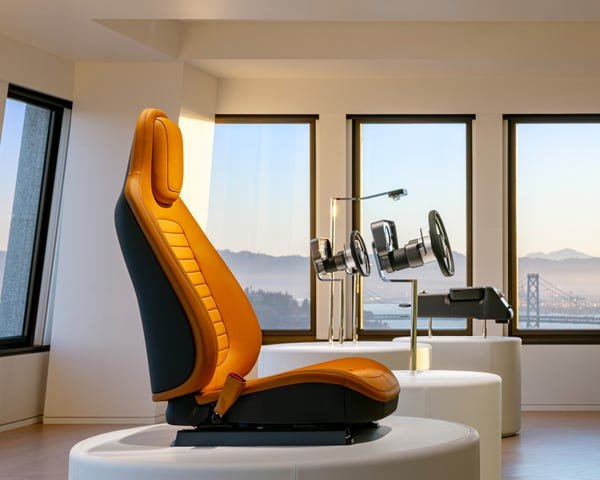
Ferrari’s all-new EV will feature an interior with elements designed by LoveFrom, a creative collective founded by Jony Ive and Marc Newson.

Ferrari

Ferrari — long synonymous with grunting, high-performance racers — is moving into the near-silence of electric power.

To guide that transition, the automaker worked with LoveFrom to refine the interior’s materials, shapes, and controls.

The result looks nothing like most EVs. The Luce’s cabin is lined with tactile hardware — rows of machined-metal toggles and physical switches designed to be clicked, not swiped.

For any curious Apple fans, there are some familiar flourishes: brushed aluminum, slim leather surfaces, and a minimalist layout.

Oh, wow. Buttons on the steering wheel!


A black and silver steering wheel with a yellow Ferrari logo in the middle.

The new Ferrari will have a ton of interior buttons, including on the steering wheel. The company said its focus is on “tactility, clarity, and intuitive interaction.”

Ferrari

The slim, three-spoke steering wheel keeps things simple — starting with directional controls mounted directly on the wheel.

More buttons sit beneath the silver spokes, putting most core functions within thumb’s reach.

On the left are controls for cruise, drive modes, and dash lighting. On the right are power modes, suspension settings, and wipers.

Volume and track controls are tucked behind the wheel, while paddles manage torque delivery, mimicking the engagement of traditional gear changes. Even in an EV, Ferrari wants drivers to feel like they’re choosing their own gears.

An almost Apple-like tablet in the middle — but with knobs and switches.


An overhead shot of the Luce's interior. It shows the driver-focused angle of the infotainment screen and the brown leather seats.

The Luce’s interior features familiar design cues for iPhone users: the infotainment system has curved edges similar to Apple’s products and blends side-mounted physical buttons for added control.

Ferrari

The center infotainment display looks a bit like an oversized Apple Watch. Ferrari’s system comes complete with fan-speed settings, heated-seat controls, and a built-in circular clock.

The tablet-like screen sits on a ball-and-socket joint, allowing it to swivel toward either the driver or the passenger.

Ferrari also says the silver bar below the screen is a palm rest — perfect for drivers to stabilize their hand while switching Spotify playlists in a sharp corner.

Glass all around — and a funky key option.


A small gear selector next to a Ferrari-badged square key.

Ferrari will use high-strength glass to make its gear selector.

Ferrari

Ferrari is leaning heavily into glass for the Luce’s interior, using Corning Gorilla Glass across many hard surfaces — including the gear selector.

The company says the material is more crack-resistant than typical smartphone glass and is designed to withstand scratches from daily use.

There’s also a touch of whimsy in the key fob. The square Ferrari badge is the key: slot it into the console, and the glass fob turns black, disappearing into the surrounding trim.

Pick it up and walk away, and it glows Ferrari’s signature racing yellow.

A helicopter-like speed-reader.


The dashboard with three circular gauges. They all have white and yellow numbers and meters.

Ferrari said its instrument cluster mixed digital interfaces with “historic automotive cues.”

Ferrari

The gauge cluster behind the steering wheel takes inspiration from helicopter cockpits.

Ferrari says the digital display is mounted directly to the steering column, keeping critical high-speed information locked in the driver’s line of sight.

The setup is also a first for Ferrari.

At the center is a hybrid speedometer: a physical needle floating over layered digital driving data, all viewed through a curved lens. While most modern cars have abandoned analog needles entirely, Ferrari kept one — blending old-school driving cues with a fully digital display.

An all-new name for the all-new EV.


A black

Ferrari is changing the name of its all-electric project. The car was initially called the Elettrica, but will now go by the name Luce.

Ferrari

Ferrari first revealed its all-electric project in October 2025 under the working name “Elettrica.” Now, it has an official name: the Luce (pronounced LOO-che).

In Italian, luce translates to “light.”

The next reveal will come in May.


Five men in a yellow room in front of a Ferrari badge. They're all next to design tables with a smattering of interior parts.

Ferrari executives (from left – CEO Benedetto Vigna, Chairman John Elkann, and design chief Flavio Manzoni) partnered with LoveFrom’s design leads, Jony Ive (in blue) and Marc Newson (in red).

Ferrari

The partnership between Ferrari and LoveFrom — first reported in 2021 — resulted in an interior designed to signal the automaker’s ambition to reimagine the electric-car experience from the ground up.

It’s an unusual move for Ferrari, which rarely brings in outside design firms.

“The team focused on perfecting and refining every solution to its purest form,” the automaker said in a press release.

The rest of the car, which was developed in-house, will be revealed in May. Ferrari has not confirmed pricing or availability for the new EV yet.


Source link