
Lauren Edmonds Profile Photo

How Disney picks its AI copyright battles depends on who’s ripping it off

No, Disney did not release footage of a never-before-seen fight sequence between Marvel’s Wolverine and Thanos (spoiler: Thanos won).

That clip, which amassed over 142,000 views on X over 48 hours, was created using Seedance 2.0, an AI video generation model that ByteDance debuted last week. The tool created a buzz on social media, where one user made a hyperrealistic AI video of Tom Cruise and Brad Pitt fighting over Jeffrey Epstein.

ByteDance’s decision to let users create content based on Disney’s IP without permission isn’t all that surprising given the AI industry’s well-established strategy to “ask for forgiveness, not permission.”

Disney, which is infamous for aggressively protecting its intellectual property, isn’t having it — though how it responds to the threats is not always the same.

On Friday, the entertainment company sent ByteDance, the Chinese company that owns Seedance and TikTok, a cease-and-desist letter, a source familiar with the matter confirmed for Business Insider.

In the letter, Disney accused ByteDance of supplying Seedance 2.0 with “a pirated library of Disney’s copyrighted characters from Star Wars, Marvel, and other Disney franchises, as if Disney’s coveted intellectual property were free public domain clip art.”

“Over Disney’s well-publicized objections, ByteDance is hijacking Disney’s characters by reproducing, distributing, and creating derivative works featuring those characters,” the letter said.

Seedance is only the latest AI company Disney says is ripping it off.

Disney and NBCUniversal sued Midjourney, an AI image generator, in June last year. In the lawsuit, the companies compared Midjourney’s tech to “a virtual vending machine, generating endless unauthorized copies of Disney’s and Universal’s copyrighted works.”

Then Disney accused Character.AI of copyright infringement in a September cease-and-desist letter last September. In December, it sent one to Google in response to the AI image generator Nano Banana Pro and its other AI models, accusing the Big Tech giant of stealing its IP on a “massive scale.” Both companies have since removed Disney characters from their platforms.

Disney is not anti-AI, however, and its strategy is not one-size-fits-all. The company took a much less adversarial approach with OpenAI, the world’s leading AI startup.

When OpenAI debuted Sora 2, an AI-powered text-to-video platform, in September, users began uploading IP-heavy content featuring Disney characters to social media. Instead of a cease-and-desist letter or legal action, though, Disney negotiated a deal.

By December, Disney and OpenAI had announced a three-year licensing agreement that gives Sora users, with some guardrails, access to 200 Disney characters. As part of the deal, Disney would also invest $1 billion in OpenAI.

Although Disney hasn’t shared plans to develop its own AI model or video generator, Disney CEO Bob Iger said the company ultimately sees the tech not as a threat but as a new path to connect with audiences.

During an earnings call late last year, he said AI would “provide users of Disney+ with a much more engaged experience, including the ability for them to create user-generated content, and to consume user-generated content, mostly short form, from others.”


Source link

B-52-bomber-crew-picks-up-award-for-pulling-their-plane.jpeg

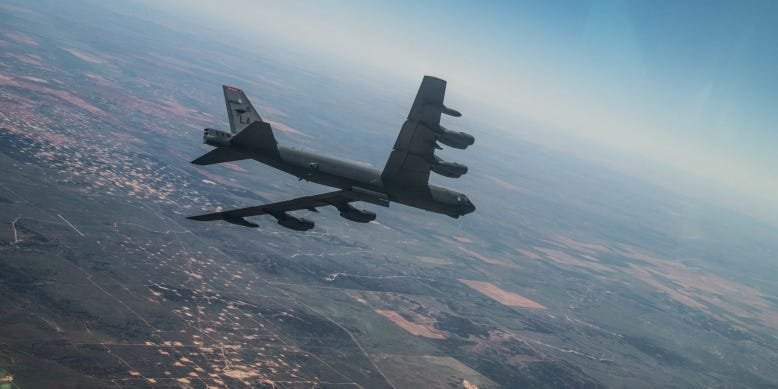
B-52 bomber crew picks up award for pulling their plane out of life-threatening ‘catastrophic’ failures at 1,200 feet

A US Air Force B-52 bomber crew received an award for pulling off an exceptional recovery during a life-threatening emergency.

“All the systems kicked off at once, and the aircraft went completely dark, engines flamed out, and controlling the aircraft became a battle,” Capt. Matthew Walls, one of three aircrew members aboard the B-52H Stratofortress bomber at the time, described in a Thursday press release.

As the heavy bomber’s crew was navigating around severe thunderstorms on their way to Barksdale Air Force Base in Louisiana on December 13, 2022, the aircraft, Scout 94 went into an uncontrolled roll.

Two of the plane’s electrical generators were off, four of the bomber’s engines gave out, and the aircraft was descending quickly while decelerating below normal approach speed.

Walls recalled that the emergency, which happened as they were making preparations to land the plane, “was sudden and caused brief but extreme disorientation to myself and the other crew members.”


Capt. Charles Powell, 11th Bomb Squadron director of staff, Lt. Col. John Conway, Air Combat Command TRSS Detachment 13 commander, and Capt. Matthew Walls, 343 Bomb Squadron unit deployment manager, stand for their photo in front of a B-52H Stratofortress June 3, 2024 at Barksdale Air Force Base, La. They recently earned the Air Force Global Strike Command General Curtis E. LeMay award for the outstanding bomber crew category for overcoming multiple failures during a flight, but still managing to land the aircraft safely.

Capt. Charles Powell, 11th Bomb Squadron director of staff, Lt. Col. John Conway, Air Combat Command TRSS Detachment 13 commander, and Capt. Matthew Walls, 343 Bomb Squadron unit deployment manager, stand for their photo in front of a B-52H Stratofortress June 3, 2024 at Barksdale Air Force Base, La.

Airman 1st Class Rhea Beil


Capt. Charles Powell attempted to restart the engines and managed to bring back two of the four that had given out.

Lt. Col. John Conway, another crew member, said “the reason Captain Powell was able to recover the aircraft safely is because he has trained to a six-engine approach many times and holds himself to a high standard when he trains.”

He added that “Capt. Powell and Capt. Walls both performed admirably and with immense poise that day.”

The bomber lost its engines on one side. Shortly after the two engines restarted, the crew was able to make an unusual turn back against the roll, declare an emergency, and achieve a safe landing with assistance from air traffic control.

The crew’s actions were significant, as they successfully recovered the unwieldy aircraft at a low altitude of just 1,200 feet while flying over a populated area in Bossier City.

“The Scout 94 crew overcame multiple catastrophic failures to safely land the aircraft, averting potential disaster in the air and on the ground,” the Air Force said.

During the 2023 Air Force Global Strike Command Operations Awards, the B-52 crew received the Air Force Global Strike Command General Curtis E. LeMay Award in the outstanding bomber crew category.

“I’m very proud of how we handled the situation,” Walls said of the emergency that lasted only minutes but required a quick response. “It was fast and intense, and there wasn’t time for discussion, just action. In my opinion, everyone fell into their role and did what was required.”


Source link