
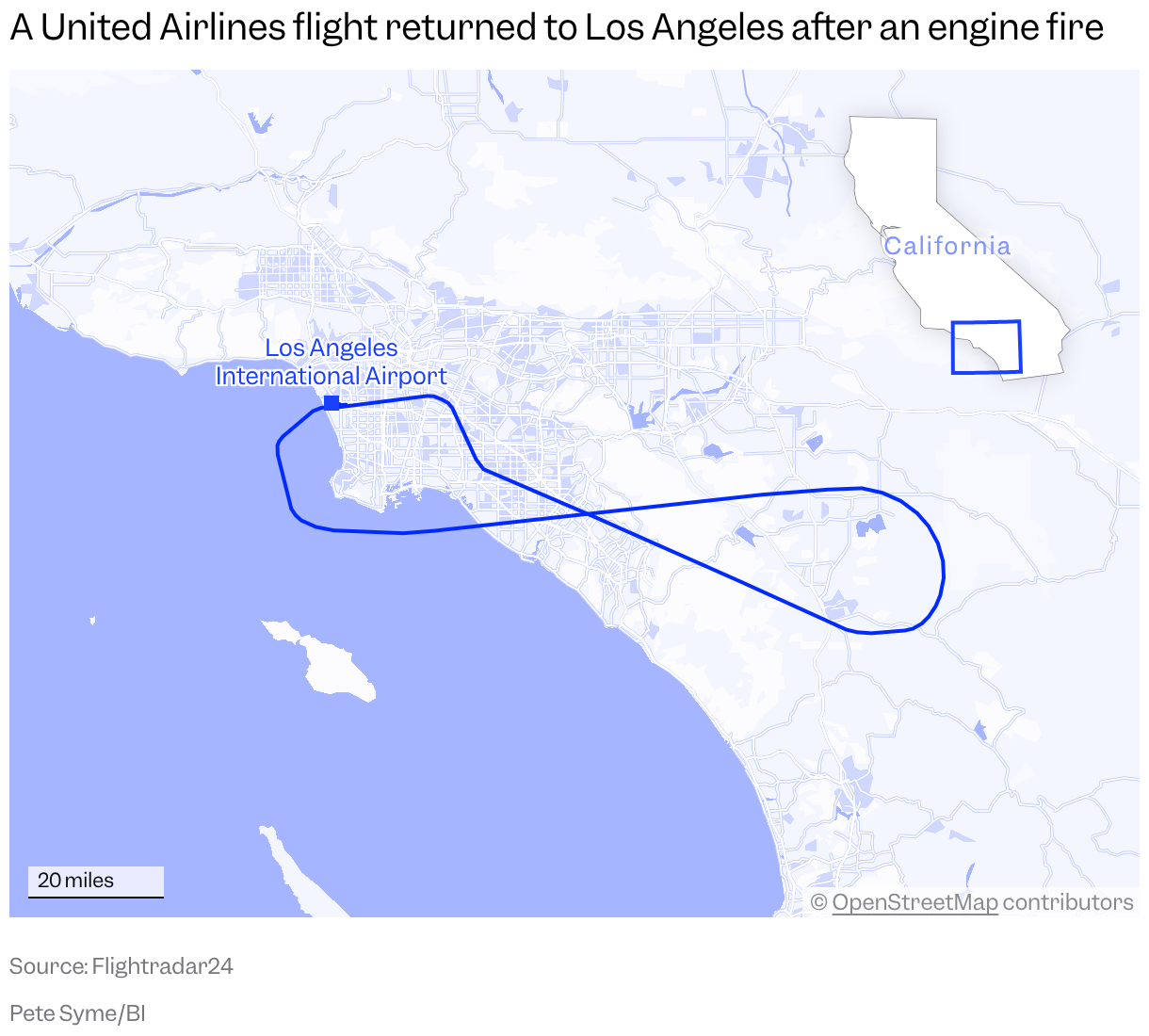
A map of southern California shows the flight path of United Airlines Flight 2127 on March 2, 2026, which circled around for an emergency landing at Los Angeles International Airport

United 787 engine fire underscores the role of pilot actions and the dangers on the ground

A United Airlines Boeing 787 turned around 15 minutes after takeoff from Los Angeles on Monday after smoke and alarms suggested a fire in one of its two jet engines.

United told Business Insider in a statement that there was a “possible engine fire.” It added that none of the 268 passengers and crew on board the plane were seriously injured, and that passengers were bused to the terminal and flown out on a different aircraft.

The plane was back on the ground at LAX within about 40 minutes; a replacement flight to New Jersey took off around 6:30 p.m. local time — eight hours after the originally scheduled departure, per Flightradar24.

“We are grateful to our pilots and flight attendants for their quick actions to keep our customers safe,” United said. The Federal Aviation Administration said it is investigating the incident.

It’s unclear what caused the engine issue, but previous incidents at United and other carriers involved bird strikes and metal fatigue.

Pilots are trained to handle engine failures and fires and to remain calm in emergency situations. Airliners like the Boeing 787 are designed to fly safely on one engine.

Recordings from the website LiveATC.net reveal the crew initially thought the fire was out but received additional “fire indications” for the left engine despite using the extinguishers, prompting the decision to evacuate passengers.

“People will be coming out the right side, the side toward the runway; we prefer to stay right here and just get people off,” one of the pilots can be heard telling firefighters after landing.

Videos circulating on social media show the scene from inside the jet, including smoke coming from the aircraft’s left engine and people evacuating via slides and airstairs onto a taxiway.

Some commentators have pointed out that individuals leaving with their bags is dangerous during an emergency. Aviation safety leaders have long instructed passengers to abandon their carry-on items during evacuations to avoid wasting time or clogging the aisles.

“The FAA’s message to passengers is simple: If you have to evacuate, leave your bags behind and follow crew instructions,” the agency said in a statement to Business Insider. “Airlines have policies requiring passengers to leave luggage behind to ensure they can evacuate as quickly as possible. Federal aviation regulations require passengers to obey crewmembers’ safety instructions.”


Everyone survived the fiery Japan Airlines crash in January.

Everyone survived the fiery Japan Airlines crash in January 2024.

STR/JIJI PRESS/AFP via Getty Images


The warning has precedent: an Aeroflot plane caught fire during landing in 2019, and industry experts said people fleeing the blaze with their luggage partially contributed to the deaths of more than half of the passengers.

In 2024, a Japan Airlines Airbus A350 collided with a Coast Guard jet on the runway in Tokyo and caught fire. All 379 people on board survived; experts partially attributed this to passengers leaving their bags behind.




Source link

Shield-AI-says-its-Hivemind-AI-pilot-just-flew-a.jpeg

Shield AI says its Hivemind AI pilot just flew a drone vying to become a future Air Force uncrewed wingman

Shield AI’s artificial intelligence pilot has flown one of the US Air Force’s next-generation drone wingman contenders for the first time, the company announced this week.

Shield AI’s Hivemind, the same AI program that previously went head-to-head with a crewed fighter aircraft in aerial combat, was picked by the Air Force for autonomy testing as part of its Collaborative Combat Aircraft, or CCA, effort earlier this month. Now, it has flown Anduril’s CCA competitor, an achievement for the software that could pilot future uncrewed aircraft built to fly and fight alongside crewed US combat aircraft.

The US defense company said Hivemind, piloting Anduril’s Fury drone, also known as YFQ-44A, completed its first flight test over the Mojave Desert. The AI pilot met all required test points, including mid-mission updates and basic operational maneuvers, the company said.

The successful test opens the door for expanded mission autonomy testing with Hivemind, Shield AI said.

“This flight test showcases the potential of airpower built on mission autonomy,” Christian Gutierrez, vice president of Hivemind Solutions, said.

“Across platforms, domains, and environments, Hivemind provides resilient mission autonomy, proving that software is central to the future of airpower,” Gutierrez said, adding that “our collaboration with Anduril reflects a new era of defense acquisition, where autonomy is treated as a foundational warfighting capability on par with the aircraft itself.”

Shield AI has spent more than a decade developing Hivemind’s AI software, which is designed to perform many of the tasks of a human pilot. Unlike autopilot or other autonomous features, Hivemind is built to make real-time decisions, adjusting flight routes depending on conditions or obstacles to continue a mission, the company says.

The same AI software was used in the Air Force’s AI-enabled X-62A VISTA, a modified F-16 that flew simulated dogfights against a crewed fighter aircraft in 2024. The service has not publicly revealed which aircraft emerged victorious in those engagements.

Hivemind is also the AI pilot behind Shield AI’s new X-BAT fighter aircraft, which the company unveiled in October. Shield AI says that the X-BAT can operate without human intervention and take off without runways, as well as in contested environments where GPS and reliable communications might not be available.

Anduril’s Fury aircraft is one of the competitors for the CCA program, a priority of the Air Force that envisions uncrewed aircraft operating alongside crewed aircraft with some mixture of autonomy and human direction. Earlier this month, a test flight saw a CCA stand-in aircraft communicate and fly with an Air Force F-22 Raptor, marking another step forward in the CCA program.

On Wednesday, Col. Timothy Helfrich, the Air Force’s portfolio acquisition executive in fighters and advanced aircraft, commended the speed of work being done on autonomous pilots flying CCAs. “Quite an accomplishment going so quickly,” he said at a panel, “but we’ve got a lot ahead of us though.”


Source link

Kelsey Baker, Military and Defense Reporting Fellow

Medal of Honor pilot was hit repeatedly by machine-gun fire during the Maduro raid, Trump says, revealing mission details

President Donald Trump shared vivid details Tuesday night of the firefight that erupted as an American helicopter reached Nicolás Maduro’s compound during the US raid into Venezuela last month.

As the Chinook helicopter carrying elite US ground troops and piloted by Chief Warrant Officer 5 Eric Slover approached what the president had previously described as a fortress, “enemy machine guns fired from every angle,” Trump said during his State of the Union Address.

“Eric was hit very badly in the leg and hip,” the president said as he awarded the military’s top valor award, the Congressional Medal of Honor, to Slover.

Immediately following the January 3 raid to capture the then-president of Venezuela, Trump said that a helicopter got hit “pretty hard” and that “a couple of guys were hit.” Official details of the injuries were limited. His speech on Tuesday shed new light on what happened that night.


US Air Force crew chiefs watch as F-35A Lightning II's taxi following military actions in Venezuela in support of Operation Absolute Resolve, Jan. 3, 2026.

Stealth fighters and supersonic bombers were among the aircraft involved in the mission.

US Air Force Photo


After numerous American warplanes, including advanced stealth fighters, suppressed Venezuela’s air defense network, helicopters carrying ground troops moved in, approaching Maduro’s fortified compound.

Slover’s helicopter encountered “two machine gunners who escaped the wrath of the previous planes,” Trump said. As the bullets hit the aircraft, Slover “absorbed four agonizing shots, shredding his leg into numerous pieces,” he continued. “He was gushing blood.”

Helicopter pilots rely on both a control stick and floor pedals for maneuvering. Most helicopters have one main rotor and a small tail rotor to keep them from spinning, but a Chinook has two large rotors that balance each other.

Despite his serious wounds, Slover managed to maneuver his helicopter into position so that onboard gunners could “take care of business” and “eliminate the threat,” the president said, crediting Slover with “saving the lives of his fellow warriors from what could have been a catastrophic crash, deep in enemy territory.”

After landing, Slover told his co-pilot, who was also wounded but not as gravely, to “take over,” saying, “I’m about ready to pass out.” A total of seven US troops were injured during the raid.


US First Lady Melania Trump presents US veteran Captain E. Royce Williams with the Medal of Honor

US First Lady Melania Trump was involved in presenting US veteran Captain E. Royce Williams with the Medal of Honor.

ANDREW CABALLERO-REYNOLDS / AFP via Getty Images


During his State of the Union address, Trump also presented a second Medal of Honor to centenarian US Navy pilot E. Royce Williams, a veteran of World War II and the Korean and Vietnam Wars.

Three years ago, Williams was awarded the Navy Cross for “extraordinary heroism” in a Korean War air battle in which he was outgunned and outmatched in his F9F Panther by Soviet MiG-15 fighters but still managed to shoot down four of them.

The 1952 dogfight was classified for decades.

The Congressional Medal of Honor is usually awarded in solemn, less politically charged ceremonies at the White House. The award can take years, or even decades, as was the case for Williams, to be bestowed. It requires eyewitness accounts and has strict criteria. Other valor awards, such as the Navy Cross or Silver Star, can occasionally be upgraded to a Medal of Honor, a notoriously lengthy process.

The top award is bestowed upon troops engaged against an enemy of the US or an “opposing foreign force,” according to the military’s awards manual.

That the medal was awarded during the State of the Union elicited reactions from some veterans online who felt that the timing dampened the gravity of the award’s significance.

During the event, Trump reiterated his previously stated desire to receive the Medal of Honor.

“I’ve always wanted the Congressional Medal of Honor, but I was informed, I’m not allowed to give it to myself,” Trump told the crowd. “I wouldn’t know why I’d be taking it, but if they ever open up that law, I will be there with you someday.”


Source link

Headshot of Chris Panella.

The Army’s new drone competition is really a talent hunt. It’s scouting out what makes a top drone pilot.

The US Army used its first Best Drone Warfighter competition not just to test skills, officials say, but to identify what makes a top drone operator — and who in the force is best suited for the job.

Rather than training every soldier to fly drones, the Army is using competition to identify the skill sets of top drone operators and whether there are specific roles within units that would make the most sense for working with uncrewed aerial systems.

The effort reflects a broader shift from treating drone flying as something for all soldiers to approaching it as a specialized skill set that requires the right aptitude, training, and sustained practice.

The inaugural drone competition took place this week at the University of Alabama in Huntsville, gathering teams from across active, Reserve, and National Guard units. There were no requirements on what types of soldiers could participate or where they came from.

Rather, “it was just send your best UAS operators,” Col. Nicholas Ryan, director of Army UAS Transformation at the Aviation Center of Excellence, told reporters, prompting a mix of operators with different backgrounds and expertise.

Over three days, soldiers competed in multiple events, testing their piloting skills. The first was an obstacle course that operators navigated using first-person-view drones.


A soldier holds a drone controller.

Recent US Department of Defense directives have prioritized the development and integration of drones across the Army.

US Army photo by Spc. Michelle Lessard-Terry


The second was a hunter-killer scenario in which teams used a reconnaissance drone to survey an array of targets and decide which were highest priority for simulated strikes with one-way attack drones. The competition didn’t involve any kinetic strikes; instead, soldiers flew the drones into nets on the targets.

The third event was focused on innovation. Soldiers could build, modify, and test their own drones.

Ryan said that the Army was taking notes throughout the competition on who the top operators were, calling it talent management.

“At the end of the day,” he said, “it’s not about receiving trophies or awards,” it is about identifying what sets the top drone operators apart and figuring out how they developed those skills. The goal, he said, is to understand “what lessons can we take from this to find out who the best operator is and how they became the best operator. What skills and resources and training allowed them to become the best operator?”

Soldiers in the US and Ukraine have noticed that gamers make excellent drone pilots, as do soldiers who have experience piloting hobby drones.

“That’s something we’re absolutely looking at right now,” Ryan said.

Army leaders have previously noted a correlation between soldiers who grew up playing video games — or who are active gamers — and drone proficiency.

Troops who game have shown quick reflexes, precise hand-eye coordination, and strong spatial awareness that make them competent with drones.

At an exercise in Germany last fall, a US Army captain told Business Insider that the top pilots were soldiers who “when they got off on Fridays, then go and play video games.”

The Army has been restructuring its approach to drone warfare, rewriting its training and focusing on integrating soldiers with small drone training into front-line units. Lessons and approaches are being shared across the service, building a broader doctrine on how the Army is adopting drones.


A quadcopter drone flies on a field with trees in the background.

The competition allowed Army leadership to learn more about the skillsets and backgrounds that make drone operators successful.

US Army photo by Sgt. Aaron Troutman


Ryan said that the service is realizing that flying drones needs to be a dedicated assignment. “You can’t be a squad rifleman and a drone operator,” he said, explaining that “it’s one or the other because you have to have the level of skill and expertise in operating and employing the drones. That’s what you have to be good at and train at and focus on for most of your time.”

Other Army officials said efforts like the competition were demonstrating where drones best fit in a formation and what aspects of training are most important to maintain these highly perishable skills.

For the most part, soldiers flew their drones successfully, but the Army did take note of communication breakdowns as soldiers went through the hunter-killer lane, specifically getting drones into position and identifying and simulating strikes on targets.

“That’s an example of something we didn’t anticipate, but it’s absolutely standing out as that is something we as an Army need to do better on,” Ryan said. “If we’re going to proliferate these drones and want them to be more effective and lethal, we just need to improve on how our soldiers talk to each other to communicate when they’re using them.”

In future iterations of the Best Drone Warfighter competition, the Army hopes to include kinetic elements as well as electronic warfare and jamming to better replicate real-world scenarios.


Source link

Ukrainian-drone-pilot-found-hidden-Russian-depot-realized-it-was.jpeg

Ukrainian drone pilot found hidden Russian depot, realized it was filled with horses and cars

Cosmos floated his quadcopter over the ruined warehouse, guiding it through a corner of the roof where shattered metal sheets had collapsed to form a hole.

The drone pilot’s unit, the Wild Division, suspected that the building was a logistics hub for Russian soldiers, roughly 15 km, or about 9 miles, from the line of contact in southern Ukraine. These hidden locations often held ordnance or fuel stockpiles, and Cosmos’ fiber-optic drone was armed with explosives to destroy them.

Yet inside, the drone rotated its camera to reveal what looked more like a farmer’s garage: Four civilian cars, a pair of motorcycles, and two bridled horses.

“We had not expected to see this. It was unusual,” Cosmos told Business Insider, speaking on condition that he be identified only by his call sign.

“We were expecting to find some armored vehicles,” he added.

Video of the discovery went viral last week in Ukraine, as the war has increasingly seen Russian soldiers using unconventional transport tools, such as pack animals and bicycles, to conduct assaults or logistics missions. Cosmos said his drone mission was conducted in early February.

The smaller profile of a horse or civilian car might be harder for a drone to spot, though Russia’s repeated use of them has also raised questions about the viability of its tactics and whether it’s been producing enough military equipment to sustain its invasion.

Cosmos’ squad mates and officers at the Wild Division, a first-person-view drone company in the 82nd Air Assault Brigade, had seen clips of Russian soldiers riding on horses to attack Ukrainian positions before.

One famous example they remember was in Zaporizhzhia, when a Ukrainian drone crew attacked Russian infantry crossing the front lines on horseback last month.

Cosmos, who’s been piloting drones for a year, said it was the first time he’d personally seen the animals on the front lines.

He flew his explosive-laden drone straight into the back of one of the cars, and said his crew later struck several other vehicles inside. When Russian troops moved their transport assets, the Wild Division found the next warehouse and attacked that one, too, Cosmos said.

“The enemy usually lives in hiding close to these places,” Cosmos said of the warehouse. “It’s common for us to check all targets. Sometimes we can see the enemy infantry, or you can see their vehicles.”

Russia calculates war differently

The Wild Division declined to say where exactly the warehouse was located, but its brigade is generally deployed in the Donbas.

The commander of Cosmos’ battalion told Business Insider that the discovery of the horses surprised him, too.

“I thought it had been a location for transport vehicles, sort of a transfer hub,” said the major, whose call sign is Fizruk.

Fizruk said the appearance of horses and cars in his area of the front line could be a sign that Russian forces are running low on standard resources, but also reflects Moscow’s attritional nature of fighting.

The cars discovered by Cosmos appear to be Nivas, inexpensive civilian off-road vehicles from the Russian Lada car brand.

“They treat these like they will be losses anyway, that they will be destroyed anyway,” he said. “Look, a Niva costs, let’s say, $2,000. A Hummer, which the Armed Forces of Ukraine uses in many places, costs $20,000, maybe more.”

“Since they lose their equipment in assaults, from that point of view, why pay $20,000 for one vehicle if you can buy 10 Nivas for $20,000?” Fizruk added.

The Kremlin is known to pressure the front line with repeated ground assaults, sending small groups of infantry to approach Ukrainian positions on foot or in cheap vehicles. The strategy has been costly, with NATO now saying that up to 25,000 Russian troops are dying each month.

Sustaining that style of war has pushed Moscow to informal means of recruitment and weapons procurement, including hiring troops from overseas and receiving ammunition from North Korea.


Source link

A-US-pilot-school-has-banned-solo-flights-for-trainees.jpeg

A US pilot school has banned solo flights for trainees at one of the world’s top airlines after a spate of incidents

An Arizona pilot school has stopped Cathay Pacific trainees from solo flights after several incidents that went unreported, Bloomberg first reported.

Cathay Pacific, the Hong Kong flag carrier, is one of the world’s best airlines — one of just 10 globally to be ranked five stars by Skytrax.

In an internal memo, the AeroGuard Flight Training Center in Phoenix said it saw “an alarming increase in solo incidents during cadet training,” per Bloomberg.

It added that the incidents involved a wingtip colliding with a fixed object, a “bounced landing” leading to a “substantial” propellor strike, and a complete runway excursion.

“While each situation was unique, in each case the concern was the same — required consultation did not occur,” the memo reportedly said.

Bloomberg also reported that the students didn’t properly report the damage in two of the three incidents.

In a statement shared with Business Insider, Cathay Pacific acknowledged the events and added, “We are taking them seriously.”

“These incidents involve our sponsored students, who will become our employees upon successful graduation from the training course,” it said.

“They will then need to undergo additional structured training before being assigned any flying duty.”

A source familiar with the situation told Bloomberg that the decision would affect around 150 of the 250 to 300 Cathay cadets training at the school.

The decision hinders Cathay’s ongoing plans to increase its number of pilots after the pandemic, when the airline instituted steep pay cuts.

Several pilots quit during that time, with some telling Reuters that strict COVID measures in Hong Kong were affecting their mental health.

In the statement, Cathay Pacific said, “Safety guides every decision we make, and we fully support the decision of the training school.”

“We will continue to prioritize the safety and well-being of our cadet pilots and crew members, and we remain dedicated to upholding the highest standards in our training programs,” it added.


Source link