This-startup-made-AI-agents-to-manage-construction-projects-like.jpeg

This startup made AI agents to manage construction projects like data centers. See the pitch deck it used to raise $9 million.

Krane, a startup building AI software for construction supply chains, has raised $9 million in funding.

The San Francisco-based startup has developed AI agents that help construction teams manage materials procurement and delivery for projects such as data centers, healthcare facilities, and schools.

Its platform pulls in data from spreadsheets, project schedules, and supplier communications into a single system. It then uses AI agents to automate tasks such as tracking orders, following up with vendors by phone or email, and reconciling invoices.

Eshan Jayamanne, the founder and CEO of Krane, told Business Insider that his company’s platform typically starts by identifying the equipment and materials specified in a construction project.

“Then we look at ‘what are all my quotes across all my suppliers, and who can I actually work with’ by comparing lead times, by comparing requirements for the spec. This is where AI comes in,” he said.

The startup has created multiple AI agents that specialize in different areas of the supply chain, such as deliveries and flagging supply risks.

Jayamanne, a former engineer and construction operator who worked on data center projects, founded the company in 2023. It aims to reduce delays in construction projects and prevent them from going over budget, and integrates with existing construction tools like Autodesk and Procore.

About half of Krane’s customers are healthcare projects, and around a third are data center buildouts, Jayamanne said. Data centers are complex projects that can be held up by any delays to critical equipment, such as generators, he added.

Construction tech has become increasingly competitive, and companies like TrunkTools and Mastt are also leaning into AI agents. While construction has historically been slower than other industries to adopt software tools, Jayamanne says that’s no longer true.

“This LLM moment has changed everything,” he said, referring to large language models, the technology underpinning AI like ChatGPT.

Jayamanne said that humans are “in the loop” to approve the decisions of Krane’s AI agents, but its voice agents have greater autonomy.

The startup’s seed round was co-led by Glasswing Ventures and Link Ventures.

The new funding will be used to expand its product and add new features, including tools aimed at subcontractors and additional automation for procurement and payments.

“I’m really focused on raising ‘just enough’ because larger rounds don’t make sense anymore,” he said, adding that companies like his can use AI to operate with smaller engineering teams.

Here’s an exclusive look at the nine-page pitch deck Krane used to raise $9 million.



Source link

Joshua Zitser's face on a grey background

We’re a couple in our 30s who dreamed of building a tiny home. My parents had concerns, so we made a pitch deck to convince them.

This as-told-to essay is based on a conversation with Anne Leijdekkers, 32, a Dutch arts entrepreneur, and Simone Solazzo, 31, an Italian who used to work in tech. Last year, the couple moved into the house they built in the tiny-home village of Minitopia in Valkenswaard, the Netherlands. This piece has been edited for length and clarity.

Anne: At first, my parents were sceptical about our plan to build our own tiny home.

Friends will always stand behind you, but family members can be more critical. It was important for us to have them on board.

Simone used to work in the corporate world and loves PowerPoint presentations, so on Christmas Day in 2024, we used one to pitch our dream to my family.

We wanted to be financially autonomous

Simone: I liked the idea of being able to explain to them why we wanted to do this and what we were planning. The first slide said, in Dutch, “We are building our home. We’d like your support.”

In the presentation, we told them about the plan, the timeline, and where we would be living. We included our budget, which ranged from 40,000 to 80,000 euros ($47,000 to $94,000).

Mostly, the slides outlined our motivations. The first reason was to be financially autonomous.

If we were to buy a big house, we’d be committing to a big mortgage. Instead, we used our savings to pay for the construction of the tiny home, and its transportation to the Minitopia site in Valkenswaard. In total, the project cost us 75,000 euros.

We don’t have a mortgage, and our monthly costs are relatively low. We spend about 500 euros a month on ground rent, utilities, and insurance. I imagine the monthly costs of running a larger property would be considerably higher.

Living in a tiny house is like being a snail

Simone: When you have a smaller space, you have to limit your possessions to what you actually need.

Anne: It was important for us to find out whether we were capable of doing that. We wanted to show that there’s a different way to live. You don’t need an attic at the end of your life filled with so many things.

It wasn’t about being minimalist as much as decluttering. It’s almost like being a snail. We keep things compact and can move our home whenever we want.

That’s how we arrived here: putting our tiny house on a truck and moving it.

Simone: We also like that the house can evolve with us. This means it can be our forever home. For example, if we decide one day to have kids, we could easily build a second module on top.


Simone Solazzo shows photos of construction and presentation

In the presentation, the couple shared their motivations for building a tiny home, which included financial autonomy.

Joshua Nelken-Zitser


Living in a tiny home encourages you to spend time outdoors

Simone: We both felt that knowing how to build and dismantle things was an important skill to learn. We like to challenge ourselves, and building our own home felt like the ultimate challenge. It turned out to be a real learning experience.

We’ve become handier. Sometimes, when it’s raining heavily, I wake up in the middle of the night worried about a leak. But now, if something goes wrong, I know how to deal with it.

Another bonus of living in a tiny house is that it encourages you to spend more time outdoors. When you have a big house, you can do most things inside. When your home is tiny, you need to get outside and move around in nature. We haven’t lived here in the spring or summer yet, so we’re looking forward to seeing what that is like.

My parents had concerns, but they stood behind us

Anne: The final slide said, “Let’s think about it and make it together — as a family.”

Before the presentation, my parents had concerns: was it a sensible investment? What if we wanted to have children? Were we actually capable of building it ourselves? My brother even suggested we buy a pre-made tiny house on Amazon.

After the presentation, they still had concerns about the financial rationale, but they understood our dream and 100% stood behind us. That was an amazing feeling.

We spent two months planning, budgeting, and designing, and then we started building. We began the process exactly a year ago, and it took about five months. Now that it’s finished, they’re very proud of us.

Simone: Anne’s father, who is in his 70s, even helped us build it. It gave her a beautiful opportunity to spend time with him and to build new memories.

Anne: It turned out to be a really warm period in our lives.


Source link

This-startup-uses-AI-to-get-you-on-a-date.jpeg

This startup uses AI to get you on a date — fast. Read the pitch deck it used to raise $9.2 million.

Allen Wang and Eric Liu, two UC Berkeley dropouts, think they can help college students find love using AI.

Their dating startup, Ditto, leverages AI to match people based on the data users input into the service. It then plans the date for them.

“We’re bringing people back to in-real-life interactions,” Wang, 23, told Business Insider.

After users make a profile, they directly message Ditto’s AI chatbot via text— no app required — about their type and dating preferences. On Wednesdays, users get a text about a potential match. After each date, Ditto follows up for feedback and uses that information as additional data for future matches.

“People are tired of being trapped behind the apps,” Wang said.

Ditto will announce on Tuesday that it has raised $9.2 million in seed funding, led by venture capital firm Peak XV, with participation from firms like Alumni Ventures, Gradient, and Scribble Ventures.

The seed funding will primarily be spent on hiring talent across AI and growth, Wang said, as well as toward Ditto’s marketing. The company has 10 staffers and has raised a total of $9.5 million to date. Ditto launched its product in early 2025.

Ditto isn’t the only AI dating app gaining momentum right now.

Other startups like Sitch, Known, and Amata have raised millions for similar products that pitch AI-powered matchmaking as the new alternative to swiping through profiles. Dating app mainstays like Tinder and Bumble, meanwhile, are also testing the AI waters to reignite user interest.

Ditto’s AI tries to determine whether two people would be a good match by using profile details, such as users’ hobbies or interests, to simulate a date, Wang said.

“Would you guys have a good conversation? Do you guys have matched humor level? Do you guys have similar vibes and values?” Wang said.

Finding love as a college student

The dating startup world has a history of targeting college students as early users. For instance, Tinder’s early success came in part from its marketing on college campuses.

“College kids are very adaptive to new technology,” Wang said.

The app now has about 42,000 people signed up across several college campuses in California. With its recent funding, Ditto plans to expand to more college campuses.

One tactic that helps get college-aged users on board: parties.

Ditto plans to host several yacht parties across the US, beginning with a Valentine’s Day party in Los Angeles (it hosted its first yacht party this summer). At the parties, 100 college students will sign up for Ditto and then get paired into 50 couples.

For now, Ditto is free.

“We are prioritizing growth over monetization,” Wang said, adding that the startup is interviewing users about what price they’d be willing to pay for dates from the service.

Read the 12-page pitch deck Ditto used to raise $9.2 million:

Note: Some details have been redacted.

Ditto introduces itself as an ‘AI social agent’


The first AI Social Agent
                                start with dating


Ditto

The deck kicks off with a little dating app history


Dating App's Paradigm Shifts Every Decade
                                DUE TO NEW TECH INNOVATION AND GENERATIONAL DEMOGRAPHIC


Ditto

Dating apps have a “paradigm shift every decade,” the slide says.

In the 1990s and 2000s, online dating websites emerged. Then in the 2010s, mobile dating apps took over. Ditto pitched investors that AI is the next frontier.

Ditto explains AI agents and what it says Gen Z wants


AI Social Agent Network
                                
                                TECH INNO
                                AI AGENTS TURNED STATIC PROFILES ALIVE


Ditto

The slide describes Ditto as an AI social agent network where “AI turns profiles into live agents that can interact on their own.”

“Gen Z is tired of swiping and chatting online,” the slide says. “They prefer ‘coffee chat vibe check’ style social: IRL, genuine, light.”

Ditto says dating apps like Tinder are ‘primitive’


AI Social Agent Network
                                
                                TECH INNO
                                AI AGENTS TURNED STATIC PROFILES ALIVE


Ditto

The slide also incorporates some old-school video game aesthetics, inspired by Super Mario Bros.

It says that AI agents setting up dates ‘is the future’


Ditto is the future
                                
                                An AI Agent that directly set up your dream dates


Ditto

Then, the deck explains how Ditto works


Tell Ditto Your type
                                
                                (On phone UI:)
                                Tell us about your type 1/2
                                When dating, what are red flags for you?
                                Type your answer here…


Ditto

On a website, users fill out a questionnaire and tell Ditto about their “type.” Then, Ditto will start texting users directly.

Ditto texts a date invite after finding a match


AI customized date invite


Ditto

The text includes a collage of the user’s photos.

Then, Ditto sets up a date and follows up for feedback


Direct to IRL Date


Ditto

Ditto pitches vibe-based matchmaking


Vibe is all you need
                                CONNECT BASED ON REASONING


Ditto

It includes a flow chart explaining how its agentic system works


How our agentic system works
                                
                                User Data


Ditto

Ditto takes user data and feeds it into an analysis agent, which performs image analysis, attractiveness analysis, and profile tagging.

Then, in the “pre-date reasoning” phase, a matchmaking agent does a “vibe check” and “hobby match” before running a “date simulation.” The date simulation agent then runs through things like “first impression” or “conversation flow” before presenting a user with a match.

Ditto’s deck concludes with a collage of testimonials from college students


People Love Us


Ditto


Source link

Read-46-pitch-decks-that-creator-economy-startups-used-to-raise.jpeg

Read 46 pitch decks that creator-economy startups used to raise millions of dollars

The creator economy has bred a generation of startups — from influencer-marketing companies to new social-media experiences.

These startups have captured the attention and wallets of influential venture capitalists and angel investors over the last several years, giving rise to several unicorn valuations in the space.

Check out 16 VC firms investing in creator economy startups

Even as the economy has weathered changing tides and investments have cooled across industries, some startups in this sector are still raising money.

In 2024, three trends drove some of the largest deals in the creator economy: AI, social commerce, and newsletters. Several startups raised at least $10 million in new funding last year, such as AI startup Captions or newsletter platform Beehiiv.

Here are 17 creator-economy startups that raised more than $10 million in 2024

AI is continuing to fuel investor interest in the creator economy in 2025, too. For instance, Hedra, a generative AI startup used by some creators to make viral content, announced a $32 million Series A led by A16z in May.

Creators themselves, like Emma Chamberlain and MrBeast, are also raising venture capital for their businesses.

See the leaked pitch deck Chamberlain Coffee used

So, how do creator-economy startups land those investments? Often, it starts with a pitch deck. 

Lumanu, a creator-focused financial startup, uses a simple pitch deck that’s more of a “conversation guider,” its cofounder and CEO, Tony Tran, told Business Insider.

“My pitch is always why, what, how, and why now?” Tran said. (Read the full pitch deck here.)

Skye, a career-coaching startup, had different pitch decks depending on the type of investor or fund they pitched to.

“I had two different versions, depending on the fund,” said Jessica Wolf, Skye’s CEO and one of its cofounders. “If I knew a fund was more into pre-seed, all about the founder, I had one deck. But if I knew that they were a numbers person, I would use another one.”

Every startup has a different approach.

Some, such as Throne, even ditch the pitch deck altogether and opt for an email or Notion document.

Read the email template creator-economy startup Throne used to secure its seed investment.

We talked with founders who’ve pitched their startups to investors about their process. They broke down the pitch decks they used to secure millions of dollars in funding.

Read the pitch decks that helped 46 creator-focused startups fundraise millions of dollars:

Note: Pitch decks are sorted by investment stage and size of round.

Series A

  • Restream, a livestreaming alternative to platforms like the Amazon-owned Twitch: $50 million Series A (14 pages)
  • Hedra, a generative AI video platform: $32 million Series A (9 pages)
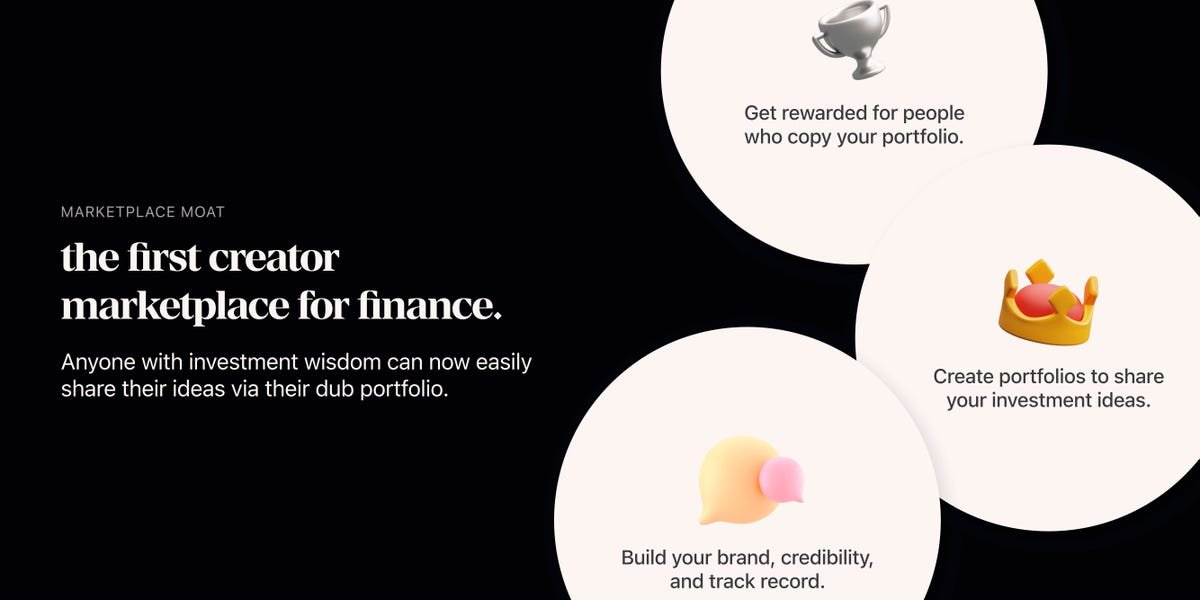
  • Dub, a fintech startup that lets people copy influencers’ stock trades: $30 million Series A (15 pages)
  • ShopMy, an affiliate platform that lets creators earn commissions through shoppable landing pages: $26.5 million Series A (23 pages)
  • Posh, an IRL events startup: $22 million Series A (12 pages)
  • Pearpop, a creator-marketing platform: $18 million Series A (18 pages)
  • Spoon Radio, a social-audio startup: $17 million Series A (15 pages)
  • Kyra, a content studio, talent-management firm, and influencer-marketing platform: $15 million Series A (20 pages)
  • Allstar, a startup helping gamers become social-media creators: $12 million Series A (6 pages)
  • Lumanu, a business-solutions platform for creators: $12 million Series A (8 pages)
  • Hype, a platform for link-in-bio and other creator-monetization tools: $10 million Series A (13 pages)
  • Catch+Release, a startup that helps creators and everyday social-media users license their content to brands: $8.8 million Series A (12 pages)
  • Slip.stream, a music startup focused on gamers: $7.5 million Series A (13 pages)
  • Brag House, an esports startup: $5 million Series A (24 pages)
  • CreatorDB, an influencer marketing company: $4.7 million Series A (13 pages)

Seed

  • Linguana, an AI video translation startup that is targeting YouTubers: $8.5 million (13 pages)
  • AvatarOS, a startup building virtual avatars for social media, gaming, and other immersive experiences: $7 million (11 pages)
  • Hypernatural, a generative AI startup that wants to be the Canva for video: $6.8 million (14 pages)
  • Scenario, a generative AI startup to create gaming art and assets: $6 million seed (8 pages)
  • Sesh, a music startup that connects artists and fans using their mobile wallets: $5 million seed (13 pages)
  • Authoritive, an online course-development startup: $5 million seed (11 pages)
  • Dstlry, a comic-book creator startup: $5 million seed (26 pages)
  • Dharma, a travel startup for creators and brands: $4.7 million pre-Series A (17 pages)
  • Glystn, an AI-powered community-management platform: $4 million seed (15 pages)
  • Daisy, an influencer marketing startup that launched in 2024: $3.9 million (9 pages)
  • Anima, an augmented-reality startup: $3 million (15 pages)
  • Grandstand, a sports startup working with athlete creators: $2.75 million
  • Seam Social, a new Web3 social-media platform: $2.5 million (10 pages)
  • Spark, a digital art platform from the YouTuber Moriah Elizabeth: $2.5 million seed (9 pages)
  • Insense, a startup helping e-commerce brands get low-cost ads: $2.5 million pre-Series A (9 pages)
  • Supercast, a podcast subscriptions startup: $2 million seed (20 pages)
  • Chartmetric, a music-data and -measurement company: $2 million seed (46 pages)
  • Ultimate Playlist, a music-marketing startup: $2 million round (9 pages)
  • Magroove, a music-distribution and -discovery platform: $1.6 million seed (21 pages)
  • Stagetime, a professional-networking startup for performing artists: $1.5 million seed (13 pages)
  • Jubilee Media, a content studio looking to expand beyond YouTube and TikTok: $1.1 million seed-plus (12 pages)

Pre-Seed

Other


Source link

Sydney Bradley brown hair denim vest slightly smiles

Read the pitch decks of 14 startups looking to disrupt dating apps and social networking that have raised millions

A new generation of consumer social startups is emerging.

From platforms focused on getting people to meet IRL to dating apps taking on Tinder or Hinge, startups are disrupting the digital social scene.

Founders of these startups are tackling problems like loneliness, dating app fatigue, and general dissatisfaction with the current social media incumbents.

Some founders come from Big Tech backgrounds, like the Instagram-heavy team behind photo-sharing app Retro, or the ex-Google employees building the social-mapping app PamPam. Gen Z founders are also throwing their hats in the ring, like Isabella Epstein’s IRL-focused app Kndrd, or Tiffany “TZ” Zhong’s Noplace app.

Investors are taking notice.

For instance, the IRL-social app 222, which matches strangers over dinner or activities with a personality quiz, raised a $2.5 million seed round from venture capital firms like 1517 Fund, General Catalyst, and Best Nights VC in 2024.

“We’re entering this new wave of social where people are trying to revert back to what people really use these platforms for to begin with — which is connection,” Maitree Mervana Parekh, a principal at Acrew Capital, told Business Insider in 2024.

Meet 19 startups in social networking, dating, and AI that investors have their eyes on

Some venture capital funds — such as French firm Intuition VC or gaming-focused firm Patron — have made tackling loneliness and relationships part of their investment theses.

But it’s not just friendship and dating that are ripe for disruption.

Startups like Khosla Ventures-backed Gigi, Yale-student-founded Series, Boardy, Filament, and Goodword have raised capital for AI tools to help people network better or maintain professional relationships.

“When people think about loneliness, they think about friends and family,” Goodword CEO Caroline Dell recently told Business Insider. “But we spend most of our waking hours at work as professionals.”

Meet the founders of 11 startups competing with dating app giants like Tinder

Other startups, like Diem and Spill, have opened up investment rounds to include users themselves using the platform Wefunder.

It’s not yet clear how many of these investments will pan out. Some startups are pre-revenue, while others are experimenting with monetization methods (such as freemium models).

“Founders have to be honest with themselves,” said Marlon Nichols, a founding partner at Mac Venture Capital. “Some of them aren’t really venture-scale or venture-type investments. We’re looking for the next big thing, the next category leader.”

Meet 12 VCs and investors eyeing new social startups

Business Insider spoke with several social media and dating app founders about how they are raising capital, including the pitch decks they used to raise millions of dollars.

Read the pitch decks that helped 14 social-networking and dating startups raise millions of dollars:

Note: Pitch decks are sorted by investment stage and size of round.

Series A

Seed

Pre-Seed

Other

Read about more social networking and dating startups raising millions:

  • Airbuds, a social music app, told Business Insider in November that it has raised $10.2 million — including a recent check from Alexis Ohanian’s VC fund.
  • Sweatpals, a fitness and wellness social platform, raised $12 million in seed funding.
  • Sitch, an AI matchmaking dating app, announced in April that it had raised $2 million in pre-seed funding.
  • Amata, another AI matchmaking dating startup, recently launched in the US and disclosed that it raised $6 million in 2023.
  • Gigi, an AI social network for making professional connections, announced in September that it raised $3 million from Khosla Ventures.
  • Corner, a social mapping app for Gen Z, disclosed in September that it has raised $3.75 million.


Source link