Lloyd Lee

Uber’s new plan to deploy 25,000 robotaxis will come from an autonomous trucking company led by ex-Uber alum

Uber has a new plan to get 25,000 robotaxis on the road — and it will come with the aid of some Uber alums and an autonomous trucking company.

On Wednesday, the ride-hailing giant announced a partnership with Waabi, a Canadian self-driving trucking startup founded by Raquel Urtasun. The partnership will include a $250 million investment from Uber, dependent on a set of milestones Waabi will have to achieve. The companies did not disclose what those were.

There are a few familiar faces here. Urtasun was the chief scientist at Uber’s self-driving car division, Advanced Technologies Group. That division was sold in 2020 to Aurora Innovation, another autonomous trucking company and Waabi’s competitor.

Waabi’s chief operating officer, Lior Ron, is also an Uber alum who founded and led the ride-hailing company’s trucking business, Uber Freight.

“Uber has always been great in building marketplaces, in matching supply and demand, and in pricing,” Ron told Business Insider. “That’s what created Uber, that what’s created Uber Eats, and that’s what I created with Uber Freight.”

Alphabet’s Waymo and Amazon’s Zoox are already on the ground providing unsupervised rides. Even in its core business, that is, autonomous trucking, Waabi has yet to deploy a fully driverless truck without safety drivers on commercial routes.

The startup didn’t disclose a timeline or announce a partnership with an automaker that can deliver that many cars.

However, Ron dismissed the first-mover advantage narrative.

“I think it’s really about: Can the system scale? Can the system be mass-deployed?” he said. “It’s not about getting the first driver out of the car or truck. It’s not about the first lane. It’s not about the first neighborhood.”

How will an autonomous trucking startup cater to robotaxis?

Trucking and ride-hailing are two different beasts. One has set routes and long stretches of highway driving; the other sees dense neighborhoods and unpredictable pedestrians.

Ron told Business Insider that Waabi has been building a generalizable AI “brain” that can be transferred to different vehicle platforms since “day one.”

“Nothing needs to be rebuilt,” Ron said.

In addition, Ron said Waabi has built a sophisticated simulator that allows the AI driver to learn from an infinite number of scenarios that can’t easily be replicated in the real world.

The simulation allows for “mixed reality testing”: An AI driver steering a truck or car is deployed on a closed course but responds to simulated events like a traffic jam or a lane-changing car that isn’t really there.

Video from Waabi shows how a truck driving on a closed-course environment can slow down, reacting to a virtual traffic jam.

“Now we can test anything you can imagine — every permutation of traffic jam under the sun, every millions of different scenarios of construction zone,” Ron said. “A motorbike cutting you off — you can never do that because you’ll be endangering the tester.”


Source link

Line chart

Inside Amazon’s ‘mind-blowing’ plan to fix groceries and beat Walmart

For years, Amazon was cast as Walmart’s great disruptor. Now, it’s borrowing from the retail giant it once sought to upend.

The company is rolling out Walmart-inspired ideas, including “Supercenter” warehouses, a new distribution layer known internally as the “1DC” network, and microfulfillment centers within Whole Foods stores, according to internal documents obtained by Business Insider.

The shift reflects a hard lesson: mastery of e-commerce does not translate into dominance in groceries, particularly perishable items that drive frequent shopping. Walmart’s dense network of stores and distribution centers, designed to move everyday goods quickly and cheaply, has proved difficult to replicate.

Nearly a decade after paying $13.7 billion for Whole Foods, Amazon still trails Walmart in everyday grocery shopping, and is now reshaping its retail infrastructure to compete head-on with Walmart’s Supercenter model.

Earlier this month, plans emerged for a roughly 225,000-square-foot Amazon megastore near Chicago. Bigger than a typical Walmart Supercenter, the new concept is designed to let customers buy “fresh groceries, household essentials, and general merchandise — all in one trip,” according to Amazon.

Michael Levin and Josh Lowitz, cofounders of Consumer Intelligence Research Partners, called the move “mind-blowing” and said “it reveals a degree of Walmart jealousy that we didn’t expect.”

Powerful store network

There’s a lot to be jealous about. With roughly 90% of the US population estimated to live within 10 miles of a Walmart store, the company’s 5,000-plus locations give it a powerful edge in selling fresh food and other perishables, along with many other everyday staples.

According to research firm Numerator, Walmart accounted for about 21% of the US grocery market, both online and in-store, as of September. Amazon and Whole Foods, meanwhile, each held roughly 1.6% of the market.

Meanwhile, Walmart is leveraging its Supercenters to deliver online orders faster, challenging Amazon at its own game.

That’s fueled a surge in Walmart shares, valuing the company close to $1 trillion. The stock is up almost 150% over 5 years, far outpacing Amazon’s roughly 53% gain (although Amazon is still worth more).

Amazon does well with non-perishable goods and everyday essentials such as toothpaste and paper towels. Overall, it offers millions of products for same-day delivery.

But when it comes to more delicate food items, such as pears, meat, and cheese, the company knows it has more work to do.

A company spokesperson said Amazon serves more than 150 million US grocery customers, offers nearly 3 million grocery and household items, and provides same-day delivery in more than 9,000 cities and towns.

Grocery is an “ever-growing” part of its fast-delivery business, the spokesperson added, while noting that in 2025, Amazon added perishable groceries to its Same-Day Delivery service, now available in 2,300 locations, allowing customers to shop without trade-offs between speed, selection, and savings.

Amazon’s Supercenter ambition

One element of this fresh Amazon effort is a new type of same-day delivery warehouse internally called an “SSD Supercenter.” SSD refers to sub-same-day deliveries, typically within four hours. Unlike traditional SSD warehouses that tend to be smaller, these facilities are designed to be larger to close the selection gap, specifically with “Walmart” in groceries, the document said.

Internal planning documents show Amazon intended to launch at least five such sites last year. Amazon wanted to test whether customers would “step-change their shopping habituation and engagement” once the Supercenter warehouses went live, one of the documents stated. Amazon planned to add products not currently sold on its site to the new warehouse and take a more hands-on approach to inventory sourcing, with in-stock targets above 95%, according to the document.

Sub-same-day grocery delivery is still a tiny part of Amazon’s business. At the end of September, it had 30 million eligible customers for this service, according to one of the internal documents obtained by Business Insider. Only 1.6 million of them, or roughly 5%, shopped through the service.

Speed, at scale

Amazon’s Supercenter warehouses are part of a broader push to expand same-day grocery delivery. Internal forecasts called for at least 34 US same-day grocery sites in 2025. Amazon already operates over 80 same-day facilities nationwide, though not all handle groceries, according to Marc Wulfraat, president of logistics consultancy MWPVL.

Amazon is also planning to take the model overseas. Under an initiative known as Project Taylor, the company plans to expand sub-same-day grocery delivery across Europe. It also plans to pilot sub-two-hour “ultrafast” deliveries in London in 2026, one of the documents showed.

A new “1DC” layer in the network

Less visible, but just as important, is a new upstream distribution layer called “1DC.”

These facilities store the most frequently purchased products and replenish fulfillment centers as demand emerges. That can shift weeks’ worth of inventory out of space-constrained fulfillment centers and into distribution sites optimized for palletized storage and rapid transfer.

One internal document described the change as a move from a “push” system, in which inventory is positioned based on forecasts, to a “pull” system that allows fulfillment centers to draw inventory from distribution centers as needed.

Amazon began rolling out the 1DC concept last year through new buildings and retrofits. By the end of 2025, the company planned to operate a dozen of these centers, capable of moving at least 20 million units a week, according to one of the documents. As of October 2025, the facilities only handled non-perishables, including shelf-stable food items, but not frozen or chilled products, the document stated.

“Untenable”

The 1DC idea emerged after Amazon introduced one-day delivery in 2018, one of the documents stated. Longer delivery windows once allowed the company to rely on a single layer of warehouses that could ship inventory from any fulfillment center to any customer. But faster delivery promises made that model “untenable,” forcing Amazon toward a structure long used by traditional retailers, the document added.

MWPVL’s Wulfraat said Walmart pioneered the distribution-center model that stores inventory for replenishing retail locations, while Amazon built its business around fulfillment centers that ship directly to consumers. Amazon also operates a cross-dock network to resupply its fulfillment centers, he said, and the 1DC sites represent a newer, more targeted layer of that system focused on high-velocity items.

Amazon’s spokesperson told Business Insider that 1DC is part of a broader initiative the company previously announced to regionalize its delivery operations and reduce shipping costs.

Whole Foods as infrastructure

Perhaps the clearest signal of Amazon’s shift is its rethinking of Whole Foods. Once positioned mainly as a premium grocer, the chain is increasingly treated as logistics infrastructure.

Amazon has begun installing micro-fulfillment centers in the back of select stores, effectively turning them into local hubs for online orders.

One upgraded Whole Foods site in suburban Philadelphia, announced last year, now fulfills Amazon orders from the back of the store. The model lets shoppers buy Whole Foods-specific items while also ordering products available only on Amazon, reducing the need to shop at other retailers.

Amazon expects this store to serve roughly 100,000 e-commerce units a week by consolidating deliveries from nearby stores, and forecasts online order adoption to grow to 10% by the end of 2026, according to one of the documents.

This approach also mirrors Walmart’s strategy of using its stores to fulfill online orders. Walmart said last year that it can offer same-day delivery to 93% of US households through its store-fulfilled network, with about 35% of those orders arriving within three hours.

The perishables problem

The success of Amazon’s new approach depends on one of the hardest problems in logistics: perishables.

Internal plans show Amazon aiming to expand its perishables distribution capacity from 2.6 billion units in 2025 to 3.3 billion units by the end of 2026. The increase would come from new distribution centers and tighter operational standards across the existing network.

The push is central to Amazon’s same-day delivery strategy and its broader grocery ambitions. Company documents stress that delivering high-quality perishables quickly and reliably is essential to scaling the business.

The goal is expansive. One document calls for making perishables available to “100% of Prime customers” as quickly as possible.

Have a tip? Contact this reporter via email at ekim@businessinsider.com or Signal, Telegram, or WhatsApp at 650-942-3061. Use a personal email address, a nonwork WiFi network, and a nonwork device; here’s our guide to sharing information securely.




Source link

My-dad-died-unexpectedly-It-taught-me-that-I-needed.jpeg

My dad died unexpectedly. It taught me that I needed to plan for my funeral ahead of time.

Sitting across from the funeral director, I held my husband’s hand. I needed to feel something real while my body moved between sadness and shock. I glanced at my mom to steady her and at my husband for support. There was one person noticeably missing from our group: my dad.

The day before, I wouldn’t have guessed I’d be spending my afternoon at a funeral home. I had talked to my dad that night and made plans for our weekly dinner. When I hung up the phone, I had no clue that was the last time I’d speak to him. There was no inner hunch that doom was on the horizon, and nothing that said he wasn’t feeling well. So, the next morning, when the ER doctor told my mom, husband, and me that they tried to revive him and failed — I didn’t know how to process the information. Dying of a heart attack made no sense. I thought we had plenty of time.

Throughout my life, we had relied on him to answer the hard questions, and we desperately needed him now. It had only been three hours since his unexpected passing, and here we were planning his funeral. I had no idea what he wanted.

He was healthy and active

I recall sitting at my parents’ dinner table with my then-9-year-old son. He drank his milk while my dad gestured to the desk behind him. The white stack of papers (the size of a small novel) stood out against the stack of magazines. “Do you want to read my will?” my dad asked with a wink.


Grandfather with grandchild

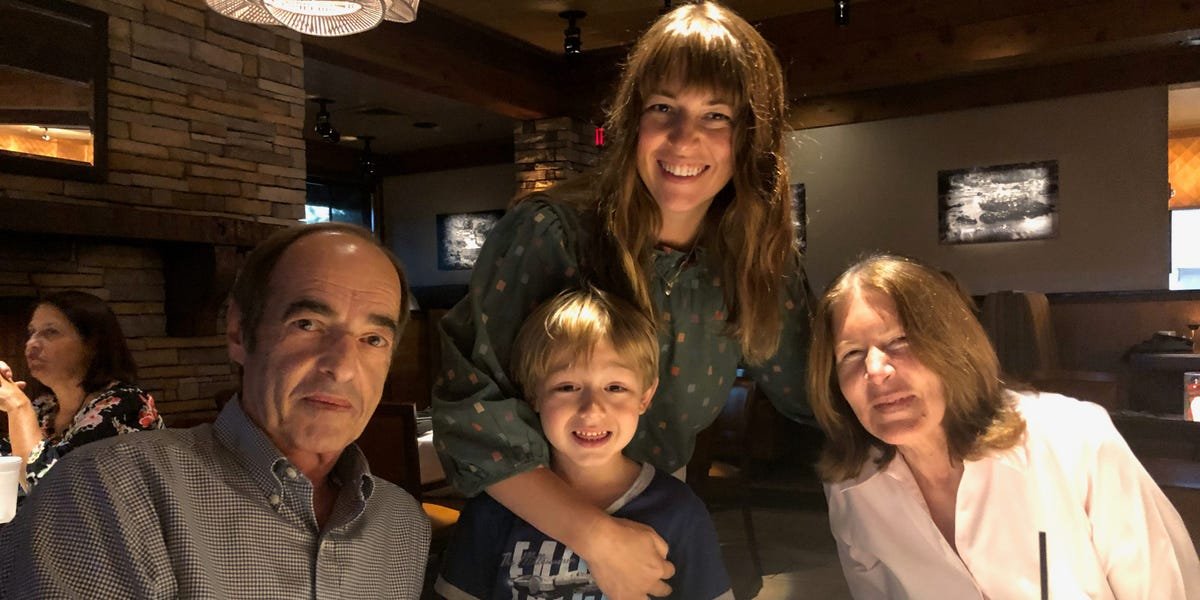
The author’s dad was healthy and active before he died.

Courtesy of the author


I paused.

Not really what I’d call an uplifting dinnertime read. At 71 years young, he was active and in good shape — a recent retiree ready to travel and spend time with his grandkids. I didn’t want to think about his potential decline — my dad was invincible.

He never caught the colds and stomach flus I brought home from school. He rarely missed work, and I figured I wouldn’t have to deal with this anytime soon. My grandparents lived well into their 80s — my great-grandmother until 100. I did the quick math — that was at least another 10 years or more.

I politely declined the read, telling him there’d be plenty of time to cover that another day. “That’s all right,” he began with a smirk,” I fell asleep when I tried to proofread it.” And that was that. There was no talk of caskets or whether he preferred The Beatles or the Rolling Stones to be played at his funeral.

No reason to discuss his death when he was so full of life. That night, we finished our hamburgers, and his will stayed on the desk, gathering dust, for the next year. And then time ran out.

Not knowing what my father wanted made it hard to grieve

This memory ran through my mind as I tried to answer the questions the funeral director asked. It was hard to concentrate with this huge lump in my stomach. Mostly, I wanted to cry and run away. Even hiding under the covers right now sounded like a good option.

I concentrated on the warmth of my husband’s hand and answered some basic questions, such as where my dad was born and his age. I failed when asked for his Social Security number. My mom tried to take over, but she was so distressed that her answers were slow and hard to access. I wanted to talk to my dad. I wish I had. This would be so much easier.

Looking at my husband, I immediately thought about my son sitting in a similar seat for us. My shoulders tensed. My tears started again, but this time because I imagined an older version of my kid stumbling through unknown answers with no space to feel his feelings. I did not want this overwhelming ordeal for him. If I could make it easier or eliminate this step completely, I would.

My husband and I made plans so my son doesn’t have to

Later that night, when my husband and I had a quiet moment alone, I told him I wanted to write out our death details for our son. He looked surprised and whispered, “We have plenty of time.” I’m sure that was meant to reassure me, but it was exactly what I said to my dad not that long ago. My mom heart would do anything to protect our son’s space to grieve. I wanted cozy childhood memories to comfort him when one of us couldn’t — not images of his mom or dad in a casket.

A few weeks later, as I processed my dad’s passing, my husband and I talked about our own. We created a checklist of what we wanted, including which funeral home and cemetery to contact. My husband and I added doodles and love notes to the list and made sure our will was in order, too. Instead of freaking my 9-year-old with more morbid information, we told trusted family members where to find all the papers. Fingers crossed, it will sit in my desk drawer gathering dust for many more years to come.


Source link

Bull

Median household wealth for Black Americans is projected to hit $0 by 2053. My estate plan is designed to protect me from that.

  • I’m working hard to build wealth, and I want to make sure it lasts forever.
  • My estate plan is designed to maintain my assets and ensure I don’t leave any surprise debt behind.
  • This article is part of “My Financial Life,” a series helping people live and spend better.

Estate planning is a fancy way of saying you’re planning for the future — a time when you’ll be unable to manage your health and wealth.

Many people focus on financial planning, but not as many think about the broader picture. However, the process doesn’t need to be complicated — it’s a matter of creating legal documents appointing people to speak and act for you.

I’m an estate-planning attorney, and I’ve seen how important this process is and where some people’s plans fall short.

I want to continue helping others after I’m physically unable to do so. A 2017 study by the Institute for Policy Studies looking at long-term projections for the racial wealth gap found that median Black household wealth could reach zero by 2053. That means my long-term goals need to factor into my estate plan to secure generational wealth.

I want to thrive today and help my future beneficiaries avoid conflicts, excessive taxes, financial burdens, and disputes that could cost time and money.

My financial plan and my estate are intertwined

I considered several questions about my estate when deciding on my financial goals:

  1. When I reflect on the wealth I have — and the wealth I’m building — what do I want done with it when I die?
  2. Who is or will be capable of managing my assets?
  3. What will happen to my digital legacy — my online accounts, digital files, pictures, and investments?
  4. What tax consequences will my choices have now and in the future?
  5. How will I keep my estate plan and financial plan updated as my life changes?

My estate plan consists of a financial power of attorney, an advance directive, a guardian nomination, a will, and a trust. As an estate-planning attorney, I frequently encounter families who created a trust but didn’t understand how it works and don’t have a plan for its upkeep.

My estate plan is designed to support all the assets I leave behind and ensure the financial moves I’m making now stay on track. For example, if I buy a house, I have to make sure there’s a plan so my trust (and the trustees I leave in charge) can continue paying for the house. I’m accounting for a mortgage, maintenance and remodeling costs, and property taxes. In one case I saw property taxes go from $3,000 to $11,000 a year following a property transfer.

I want to minimize the debt my trust will have to pay off

If your estate plan is set up correctly, some debts cannot be collected after death. I’ve chosen to save, invest, and pay down debts to minimize the bills my estate and trust would be responsible for. Considering my estate plan early in life will help me figure out which debts I should pay off first.

When it comes to my plans, the most important part is educating the people around me about my moves and my wishes. It’s easy for your plan to fail when the people you leave in charge don’t know what to do or how to do it. Having financial conversations and being transparent is the best way to ensure my financial and estate plans remain on track.

My goal is to create a comprehensive financial road map that will address my current needs and future aspirations. I’ve thought about my financial stability at every stage of life. I’ve found it helps to think about your long-term goals and values first. Then you can ask yourself the big questions — the who, what, why, and how — and get the ball rolling.


Source link

Metas-plan-to-train-its-AI-on-all-your-old.jpeg

Meta’s plan to train its AI on all your old Facebook data is raising eyebrows among privacy advocates

Meta is scrambling to compete in the red-hot AI arms race, but an advocacy group is demanding nearly a dozen European countries force Meta to pump the breaks.

The European advocacy group announced complaints in 11 European countries over an upcoming Meta policy change that would allow it to scrape old user data from Facebook to train its artificial intelligence models.

Meta “plans to use years of personal posts, private images, or online tracking data for an undefined ‘AI technology’ that can ingest personal data from any source and share any information with undefined ‘third parties,'” the group, aptly named None of Your Business, or NOYB, said in a press announcement asking authorities to step in and suspend the policy.

Meta’s updated privacy policy is scheduled to go live in late June. It would impact some 400 million European users, NOYB said. The group said it was concerning that users would have to manually opt out of providing data in the future.

“Instead of asking users for their consent (opt-in), Meta argues that it has a legitimate interest that overrides the fundamental right to data protection and privacy of European users,” NOYB said. Europe has strict data privacy laws outlined in the European Union’s General Data Protection Regulation, which went into effect in 2018 and has had a profound effect on Big Tech’s operations in Europe.

NOYB filed complaints in Austria, Belgium, France, Germany, Greece, Italy, Ireland, the Netherlands, Norway, Poland, and Spain.

A Meta spokesperson did not immediately respond to a request for comment from Business Insider, but the company previously told Reuters that its new policy followed the law.

“We are confident that our approach complies with privacy laws, and our approach is consistent with how other tech companies are developing and improving their AI experiences in Europe (including Google and Open AI),” a Meta spokesperson said, according to Reuters.

In the United States, Meta AI has already had access to public user data and private chat conversations on Facebook, Instagram, and WhatsApp, and there is no way to fully opt out of sharing your information, The Washington Post reported.


Source link