Just-when-you-thought-it-was-safe-to-buy-a.jpeg

Just when you thought it was safe to buy a plane ticket, House Republicans added a new wrinkle

The era of American travel chaos might not come to a close anytime soon, as a potential deal to fund the Department of Homeland Security — and Transportation Security Administration workers’ paychecks — appears to be falling apart.

Republican members of the House’s Freedom Caucus are signaling they won’t move forward with a proposal to fund DHS, potentially lengthening a shutdown that began on February 14.

Early Friday morning, the Senate voted to move forward with a proposal to end the partial shutdown that’s currently preventing TSA workers from getting paid. The Senate-approved proposal excludes funding for immigration operations and came as Congress prepared to depart on a scheduled recess Friday evening. For that legislation to become law — and get TSA workers paid — it needs to be passed by the House.

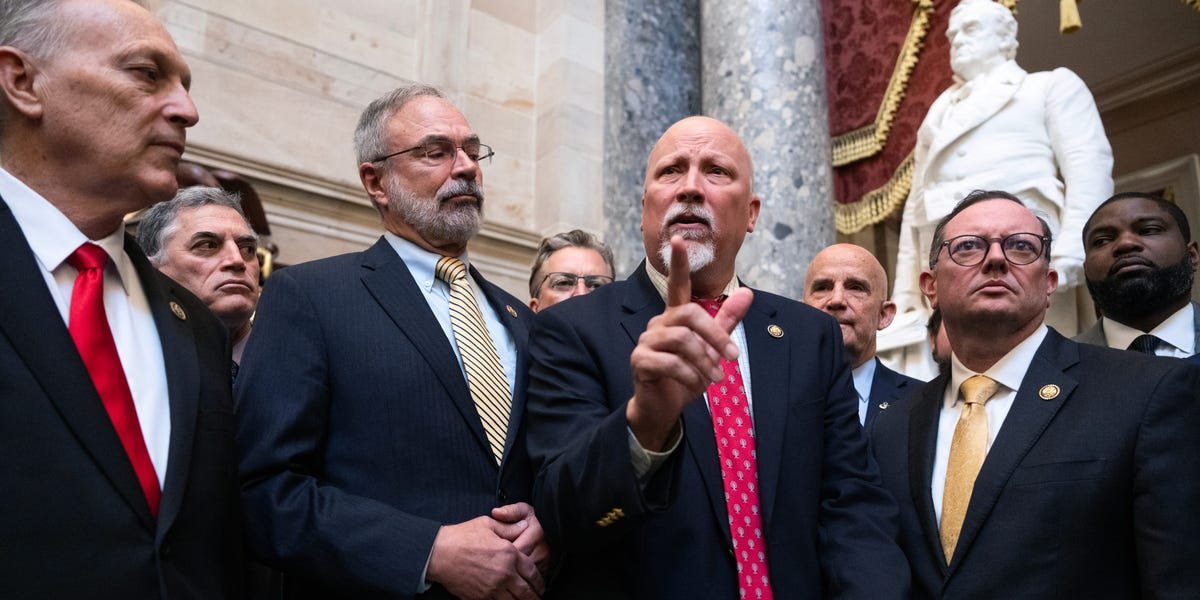
“Could the Senate be any more lazy than to send to us a bill that doesn’t do the job and then leave town?” Rep. Chip Roy, a Republican from Texas and member of the House Freedom Caucus, said at a press conference. “So we’re going to stand up and say no to that. We’re going to send back a bill that’s responsible to the American people.”

This is a developing story, check back for updates.


Source link

The-Enola-Gay-dropped-the-atomic-bomb-on-Hiroshima-in.jpeg

The Enola Gay dropped the atomic bomb on Hiroshima in World War II. Here’s where the plane is now.

  • Enola Gay, a B-29 bomber, dropped the “Little Boy” atomic bomb on Hiroshima on August 6, 1945.
  • The plane is on display at the National Air and Space Museum’s second, larger location in Virginia.
  • The exhibit has been the subject of controversy as interest groups have debated the plane’s legacy.

The Enola Gay, the Boeing B-29 Superfortress bomber that dropped the atomic bomb on Hiroshima in World War II, is so large that it couldn’t fit into the Smithsonian National Air and Space Museum’s flagship location on the National Mall in Washington, DC.

Instead, it’s displayed at the museum’s second location, the Steven F. Udvar-Hazy Center in Chantilly, Virginia.

The Udvar-Hazy Center features over 200 aircraft on display, but the Enola Gay remains one of the most prominent objects in its collection.

Take a closer look at the historic aircraft.

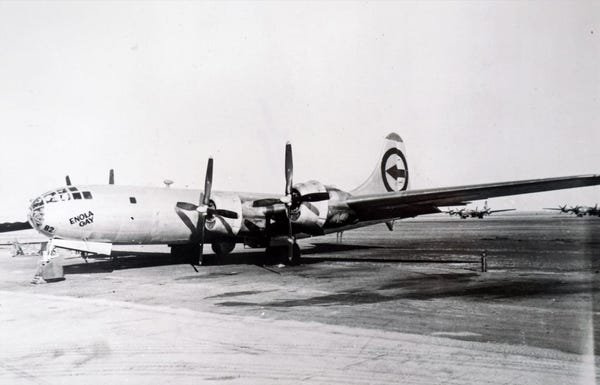
Enola Gay dropped the first-ever atomic bomb used in warfare on Hiroshima on August 6, 1945.

Enola Gay.

Photo 12/Ann Ronan Picture Library/Photo 12/Universal Images Group via Getty Images

A second “Fat Man” atomic bomb was dropped on Nagasaki on August 9, 1945, by another Boeing B-29 Superfortress named Bockscar, which is on display at the National Museum of the US Air Force in Dayton, Ohio.

The emperor of Japan announced the country’s surrender on August 15.

The plane was named after pilot Paul Tibbets’ mother, Enola Gay Tibbets.


The crew of the Enola Gay.

The crew of the Enola Gay. Paul Tibbets is second from the left.

Art Edger/NY Daily News Archive via Getty Images

Tibbets commanded the Air Force’s 509th Composite Group in charge of deploying nuclear weapons. The hand-picked squadron trained at an abandoned airfield in Windover, Utah.

The “Little Boy” atomic bomb deployed by the Enola Gay weighed 9,700 pounds.


The

The “Little Boy” atomic bomb was loaded into the Enola Gay.

PhotoQuest/Getty Images

To make the B-29 aircraft capable of carrying the atomic bomb, all of its protective and defensive armament, except for the 50-caliber tailguns, were removed to get rid of excess weight. It was also left unpainted, which saved the 850 pounds that the paint would have added.

The bomb exploded 1,900 feet above Hiroshima with devastating effects.


Hiroshima after the atomic bomb.

Hiroshima after the atomic explosion of August 1945.

Universal History Archive/Universal History Archive/Universal Images Group via Getty Images

At least 70,000 people died in the initial blast from the bombing of Hiroshima, and the death toll over five years may have exceeded 200,000 people due to the aftereffects, according to the US Department of Energy’s Office of History and Heritage Resources.

Japan and anti-nuclear weapons scientists released an updated higher estimate in the 1970s that counted 140,000 deaths at Hiroshima.

The Enola Gay was rattled by shockwaves from the explosion, even as it had already flown 11.5 miles away.

After the Enola Gay spent decades in storage, the Smithsonian began restoration work on the bomber in 1984.


The Enola Gay underwent restoration work at a Smithsonian facility.

Restoration of Enola Gay at the Paul E. Garber facility of the Smithsonian in Silver Hill, Maryland.

Ben Martin/Ben Martin/Getty Images

It took museum staff 300,000 hours to reassemble and restore the Enola Gay, with 12 truckloads transporting all of its parts.

The historical narratives around the use of the atomic bomb were fiercely debated when parts of the Enola Gay first went on display in 1995.


The fuselage of the Enola Gay on display at the National Air and Space Museum in Washington, DC, in 1995.

The fuselage of the Enola Gay on display at the National Air and Space Museum in Washington, DC, in 1995.

Jeffrey Markowitz/Sygma via Getty Images

In 1995, the fuselage and other parts of the Enola Gay were displayed at the National Air and Space Museum’s flagship location in Washington, DC, in an exhibit tied to the 50th anniversary of the bombing of Hiroshima.

The script of the exhibit was rewritten several times as various interest groups debated how it was presented and how the decision to drop the bomb was framed, according to the Smithsonian Institution Archives.

Veterans’ groups pushed for the exhibit to emphasize Japanese aggression and present the narrative that dropping the atomic bomb saved lives by ending the war. Anti-war activists opposed having the exhibit justify the use of the bomb and sought to highlight its victims by protesting with alternative exhibits on the sidewalk outside the museum.

The Enola Gay went on permanent display at the National Air and Space Museum’s Steven F. Udvar-Hazy Center in 2003.


The Enola Gay Superfortress bomber at the Smithsonian Air and Space Museum's Udvar-Hazy Center ahead of its opening in 2003.

The Enola Gay Superfortress bomber at the Smithsonian Air and Space Museum’s Udvar-Hazy Center ahead of its opening in 2003.

Mark Wilson/Getty Images

Weighing 137,500 pounds with a wingspan of 141 feet, the fully assembled plane is too large for the National Air and Space Museum’s flagship location on the National Mall in Washington, DC. The Steven F. Udvar-Hazy Center in Chantilly, Virginia, offers more room with 340,000 square feet of exhibit space.

The Udvar-Hazy Center features an elevated walkway, allowing visitors to view the plane from above as well as on the ground.


The Enola Gay viewed from an elevated platform at the National Air and Space Museum's Steven F. Udvar-Hazy Center.

The Enola Gay viewed from an elevated platform at the National Air and Space Museum’s Steven F. Udvar-Hazy Center.

Talia Lakritz/Business Insider

The Enola Gay is displayed among other aircraft from World War II, including the Northrop P-61C Black Widow, the first US aircraft designed for combat at night.

The Enola Gay stands out as one of the museum’s most historically significant aircraft.


The Enola Gay.

The Enola Gay.

Talia Lakritz/Business Insider

Over 80 years after the bombing of Hiroshima, the Enola Gay remains not just a World War II artifact, but a symbol of a turning point that ushered the world into the nuclear age.

After years of debate over how to present the aircraft, the permanent exhibition takes a minimalist approach, leaving visitors to decide how to understand its legacy.


Source link

John F. Kennedy Jr. and Carolyn Bessette Kennedy in black tie attire

JFK Jr. and Carolyn Bessette died in a plane crash 27 years ago. It fueled rumors of a ‘Kennedy curse.’

John F. Kennedy Jr. and his wife, Carolyn Bessette Kennedy, attended the Municipal Art Society Gala in 1998.

  • John F. Kennedy Jr., his wife, and her sister died in a 1999 plane crash near Martha’s Vineyard.
  • Rumors of a “Kennedy curse” were fueled by multiple family tragedies over the decades.
  • JFK Jr. and Carolyn Bessette’s relationship is now the topic of an FX series, “Love Story.”

The Kennedy family has been subjected to many tragedies over the years, including two assassinations and a plane crash that took the lives of John F. Kennedy Jr. and two other passengers.

Nearly 27 years ago, on July 16, 1999, John F. Kennedy Jr., his wife Carolyn Bessette-Kennedy, and her older sister Lauren Bessette were killed in a plane crash off the coast of Martha’s Vineyard in Massachusetts. There were no survivors from the accident.

The relationship between John F. Kennedy Jr. and Carolyn Bessette-Kennedy is now the topic of an FX series executive-produced by Ryan Murphy, “Love Story.”

Their deaths became a major news story and perpetuated rumors of a “Kennedy curse.”

JFK Jr.’s father, former President John F. Kennedy, was assassinated in 1963. His uncle, Robert “Bobby” Kennedy, was assassinated five years later in 1968. And two years before JFK Jr.’s death, his cousin Michael Kennedy also died after hitting a tree while skiing in Aspen, Colorado.

Here’s what we know about the plane crash that killed John F. Kennedy Jr. and two others.

John F. Kennedy Jr. frequently made headlines throughout the 1990s.
John F. Kennedy, Jr. addresses the Democratic National Convention in 1988
John F. Kennedy, Jr. at the Democratic National Convention in 1988.

As the son of a president and a member of one of America’s most prominent political dynasties, John F. Kennedy Jr. was destined for the spotlight.

JFK Jr. was born on November 25, 1960, just two weeks after his father was elected president. His father was assassinated on November 22, 1963, just three days shy of JFK Jr.’s third birthday.

JFK Jr., affectionately nicknamed “John-John” by the public, attended the funeral on his birthday and was famously photographed saluting his father’s casket.

Throughout much of his adolescence and adulthood, he mostly remained out of the public eye.

However, his public image began to change after he introduced his uncle, Ted Kennedy, at the Democratic National Convention in 1988.

In September 1988, People named Kennedy, who was then a 27-year-old third-year law student at NYU, the “Sexiest Man Alive.”

JFK Jr. also dated a few celebrities throughout the 1990s, including “Sex and the City” star Sarah Jessica Parker, Cindy Crawford, and Daryl Hannah.

John F. Kennedy Jr. began dating Carolyn Bessette, a publicist for Calvin Klein, in 1994.
John F. Kennedy Jr. and Carolyn Bessette-Kennedy in 1995
John F. Kennedy Jr. and Carolyn Bessette-Kennedy in 1995.

They met in the fitting room at Calvin Klein, where Bessette helped JFK Jr. pick out wardrobe items, Elizabeth Beller wrote in “Once Upon a Time: The Captivating Life of Carolyn Bessette-Kennedy,” cited by People.

Tall, sophisticated, and beautiful, JFK Jr.’s new girlfriend captivated the public.

After two years of dating, the pair married in an intimate ceremony on Cumberland Island, Georgia, People reported.

While their wedding ceremony was private, their relationship was anything but, thanks to the prying eyes of the paparazzi.
John F. Kennedy Jr. and Carolyn Bessette in New York City and the front cover of the October 7, 1996, Daily News picturing the couple and the headline

The media attention may have even inspired Kennedy to get his pilot’s license in 1998.

“That was some of the happiest times he ever had. Floating around with the buzzards in his Buckeye [plane]. It was the freedom,” his close friend Robbie Littell told “JFK Jr: An Intimate Oral Biography” author RoseMarie Terenzio, according to People.

“He said, ‘It’s the only place I can go where no one is bothering me. I have complete silence, and no one can get to me except the air traffic controllers.’ Maybe that gives you insight into what he was really dealing with on the ground,” his college friend Gary Ginsberg said, People reported.

John F. Kennedy Jr. was traveling to Martha’s Vineyard with his wife and her older sister when their plane was reported missing.
The hangar where John Kennedy Jr. kept his Piper Saratoga airplane and a similar model plane.
The hangar where John Kennedy Jr. kept his Piper Saratoga airplane.

The Washington Post reported that Kennedy departed Essex County Airport near Fairfield, New Jersey, at around 8:38 p.m. on Friday, July 16, 1999. The sun was already beginning to set and “hazy conditions,” which had been reported earlier in the evening, were getting worse, People reported.

Kennedy planned to drop his sister-in-law Lauren Bessette on Martha’s Vineyard before traveling to his family’s compound in Hyannis Port with Carolyn. The couple was due to attend his cousin Rory Kennedy’s wedding the following day, according to People.

However, the plane never landed in Martha’s Vineyard.

An unidentified driver reported the plane had failed to arrive at Martha’s Vineyard Airport as expected, according to the Post, citing an NBC report. It kicked off a search for the missing aircraft in the early hours of July 17.

The Kennedy family notified the Cape Cod Coast Guard that the couple had not made it back to Hyannis.
A Coast Guard helicopter lifts a rescue swimmer after the swimmer jumped into the water on July 17, 1999, to look for debris from John Kennedy Jr.'s plane
A Coast Guard helicopter searching for debris from John Kennedy Jr.’s plane.

The Washington Post reported that the Coast Guard then began investigating whether the plane had landed at another airport.

By 4 a.m., the Coast Guard began searching for the missing plane, and by 7:30 a.m., the Air Force and Coast Guard had launched 20 aircraft vehicles and two boats to search the area between Long Island and Martha’s Vineyard, according to the Post’s timeline.

On Sunday afternoon, what was presumed to be debris from the plane was found on Philbin Beach on Martha’s Vineyard. Among the debris was a headrest that was later concluded to be from the missing aircraft and a black suitcase that contained Lauren Bessette’s business card.

Rory Kennedy’s wedding, scheduled for 6 p.m. that night, was put on hold as the family awaited more news.

The Washington Post reported that after more debris was found in the days to follow, the search-and-rescue mission became a search-and-recovery mission.

All three of the plane’s passengers were now presumed dead. John F. Kennedy Jr. was 38 years old. Carolyn Bessette-Kennedy was 33, and her sister Lauren Bessette was 34.

Five days after the crash, the bodies of John F. Kennedy Jr., Carolyn Bessette-Kennedy, and Lauren Bessette were recovered.
Massachusetts State Police divers left Menemsha on Martha's Vineyard on July 19, 1999.
Massachusetts State Police divers left Menemsha on Martha’s Vineyard on July 19, 1999.

The debris field was identified off the coast of Martha’s Vineyard, relatively near the estate once owned by Jacqueline Kennedy Onassis, Kennedy’s mother, The New York Times reported. (Kennedy Onassis died in 1994.)

The bodies of John F. Kennedy Jr., Carolyn Bessette-Kennedy, and Lauren Bessette were discovered by Navy divers on July 22, 1999, after an extensive search approved by President Bill Clinton.

The bodies of the crash victims, which were ”near and under” the main body of the aircraft, were still strapped in, according to the Times.

Details began to emerge about what led to the crash.
A television technician holds up the official handout map of the search and rescue area off Martha's Vineyard
A television technician holds up the official handout map of the search and rescue area off Martha’s Vineyard.

Kennedy had only flown about 72 hours without a flight instructor, and had only about 300 total hours of flying experience, The New York Times reported in July 2000. He had reportedly rejected an offer to have a flight instructor accompany the group on their journey.

As a newly trained pilot, Kennedy was not licensed to fly and navigate the air using flying instruments. Instead, he had only trained to fly using sight alone, which would have been extremely difficult in dark or hazy conditions such as those on the night of July 16.

Warren Morningstar, a spokesman for the Aircraft Owners and Pilots Association, told the Times that “flying at night over featureless terrain or water, and particularly in haze or in overcast, is a prime setup for spatial disorientation.”

About an hour into the trip, the plane’s flight path became irregular as it began its descent into Martha’s Vineyard, indicating that the pilot may have become disoriented by the darkness of the sky and the water, the National Transportation Safety Board concluded.

“His flight path into the water is consistent with what is known as a graveyard spiral,” Jeff Guzzetti, an NTSB investigator in the accident, told Terenzio, according to People. “The airplane makes a spiral nose down … kind of like going down a drain. The plane went into one final turn and it stayed in that turn pretty much all the way down to the ocean.”

The aircraft went down in the water about 7 miles from its intended destination of Martha’s Vineyard.
A mourners cries as people pay respects at the floral shrine outside of the building where John F. Kennedy Jr. and Carolyn lived in 1999.
Mourners pay respects at the floral shrine outside of the building where John F. Kennedy Jr. and Carolyn lived in 1999.

The Washington Post reported that the plane did not send out a distress call. Instead, it made its final descent and crashed into the Atlantic Ocean in under 30 seconds.

Kennedy, Kennedy-Bessette, and Bessette’s bodies were cremated and buried at sea off the coast of Martha’s Vineyard on July 22, 1999.

“We are filled with unspeakable grief and sadness by the loss of John and Carolyn and Lauren Bessette,” Ted Kennedy said in a statement on behalf of the Kennedy family. “John was a shining light in all our lives and in the lives of the nation and the world that first came to know him as a little boy.”

As the country mourned the loss, rumors of a “Kennedy curse” were reignited.
John F. Kennedy, Jr. gives his wife Carolyn a kiss on the cheek during the annual White House Correspondents dinner
John F. Kennedy, Jr. and Carolyn Bessette-Kennedy attended the White House Correspondents dinner in 1999.

The extensive search captured the nation’s attention, as did the tragedy of the three young passengers’ deaths. Yet another tragic accident for the Kennedy family, the plane crash only added to rumors of a Kennedy family curse.

“I’ve looked high and low and cannot find another family since the ancient Greek House of Atreus that has suffered more calamities and misfortunes than the Kennedys,” Edward Klein, the author of “The Kennedy Curse: Why Tragedy Has Haunted America’s First Family for 150 Years,” said, according to The Washington Post.

While there are many logical reasons for the fateful plane crash, it’s nevertheless poignant that the Kennedy family, one of the wealthiest and most influential political families in the world, has suffered so much tragedy throughout the last 100 years.

“The humanity of their story is what keeps us engaged,” Kennedy family biographer J. Randy Taraborrelli told NBC News in 2019.

“We peer behind the scenes of their wealthy lifestyle, and we see, for all the advantages they have, tragedy can still happen.”

Read the original article on Business Insider

Source link

Aditi Bharade

A JetBlue plane made an emergency landing at Newark after smoke was reported in the cabin

A JetBlue flight from New Jersey to Florida on Wednesday made an emergency landing after smoke was reported in the cabin.

In a statement to Business Insider, a JetBlue representative said that JetBlue flight 543 from Newark to West Palm Beach returned to Newark Liberty International Airport shortly after takeoff, “following a reported engine issue and smoke in the cabin.”

The representative said the aircraft landed safely and passengers and crew evacuated using the aircraft’s slides. They added that JetBlue was working with federal authorities to investigate the incident.

Data from the aircraft-tracking website FlightRadar24 showed the plane, an Airbus A320, making a circular loop in the air above Newark.

It departed from Newark at 5:30 p.m. E.T., 45 minutes later than its scheduled departure time, and returned about 20 minutes later.

There have been several instances of flights in the US making emergency landings because of smoke in recent years.

In November, a United Airlines flight from San Francisco to Hong Kong was forced to return to SFO. The airline said that the flight crew had detected a “burning rubber smell in the cabin,” and it returned to address the issue.

Last February, a Delta Air Lines flight from Atlanta to Columbia, South Carolina, was forced to return after just 10 minutes in the air.

Communications between the pilot and air traffic control staff captured the Delta pilot saying, “Got smoke in the cabin and need to plan a return back. Have the fire trucks roll for us, please.”

And in October 2024, a Frontier Airlines flight with nearly 200 people on board, arriving from San Diego, caught fire upon landing in Las Vegas. A video from an onlooker on X showed the plane’s right engine aflame as it slowed to a halt.

Representatives for the Federal Aviation Administration did not respond to a request for comment from Business Insider.


Source link

A map of the Pacific Ocean shows the flight path of ANA Flight 223 on Tuesday, 17 February, that turned around north of Alaska before returning to Tokyo

Travelers endured a half-day flight to nowhere after their plane u-turned over the Arctic 7 hours into the journey

Passengers flying from Japan to Europe endured a 14-hour-long flight to nowhere on Tuesday after an engine issue.

All Nippon Airways Flight 223 left Tokyo around 11 a.m. and was scheduled to land in Frankfurt, Germany, about 14 hours later.

However, over six hours into the journey, it turned around while flying over the Arctic Ocean, north of Alaska.

Flight-tracking data shows how the Boeing 787 then headed back to the Japanese capital.

It took another eight hours to reach Tokyo’s Haneda Airport, where Flight 223 touched down around 1 a.m.

The plane diverted due to a “low engine oil level,” an ANA spokesperson told Business Insider.

Engine oil differs from jet fuel and is used to lubricate and cool the moving parts inside the engine. Returning to Tokyo, the airline’s main hub, would mean more resources for maintenance and repair.

The spokesperson added that the flight departed again on Wednesday morning, with a change of aircraft and crew.

Data from Flightradar24 shows the new plane departed at around 7:30 a.m. and is supposed to land in Frankfurt around 1 p.m. local time. That’s about 20 hours later than passengers initially expected to get there.

“The safety of our passengers and crew is our top priority,” the spokesperson said. “We sincerely apologize for the inconvenience caused to our customers by this extensive delay.”

Since the plane turned around roughly halfway through a huge journey, it was a particularly gruelling flight to nowhere — but not the longest.

Last June, a Qantas flight to Paris returned to Perth after 15 hours. It was mid-flight when Iran launched strikes against a US air base in Qatar, closing some of the world’s most congested airspace.

And in 2023, Air New Zealand passengers had a 16-hour flight to nowhere after an electrical fire in a terminal at New York’s JFK Airport.


Source link

Take-a-look-inside-the-Air-Force-One-plane-that.jpeg

Take a look inside the Air Force One plane that carried 8 presidents and brought home JFK’s body from Dallas

Updated

  • SAM 26000 operated as Air Force One from 1962 to 1998, carrying eight US presidents.
  • Lyndon Johnson was sworn in on board, and the plane transported John F. Kennedy’s body from Texas.
  • SAM 26000 is housed at the National Museum of the US Air Force, where visitors can walk through it.

“If history itself had wings, it would probably be this aircraft,” Vice President Al Gore said of the SAM 26000 Air Force One plane upon its retirement in 1998.

The first Air Force jet designed and built specifically for US presidents, SAM 26000 (pronounced two six thousand) carried eight presidents between 1962 and 1998 — every leader from John F. Kennedy to Bill Clinton.

After 13,000 flying hours over 36 years of service, the plane was retired to the National Museum of the US Air Force in Dayton, Ohio, where it remains on display.

I visited the museum in August and walked through the historic aircraft. Take a look inside.

The SAM 26000 Air Force One jet, a Boeing VC-137C, was completed in 1962 for President John F. Kennedy.

SAM 26000 at the National Museum of the US Air Force.

US Air Force photo by Ken LaRock

The Boeing VC-137C was a customized and modified version of a civilian 707-320B airliner. It was powered by four Pratt & Whitney TF33 engines, each with 18,000 pounds of thrust.

First lady Jacqueline Kennedy chose the plane’s blue and white paint colors in coordination with industrial designer Raymond Loewy.


A blue and white plane on display in a museum, with

Eight US presidents flew on this Air Force One plane known as SAM 26000.

US Air Force photo by Jim Copes

The first lady also added the words “United States of America” to the aircraft to signal its importance as the president’s plane.

In a tragic period of American history, SAM 26000 transported President John F. Kennedy’s body home after his assassination in 1963.


Air Force One arrives with President John F. Kennedy's coffin.

President John F. Kennedy’s coffin was transported on Air Force One after his assassination.

Schulman-Sachs/picture alliance via Getty Images

President Lyndon Johnson was sworn in as president aboard the plane hours after Kennedy was pronounced dead.

Now an interactive museum artifact, visitors can board the plane the same way US presidents did via a staircase leading into the cabin.


Air Force One at the National Museum of the US Air Force.

Air Force One.

Talia Lakritz/Business Insider

Admission to the National Museum of the US Air Force is free.

SAM 26000 is located in the museum’s William E. Boeing Presidential Gallery, which includes other presidential planes such as the Douglas VC-54C, the first presidential aircraft, which was known as the “Sacred Cow.”

The first stop on my self-guided tour was the cockpit, which featured a four-person crew.


The flight deck of SAM 26000.

The cockpit.

Talia Lakritz/Business Insider

The crew consisted of a pilot, copilot, navigator, and flight engineer. The navigator and flight engineer roles were eventually replaced by GPS and computerized technology on later Air Force One planes.

Two phones were located behind the flight deck.


Two phones aboard Air Force One, SAM 26000.

Two phones aboard Air Force One.

Talia Lakritz/Business Insider

A plaque above the phones read, “This telephone is subject to monitoring at all times. Use of this telephone constitutes consent to monitoring.”

An equipment storage space featured a first aid kit and firearms.


A first aid kit and weapons on Air Force One SAM 26000.

A first aid kit and weapons on Air Force One.

Talia Lakritz/Business Insider

The closet also had a rack to hang suits and coats.

Next, I walked by the plane’s communication facility.


The communication facility on board SAM 26000.

The communication facility.

Talia Lakritz/Business Insider

The secure communication center allowed presidents to place calls anywhere in the world while in flight.

Meals were prepared in the galley.


The galley on board SAM 26000.

The galley.

Talia Lakritz/Business Insider

The galley included a stovetop, oven, and sink.

This seating area was used by presidential staff, members of the press, and Secret Service agents.


A seating area aboard SAM 26000.

A seating area aboard SAM 26000.

Talia Lakritz/Business Insider

The aircraft could hold up to 40 passengers.

The seating area, like many areas of the plane, is now protected by plastic barricades.

I noticed fox decals above the seats, which a museum volunteer told me was a nod to the 89th Airlift Wing, which operates Air Force One.


A fox decal on Air Force One SAM 26000.

A fox decal on Air Force One.

Talia Lakritz/Business Insider

Stationed at Joint Base Andrews in Maryland, the 89th Airlift Wing is tasked with flying the president and high-ranking government officials. The group is also referred to as “SAM FOX,” which stands for “Special Air Missions Foreign.”

The presidential stateroom was located down a long hallway.


A hallway on Air Force One.

A hallway on Air Force One.

Talia Lakritz/Business Insider

The benches in the hallway were hollow to offer additional storage.

The president’s spacious quarters featured a desk, couch, television, and private bathroom.


The president's stateroom aboard SAM 26000.

The president’s stateroom.

Talia Lakritz/Business Insider

In 1969, Nixon redesigned Air Force One and moved the presidential quarters over the wings, which was the quietest and smoothest part of the plane during flight.

The stateroom came with two phones, each with different purposes.


Two phones in the president's stateroom on Air Force One SAM 26000.

Two phones in the president’s stateroom.

Talia Lakritz/Business Insider

Presidents used the white phone to communicate with crew members and other passengers on the plane, while the beige phone could be used to call anywhere in the world.

Behind the presidential stateroom, a conference room provided more meeting space.


A conference room on SAM 26000.

A conference room.

Talia Lakritz/Business Insider

The room was furnished with throne chairs, a folding table, and another TV.

Additional conference areas provided more seating for staff, Secret Service members, and VIPs.


Seating aboard SAM 26000.

A conference room aboard SAM 26000.

Talia Lakritz/Business Insider

Presidents Nixon, Ford, and Carter sat here while flying to attend Egyptian President Anwar El-Sadat’s funeral in 1981.

An office area across the aisle featured an electric typewriter, scanner, and more phones.


A conference room with a map of the United States aboard SAM 26000.

A conference room.

Talia Lakritz/Business Insider

Presidents used the electric typewriter to write and edit speeches while on board the plane.

The wall of the office space was decorated with a map of the United States.

President Lyndon Johnson was sworn in as president in this area of Air Force One’s cabin after Kennedy’s assassination in 1963.


Lyndon Johnson takes the oath of office aboard Air Force One after the assassination of John F. Kennedy.

President Lyndon Johnson was sworn in on board Air Force One after President John F. Kennedy’s assassination.

Universal History Archive/Getty Images

Kennedy was assassinated on November 22, 1963, while visiting Dallas. He was pronounced dead at Parkland Memorial Hospital at 1 p.m., and Johnson took the oath of office at 2:38 p.m.

Jacqueline Kennedy’s pink suit was still smeared with blood when Federal Judge Sarah T. Hughes administered the oath of office on Air Force One. Johnson’s wife, Lady Bird Johnson, stood to his right.

Standing in the very spot where Johnson was sworn in after Kennedy’s assassination was awe-inspiring.


A hallway on SAM 26000.

A hallway between conference rooms on SAM 26000.

Talia Lakritz/Business Insider

Even blocked off by plastic barricades, the plane’s cabin preserves a pivotal moment in US history.

These four seats toward the back of the plane were removed to make room for Kennedy’s coffin on the flight from Dallas back to Washington, DC, in 1963.


Seats on Air Force One.

Seats on Air Force One.

Talia Lakritz/Business Insider

The Secret Service had to break the handles off the casket to make it fit through the plane door.

Air Force security personnel operated out of this area at the back of the aircraft to secure the plane while it was on the ground.


Seats for security personnel aboard SAM 26000.

Seats for security personnel.

Talia Lakritz/Business Insider

The seating area featured six seats, a phone, and a folding table.

My tour ended at the back of the plane with a view of its call sign on the tail and an American flag.


The tail of SAM 26000.

The tail of SAM 26000.

Talia Lakritz/Business Insider

According to US Flag Code, an American flag decal must always be positioned so that the stars face forward.

Air Force One remains an instantly recognizable symbol of US might, making my walkthrough tour a memorable experience.


The presidential seal on Air Force One.

The presidential seal on Air Force One.

Talia Lakritz/Business Insider

Like many modes of presidential transportation, such as the bulletproof limousine known as “The Beast” and the Marine One helicopter, Air Force One is about more than simply getting the president from point A to point B. It symbolizes the power of the United States and its elected leader wherever it goes.

The image projected by presidential planes remains of great interest to President Donald Trump, who opted to accept a luxurious Boeing 747-8 jet from the Qatari royal family instead of waiting for Boeing to deliver its long-delayed new Air Force One jets.


Source link

Aditi Bharade

Why Starbucks is letting Brian Niccol use the company plane for more personal travel

Starbucks is getting CEO Brian Niccol to use the company jet for all his travels — and removing his quarter-million travel budget cap.

In a Monday filing, the Seattle-based coffee chain said that it was changing its agreement on how much Niccol could use the company’s private jet for his personal travel. And the main reason for this change is to ensure Niccol’s safety.

Before September, Niccol’s use of the Starbucks plane for non-work reasons was subject to an annual cap of $250,000, and if he exceeded that amount, he had to reimburse the company, the Monday filing wrote.

But after September, the board removed the $250,000 annual cap and replaced it with a “more frequent quarterly review of Mr. Niccol’s personal flights by the chair of the Compensation Committee,” per the filing. Starbucks has not imposed a new maximum spending limit.

“This change was driven by the security study’s recommendation that Mr. Niccol use Company aircraft for all air travel, including personal travel, and the Company’s ongoing monitoring of Mr. Niccol’s security situation,” the filing wrote.

A Starbucks spokesperson said the company’s board recently decided to enhance security measures for Niccol, following a review of threats and risks to the chief executive.

Following the review, the board has made it a requirement to use private aircraft for all his travels, the spokesperson added.

Last year, Starbucks was hiring for a pilot to fly its private Gulfstream jets. In the job listing, the company said it would pay the pilot a salary between $207,000 and $360,300.

The filing also wrote that Niccol was paid about $31 million in compensation in 2025, a drop from the $95.8 million he was paid in 2024. His 2024 compensation was boosted by $90.2 million in stock awards he received as part of his signing contract.

Niccol started at the company in September 2024, moving over from Chipotle. He has helmed the chain’s “Back to Starbucks” turnaround plan, an effort to turn around several quarters of poor results because of a declining customer experience.

His offer letter in August 2024 showed that Starbucks had permitted him to use the company jet to commute from his home in California to the company’s headquarters in Seattle. In July last year, Business Insider learnt that Starbucks had set up a satellite office close to Niccol’s residence in Newport Beach.


Source link