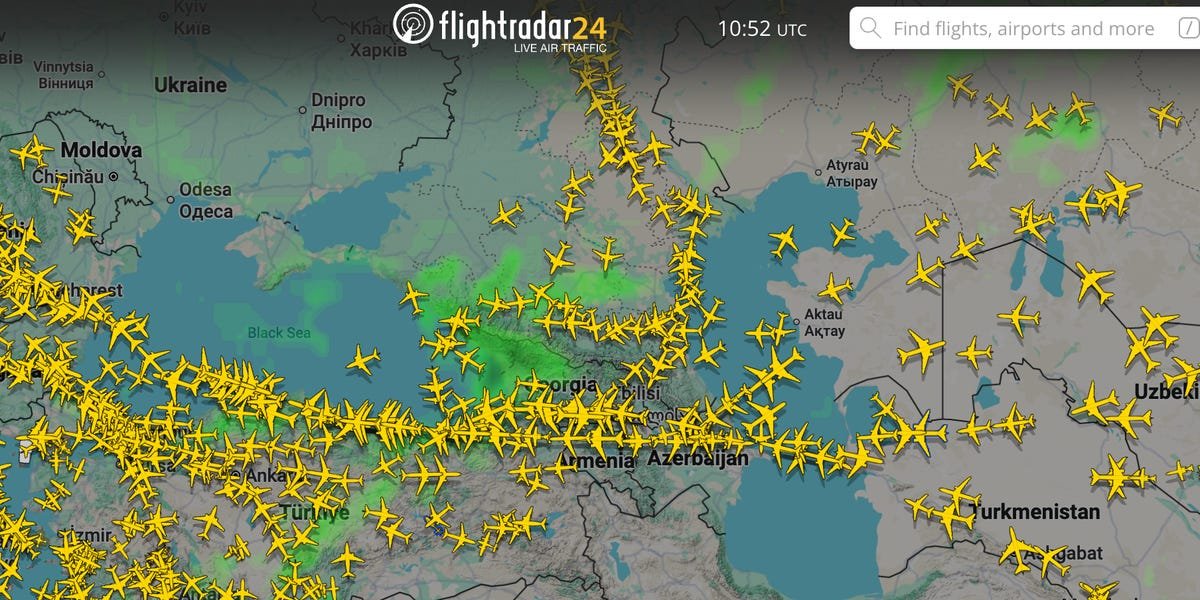
A narrow flight corridor that’s become vital to airlines is shrinking as the Iran conflict expands.
On Thursday, Azerbaijan’s foreign ministry said that Iranian drones attacked the Nakhchivan Autonomous Republic. It’s an exclave to the north of Iran, which is separated from the rest of Azerbaijan by Armenia.
One drone damaged the terminal at Nakhchivan Airport, and another fell near a school building, the ministry said. Two civilians were injured, it added.
As a result, Azerbaijan closed the southern sector of its airspace.
It leaves airplanes flying between Europe and Asia with an even smaller space to navigate.
Since the US and Israel launched strikes against Iran on Saturday, airlines have been unable to fly over the Persian Gulf, which was previously the main route.
Following drone strikes on Nakhchivan International Airport (NAJ) earlier today, Azerbaijan has closed the airspace in its southern sector. Learn more about this, and more, in our updated list of airspace closures and restrictions: https://t.co/AU0KOdzprtpic.twitter.com/X19SnOglD5
Instead, they have been rerouting through Saudi Arabia or the Caucasus. The region consists of Armenia, Georgia, and Azerbaijan, and links the Black Sea with the Caspian Sea. It is bordered by Iran and Turkey to the south, and Russia to the north.
Most airlines have been unable to fly over Russia since the invasion of Ukraine in 2022.
The Caucasus is not without its own tensions, either.
In 2023, Azerbaijan launched a military offensive against Nagorno-Karabakh, a region within its territory that was governed and mostly populated by ethnic Armenians.
The conflict in Iran, however, is encouraging Armenia and Azerbaijan to refrain from escalating tensions.
After the drone attack on Nakhchivan, the two foreign ministers held a phone call where they “noted the importance of sustainable peace between Armenia and Azerbaijan and exchanged views on matters of mutual interest,” according to a press release.
Six-figure private charter flights, chauffeured drives, hours-long waits to cross borders: Some wealthy travelers and expats in the UAE are doing whatever it takes to evacuate the Gulf region amid air strikes and the possibility of escalation.
“Demand is definitely increasing,” Glenn Phillips, a PR and advertising manager at global charter firm Air Charter Services, told Business Insider, adding that “there are an increasingly limited number of aircraft willing and able to fly to and from the area.”
On Monday, two days after the start of the US and Israel’s war against Iran, flights out of the United Arab Emirates — whose two main airports were damaged by Iranian air strikes — were still few and far between, and major hubs, including Qatar, Bahrain, and Kuwait, had to shut down due to airspace restrictions.
That left wealthy people in financial hotspots like Dubai and Abu Dhabi — hubs for monied tourists and Western expats in recent years — scrambling to reach Oman or Saudi Arabia, two countries that had open airspace through Monday. They spent hours in the car to reach the airports, as border-crossing waits increased by the day.
It may soon get harder for travelers to reach functioning private jets. Some commercial flying had resumed from the UAE on Monday evening, but that appears to have slowed amid new missile threats. Reported attacks on the US embassy in Riyadh have similarly forced several flights to turn around or divert from the Saudi city.
In what appears to be a warning of escalating tensions that could further snowball the conflict, the US State Department on Monday night urged Americans to evacuate over a dozen Middle Eastern nations — including those that still had their airspace open to commercial and private flights, like Oman and Saudi Arabia.
Flights out for $200,000+
Charter flights can cost as much as $200,000, Jay Smedley, the owner of luxury concierge firm Dubai Key, told Business Insider. The company has arranged short-haul private charter flights to Istanbul, Cairo, and the Maldives for clients since requests began to increase on Saturday.
Flights to Europe can cost even more, with Ameerh Naran, the CEO of Vimana Private Jets, saying the firm is pricing the flights between $175,000 and $235,000.
Air Charter Services has arranged “a number” of evacuation flights — and has more scheduled on Tuesday — out of Muscat, Oman, largely for people looking to leave Dubai, Phillips said.
The trip involves a five-hour drive, plus an additional three- to four-hour wait at the Hatta border crossing, which he expects will increase.
The demand to leave the region began last week, Naran told Business Insider, adding that there was “a noticeable increase in enquiries from Friday onwards.”
“Expect long waiting queues and security check delays,” Camille d’Harambure, a general manager at luxury travel firm Lightfoot Travel, told Business Insider.
Mike D’Souza, the operations coordinator for Dubai-based chauffeur service Indus Chauffeurs, told Business Insider that the “demand appears precaution-driven rather than panic-driven.”
“There has been a clear emphasis on speed and certainty of departure, with many clients prioritizing the earliest viable routing rather than specific aircraft types or traditional preferences,” Naran said. “We have also seen increased demand for coordinated ground support to facilitate access to airports where airspace remains open.”
Phillips echoed that clients just want to get out and are not all that concerned about where “out” is.
Prices have increased with demand, Phillips added — and in some cases, even those wealthy enough to pay their way out of the Middle East are looking twice at the price tag of departure.
“Many people are taking shorter flights to places out of the region and then picking up scheduled connections for the rest of their journey to reduce full journey costs,” he said.
Hundreds of people spent a snowy and freezing night trapped on board parked airplanes last Thursday.
Six flights, with around 600 passengers total, were unable to take off before Munich Airport’s 1 a.m. curfew due to the bad weather, the airport said in a Monday statement.
The airport police department has prepared a report on the incident, which is set to be submitted to the public prosecutor on Tuesday, Sven Otto, chief inspector for the Upper Bavaria North Police, told Business Insider.
He added that no complaints have yet been filed with the police by affected passengers.
Around 100 flights were canceled in Munich on Thursday, and temperatures dropped to 30 degrees Fahrenheit. There were long lines to de-ice planes, while runways were periodically closed at short notice to clear the heavy snowfall, the airport said.
Every time Pete publishes a story, you’ll get an alert straight to your inbox!
Stay connected to Pete and get more of their work as it publishes.
Munich, Europe’s 10th-busiest airport, typically shuts at midnight, but it received a permit that day to operate an hour later.
When the six flights couldn’t depart on time, there was no space left to park at the terminal due to all the cancellations, the airport said.
However, the passengers couldn’t be transported to the terminal because “bus service was severely restricted” due to “the late hour and communication problems,” it added.
Five of the flights were operated by Germany’s Lufthansa Group, and another by Air Arabia, a budget airline based in the UAE, according to the airport.
It said that airlines “provided the passengers with the best possible care on the aircraft.” Although those on board spoke of their distress.
“There was no food or drink for us. There were no blankets for us either,” Søren Thieme, who was on one of the Lufthansa planes, told Ekstra Bladet, a Danish newspaper that first reported the incident.
He said passengers on the canceled flight to Copenhagen asked if they could enter the airport, but they were told it was forbidden, and that all the bus drivers had gone home.
“We’re simply trapped here, along with the staff, too,” he told the newspaper.
Lufthansa and Air Arabia did not immediately respond to a request for comment sent by Business Insider.
Munich Airport said it “apologized expressly” to the affected passengers.
“Our top priority is always the safety and satisfaction of our passengers, and these incidents do not meet our standards.”
Traveling in a group can be a challenge, and confusing airline policies can make the experience even more of an ordeal. For adults, being separated on a flight is an inconvenience. But for families with young children or caregivers of travelers with special needs, sitting apart on the plane can be a crisis.
For many years, families have favored Southwest Airlines for its open seating policy, which allows travelers to choose their own seats in boarding order. But Southwest switched to assigned seating on January 27 after more than 50 years of flexible seating, joining virtually every other commercial airline. Moving forward, all Southwest passengers will have designated seats and board the plane accordingly.
If sitting together on the plane is important for your family, here’s how to ensure you always get seats together.
What to know about family seating policies on US airlines
Concerns about families being separated on planes have grown so common that federal regulators have taken notice. In 2024, the Department of Transportation proposed a rule prohibiting US airlines from charging parents additional fees to sit next to children under 13. While that proposal has not yet become law, it highlights how significant the issue has become for travelers.
For now, airline policies vary. The DOT maintains an airline family seating dashboard summarizing family travel policies across 10 major US carriers. Alaska, American, Frontier, Hawaiian, and JetBlue guarantee family seating for eligible children at no additional cost, while Allegiant, Delta, Southwest, Spirit, and United do not.
Select your preferred seats when booking your flights
The simplest and most reliable way to sit together is to choose your seats when you purchase your tickets.
During the booking process, most airlines display a seat map that allows travelers to select exact locations. Take the time to click through each passenger on the reservation and assign seats individually. Tools like SeatMaps.com can help you get an idea of the aircraft layout and choose seats with desirable features like extra legroom or window views.
The author recommends choosing seats when you book your trip to ensure everyone is seated together.
Courtesy of Southwest Airlines
Some airlines automatically block adjacent seats when minors are included on a reservation, while others attempt to make adjustments closer to departure. Reviewing these policies in advance can help you choose an airline and avoid surprises after the fact.
Pro tip: If you’ve chosen an airline that charges for advanced seat assignments, you may be able to recoup some of those costs with a good travel credit card that comes with annual travel credits toward eligible expenses. You may also avoid seat selection fees if you have elite status with that airline or if you purchase higher fare-class tickets.
Book everyone on the same reservation
Whenever possible, book everyone together in one transaction. This simple step makes it much easier for customer service representatives to assist if problems arise.
Keeping all family members on a single reservation is another essential strategy for ensuring you’re seated together, unless you’re experienced travelers with very specific reasons for separating your bookings. In fact, some airlines like Alaska require you to be booked on the same reservation with your children in order to be eligible for the guaranteed seat selection policy.
Airline computer systems do not automatically recognize separate bookings as part of the same group, even when the passengers share a last name, and it’s far harder to identify seating needs or make changes across multiple reservations, especially if you need to change your flights for any reason.
Pro tip: If you’ve already purchased your flights across different reservations, a quick call to customer service can help you link them.
Don’t book basic economy fares
Low-cost basic economy tickets can be tempting, especially for larger families trying to keep travel expenses down, but these fares come with significant drawbacks that impact seating choices.
Most basic economy tickets do not allow advance seat selection, even if you’re willing to pay for the privilege. Instead, seats are assigned automatically, often at check-in, after all the higher-paying passengers have had their choice.
For parents, basic economy creates unnecessary uncertainty since you’re far more likely to end up with scattered seat assignments, especially on airlines that don’t guarantee family seating.
Pro tip: If you can’t avoid basic economy, contact your airline immediately after booking to let them know you’re traveling with minors. Some carriers will make notes on the reservation or allow you to upgrade your tickets to a fare class that offers seat selection.
Avoid layovers whenever possible
There are pros and cons for families considering connecting flights. For families with little kids, layovers can offer a chance to stretch in the airport and get some of the wiggles out.
But if it’s extremely important to you to sit together during your travels, your safest bet is to book the most direct route, especially during busy travel periods. That way, you only have one flight to worry about instead of two or even three.
Pro tip: If connecting flights are your only option, do your homework ahead of time to ensure you know which gate you’re arriving into, which gate your next flight departs from, and make sure you budget enough time to purchase food, traverse the airport, and everything else you need to do before showing up to board your flight on time.
Timing is everything: Buy early and choose off-peak travel times
Purchase your flights as early as possible to give yourself the greatest flexibility in seat selection, since the best seats get snatched up as flights fill. If you have no choice but to buy last-minute tickets, contact your airline as soon as you’ve booked your tickets to ensure they know you’re traveling with little ones.
Choosing less popular travel times can also improve your chances of finding good seats together. Flying on Christmas Day itself, for example, can often be easier than fighting the holiday travel crowds the weekend prior.
Pro tip: Many travelers avoid early-morning or red-eye flights, which tend to be less full than routes operating during peak travel hours.
Check for flight changes (even if nothing is wrong)
Even after you’ve selected your seats, it is important to monitor flight reservations periodically, even if you haven’t gotten a notification that anything is amiss. Aircraft substitutions and schedule changes are common and can disrupt previously assigned seating.
For example, if your original flight is scheduled on a larger aircraft that’s later swapped for a smaller plane, you can easily end up in different seats even though your flight number and reservations remain the same.
Checking the reservation a few times in the weeks leading up to departure lets you spot any problems early, while there’s still time to correct them. Airline mobile apps make this process easy, and often allow free adjustments if better seats become available.
Pro tip: If you start seeing inclement weather reports, you can also proactively reach out to your airline to change your flights before you are rescheduled. That way, you may be able to stay at home in comfort and peace instead of spending an exhausting day at the airport getting nowhere.
Show up early and stick to your guns (if needed)
The best-laid plans can still go awry — but having extra time on hand can make all the difference when resolving unexpected issues, such as seating changes due to last-minute equipment swaps.
Customer service agents at the airport typically have more tools at their disposal on the day of travel than phone representatives do beforehand. Calmly explaining the situation and courteously emphasizing that you are traveling with minors often prompts agents to look for workable solutions.
Make sure you read all the fine print carefully before you travel, so you know your rights. That way, you’ll know your options should a situation arise that requires immediate decision-making.
Pro tip: If a problem remains unresolved by boarding time, parents still have options. If the seats you booked aren’t available and a satisfactory solution can’t be found, you can usually request to be booked on a later flight at no additional cost or request a full refund.
Cuba has warned airlines that it has no jet fuel, forcing some carriers to cancel flights, add refueling stops, or carry extra fuel.
Cuban aviation authorities issued a monthlong advisory on Monday that said jet fuel is unavailable at all of the country’s international airports.
The country relies heavily on Venezuela for much of its jet fuel, but supplies have been hit by US sanctions that have constrained Venezuelan oil exports. President Donald Trump has also threatened tariffs on countries that sell oil or petroleum products to Cuba.
Because of this, the country is running out of jet fuel, and therefore, airlines cannot refuel their planes on the island.
From the US, American Airlines, Delta Air Lines, and Southwest Airlines all operate direct flights to Cuba.
Every time Pete publishes a story, you’ll get an alert straight to your inbox!
Stay connected to Pete and get more of their work as it publishes.
American and Delta said they are operating as usual. In a statement to Business Insider, Southwest said that it was requiring any aircraft flying there to also carry enough fuel to reach its next destination.
Some Canadian airlines are canceling flights entirely.
Air Canada, which had operated 32 flights a week to and from Cuba before, said it would suspend service to the country on Monday.
It will send empty planes to pick up some 3,000 customers who have already traveled to the island. These flights will be loaded with extra fuel, although the airline said refueling stops on the return leg may also be necessary.
Canadian airlines WestJet and Air Transat also said they would operate empty aircraft to help their customers. Air Transat said it would suspend flights to Cuba until at least April 30.
Several international airlines serve Cuba, and many of them are still operating flights. However, some of these will have to stop to refuel elsewhere.
Air Europa, a Spanish airline, said its flights from Havana to Madrid would stop in Santo Domingo, in the Dominican Republic, about two hours away.
“We apologise for any inconvenience this situation, which is beyond Air Europa’s control, may cause you,” it said in a travel alert.
Iberia, the Spanish flag carrier, Air France, and Turkish Airlines also fly to Cuba. They did not immediately respond to requests for comment, although it seems likely the distance would necessitate a refuelling stop.
Some European airlines are facing significant delays as their flights from the Middle East make fuel stops after being rerouted around Iran.
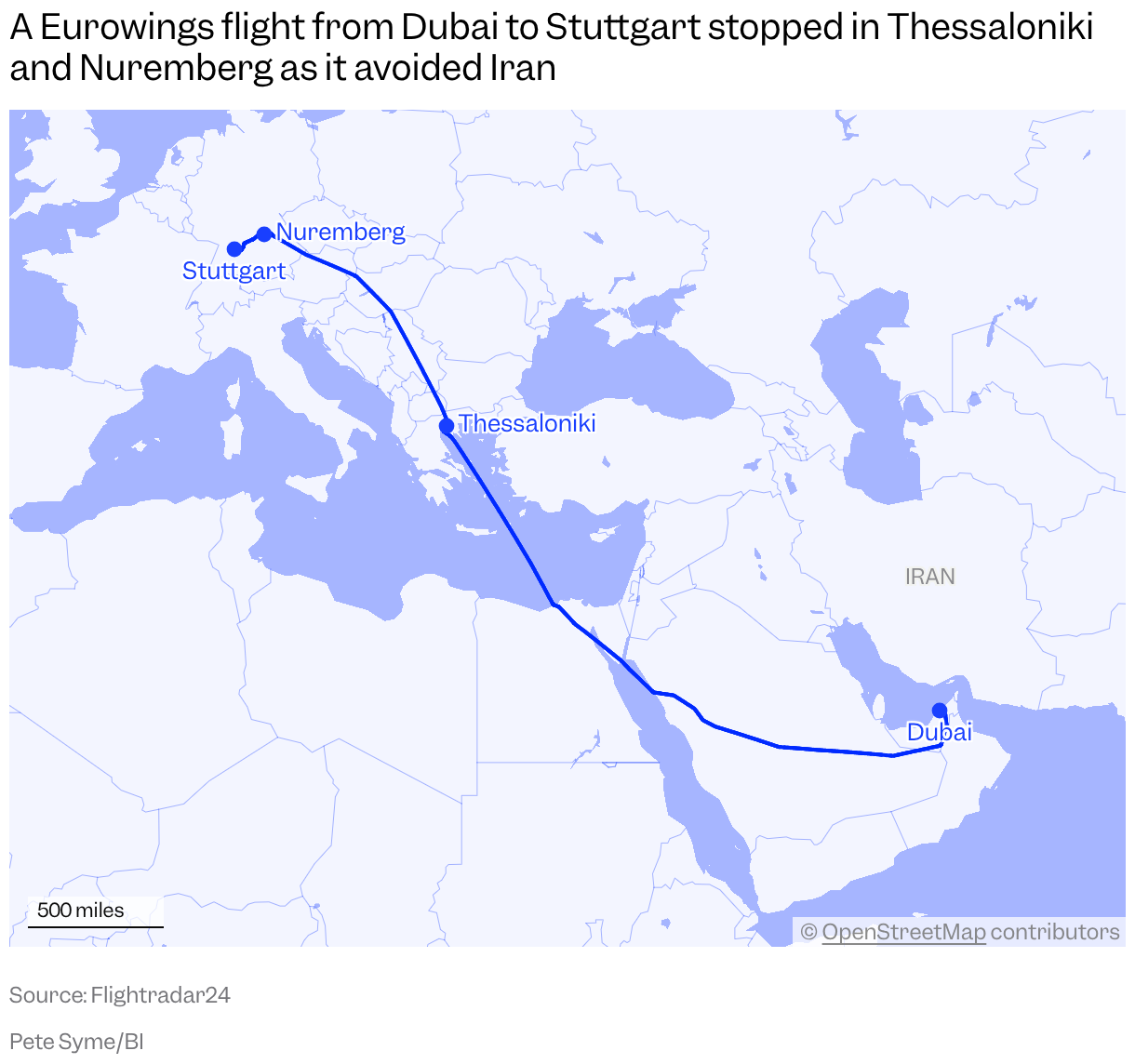
Sunday’s Eurowings Flight 1153, from Dubai, made two stopovers on its way to Stuttgart, Germany.
It first flew for just over 6 hours to Thessaloniki, Greece, for a refuelling stop, data from Flightradar24 shows.
After about 50 minutes on the ground, it took off again for Germany. However, the 2-hour flight landed in Nuremberg around 1:30 a.m.
It appears that it was too late to land in Stuttgart due to nighttime flight restrictions.
Therefore, it wasn’t until the next morning that the plane made another 30-minute flight to reach its intended destination.
In all, it arrived in Stuttgart 11 hours after the usual direct flight from Dubai.
A Eurowings spokesperson told Business Insider that its owner, the Lufthansa Group, decided not to fly over Iranian or Iraqi airspace as a precautionary measure.
They added that the refueling stop was “due to a longer flight distance and stronger headwinds on the alternative route at the time.”
“In the event of such refueling, we inform our passengers accordingly before departure in Dubai,” they said.
It isn’t the only European airline that has made such adjustments.
A spokesperson for Wizz Air, another budget airline, told Reuters that some of its flights from Dubai and Abu Dhabi would make “refuelling and crew change” stops in Cyprus or Thessaloniki.
Budget airlines are perhaps more susceptible to refueling stops because they typically operate only one type of airplane.
Their single-aisle jets are already near their maximum range for flights between the Middle East and Europe.
Meanwhile, the likes of British Airways and Air France are flying to Dubai with Boeing 777 or 787 jets. These twin-aisle airplanes have much larger fuel tanks, so any rerouting won’t require a fuel stop.
Over the past few days, flight-tracking data shows British Airways’ flight from Dubai to London has flown over Saudi Arabia instead of Iraq — taking around an hour longer than usual.
Earlier this month, the European Union Aviation Safety Agency warned airlines not to fly over Iran.
“The presence and potential use of weapons and air defense systems create a high risk for civilian flights,” it said in a statement, per Reuters. “There is a high probability of misidentification, against the backdrop of a possible American attack as well as the high alert status of Iran’s air defense systems.”
President Donald Trump’s threat to “decertify” Canadian-made aircraft — the backbone of many US carriers’ regional jet fleet — is a threat to aviation safety, industry watchers said Friday.
The president also doesn’t have the authority to unilaterally declare planes unworthy to fly in the US, Henry Harteveldt, an aviation industry authority and president of Atmosphere Research Group, told Business Insider. That authority belongs to the FAA.
The trade spat — another in a continuing back-and-forth between Trump and Canada — comes after Canada hasn’t fully certified newer US-made Gulfstream jets to fly in its skies. (It has certified older models.) Gulfstream planes are used almost exclusively by private aviation companies, governments, and the ultrawealthy.
Trump said on Thursday night, in a Truth Social post, that he would “decertify” Canada-made Bombardier jets until Canada approved the Gulfstream models. He also threatened a 50% tariff on “any and all” Canadian aircraft sold in the US until the situation was corrected.
Bombardier said in a statement that it’s in contact with the Canadian government. The FAA referred Business Insider to the White House. A White House official said decertification would not immediately affect aircraft already in operation; it would apply only to new deliveries.
Every time Taylor publishes a story, you’ll get an alert straight to your inbox!
Stay connected to Taylor and get more of their work as it publishes.
That would be a relief for US airlines like American, Delta, and United, whose regional affiliates operate Bombardier CRJ aircraft to cities across the country.
Regional carrier SkyWest, operating on behalf of the Big 3 and Alaska Airlines, is the largest operator of Canadian-made planes. It has 238, per Cirium.
Fabrizio Gandolfo/SOPA Images/LightRocket via Getty Images
Still, any move to decertify these more than 2,000 passenger airliners and private jets — part of almost 5,550 Canadian-made aircraft and helicopters certified in the US, according to Cirium — could trigger thousands of flight cancellations a day. A 50% tariff would likely raise airline ticket prices.
Aviation analysts said Trump’s threat posed a safety risk in itself.
“Anything that intrudes on the turf of safety regulators coming from politics, trade issues, or personal grievances is a very, very bad idea,” Richard Aboulafia, managing director of the aviation consultancy AeroDynamic Advisory, told Business Insider.
Aboulafia said aircraft certification is intentionally non-political for a reason: Regulators are meant to evaluate risk, not respond to trade threats. Once certification becomes a political weapon, trust in the system erodes for manufacturers, operators, and the flying public, he contended.
Why is the Gulfstream certification delayed in Canada?
In Canada’s case, the delay in certification is likely not obstructionism but the result of independent regulatory decisions.
For the Gulfstream G700 and G800, Canada hasn’t completed its own certification, while the FAA has granted Gulfstream a temporary exemption from certain fuel‑icing rules designed to ensure aircraft engines and systems operate safely in extreme cold.
The FAA waiver means Gulfstream has until the end of this year to meet those requirements — meaning the aircraft is operating under essentially conditional certification in the US, despite being allowed to be delivered.
These waivers are not unusual and are typically granted to allow new aircraft to enter service while completing certain technical tests and paperwork, rather than because the planes are unsafe.
Still, history shows what can sometimes go wrong when thorough certification and safety protocols are deprioritized. The most consequential example was the Boeing 737 Max, which suffered two fatal crashes in 2018 and 2019 due to systemic design issues, killing 346 people.
More recently, in early 2024, a door plug separated on another 737 Max due to quality-control issues at Boeing’s Washington factory, further exacerbating scrutiny of production and certification. No one died in that incident.
Part of the reason the 737 Max issues slipped past regulators is that, for decades, global authorities often relied on reciprocal approvals, effectively rubber-stamping each other’s certifications to speed aircraft to market.
The Max disasters exposed the risks of that approach. Today, regulators — including those in Canada — are expected to conduct their own full assessments rather than automatically rely on approvals from foreign authorities.
The FAA itself is taking extra precautions before certifying the Boeing 737 Max 7 and 10, as both aircraft have technical problems that could lead to engine overheating. Boeing initially asked for a waiver but rescinded it amid the scrutiny.