
Alice Tecotzky

Wells Fargo’s head of AI shares his playbook for staying in demand as banks weigh what the tech means for head count

Saul Van Beurden is the man helping Wells Fargo confront a question hanging over banks of every size: What happens to jobs in the age of AI?

He and his central team can’t, and shouldn’t, figure out what an AI-ready Wells Fargo looks like alone. The bank must teach employees skills to stay competitive in a changing industry, and they must choose to learn them, Van Beurden said.

“You cannot deny things,” Van Beurden, who is the head of AI and the co-CEO of consumer banking and lending, told Business Insider. “But how do you make it a thing where everybody has a role to play and takes their own accountability and responsibility?”

The bank is leaning on AI literacy programs and demos, among other things, to hopefully inspire “grassroots enthusiasm.” The goal is to make employees comfortable enough with the technology that they can be redeployed if their jobs change, or competitive in the job market if they leave Wells Fargo, he said. Wells Fargo doesn’t mandate AI usage, even as it bets the technology will help supercharge its growth following the Federal Reserve’s decision to lift a $1.95 trillion asset cap.

Van Beurden thinks that fluency starts outside the office. He’s trying to build an agent to help pull documents for his 2026 tax returns, and believes it’s crucial for employees to use AI in their personal lives, too.

“It’s really important to have that personal usage, to understand the power of what it can do. And then we are enabling that and allowing that to happen at the workplace,” he said.

Still, Van Beurden emphasized that everyone needs to “stay cognitive,” since AI could generate all of our ideas if we let it. He suspects that most college students are comfortable with technology but should invest time in activities like reading or playing chess. Staying sharp, he thinks, will help them in what’s broadly a brutal job market.

Wells’ workforce, like many of its competitors, is already changing because of AI. The bank’s CEO, Charlie Scharf, said in November that it will probably “have less head count as we look forward,” and added in December that generative AI has already made engineers up to 35% more productive.

Van Beurden didn’t say whether the bank would need 30% fewer engineers as a result or whether it would necessarily alter hiring, leaving it at, “it’s a great question.” Instead, he said that growth and head count aren’t always one-to-one.

“How great is it to grow without the need to hire people, because you have created the capacity to take on more clients, to take on more customers with the same amount of people?” he said, calling AI the “ideal tool” for that growth. Wells Fargo recorded $21.3 billion in revenue in the fourth quarter, up 4% year over year; revenue in its consumer bank, which Van Beurden oversees, rose 7% year over year.

The leaders of other big banks have also said that AI will likely eliminate some jobs and slow hiring, both publicly and in internal memos. JPMorgan CEO Jamie Dimon has said his bank has “huge redeployment plans.”

Efficiency promises and big technology budgets aside, the head count cuts haven’t yet materialized at most banks. Around 60% of 240 financial services CEOs surveyed by EY said they expect AI investments to maintain or boost their head count this year.


Source link

The-playbook-fueling-a-bookstores-4-year-sales-streak.jpeg

The playbook fueling a bookstore’s 4-year sales streak

Kandi West has always been a huge reader.

With a background in information technology project management, West began working part-time at WordsWorth Books in 2020, while being a stay-at-home mom and caring for her parents.

When an owner decided to step back, West bought in.

Now, as co-owner and general manager of the Little Rock, Arkansas, independent bookstore, West strives to “preserve the store for the next generation.”

WordsWorth has been around for at least 30 years. In 2022, West became the managing owner and began handling the shop’s day-to-day. Two other co-owners, Lynne Phillips and Lia Lent, oversee other aspects of the business.

Since taking over, West has been dedicated to increasing revenue and putting the bookstore on a path to sustainable growth.

Independent bookstores are “resilient and a great example of the innovation, flexibility, and passion that is evident in many small businesses,” said Allison Hill, CEO of the American Booksellers Association.

“The future is indie.”

‘We needed to be profitable to grow.’

The demand for independent bookstores is growing nationwide, Hill said. About 1,500 new indie bookstores have opened over the past five years, more than 400 in 2025 alone, she added.

In a recent ABA survey, 73% of its members said their sales increased in 2025.

To grow, the WordsWorth team has revved up its online shop, added more in-store events, and created new community partnerships. But West told Business Insider the mission goes further: “The decisions aren’t just about growth, they’re about long-term sustainability. Every day, there’s something we’re deciding based on those things.”


Owners and staff at WordsWorth Books in Little Rock, Arkansas.

West said the store is becoming more selective and developing a process for choosing the events most likely to succeed.

Katie Adkins for BI


This started with focusing on inventory management to better understand what was and wasn’t selling, said West, who took a course on the subject. “I was excited to see what I could do with making it more profitable,” she added. “It needed to be a little more profitable before I felt like I could push it to grow.”

This helped her realize that the books are “literally like money on the shelf,” West said. She began closely examining how often books needed to be restocked and which needed to be returned to the publishers. “I’m still learning every day,” she said.

Adopting a growth strategy

West said hosting and monetizing events, including author readings, story times, wine tastings (in partnership with a local liquor store), book clubs, and puzzle contests, has created an additional revenue stream.

She said the store receives many event requests, and they’re becoming more selective and developing a process for choosing the events most likely to succeed. In November, the bookstore hosted the launch of the latest book by best-selling author Ayana Gray, who lives in Arkansas, which West said was a ticketed event that sold out quickly.

The bookstore has also expanded its e-commerce footprint. WordsWorth uses the ABA’s IndieCommerce platform for online orders. The store also gets a percentage of sales from Bookshop.org — when shoppers select it as the bookshop they want to support — and Libro.fm, the audiobook platform.


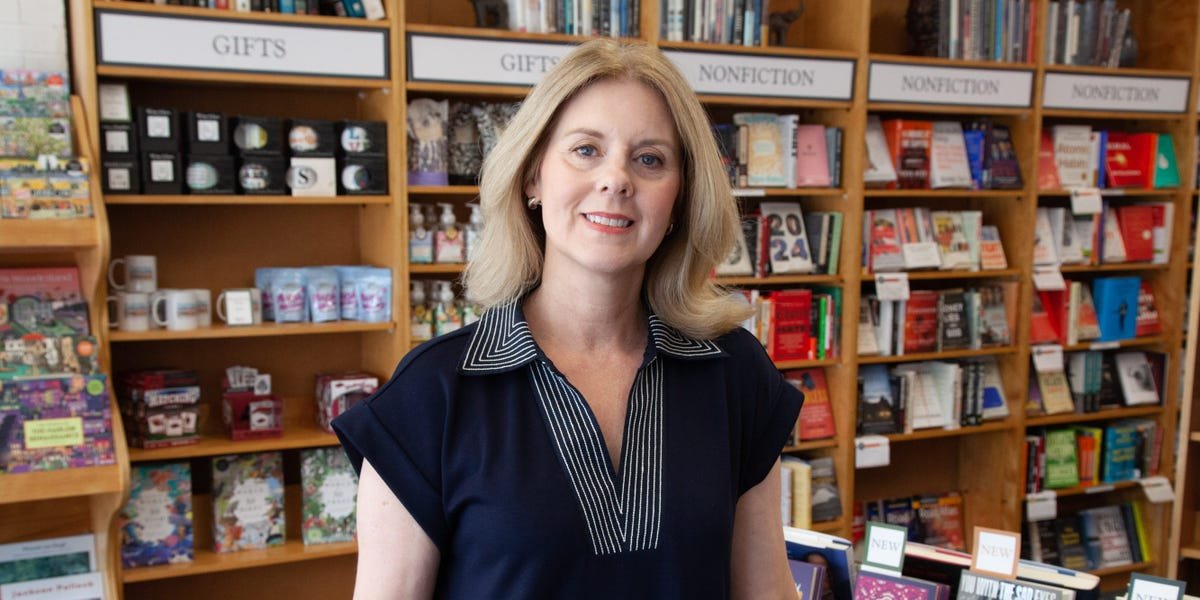
In addition to books, WordsWorth Books located in Little Rock, Arkansas, sells gifts, cards, and puzzles to diversify their income.

Hill said offering more products can diversify an indie bookstore’s revenue.

Katie Adkins for BI


They’ve also started offering more non-book items in the store, such as cards and reading glasses, which West said comprise about 10% of sales. Hill added that carrying more products, such as art, games, and toys, is a trend that more indie bookstores are embracing to diversify their revenue streams.

“That has helped our profitability,” West said, but added, “We don’t want to be a gift shop; we want to be a bookstore.”

Marketing efforts, such as a partnership with the Central Arkansas Library System and a local TV segment, have also boosted awareness of the bookstore, West said.

WordsWorth’s sales have grown about 7% a year since 2022, which “for an indie, is good, but we’d love to get that higher.”

Hill told Business Insider that independent bookstores have faced a number of challenges recently, including “an uncertain economy, federal layoffs, the labor shortage, tariffs, free speech harassment, communities impacted by ICE raids, book bans, and Amazon’s chokehold on the book industry.”


The exterior of WordsWorth Books, an independent bookstore located in the Heights neighborhood of Little Rock, Arkansas.

WordsWorth recently expanded its e-commerce footprint.

Katie Adkins for BI


WordsWorth has experienced some of this firsthand. West said some of its main challenges include rising book prices and credit card fees.

In 2023, WordsWorth joined a lawsuit challenging a state law on how libraries handle contentious materials. The court ruled that certain provisions of the law were unconstitutional, but the state is appealing the decision.

West said she tries “never to get comfortable” and stays focused on building a community.

“We want to enhance the reading community in central Arkansas and connect readers to authors, connect readers with each other, connect readers with literature-adjacent things.”


Source link