
What-gas-price-shock-Pokemon-cards-and-Needoh-tell-another.jpeg

What gas price shock? Pokémon cards and Needoh tell another story

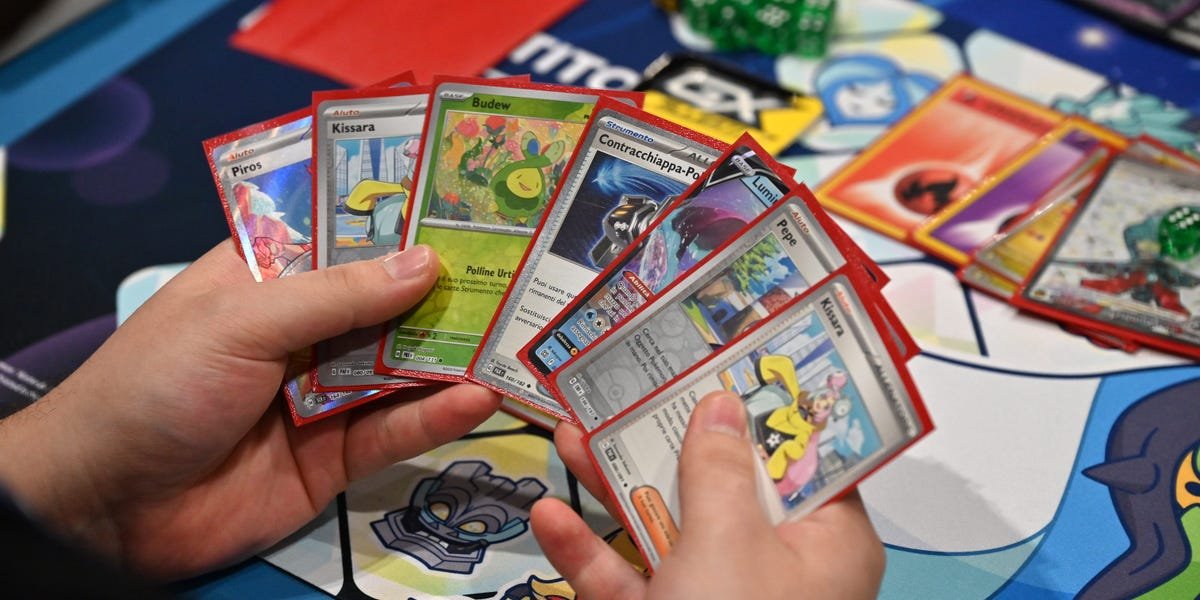
Rising gas prices might not be hurting consumer spending as much as feared. Look at Pokémon card sales.

Average gas prices in the US passed $4 a gallon last week, increasing more than a dollar over one month after the US and Israel began a war with Iran that disrupted oil shipments through the Strait of Hormuz.

“If there was ever a time for a gas price shock, this is it,” Mizuho analyst David Bellinger wrote in a note to clients on Monday.

A slew of economic and spending data, from Pokémon cards to movie tickets, suggests that gas prices aren’t causing consumers to pull back spending elsewhere yet, Bellinger wrote.

Higher gas prices are coinciding with tax season, and many shoppers are receiving tax refunds that could be boosting their spending power. Bellinger wrote that data from the Internal Revenue Service suggests the average tax refund is up by double digits over last year.

Then, there’s what shoppers are spending money on. Box office returns over the Easter weekend broke records, Bellinger wrote, and shoppers are still spending on toys such as Needoh sensory toys — an item that few consumers would consider essential.

Trading cards, including Pokémon, are subject to purchasing limits at some retailers, which Bellinger said shows “a clear uptick in the category.”

And JPMorgan CEO Jamie Dimon said in the bank’s annual shareholder letter on Monday that consumers are “still earning and spending.”

“For now, spending seems to be in a good place,” Bellinger wrote.

That could change if fuel prices keep rising. Gas prices could hit $5 a gallon this month if the war with Iran continues, analysts at JPMorgan said on Monday.

Other parts of the economy are feeling the pinch of higher fuel prices, too.

Wholesale prices for many kinds of fresh produce have increased over the past month, for example, as diesel prices have risen. Prices for temperature-sensitive produce, such as raspberries, and produce that has to travel long distances to get to market, such as limes from Mexico, have jumped the most.

Dimon also warned in his letter on Monday that “inflation slowly going up” could pull down markets and consumer sentiment this year.

Do you have a story to share about rising prices? Contact this reporter at abitter@businessinsider.com or via encrypted messaging app Signal at 808-854-4501. Use a personal email address, a nonwork WiFi network, and a nonwork device; here’s our guide to sharing information securely.




Source link

Madeline berg on grey background

My kid wants to get into Pokémon cards. Help.

Everything old is new again — and on playgrounds across America, that means Pokémon cards are back.

Pokémon was the No. 1 toy property globally last year, generating $2.5 billion in the US, up 87% from 2024, according to a report from market research firm Circana. As of the end of last year, collectible card games were the most-purchased secondhand product category for American Gen Zers on eBay, the e-commerce company said.

Most children’s hobbies don’t involve products that can cost as much as a Rolex, so the pressure is on for parents to figure out how to navigate this complex marketplace.

If a parent were a collector themselves, that can help. But plenty of parents come in blank, with no idea of the difference between a Charizard and a Charmander, or an Elite Trader Box (more on that later) and a Booster Bundle.

“You probably think to yourself, what is my child getting into right now and how do I have them approach it in a healthy, responsible way,” Matthew Winkelreid, the owner of Bleecker Trading, a collectibles store and event space with two Manhattan locations, told Business Insider. “You can get overwhelmed by the sheer volume of information.”


Matthew Winkelried

“You can get overwhelmed by the sheer volume of information,” Matthew Winkelried, the owner of Bleecker Trading, told Business Insider.

Courtesy of Bleecker Trading


While you may well be surprised with what your eight-year-old has picked up on at school, it doesn’t hurt to educate yourself a little bit on what has the potential to be an expensive — or lucrative — hobby.

Here are three things to consider before diving headfirst into your child’s Pokémon obsession.

Understand your budget

“My first question is, what’s your price point?” Winkelreid said.

Pokémon products have an expansive price range. One 2.5 by 3.5-inch card can cost $1, another — which may look identical to an unwitting parent — can cost six figures.

So going in with a clear idea of how much you want to spend is key.

If your kid did well in school and you want to reward them, maybe choose a $15 Tin, which contains two packs of 10 trading cards each. If it’s a big birthday, then maybe you splurge on a $125 Eliter Trader Box with nine packs, a promo card, sleeves, top loaders, and energy cards.

(For the uninitiated, Pokémon cards come in packs; part of the thrill is buying a pack to see if it contains a very valuable card, in terms of rarity or market value.)

It’s easy to spend a lot on the hobby, but there are options at every price point, so set that limit before you start shopping.

Understand what your child likes to collect

The majority of kids see Pokémon cards as collectibles rather than a game, Winkelreid said, and, as with any collectible, people have different interests. Some collect specific characters, some want a master set, some just like to rip packs.

Knowing what your child is looking for can direct your purchase, so you don’t blow their birthday budget on a pack they have no interest in.


kid in pikachu hat

Pokémon, which celebrated its 30th anniversary this year, has experienced a resurgence since the pandemic.

Patrick T. Fallon / AFP


And don’t underestimate kids’ ability to know real from fake. Sure, you can buy them plenty of cards on Amazon for a fraction of the price of an accredited retailer, but buyer beware.

“Go to a verified card store,” he said. If you can’t go to Bleeker trading, he suggests a known retailer. “Target, a big box store — do it in person rather than do it through Amazon.”

Understand the market

It’s not just about how much you are willing to spend, but also about spending in a smart way.

“Every card has an inherent value, whether it’s 50 cents or $500,” Winkelreid said.

Before buying a card secondhand, research its value to make sure you’re getting a fair price. Just like with stocks, there are websites that track market value, including Card Ladder, which pulls data from eBay to monitor specific transactions, and TCGplayer, a large marketplace that reflects real-time market value.

If your kid ends up with a valuable card, there are some best practices.

Winkelreid suggests educating your kids on how to store the products — putting cards in plastic sleeves and toploaders — and how to make fair trades. Don’t swap a Mew worth $500 for a Snorlax worth $50 just because you like the color, and if you are the one with the Snorlax, don’t take advantage of someone on the playground who doesn’t know how much their Mew is worth.

And if you have any doubt, talk to one of the many non-kid experts.

“Go to a local store. You have no idea what you’re getting yourself into without getting eyeballs on it,” he said. “Bonus points if you get involved.”


Source link

Paul Squire Headshot

Logan Paul’s Pokémon card investment pays off; he just sold it for millions in profit

Logan Paul just made millions off a Pokémon card.

The influencer turned wrestler sold his one-of-one Pikachu Illustrator card — one of 41 ever distributed and the only one graded the highest quality by collectibles company PSA — at auction Monday for a jaw-dropping $16.492 million.

The winner? AJ Scaramucci, the founder of venture capital firm Solari Capital and the son of former White House communications director Anthony Scaramucci.

Scaramucci appeared on Logan Paul’s livestream early Monday after auction house Goldin announced him the winning bidder in the auction, which closed at 1:14 am ET.

“My ambition for the card is just a small story,” Scaramucci said at the event. “The real story is that I’m on a planetary treasure hunt. I’m planning to buy a T. rex dinosaur fossil, the Declaration of Independence, and I’m not stopping there. This is only the beginning.”

“You’re just starting?” Paul replied. “Bro. Bro, that is so epic.”

Paul also used the livestream to open packs of Pokémon cards and announce RipIt, a new collectibles business he’s launching.


This Pikachu illustrator Pokémon card set a new record for the most expensive Pokémon card sold privately.

This Pikachu illustrator Pokémon card set a record for the most expensive Pokémon card sold privately.

Goldin


In a statement, Goldin described the Pokémon card, which was originally given to winners of an illustration competition in Japan, as “one of the Holy Grails of the collectibles industry.”

Paul previously set the world record back in July 2021 when he purchased the same card for $5.275 million, meaning he will make millions in profit.

The card also came with a diamond-encrusted chain appraised at $75,000, Goldin said. Paul wore the card during his WWE debut at WrestleMania 38 in 2022.

In an Instagram post on Saturday, Paul bid farewell to the card.

“Goodbye my friend 😢 What a privilege it’s been to be the owner of the greatest collectible in the world,” he wrote.

The markets for Pokémon cards, along with other collectible card sets like Magic: The Gathering and Yu-Gi-Oh!, have become huge in recent years among collectors — especially Gen Z — with the rarest cards selling for tens of thousands of dollars, if not more.

Some people are even forgoing stocks and investing in Pokémon cards instead.


Source link