
Photos-show-presidents-official-White-House-portraits-over-the-last.jpeg

Photos show presidents’ official White House portraits over the last 100 years

Updated

  • The White House released a new official portrait of President Donald Trump in June.
  • The dramatically lit photo shows Trump against a dark backdrop with a serious expression.
  • Unlike most contemporary presidential portraits, the background doesn’t include an American flag.

President Donald Trump’s official White House portrait does not feature an American flag in the background — it’s the first presidential photo in over 60 years without one.

Taken by chief White House photographer Daniel Torok, the dramatically lit photo shows Trump against a dark backdrop with a serious expression. The style hearkens back to the past presidential portrait styles of Presidents Franklin D. Roosevelt, Herbert Hoover, and Calvin Coolidge, who also appeared unsmiling against dark backgrounds.

And while there is no flag behind Trump in his new portrait, he is wearing an American flag pin on the lapel of his blue suit, a tradition that began with President George W. Bush’s photo.

A portrait of Trump released earlier last year, which did feature an American flag, was taken during the presidential transition period and “was always meant to serve as a placeholder,” a White House official told Business Insider.

The new photo is one of several aesthetic changes Trump has made to the White House in his second non-consecutive term. In the Entrance Hall, he moved President Barack Obama’s painted White House portrait across the hall and replaced it with a painting depicting his raised fist following an assassination attempt. He has also added numerous gilded gold furnishings to the Oval Office and paved over the lawn in the Rose Garden to create a terrace he said would be better suited for large events.

Take a look at how presidential portraits have changed through the years.

President Calvin Coolidge, 1923

A portrait of President Calvin Coolidge.

Library of Congress

President Herbert Hoover, 1929


President Herbert Hoover's official White House portrait.

A portrait of President Herbert Hoover.

Underwood & Underwood

President Franklin D. Roosevelt, 1933


An official portrait of President Franklin D. Roosevelt.

An official portrait of President Franklin D. Roosevelt.

Elias Goldensky/Library of Congress

President Harry Truman, 1945


President Harry Truman's official White House portrait.

President Harry Truman’s official White House portrait.

Keystone-France/Gamma-Keystone via Getty Images

President Dwight Eisenhower, 1953


President Dwight Eisenhower's official White House portrait.

President Dwight Eisenhower’s official White House portrait.

Keystone-France/Gamma-Keystone via Getty Images

President John F. Kennedy, 1961


John F. Kennedy's official White House portrait.

President John F. Kennedy’s official White House portrait.

Bachrach/Getty Images

President Lyndon B. Johnson, 1963


President Lyndon B. Johnson's official White House portrait.

President Lyndon B. Johnson’s official White House portrait.

Official White House photo

President Richard Nixon, 1969


President Richard Nixon's official White House portrait.

President Richard Nixon’s official White House portrait.

Official White House photo

President Gerald Ford, 1974


President Gerald Ford's official White House portrait.

President Gerald Ford’s official White House portrait.

Official White House photo

President Jimmy Carter, 1977


President Jimmy Carter's official White House portrait.

President Jimmy Carter’s official White House portrait.

Official White House photo by Karl Schumacher

President Ronald Reagan, 1981


President Ronald Reagan's official White House portrait.

President Ronald Reagan’s official White House portrait.

Official White House photo

President George H.W. Bush, 1989


President George H.W. Bush's official White House portrait.

President George H.W. Bush’s official White House portrait.

Official White House photo by David Valdez

President Bill Clinton, 1993


President Bill Clinton's official White House portrait.

President Bill Clinton’s official White House portrait.

Official White House photo

President George W. Bush, 2001


President George W. Bush poses for his official portrait in the Roosevelt Room in a blue tie.

President George W. Bush’s official White House portrait.

Official White House photo by Eric Draper

President Barack Obama, 2009


Barack Obama's official White House portrait.

President Barack Obama’s official White House portrait.

Official White House photo by Pete Souza

President Barack Obama, 2013


President Barack Obama's second official White House portrait.

President Barack Obama’s second official White House portrait.

Official White House photo by Pete Souza

President Donald Trump, 2017


Donald Trump's first White House portrait.

President Donald Trump’s first White House portrait.

Official White House photo by Shealah Craighead

President Joe Biden, 2021


President Joe Biden's official White House portrait.

The official portrait of President Joe Biden, taken in the Library room at the White House.

Official White House photo by Adam Schultz

President Donald Trump, 2025


Donald Trump's presidential portrait.

President Donald Trump’s second official White House portrait.

Official White House photo by Daniel Torok

President Donald Trump, 2025


Donald Trump's new White House portrait.

Donald Trump’s new White House portrait.

Official White House photo by Daniel Torok


Source link

Take-a-look-inside-the-Air-Force-One-plane-that.jpeg

Take a look inside the Air Force One plane that carried 8 presidents and brought home JFK’s body from Dallas

Updated

  • SAM 26000 operated as Air Force One from 1962 to 1998, carrying eight US presidents.
  • Lyndon Johnson was sworn in on board, and the plane transported John F. Kennedy’s body from Texas.
  • SAM 26000 is housed at the National Museum of the US Air Force, where visitors can walk through it.

“If history itself had wings, it would probably be this aircraft,” Vice President Al Gore said of the SAM 26000 Air Force One plane upon its retirement in 1998.

The first Air Force jet designed and built specifically for US presidents, SAM 26000 (pronounced two six thousand) carried eight presidents between 1962 and 1998 — every leader from John F. Kennedy to Bill Clinton.

After 13,000 flying hours over 36 years of service, the plane was retired to the National Museum of the US Air Force in Dayton, Ohio, where it remains on display.

I visited the museum in August and walked through the historic aircraft. Take a look inside.

The SAM 26000 Air Force One jet, a Boeing VC-137C, was completed in 1962 for President John F. Kennedy.

SAM 26000 at the National Museum of the US Air Force.

US Air Force photo by Ken LaRock

The Boeing VC-137C was a customized and modified version of a civilian 707-320B airliner. It was powered by four Pratt & Whitney TF33 engines, each with 18,000 pounds of thrust.

First lady Jacqueline Kennedy chose the plane’s blue and white paint colors in coordination with industrial designer Raymond Loewy.


A blue and white plane on display in a museum, with

Eight US presidents flew on this Air Force One plane known as SAM 26000.

US Air Force photo by Jim Copes

The first lady also added the words “United States of America” to the aircraft to signal its importance as the president’s plane.

In a tragic period of American history, SAM 26000 transported President John F. Kennedy’s body home after his assassination in 1963.


Air Force One arrives with President John F. Kennedy's coffin.

President John F. Kennedy’s coffin was transported on Air Force One after his assassination.

Schulman-Sachs/picture alliance via Getty Images

President Lyndon Johnson was sworn in as president aboard the plane hours after Kennedy was pronounced dead.

Now an interactive museum artifact, visitors can board the plane the same way US presidents did via a staircase leading into the cabin.


Air Force One at the National Museum of the US Air Force.

Air Force One.

Talia Lakritz/Business Insider

Admission to the National Museum of the US Air Force is free.

SAM 26000 is located in the museum’s William E. Boeing Presidential Gallery, which includes other presidential planes such as the Douglas VC-54C, the first presidential aircraft, which was known as the “Sacred Cow.”

The first stop on my self-guided tour was the cockpit, which featured a four-person crew.


The flight deck of SAM 26000.

The cockpit.

Talia Lakritz/Business Insider

The crew consisted of a pilot, copilot, navigator, and flight engineer. The navigator and flight engineer roles were eventually replaced by GPS and computerized technology on later Air Force One planes.

Two phones were located behind the flight deck.


Two phones aboard Air Force One, SAM 26000.

Two phones aboard Air Force One.

Talia Lakritz/Business Insider

A plaque above the phones read, “This telephone is subject to monitoring at all times. Use of this telephone constitutes consent to monitoring.”

An equipment storage space featured a first aid kit and firearms.


A first aid kit and weapons on Air Force One SAM 26000.

A first aid kit and weapons on Air Force One.

Talia Lakritz/Business Insider

The closet also had a rack to hang suits and coats.

Next, I walked by the plane’s communication facility.


The communication facility on board SAM 26000.

The communication facility.

Talia Lakritz/Business Insider

The secure communication center allowed presidents to place calls anywhere in the world while in flight.

Meals were prepared in the galley.


The galley on board SAM 26000.

The galley.

Talia Lakritz/Business Insider

The galley included a stovetop, oven, and sink.

This seating area was used by presidential staff, members of the press, and Secret Service agents.


A seating area aboard SAM 26000.

A seating area aboard SAM 26000.

Talia Lakritz/Business Insider

The aircraft could hold up to 40 passengers.

The seating area, like many areas of the plane, is now protected by plastic barricades.

I noticed fox decals above the seats, which a museum volunteer told me was a nod to the 89th Airlift Wing, which operates Air Force One.


A fox decal on Air Force One SAM 26000.

A fox decal on Air Force One.

Talia Lakritz/Business Insider

Stationed at Joint Base Andrews in Maryland, the 89th Airlift Wing is tasked with flying the president and high-ranking government officials. The group is also referred to as “SAM FOX,” which stands for “Special Air Missions Foreign.”

The presidential stateroom was located down a long hallway.


A hallway on Air Force One.

A hallway on Air Force One.

Talia Lakritz/Business Insider

The benches in the hallway were hollow to offer additional storage.

The president’s spacious quarters featured a desk, couch, television, and private bathroom.


The president's stateroom aboard SAM 26000.

The president’s stateroom.

Talia Lakritz/Business Insider

In 1969, Nixon redesigned Air Force One and moved the presidential quarters over the wings, which was the quietest and smoothest part of the plane during flight.

The stateroom came with two phones, each with different purposes.


Two phones in the president's stateroom on Air Force One SAM 26000.

Two phones in the president’s stateroom.

Talia Lakritz/Business Insider

Presidents used the white phone to communicate with crew members and other passengers on the plane, while the beige phone could be used to call anywhere in the world.

Behind the presidential stateroom, a conference room provided more meeting space.


A conference room on SAM 26000.

A conference room.

Talia Lakritz/Business Insider

The room was furnished with throne chairs, a folding table, and another TV.

Additional conference areas provided more seating for staff, Secret Service members, and VIPs.


Seating aboard SAM 26000.

A conference room aboard SAM 26000.

Talia Lakritz/Business Insider

Presidents Nixon, Ford, and Carter sat here while flying to attend Egyptian President Anwar El-Sadat’s funeral in 1981.

An office area across the aisle featured an electric typewriter, scanner, and more phones.


A conference room with a map of the United States aboard SAM 26000.

A conference room.

Talia Lakritz/Business Insider

Presidents used the electric typewriter to write and edit speeches while on board the plane.

The wall of the office space was decorated with a map of the United States.

President Lyndon Johnson was sworn in as president in this area of Air Force One’s cabin after Kennedy’s assassination in 1963.


Lyndon Johnson takes the oath of office aboard Air Force One after the assassination of John F. Kennedy.

President Lyndon Johnson was sworn in on board Air Force One after President John F. Kennedy’s assassination.

Universal History Archive/Getty Images

Kennedy was assassinated on November 22, 1963, while visiting Dallas. He was pronounced dead at Parkland Memorial Hospital at 1 p.m., and Johnson took the oath of office at 2:38 p.m.

Jacqueline Kennedy’s pink suit was still smeared with blood when Federal Judge Sarah T. Hughes administered the oath of office on Air Force One. Johnson’s wife, Lady Bird Johnson, stood to his right.

Standing in the very spot where Johnson was sworn in after Kennedy’s assassination was awe-inspiring.


A hallway on SAM 26000.

A hallway between conference rooms on SAM 26000.

Talia Lakritz/Business Insider

Even blocked off by plastic barricades, the plane’s cabin preserves a pivotal moment in US history.

These four seats toward the back of the plane were removed to make room for Kennedy’s coffin on the flight from Dallas back to Washington, DC, in 1963.


Seats on Air Force One.

Seats on Air Force One.

Talia Lakritz/Business Insider

The Secret Service had to break the handles off the casket to make it fit through the plane door.

Air Force security personnel operated out of this area at the back of the aircraft to secure the plane while it was on the ground.


Seats for security personnel aboard SAM 26000.

Seats for security personnel.

Talia Lakritz/Business Insider

The seating area featured six seats, a phone, and a folding table.

My tour ended at the back of the plane with a view of its call sign on the tail and an American flag.


The tail of SAM 26000.

The tail of SAM 26000.

Talia Lakritz/Business Insider

According to US Flag Code, an American flag decal must always be positioned so that the stars face forward.

Air Force One remains an instantly recognizable symbol of US might, making my walkthrough tour a memorable experience.


The presidential seal on Air Force One.

The presidential seal on Air Force One.

Talia Lakritz/Business Insider

Like many modes of presidential transportation, such as the bulletproof limousine known as “The Beast” and the Marine One helicopter, Air Force One is about more than simply getting the president from point A to point B. It symbolizes the power of the United States and its elected leader wherever it goes.

The image projected by presidential planes remains of great interest to President Donald Trump, who opted to accept a luxurious Boeing 747-8 jet from the Qatari royal family instead of waiting for Boeing to deliver its long-delayed new Air Force One jets.


Source link

Photos-show-how-US-presidents-have-redecorated-the-Oval-Office.jpeg

Photos show how US presidents have redecorated the Oval Office through the years, from Taft to Trump

  • US presidents have redecorated the Oval Office in different ways since it was first built in 1909.
  • Most presidents have sat at the Resolute Desk, but others brought in their own personal furniture.
  • President Donald Trump has added numerous gold embellishments to the Oval Office.

It’s been nearly 100 years since the Oval Office was first built under President William Howard Taft. Throughout that time, US presidents have each made different design choices to redecorate the formal workspace.

Some presidents, like President George H.W. Bush, have brought in their own furniture to replace the Resolute Desk. Others, like President Donald Trump, have reinstated vintage Oval Office pieces while adding their own personal flair.

Take a look at how the Oval Office has changed through the years.

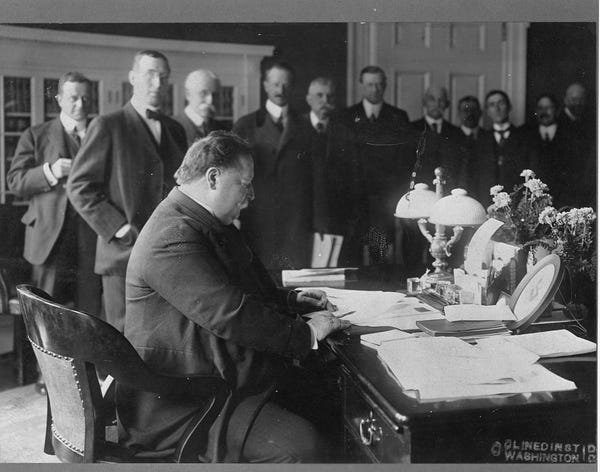
The first iteration of the Oval Office was built under President William Howard Taft in 1909 as part of an expansion of the West Wing.

President William Howard Taft in the Oval Office.

B.M. Clinedinst/Library of Congress/Corbis/VCG via Getty Images

Inspired by the White House’s oval-shaped Blue Room, the president’s formal workspace was designed by architect Nathan C. Wyeth.

Taft’s Oval Office featured an olive-green color scheme.

President Franklin D. Roosevelt redesigned and moved the Oval Office as part of another West Wing expansion in 1934.


FDR in the Oval Office.

President Franklin D. Roosevelt in the Oval Office.

History Archive/Universal Images Group via Getty Images

The Oval Office was moved to the southeast corner of the White House.

Roosevelt kept a variety of items on his desk, including photos of his sons, ceramic animal figurines, and an appointments easel with his daily schedule, according to the Franklin D. Roosevelt Presidential Library and Museum.

President Harry Truman’s Oval Office was the first to feature a rug with the presidential seal.


Harry Truman in the Oval Office.

President Harry Truman with staff in the Oval Office.

FPG/Archive Photos/Getty Images

Truman decorated the Oval Office with the turquoise rug and matching curtains. The walls were painted a lighter seafoam green.

President John F. Kennedy was the first president to use the Resolute Desk in the Oval Office.


The Resolute Desk in the Oval Office.

The Resolute Desk in the Oval Office.

Cecil W. Stoughton/White House Photo

The Resolute Desk, made of wood from the British ship H.M.S. Resolute, was gifted to President Rutherford B. Hayes by Queen Victoria in 1880. Previous presidents kept the desk in the second-floor office of the White House Residence and the Broadcast Room, according to the White House Historical Association.

President Lyndon Johnson replaced the Resolute Desk with his own desk, which he’d used as a US senator and vice president.


Lyndon Johnson in the Oval Office.

President Lyndon Johnson in the Oval Office.

Corbis via Getty Images

He also redecorated the Oval Office with white drapes with red trim, evoking the American flag.

President Richard Nixon chose bold hues of blue and yellow to decorate the Oval Office.


Richard Nixon's Oval Office.

President Richard Nixon’s Oval Office.

Bettmann Archive/Getty Images

Nixon’s Oval Office rug, in the same blue color as the American flag, was designed by first lady Pat Nixon.

President Gerald Ford changed the color scheme of the upholstery to burnt orange and khaki.


Gerald Ford in the Oval Office.

President Gerald Ford in the Oval Office.

Historical/Corbis via Getty Images

Ford’s decor included the wheel from the SS Mayaguez, an American container ship that was seized by Cambodian forces in 1975 and rescued at Ford’s direction.

Ford also added a mahogany Seymour tall case clock in 1975.


The Oval Office in 1975.

The Oval Office in 1975.

Bettmann Archive/Getty Images

The clock, built between 1795 and 1805, has remained in the Oval Office under every subsequent president since 1975.

President Jimmy Carter brought the Resolute Desk back to the Oval Office.


Jimmy Carter in the Oval Office.

President Jimmy Carter in the White House’s Oval Office.

Corbis via Getty Images

Otherwise, he left most of Ford’s decor.

President Ronald Reagan redecorated the Oval Office during his second term with a rug designed by first lady Nancy Reagan.


Ronald Reagan in the Oval Office.

Ronald Reagan in the Oval Office.

HUM Images/HUM Images/Universal Images Group via Getty Images

The rug featured the presidential seal in the center with sunbeams emerging from the middle, surrounded by a border of olive branches.

President George H.W. Bush redid the Oval Office in shades of blue and gold and brought in the C&O desk that he used as vice president.


George HW Bush's Oval Office.

President George H.W. Bush’s Oval Office.

Susan Biddle/White House via CNP/Getty Images

The Resolute Desk was moved to the Residence Office.

President Bill Clinton chose Arkansas-based interior designer Kaki Hockersmith to give the Oval Office a new look.


Bill Clinton's Oval Office.

President Bill Clinton’s Oval Office.

BILL O’LEARY/The Washington Post via Getty Images

Hockersmith designed the yellow curtains and the blue rug with the presidential seal. Clinton also chose to bring the Resolute Desk back to the Oval Office.

First lady Laura Bush designed a new rug for President George W. Bush’s Oval Office.


George W. Bush's Oval Office.

President George W. Bush in the Oval Office.

Greg Mathieson/Mai/Getty Images

The rug featured a sunbeam design with the presidential seal at its center, reminiscent of Reagan’s rug, and a lone star in a nod to Bush’s home state of Texas.

President Barack Obama added striped wallpaper and a new rug with a quote from Martin Luther King Jr.


Barack Obama in the Oval Office.

President Barack Obama in the Oval Office.

HUM Images/Universal Images Group via Getty Images

The quote on the border of the rug read, “The arc of the moral universe is long, but it bends toward justice.”

During his first term, President Donald Trump reinstalled Reagan’s rug and added a portrait of President Andrew Jackson.


President Donald Trump in the Oval Office during his first term.

President Donald Trump in the Oval Office during his first term.

Official White House Photo by Joyce N. Boghosian

He also brought back Clinton’s gold curtains and chose a new off-white wallpaper.

President Joe Biden brought back Clinton’s Oval Office rug and added new portraits.


The Oval Office during Joe Biden's presidency.

President Joe Biden’s Oval Office.

Bill O’Leary/The Washington Post via Getty Images

Biden hung portraits of Franklin D. Roosevelt, Thomas Jefferson, and Alexander Hamilton.

In his second non-consecutive term, Trump has made significant changes to the Oval Office, adding numerous gold embellishments.


Donald Trump's gold-filled Oval Office.

President Donald Trump in the Oval Office.

Demetrius Freeman/The Washington Post via Getty Images

Many of the gold decor pieces in Trump’s Oval Office came from the White House collection, but Trump also imported some statuettes from his Mar-a-Lago estate in Palm Beach, Florida.

Trump also added flags representing different branches of the US military and additional presidential portraits, with President George Washington in the prominent center spot above the fireplace mantle.


Source link