
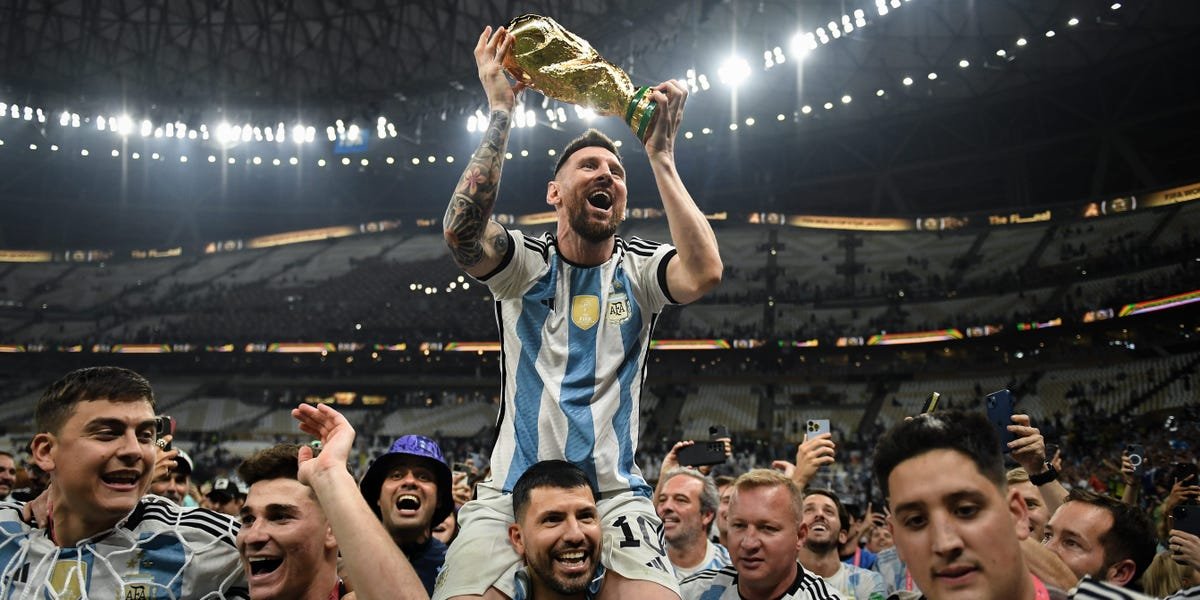
Soccer-fans-spending-hundreds-on-World-Cup-tickets-have-another.jpeg

Soccer fans spending hundreds on World Cup tickets have another problem: sky-high transit fares

It isn’t just tickets to games that FIFA World Cup fans will have to shell out for — they’ll also have to pay way more for transit to stadiums.

Gillette Stadium, the home of the New England Patriots, is hosting seven matches of the tournament, which is being held across the US, Canada, and Mexico. Fans going to games at the venue face $80 round-trip train fares for the journey to and from Boston’s South Station, the Massachusetts Bay Transportation Authority announced last week.

Such tickets usually cost $20 during other events, or $8.75 on a regular day. The two rail stations are about 20 miles apart.

The Athletic also reported on Tuesday that New Jersey Transit is planning to charge $100 for a round-trip rail ticket between Penn Station and MetLife Stadium. It’s set to host eight World Cup matches, including the final.

That journey usually costs $12.90, meaning prices during the World Cup could be up to 8 times higher than during most events.

The report drew criticism from Chuck Schumer, the New York senator and Senate minority leader.

“FIFA is set to reap nearly $11 billion from this summer’s World Cup, yet New York area commuters and residents are being handed the bill,” he said in a post on X. “The least FIFA can do is ensure New York residents can go to the stadium without being gouged at the turnstile.”

Schumer also called on the sport’s governing body to cover transportation costs.

FIFA and NJ Transit did not immediately respond to a request for comment sent by Business Insider outside US working hours. An NJ Transit spokesperson told The Athletic that prices “have not been finalized.”


An outside view of MetLife Stadium on a sunny day.

Ticket prices for World Cup games have already faced heavy criticism from fans. 

Richard Sellers/Sportsphoto/Allstar via Getty Images


The MBTA said last Thursday that it sold some 17,450 rail tickets to Gillette Stadium on the first day sales opened.

Phillip Eng, the CEO and general manager, said the “tremendous demand” showed the MBTA “needed to think outside the box to safely deliver unprecedented train service.”

With 6,200 tickets, fans attending the Haiti vs. Scotland game on June 13 broke the record for the most special-event train tickets sold for an individual event at Gillette Stadium — including Taylor Swift’s three concerts in 2023.

This year’s World Cup is the biggest one yet, as FIFA expanded it from 32 teams to 48. That has helped the debuts of countries including Uzbekistan, Cape Verde, and Jordan.

The price of tickets for games has drawn criticism from fan groups, particularly as only a small number of match tickets were originally offered at the lowest price of $60.

“In practice they were so scarce that the entire Category 4 inventory was practically sold out before general public sales opened,” said Football Supporters Europe, a fan group that advocates for affordability.

While Scotland qualified for its first World Cup in 28 years, political leaders said fans could be priced out.

The BBC found that the cheapest ticket available on FIFA’s resale platform cost $690 for the Scotland vs Haiti match, up from $400.

“Our historic return has been marred by FIFA’s dynamic pricing model that has made the trip simply unaffordable for so many loyal supporters,” Scottish First Minister John Swinney said in a letter to FIFA President Gianni Infantino earlier this month.

“This model has made this the most expensive World Cup in history and it is the opposite of what football, and indeed the biggest sporting occasion on the planet, should be about.”



Source link

Bryan Metzger

The Jerome Powell-sized problem standing in the way of Kevin Warsh’s Fed confirmation

President Donald Trump has a Jerome Powell-sized problem with installing Kevin Warsh as the new Fed chair.

A key Republican senator has vowed to oppose the confirmation of any nominee to be the next Federal Reserve chairman until the Department of Justice’s probe into Powell, the current chair, is resolved.

That senator — Thom Tillis of North Carolina — happens to sit on the Senate Banking, Housing, and Urban Affairs Committee, which considers Fed chair nominations. If all Democrats join Tillis in opposing Warsh’s confirmation, Warsh’s nomination will effectively be stuck in committee.

In a post on X on Friday, Tillis made clear that he has nothing against Warsh, who has otherwise been lauded as a strong pick by both Republicans and economists.

“Kevin Warsh is a qualified nominee with a deep understanding of monetary policy,” Tillis wrote, later adding: “Protecting the independence of the Federal Reserve from political interference or legal intimidation is non-negotiable.”

Earlier this month, Powell revealed that the DOJ issued grand jury subpoenas to the Federal Reserve related to recent renovations at the building.

Powell called the probe an effort to exert pressure on the central bank’s monetary policy, and central bankers from around the world have rallied to Powell’s defense.

Trump has said that he had no knowledge of the subpoenas before Powell made them public.

In a statement, White House spokesman Kush Desai said that Warsh is “eminently qualified to serve” as the next Fed chair and that the White House “looks forward to working with the Senate to quickly confirm him and get the Federal Reserve back on track.”

Trump appeared unmoved by Tillis’s opposition, telling reporters in the Oval Office later on Friday that it’s “too bad.”

He also suggested that Warsh’s confirmation may have to wait until Tillis is out of office. The North Carolina senator’s term ends in January 2027.

“If he doesn’t approve, we’ll just have to wait until somebody comes in that will approve it,” Trump said.

Why one senator has so much power

Under Senate rules, before the full chamber can vote on a nominee, it must be reported “favorably” by the committee with jurisdiction, which requires a majority vote.

Democrats are expected to broadly oppose Warsh’s confirmation, with many raising concerns about the independence of the Fed.

Sen. Elizabeth Warren, the top Democrat on the committee, said in a statement on Friday that “no Republican purporting to care about Fed independence should agree to move forward with this nomination” under the circumstances.

If Tillis and every Democrat vote against Warsh’s nomination, that leads to a deadlocked 12-12 committee vote.

It would take 60 votes in the Senate to bypass that committee vote and bring his nomination to the floor — an unlikely prospect, given that it requires Democratic support.

Senate Majority Leader John Thune has acknowledged the predicament. According to POLITICO, when asked on Thursday whether Warsh could be confirmed without Tillis’s support, Thune said: “Uh, probably not.”

Earlier this year, Tillis opted not to seek reelection, making it far more difficult for Trump to exert pressure on him to change his mind.


Source link

Streamers-like-Disney-and-HBO-Max-have-a-key-problem.jpeg

Streamers like Disney+ and HBO Max have a key problem with no clear solution

Free streaming services are having success, and it may be coming at the expense of their paid peers.

YouTube and other free ad-supported services, such as The Roku Channel and Fox-owned Tubi, have become increasingly popular over the last two years, according to Nielsen’s viewership data.

“For consumers, cost sensitivity is often a more important deciding factor than user experience,” said Brandon Katz, a media analyst at entertainment data provider Greenlight Analytics. “Saving money outweighs the annoyance of terrible insurance commercials.”

As these free streamers eat up a larger chunk of viewership time on US smart TVs, they may be holding back the growth of services like Disney+, Hulu, and HBO Max.

Free-to-access services YouTube, Tubi, and The Roku Channel have grown their viewership by 53% from December 2023 through November, according to a Business Insider analysis of Nielsen data. Those three free streamers make up nearly 18% of all watch time on US TVs, and that doesn’t include Paramount’s Pluto TV, which Nielsen broke out individually until March.

In that span, major paid streamers’ collective watch time is only up 5%. That includes Netflix, Amazon Prime Video, Disney+, Hulu, Peacock, and HBO Max, formerly known as Max. (Paramount+ was included until March, when Nielsen stopped reporting its individual share. And HBO Max’s viewership includes sister streamer Discovery+.)

That means free streamers are growing more than 10 times faster than their paid counterparts, though the bulk of that growth is driven by YouTube, which has become a force in Hollywood.

Slower engagement growth is a troubling sign for paid streamers. Viewership is positively tied to pricing power and inversely correlated with cancellations, meaning that people who watch a streamer more often are less likely to cancel.

“Engagement drives churn down,” said Hernan Lopez, founder of media consulting firm Owl & Co.

“It’s not just about hours spent,” he added, but also the frequency that viewers return to an app and the breadth of content that they watch.

Engaged streaming subscribers are also usually more receptive to price hikes, Katz said, since they likely place a higher value on the service than inactive users.

“The goal is to offer customers enough attractive content that opening the app becomes a regular occurrence,” Katz said. “At that habitual usage point, streamers are able to reasonably raise prices without fear of a mass exodus of customers.”

For customers on ad-supported plans, higher engagement also translates to more ad revenue.

It’s not all bad news for paid streamers. Streaming is an increasingly profitable business, thanks in large part to price hikes, which every major service (except for Prime Video) has implemented or announced in the past 12 months.

Disney+, Hulu, and HBO Max have also continued to add customers this year. However, Peacock hasn’t grown its subscriber base since the first quarter of 2025, and Netflix no longer reports its subscriber count on a quarterly basis.

The large gap between free and paid streamer viewership growth rates suggests that so-called stream-flation could be taking a toll. Media giants must walk a tightrope between pleasing Wall Street and pushing consumers toward free streamers, or apps like Instagram and TikTok.

Streaming giants Netflix and Disney each have creative ideas for driving engagement in 2026.

Netflix is turning to video podcasts in hopes of adding lean-back content that keeps subscribers engaged throughout the day. It’s also been trying to use games as a way to create daily habits among its users.

Disney is taking a different tack by betting on AI-generated video through a new partnership with OpenAI. This AI initiative will enable fans to create short clips of Disney characters, such as Mickey Mouse or Darth Vader, eventually within the Disney+ app.


Source link

AI-is-creating-a-security-problem-most-companies-arent-staffed.jpeg

AI is creating a security problem most companies aren’t staffed to handle, says an AI researcher

Companies may have cybersecurity teams in place, but many still aren’t prepared for how AI systems actually fail, says an AI security researcher.

Sander Schulhoff, who wrote one of the earliest prompt engineering guides and focuses on AI system vulnerabilities, said on an episode of “Lenny’s Podcast” published Sunday that many organizations lack the talent needed to understand and fix AI security risks.

Traditional cybersecurity teams are trained to patch bugs and address known vulnerabilities, but AI doesn’t behave that way.

“You can patch a bug, but you can’t patch a brain,” Schulhoff said, describing what he sees as a mismatch between how security teams think and how large language models fail.

“There’s this disconnect about how AI works compared to classical cybersecurity,” he added.

That gap shows up in real-world deployments. Cybersecurity professionals may review an AI system for technical flaws without asking: “What if someone tricks the AI into doing something it shouldn’t?” said Schulhoff, who runs a prompt engineering platform and an AI red-teaming hackathon.

Unlike traditional software, AI systems can be manipulated through language and indirect instructions, he added.

Schulhoff said people with experience in both AI security and cybersecurity would know what to do if an AI model is tricked into generating malicious code. For example, they would run the code in a container and ensure the AI’s output doesn’t affect the rest of the system.

The intersection of AI security and traditional cybersecurity is where “the security jobs of the future are,” he added.

The rise of AI security startups

Schulhoff also said that many AI security startups are pitching guardrails that don’t offer real protection. Because AI systems can be manipulated in countless ways, claims that these tools can “catch everything” are misleading.

“That’s a complete lie,” he said, adding that there would be a market correction in which “the revenue just completely dries up for these guardrails and automated red-teaming companies.”

AI security startups have been riding the wave of investor interest. Big Tech and venture capital firms have poured money into the space as companies rush to secure AI systems.

In March, Google bought cybersecurity startup Wiz for $32 billion, a deal aimed at strengthening its cloud security business.

Google CEO Sundar Pichai said AI was introducing “new risks” at a time when multi-cloud and hybrid setups are becoming more common.

“Against this backdrop, organizations are looking for cybersecurity solutions that improve cloud security and span multiple clouds,” he added.

Business Insider reported last year that growing security concerns around AI models have helped fuel a wave of startups pitching tools to monitor, test, and secure AI systems.


Source link

Disney-is-betting-OpenAI-can-help-it-solve-a-key.jpeg

Disney is betting OpenAI can help it solve a key problem

Disney is losing the war for attention. Can its blockbuster OpenAI licensing deal change the momentum on the battlefield?

Soon, you’ll be able to use OpenAI products, such as ChatGPT and the video generator Sora, to create content featuring Disney characters like Mickey Mouse, Ariel, and Darth Vader.

CEO Bob Iger said the move would let Disney take advantage of a fast-growing area of entertainment.

Iger said initially Disney would “curate some of the videos that have been created on the Sora platform and put them onto Disney+, which we think is a great way to increase engagement with our Disney+ users, particularly the younger users.” Iger said eventually the company wants users to create AI videos within Disney+ itself.

There’s a key word in Iger’s comment that signals why Disney might be particularly motivated to make this deal: engagement.

Time people spend on Disney’s and other leading streaming services has stayed essentially flat over the past few years, while YouTube and social video have grown. Disney’s share of US TV viewership for its streaming services — including Disney+, Hulu, and ESPN+ — has been stuck at around 4.8% this year, according to Nielsen. YouTube is the top streaming platform on TVs, with a nearly 13% share in October, and its lead has been widening.

Data from analytics firm Luminate showed that engagement with Disney+’s original content fell to a 3% share of US viewing time in the third quarter of 2025. That’s down from 9% three years earlier, the largest decline among paid streamers.

Disney has been highly protective of its famous characters and favors keeping people on its own platforms. This stance has made it difficult for the company to capitalize on the rise of user-generated content. And it’s losing its monopoly on its core constituency, kids, as they increasingly watch YouTube over Disney+.

Hollywood needs new strategies to keep people engaged

Traditional media companies are struggling to grow, so they’re trying to figure out new ways to get people to engage with their content, whether it be games, live events, or fan content creation, media analyst Doug Shapiro, a senior advisor at BCG, recently told Business Insider.

“It’s a zero-sum game they’re losing, and it’s only going to get worse,” he said. “I think they’re all asking themselves, how can they have a deeper relationship with fans?”

Disney invested $1.5 billion in Fortnite maker Epic Games last year and struck a deal with Webtoon to create a new digital platform for Disney’s comics, including Marvel and Star Wars. Outside Disney, Netflix is opening Netflix Houses, mini theme parks in malls that let people enter the worlds of its popular shows. Amazon has backed Fable Studios, a startup that has an AI streaming platform that lets users make their own shows and play with existing IP.

John Attanasio, CEO of Toonstar, a tech-driven animation studio, said Disney’s IP is so popular that the Sora videos could help drive more audience. He thought Disney could potentially charge for access to AI tools on Disney+ or use the Sora videos to discover franchise extensions.

“UGC, when it’s so specific, the reach is limited,” he said. “But when you use known IP, that expands the potential audience.”

Disney fans and Hollywood insiders had mixed reactions to the OpenAI news.

Shae Noble, a Disney superfan in her late 30s, said she could see herself sending birthday messages or making fan videos of the characters interacting in interesting ways — especially if it were integrated into Disney+.

“I’ve already seen some of the negative impacts of AI and people pushing it too far to create harmful images,” she added. “So it’s smart of them to be proactive about it.”

Some in Hollywood worried about the risks to professional creators.

For one thing, the deal puts the emphasis on existing IP rather than making new content, Toonstar’s Attanasio said.

The Writers Guild of America came out swinging against the deal, and said it planned to meet with Disney to explore how much the pact would let user-generated videos use the work of its members.

Sam Tung, a storyboard artist and cochair of the Animation Guild’s AI committee, wondered if OpenAI’s guardrails would be strong enough to protect Disney’s IP, recalling a widely publicized incident earlier this year when Fortnite users used AI to make the Darth Vader character swear. He also doubted the UGC would move the needle on engagement.

“I think what audiences want is high-quality stuff to watch with your family,” Tung said.

James Faris contributed reporting.


Source link

Trump-says-Netflix-Warner-deal-could-be-a-problem.jpeg

Trump says Netflix-Warner deal ‘could be a problem’

President Donald Trump is getting involved in the Netflix-Warner Bros. deal.

On Friday, Netflix announced that it would acquire Warner Bros., including its TV and film studios, HBO and HBO Max, for $72 billion. If the deal goes through, it will be Netflix’s biggest acquisition to date.

Speaking to reporters at the Kennedy Centre on Sunday, Trump said Netflix is a great company that has done a “phenomenal job.”

But he added, “They have a very big market share, and when they have Warner Brothers, you know, that share goes up a lot.”

“So I don’t know, that’s going to be for some economists to tell. And also, I’ll be involved in that decision, too,” Trump said.

Trump added that Netflix’s CEO, Ted Sarandos, visited him in the Oval Office last week. He said Sarandos was a “great person” who has done “one of the greatest jobs in the history of movies.”

“But it is a big market share, there’s no question about that. It could be a problem,” he added.

Representatives for Netflix and Warner Bros. did not respond to requests for comment from Business Insider.

The announcement of Warner Bro.’s sale has drawn criticism. Paramount CEO David Ellison was at the White House last week, where he objected to the deal on antitrust grounds, per a report by The New York Post. Paramount Skydance had been competing with Netflix and Comcast to buy Warner Bros.

This is not the first time Trump has become involved in an antitrust case. In 2017, he opposed AT&T’s proposed acquisition of Time Warner, saying it was “not good for the country.”

Netflix’s stock price is down about 7% in the past five days, while Warner Bro.’s stock price is up more than 8% in the same period.


Source link