
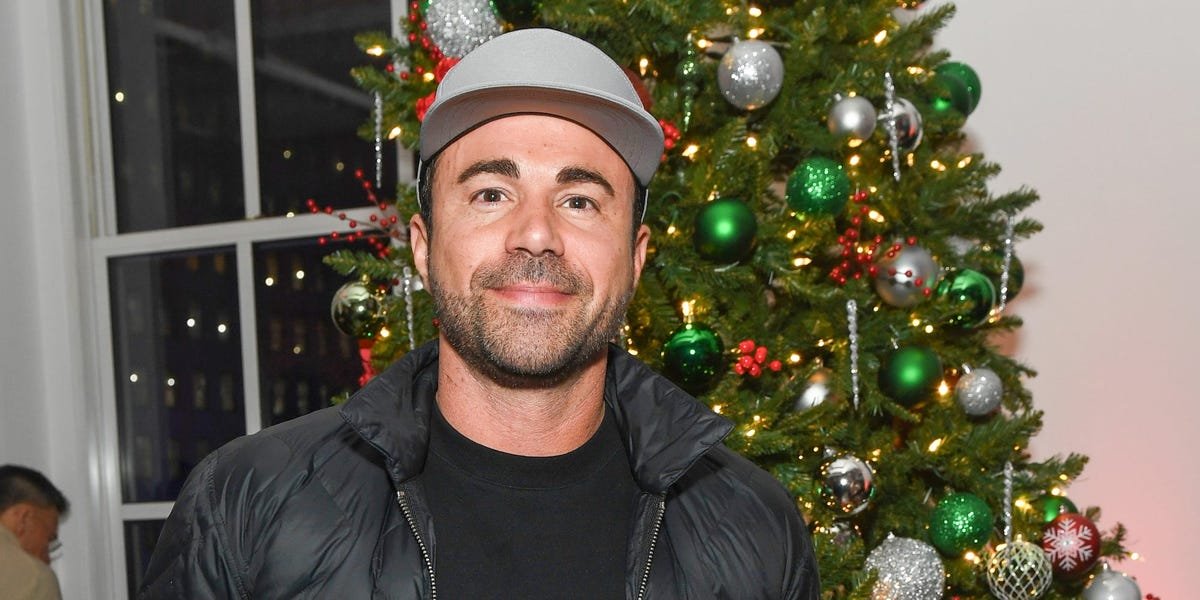
YouTube-star-Mark-Rober-got-a-big-boost-in-product.jpeg

YouTube star Mark Rober got a big boost in product sales after his Netflix deal

Netflix co-CEO Ted Sarandos says the streamer’s push into podcasting and YouTube-born content is bearing fruit.

Sarandos specifically called out science educator Mark Rober’s show as an early success. He stressed that Netflix was both allowing the YouTube star to reach a larger audience and also sell more of his science kits.

“What he saw was a big increase in his consumer product sales after this first week on Netflix, even though he reaches an enormous audience around the world,” Sarandos said in a new interview with POLITICO, which, like Business Insider, is part of the Axel Springer Global Reporters Network.

On “Mark Rober’s CrunchLabs,” which launched in November, the former NASA engineer stages science experiments and competitions in his backyard.

Sarandos said he was also bullish on Netflix’s Pete Davidson interview show, as well as its official behind-the-scenes podcasts about popular shows like “Bridgerton.”

“I think a video podcast is just the evolution of talk shows,” Sarandos said.

YouTube, already the top US streaming TV service, has solidified its position as the No. 1 destination for podcasts. Netflix has been looking to challenge YouTube by luring some of its star creators like Rober and preschool educator Ms. Rachel. Netflix also rolled out a slate of video podcasts early this year, including Bill Simmons’ show, Charlamagne Tha God’s “The Breakfast Club,” and Barstool Sports fare.

Some creator reps have wondered whether Netflix can turn its viewers into habitual consumers of video podcasts, and whether leaving YouTube will cost creators in audience and revenue. Netflix has sought video exclusivity with many of its podcast deals, while some YouTube creators’ deals, like Rober’s and Ms. Rachel’s, have been nonexclusive.

Sarandos said Netflix was seeing “promising numbers” from its podcasts, which focus on subjects like comedy, sports, and true crime, areas that already do well on the platform. He didn’t share specific figures.

As broadcast TV audiences have shrunk, viewership for traditional talk shows has declined, and Sarandos acknowledged the difficulty of porting the format to streaming services. Netflix has had some growing pains with talk shows, which often haven’t drawn huge audiences.

“We have tried to and failed at many talk shows over the years,” Sarandos said. “Much smaller audiences tune into multiple shows in the form of a podcast every day. It’s a deeper relationship than it is a broad one. So, instead of trying to make one show for the world, you might have to make hundreds or thousands of shows for the whole world.”




Source link

Employees-who-dont-vibe-code-are-probably-underperforming-fintech-startup.jpeg

Employees who don’t vibe code are ‘probably underperforming,’ fintech startup product chief says

The product chief of a $32 billion fintech startup has called out employees who aren’t using AI-assisted coding tools.

Geoff Charles, chief product officer of Ramp, an AI fintech startup that helps companies pay their bills, said in a Sunday episode of “Behind the Craft” podcast that employees are expected to be AI-native.

“If you’re not using Claude code this year, no matter what your role is, you’re probably underperforming compared to others on the company,” he added.

Charles said that the company frames AI proficiency across multiple levels. At the bottom level — level zero — are people who “sometimes use ChatGPT.” At the top, level three, are people who are “systems builders.”

Employees who vibe code and can proficiently build apps that automate parts of their job belong to level two, while staff who have built custom GPTs and have some experience with Claude Code fall under level one.

“Our job is to get everyone in the organization up the ladder,” Charles said.

“The people who are still in L0, they will most likely not be at the company,” he added, referring to level zero.

“If you’re not a self-starter and you don’t have that growth mindset, it’s going to be very, very hard to train,” he said.

Charles said 50% of the company’s code is built by AI, and it would probably be 80% by March. He added that the role of product managers will evolve in the AI-native era, with some becoming builders and others focusing on business strategy.

The fintech startup announced in November that it raised $300 million in funding, bringing its valuation to $32 billion. The round was led by Lightspeed Venture Partners, with investors including Founders Fund, Coatue, GIC, Thrive Capital, and Khosla Ventures, among others.

Companies going all in on AI

Charles’ comments come as tech companies increasingly reshape their workforces around AI.

Block last month cut nearly half of its workforce, saying advancements in AI were behind the layoffs.

Last week, Atlassian laid off about 1,600 roles, roughly 10% of its global staff, as the Australian-American proprietary software company reorganizes to prioritize AI development and enterprise growth.

“It would be disingenuous to pretend AI doesn’t change the mix of skills we need or the number of roles required in certain areas. It does,” CEO Mike Cannon-Brookes wrote in a message to employees.

Ramp is not the only company paying closer attention to how employees use AI at work.

In February, managers at Google told some staff in non-technical roles that they are expected to incorporate AI into their daily workflows, four employees familiar with the matter told Business Insider.

In some cases, non-technical employees were told their use of AI could factor into their performance reviews later this year, two of the employees said.

Daniel Yanisse, the CEO of background-check startup Checkr, said the company has pushed employees across departments to adopt AI tools, not just engineers.

“We gave every employee a monthly stipend to try AI tools, and we did AI days and demos. After one year, 95% of the employees use prompting daily,” Yanisse said last month.


Source link

Chong Ming Lee, Junior News Reporter at Business Insider's Singapore bureau.

I’ve been a product manager at one of China’s biggest tech firms. Here’s how Chinese AI products are built differently.

This as-told-to essay is based on a conversation with Yilin Zhang, an AI product manager at AI startup Kuse who worked at Meituan for more than three years. It has been edited for length and clarity. Business Insider has verified his employment and academic history.

I graduated from Tsinghua University with a master’s degree in computer science in 2021 and then joined Meituan — one of China’s biggest tech firms — as a product manager.

At Meituan, China’s platform for local services, especially known for food delivery, I worked on two AI projects. One was a consumer-facing AI assistant that helps users complete various tasks, including ordering food. The other was a merchant-facing AI agent designed to help businesses manage their daily operations, including handling reservations, managing orders, and supporting routine operational tasks.

The main difference between how products are built in China and in the US comes down to the market.

Why Chinese tech companies are so cost-efficient

Across most large Chinese tech companies, AI product development accelerated more aggressively around 2025.

The AI initiatives I worked on at Meituan started around April or May of that year. It coincided with the surge of interest around DeepSeek, when attention around AI agents took off.

Large companies began racing to build AI projects, and almost every business unit launched its AI initiative.

For a long time, especially before 2021 or 2022, Chinese tech companies were primarily focused on domestic competition rather than overseas expansion. Because competition in China is intense, tech companies were forced to become extremely efficient. Their execution methods have been sharpened to an almost frightening degree.

Constraints have also pushed Chinese AI companies to pursue different paths, with a strong focus on open-source models and cost efficiency. These limitations forced exploration in new directions, and those paths have proven valuable in their own way.

DeepSeek is a good example. Because of international restrictions, it couldn’t access large numbers of GPUs and was forced to innovate around efficiency instead.

Why Chinese AI products differ from the West

Chinese and overseas markets are fundamentally different, leading to distinct user bases, expectations, and product designs.

Chinese users have a much lower willingness to pay for software; hence, many mass-market AI products, such as Doubao, tend to be free. The core objective is often to scale active usage.

Many capabilities are packaged into a single prompt you can ask, essentially a chatbox interface with a low barrier to entry.

International AI products target users doing high-value tasks. They are more often designed for desktops than for mobile devices, with interfaces better suited to work contexts. These products explore how AI and humans can collaborate and intersect across different work scenarios, helping users complete tasks more effectively and efficiently.

In China, that user group is relatively small. That makes it harder for its mainstream AI products to move beyond chat-based forms into more advanced products.

China’s internet success over the past decade has also largely come from consumer-facing apps. That environment forces product managers to obsess over user feedback and relentlessly polish even the smallest features.

Teams may spend enormous effort refining a tiny feature just to win over a small group of users. In markets with less competition, that level of detail isn’t always necessary.

The AI startup scene is growing in China

After three to four years at Meituan, I felt I had learned most of what I could from that environment. I left to join the AI startup Kuse in October.

AI is evolving extremely fast. In large companies, iteration speed can be slower. Many of my friends across different Big Tech companies share this same frustration. Smaller, more agile companies can adapt faster.

In the past, top graduates had basically two paths: becoming a civil servant or joining a Big Tech company.

That’s changing. Especially over the past year, many AI startups have emerged, and more young people are choosing entrepreneurship. AI has created a new path outside Big Tech.

By 2025, not being involved in AI at all will feel like staying in the PC internet era of 2010 instead of joining the mobile internet wave.

Do you have a story to share about working in a Chinese tech company? Contact this reporter at cmlee@insider.com.


Source link

Melia Russell smiles

Harvey makes a big chief product officer hire as legal tech competition heats up

Harvey, the $8 billion legal software startup, is becoming a default vendor in Big Law. Now, with rival startups nipping at its heels and AI model providers moving closer to legal workflows, Harvey is bringing in a new executive to help defend its lead.

The company tells Business Insider it has hired Anique Drumright as its first chief product officer. In this role, she’ll shape what Harvey builds next and how quickly it can ship. Drumright has held roles at Uber, TripActions, Loom, and, most recently, HR software startup Rippling, where she led the company’s push into IT management software.

“Her slope of learning is very high,” said Winston Weinberg, Harvey’s chief executive. He described sending Drumright a lengthy Google Doc on the state of law firm technology and the day-to-day mechanics of legal work. She came back quickly with “really good product ideas,” he said.

The C-suite hire comes at a critical moment for Harvey — and for legal tech more broadly. Law firms are pouring money into new software meant to help lawyers work faster and save costs. Clients are driving much of that spend. After seeing chatbots and virtual assistants transform their own operations, they now expect the same efficiency from outside counsel.

Those tools don’t come cheap, and recent moves by the model providers themselves have complicated the picture. Anthropic’s release last week of a contract-review tool sent ripples through the industry and led to a major sell-off of legal-research stocks. It raised a pointed question: If a foundation model can review contracts, on top of handling tasks across the rest of the organization, how much specialized legal software will firms still pay for?

Harvey sits at the top of the heap for now. The startup has emerged as one of the best-known and best-funded players in legal tech, with licenses at over half of the 100 largest US law firms. The company said it ended last year with more than $190 million in annual recurring revenue. And job postings reviewed by Business Insider suggest it is pushing into mid-market and smaller firms, a long tail of potential growth beyond Big Law.

Earlier this week, Forbes reported that Harvey is raising a new round of funding that would value the company at $11 billion, citing unnamed people familiar with the deal. A Harvey spokesperson declined to comment on the report.

Harvey’s dominance comes with pressure. The company still needs to show lawyers its product can boost revenue, not just save hours. At the same time, competition is intensifying, from legal software startups like Legora and from OpenAI and Anthropic, the same companies whose technology powers Harvey’s platform.

Weinberg said Anthropic’s latest release doesn’t change Harvey’s product direction, but it does emphasize the need to move faster on shipping what makes the company distinctive. “Part of hiring Anique is to accelerate that,” he said.

If the next fight is adoption, Drumright has put in the reps. She’s spent years building products that ask people to change their habits.

At Uber, she worked in product and marketing as the ride-hailing giant scaled to billions of trips a year. Later, at Loom, she helped grow a product that nudged office workers away from meetings and long email chains, replacing them with screen-recorded video messages.

Drumright faces a similar challenge at Harvey, where the company has to convince reluctant lawyers, a famously luddite profession, to trade the familiar way of doing things for new tools. Those take time to use effectively.

“When something is new, even if it’s powerful, it’s still harder to do than the way you’ve always done it,” she said. Her job, she said, is to make those new capabilities feel intuitive.

Drumright is the daughter of two lawyers, and she has seen firsthand how low-tech legal work can be. She remembers her mother siting on the couch, preparing for a deposition by speaking into a tape recorder.

Drumright starts on Tuesday. Her first weeks at Harvey will be spent on a listening tour, meeting lawyers using the product and legal teams deciding whether to buy it. “Legal is a very specific domain,” she said, but the work starts with understanding how lawyers actually work today, and designing products that don’t slow them down.

Have a tip? Contact this reporter via email at mrussell@businessinsider.com or Signal at @MeliaRussell.01. Use a personal email address and a non-work device; here’s our guide to sharing information securely.


Source link

James Faris headshot

Paramount’s head of streaming product and tech is leaving the company. Read his Slack message to colleagues.

The head of Paramount Skydance’s streaming product and tech is leaving the company, Business Insider has learned.

Vibol Hou told colleagues in the company’s streaming tech Slack channel that he’s leaving Paramount at the end of January.

“After nearly 12 years of exhilarating work pushing our businesses to new heights, it feels like the right time to hand the torch to the next wave of leaders while I take a much-needed pause to rest, focus on my health (including some serious marathon training), and spend more time with my family before I jump into whatever comes next,” Hou wrote in the Slack message, which was viewed by Business Insider.

Hou’s exit has been anticipated within Paramount for months.

In Hou’s Slack message, he referenced a previous memo from Dane Glasgow, Paramount’s chief product officer, that hinted at the move.

“Vibol has expressed interest in exploring other opportunities, and while he will remain in his role with an anticipated transition early next year, we will continue to explore new projects together,” Glasgow wrote in a mid-October email viewed by Business Insider.

Hou was at Paramount or its subsidiaries for over a decade, including six years at its free streamer, Pluto TV. In that span, Paramount went through several corporate changes, from a ViacomCBS merger to the Paramount Skydance merger that closed in the summer of 2025.

“What we’ve built together across Pluto TV, CBS All Access/Paramount+, and Network Streaming was never easy,” Hou wrote in the Slack message. “But we built these products from the ground up, in tough environments that didn’t necessarily believe in our vision, with limited resources and non-existent technology where we often had to build our own, and under constant pressure to deliver.”

Hou’s Slack message was received warmly, with 118 “care” emojis, 67 classic “red heart” emojis, and 43 “thank you” emojis, among other signals of support as of early Thursday afternoon.

Since Paramount Skydance CEO David Ellison took over in early August, he’s made several noteworthy moves, like landing UFC rights in the US and hiring Bari Weiss to lead CBS News.

Ellison is now focused on buying Warner Bros. Discovery, which has rejected its takeover offer eight times.

Paramount did not immediately respond to a request for comment.

Read Hou’s Slack message to colleagues announcing the move:

@channel Team,

As Dane shared in his note, I’ll be transitioning out of my role and leaving the company at the end of January. After nearly 12 years of exhilarating work pushing our businesses to new heights, it feels like the right time to hand the torch to the next wave of leaders while I take a much-needed pause to rest, focus on my health (including some serious marathon training), and spend more time with my family before I jump into whatever comes next.

What we’ve built together across Pluto TV, CBS All Access/Paramount+, and Network Streaming was never easy — but we built these products from the ground up, in tough environments that didn’t necessarily believe in our vision, with limited resources and non-existent technology where we often had to build our own, and under constant pressure to deliver. Yet again and again, this team showed grit, creativity, and passion. Whether you came from Pluto or another part of Streaming, the story is the same: we took on impossible problems and innovated our way through.

The culture we live — being curious about everything, feeling that hunger to solve problems, caring deeply for others, iterating constantly, and innovating in everything we do — belongs to all of you now. You should be proud of what you’ve achieved, and you should be confident that this is a team that can handle anything thrown its way.

As to the future, I have a lot of confidence in Dane and the vision and strategic pillars he’s laid out for the year ahead. They set a strong foundation for where this organization can go over the next several years, and I’m excited to see what you all do together under his leadership.

I plan to hold my last open office hours next Friday so anyone who wants to drop in, ask questions, or just say hello/goodbye has a space to do that together. In the meantime, if you’d like to stay in touch beyond my time here, please feel free to connect with me on LinkedIn.

Serving alongside you has been one of the great privileges of my life, and I’ll be proudly cheering you on as you write the next chapter together.

Boldly go, always. ❤️

Vibol


Source link