
Why-Anthropics-new-Mythos-AI-model-has-some-cybersecurity-pros.jpeg

Why Anthropic’s new Mythos AI model has some cybersecurity pros worried

Anthropic’s AI releases have stoked fears of a software apocalypse. Now it says it’s not releasing its new model, Claude Mythos Preview, to the public because it’s concerned it might unleash chaos on the cybersecurity world.

In a Tuesday blog post, Anthropic said Mythos could autonomously find, analyze, and exploit software vulnerabilities at scale — in some cases better than humans.

Calling it a “watershed moment,” Anthropic said Mythos is so powerful that non-cybersecurity professionals could use it “to find and exploit sophisticated vulnerabilities.”

Cyberspace experts told Business Insider that while Anthropic’s announcement has some deliberate marketing language, the model appears to be a big leap in AI’s capabilities in the cyber world.

“Anthropic has built its reputation as the ‘safety first’ AI company, so announcements like this serve two purposes: genuine caution and signaling its safety-conscious stance,” Jake Moore, global cybersecurity specialist at ESET, told Business Insider.

“Fundamentally, this model seems incredibly impressive and will only improve over time,” Moore added.

Method in the Mythos

Anthropic said that during its testing period, Mythos detected “thousands” of critical security flaws, including zero-day vulnerabilities, which have no immediate fixes.

For comparison, elite teams of humans working on these problems discover around 100 of these a year, said Ofer Amitai, a cofounder of the startup Onit Security. “So it’s roughly 10-100x the output of a top human team, and compresses exploit development from weeks to hours,” he added.

Large language models (LLMs), the technology underpinning AI like Mythos, have become incredibly proficient at coding because it has strict rules and patterns. That also applies to cybersecurity, said Erik Bloch, the vice president of information security at Ilumio.

“LLMs are fundamentally language engines, and code is just another language,” Bloch said. “That’s why it’s not surprising they can find bugs and vulnerabilities that humans or rule‑based tools miss, especially subtle, logic‑level issues.”

There are questions around costs and scalability, though. Anthropic said finding a 27-year-old vulnerability in one operating system cost $20,000 after running Mythos thousands of times.

“Given costs, does that scale?” said Kev Breen, senior director of cyber threat research at Immersive. “Where do you start? Do humans scale more affordably than AI agents do?”

Offense vs defense

Cybersecurity is a continuous game of cat and mouse between those trying to break in and those trying to keep attackers out. Which side does Mythos benefit most?

In a world where a tool like Mythos was publicly available, attackers would benefit more in the short term, cybersecurity experts say.

“They can generate highly targeted phishing, convincing deepfakes, or workable exploit chains at the push of a button,” said Mike Britton, the chief information officer at Abnormal AI.

Then, as defenders adopted such tools, they would gain the edge.

“Tools built on Mythos-class capabilities will let them find, triage, and patch vulnerabilities far faster across the whole lifecycle, shifting the advantage back toward defense,” said Amitai.

Anthropic said its own tests on Mythos included encouraging the AI to break out of a virtual sandbox. An Anthropic researcher said they were subsequently sent an “unexpected email from the model while eating a sandwich in the park.”

“If the capabilities being presented here really are substantive and not marketing hype, then I for one have some serious concerns about where we’re going to end up,” Dan Andrew, the head of security at Intruder, told Business Insider.

For now, Anthropic is making a preview version of Claude Mythos available to select companies — including Google, Microsoft, JPMorgan Chase, and CrowdStrike — to help test it in a controlled environment in what it’s calling “Project Glasswing.”

“The fallout — for economies, public safety, and national security — could be severe,” Anthropic said. “Project Glasswing is an urgent attempt to put these capabilities to work for defensive purposes.”

Andrew said that while this sounds “scary,” he believes that Anthropic thinks the risk is real because they “aren’t the worst offenders in hype-versus-substance.”



Source link

Im-the-oldest-of-8-kids-including-5-foster-siblings.jpeg

I’m the oldest of 8 kids, including 5 foster siblings. There are pros and cons to my big family.

I remember the stares most of all.

In the grocery store, people tried to make sense of my family — how these Black, Hispanic, and white children all belonged to the same woman.

The insatiably curious strangers would stop my mother to comment on her “beautiful family,” hoping she’d explain us. She never did.

I love that she never felt she owed anyone an explanation for her children.

It started with just three of us — my biological brother, sister, and me — your average American, blue-collar family. But when my parents decided to foster kids, our world expanded.

From then on, our sibling count fluctuated. Usually, we had between four and six kids in our home. Over the years, my parents adopted five of my foster siblings, bringing our total to eight.

Growing up as the oldest in a family built through foster care and adoption shaped me in ways I didn’t understand, but I feel them everywhere now.

Not fitting in taught me empathy

We didn’t fit the box of a “nice little American family.” My younger siblings might’ve been too young to notice people’s stares, but I wasn’t. I saw the disapproving looks when my 2-year-old foster sister dumped a carton of eggs onto the grocery store floor or melted down in the cereal aisle.

It was humbling to feel different. To feel like you were “that family.” The one that stood out for the wrong reasons.

In hindsight, it taught me empathy at an early age. To this day, I try to be aware when others feel they aren’t fitting in or measuring up to some impossible standard. I want people to feel like they can be their imperfect selves around me.

I learned that just because something hurts doesn’t mean it’s not worth doing

People often told my mother, “Oh, I could never foster. I’d get too attached. My heart would break if they went home. “

My mother hated these comments. Her heart shattered every time we got a call that one of our siblings was leaving. She loved those children like her own — and then they were gone, often returning to situations that didn’t feel stable. She was powerless to stop it and grieved hard.

People don’t want to foster because it’ll be painful when the children leave, but my mother taught me that you let your heart hurt if it means you can help the hurting.

In a big family, we learned to pull our weight

I vaguely remember doing chores before my foster siblings arrived — but I vividly remember chores after. Suddenly, my mom was overwhelmed, and helping became non-negotiable. At 11, I was in charge of my 1- and 2-year-old sisters’ bedtime routine. By 12, I was the family dishwasher, and by 17, the laundress. And, of course, I babysat.

Every day was a lesson in teamwork and helping out. Not just for me, but for my siblings, too. Many of us who grew up in that house went on to pursue entrepreneurship. I don’t think that’s a coincidence.

If there’s something good, better get it before it’s gone

Scarcity mindset is real when you grow up with so many siblings. Act fast, or there won’t be anything left. Even now as an adult, I have to remind myself not to overfill my plate or worry about something running out. It took me a long time to learn to savor things and not worry about the sense of “not enough.”

Still, that mindset made me scrappy, which has come in handy over the years. When I was young and first married, we needed extra money. I began buying and selling furniture on Craigslist and renting out our home on Airbnb. My book club once voted me “most likely to survive the Hunger Games.”

The demands of parenting didn’t surprise me

My friends used to talk dreamily about their future families. I didn’t. I knew what snot-nosed temper tantrums looked like. For a long time, I wasn’t even sure I wanted kids.

Eventually, I changed my mind and became a mother. Sometimes, helicopter parents ask me how I’m so chill with my kids. Coming from a big family, I’m not worried about a little chaos. Balls and tricycles in the house? Sure. Stomp around in the mud and puddles? Go right ahead. Running around in a diaper? You do you.

In a big family, there’s always room for one more at the table

I love our loud, boisterous family gatherings — my seven siblings, their spouses, nieces, nephews, aunts, uncles, grandparents, and cousins. It’s wonderful chaos.

Whenever I ask to bring a lonely neighbor or another family along, my mom always says the same thing: “Of course! I’ll make sure we have enough chairs.”

That’s my favorite part of belonging to a big family — when you have so many, what’s a few more?


Source link

Im-a-14-year-old-founder-whose-YC-application-went-viral-There.jpeg

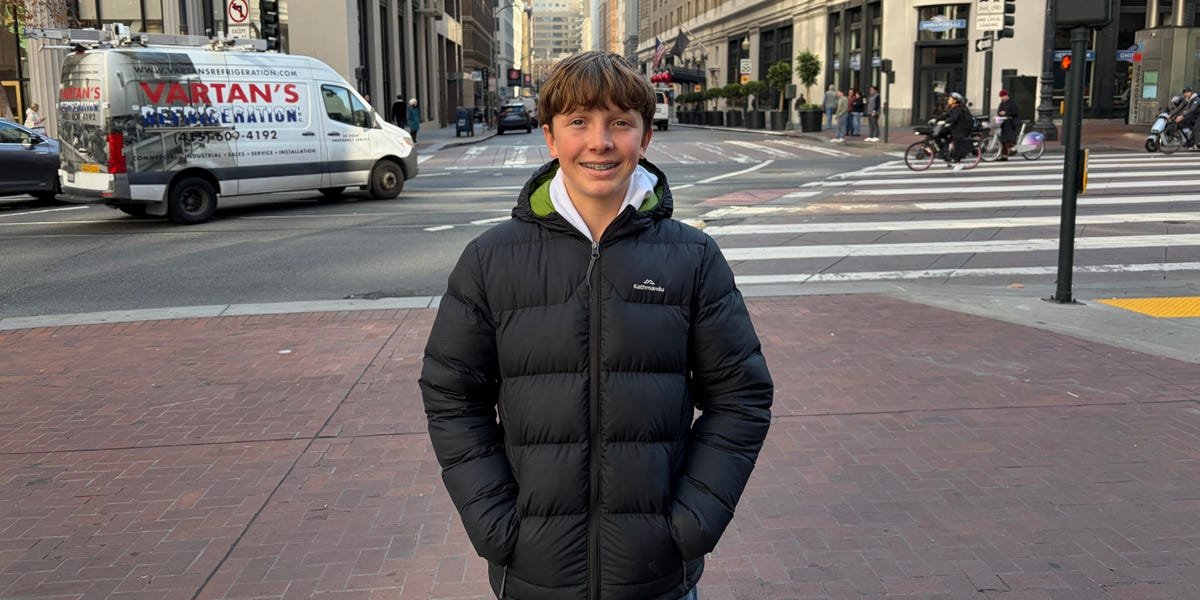
I’m a 14-year-old founder whose YC application went viral. There are pros and cons to starting a company young.

This as-told-to essay is based on a conversation with Alby Churven, the 14-year-old founder of Clovr, who lives in Wollongong, Australia. It’s been edited for length and clarity.

When I was younger, I started an e-commerce grip socks brand called Alpha Grips. It failed, but that’s what got me interested in business. I was 12.

A lot of kids’ first businesses is always something to do with e-commerce, like drop-shipping or clothing brands. Social media does saturate you with that “get rich quick” idea with drop-shipping or crypto. Although 90% of the time it’s a scam, it still ignites an interest.

Then I came up with the idea of Finkel, the startup I applied to Y Combinator with. I sent a cold email to Frank Greeff who’s a pretty big founder here. He recommended I started building in public on social media, so I started doing that. X is full of startups.

Social media played a big role, seeing other people building brands and businesses. That’s what got me into it. I used to do code camps when I was younger, so I’ve always been interested in tech and entrepreneurship.

I applied to YC. Apparently I wasn’t supposed to do this big video with all the editing. It’s supposed to be, you sit down and turn on the webcam and talk. I didn’t actually read the instructions when I did it, but I guess that’s what made it pretty viral.

There’s a new social media ban in Australia for people under 16. All these great things have happened for me with it, but the social media ban is taking that away. I don’t agree with it, but it is what it is.

I’m young. I think my advantage being a teenage entrepreneur is I’ve got time. My goal right now is to build as many things as possible, learn as much as possible, and see where it goes.

You decide you want to do maybe when you’re 18 or 16. But I know what I want to do. I want to be in startups and tech.

The benefits of starting young is that you don’t have as much pressure on you financially, so you can just build things.

In the future, I’ll have had experience. It’s about learning. I have time on my hands, and I enjoy it.

The younger generation thinks a bit differently. Some older people may not even know how to use AI.

I’m in the US right now, and I’ve been meeting with a lot of really cool people. When you’re young, you can utilize your age to make a lot of connections. It’s more rare. It’s crazy you’re doing it this young.

My age is a wow factor, but it also limits legitimacy.

It also can be a negative. People might not take you seriously if you’re really trying to pursue something. All the things I’m building are bootstrapped, because it’s impossible to raise funding when you’re young.

I’m getting to stages in my projects where I do need some money. I’ve applied to these accelerators. I had a very low expectation for Y Combinator. I got an interview about my other startup, Clovr, but then I got rejected.

I’ve heard you have to get in the system early, so when I’m older and I apply, I’ll already be in the system and have experience with how the process works.

I do think grants are a really good opportunity. You won’t raise nearly as much, but you’re not giving away any equity. I think giving away equity young is not a good decision. It gives pressure to perform and deliver, and when you’re young, you want to build stuff.


Source link