

Dominick Reuter

Target boycott organizers claim victory in their yearlong protest — but they say more work needs to be done

A fast is typically 40 days, but the Target Fast lasted nearly 10 times that long.

The organizers of the nationwide boycott against Target declared victory Wednesday after they said the company is largely satisfying the demands that were laid out a year ago.

Pastor Jamal Bryant and community leaders said at a press conference that their protest of the bullseye retailer’s DEI policies is over after a series of conversations with Target representatives, including new CEO Michael Fiddelke.

“We are effectively, today, closing this chapter because we have other fights that we’ve got to see,” Bryant said. “Stay tuned for the next fight, but this fight for us has now reached its conclusion.”

Bryant said the Target Fast pledge garnered more than 300,000 signatures from people across the US. The company said last year that the reaction to its DEI changes dragged on first-quarter sales.

The bullseye retailer welcomed the conclusion of the Target Fast, saying it is more committed than ever to supporting growth and opportunity for all the people it serves.

“We’re pleased to be moving forward, and we will continue showing up as trusted neighbors while delivering results for our team members, guests, and the more than 2,000 communities in which we serve,” a spokesperson said.

The end of the action marks a cultural win for Target, a week after it unveiled an ambitious turnaround strategy to re-engage shoppers and win them back.

So far in 2026, the company’s share price is up more than 20% after a down year in 2025 marked by falling foot traffic and net sales. The S&P 500 is roughly flat year-to-date by comparison.

Target provided the receipts to address organizers’ concerns

Bryant said Target’s programs have met three of the four demands his coalition expressed last year, including commitments to Black entrepreneurs, partnerships with HBCUs, and internal programs that support diversity and inclusion.

The outstanding issue is the organizers’ call for Target to deposit $250 million in Black-led banks, which Bryant conceded would take more time to identify institutions that could work with that amount of capital.

Bryant said a demand that the company commit $2 billion to Black-owned businesses was 97% complete and on a path to be exceeded by another $100 million this spring.

He also said the company is piloting an HBCU partnership that will equip students with business skills and serve as a model for future engagement with Black schools. Target says it has provided $10 million over the past five years for 1,000 HBCU students in its Target Scholars program.

Most of the goals were met through Target’s ongoing community engagement efforts, which the company has been seeking to communicate about more effectively under Fiddelke’s leadership.

‘We will not be going back to Target’

Although this specific boycott is over, co-organizer Nina Turner says she’s not yet ready to go back to Target until she hears a public apology from the company for breaking its trust with the Black community.

“People have to make their own decision, but as for me and my house, we will not be going back to Target,” the former Ohio state senator said.

Some social media users were similarly skeptical about returning to Target’s stores.

“I’m still not going to shop there but sure the boycott is over,” one user posted on X.

On social media, mentions related to Target boycotts spiked in January 2025 but tapered off during the year before climbing again in January and February 2026, according to data from PeakMetrics.

Bryant said new challenges for Target and other large companies have emerged in the past year, particularly related to the company’s response to immigration issues. But those are distinct from the demands his coalition made last year, and he’s happy with what he’s learned.

“This journey for all of us was not a symbolic one,” he said.

Have you participated in the Target boycott? Are you planning to start shopping again this year? Contact Dominick Reuter via email at dreuter@businessinsider.com



Source link

I-was-at-a-QuitGPT-protest-and-the-discontent-extends.jpeg

I was at a QuitGPT protest, and the discontent extends far beyond OpenAI’s Pentagon deal

Some people are angry with OpenAI, and it’s about more than just the company’s deal with the Pentagon.

On Tuesday evening, I visited the OpenAI headquarters in Mission Bay, San Francisco, and I was met with a relatively small but energetic and diverse group of protesters, each with very different demands. This protest was part of the nascent QuitGPT movement; between 40 and 50 people attended, holding signs and chalking hundreds of slogans on the sidewalk.

OpenAI triggered widespread backlash when it signed a contract with the Pentagon on Friday, hours after President Donald Trump ordered federal agencies to halt use of Anthropic’s Claude. The negotiation between the Pentagon and Anthropic had broken down because the OpenAI rival sought contractual guarantees against mass surveillance and fully autonomous weapons, its CEO said in a statement.

The backlash against OpenAI sparked a wave of support for Anthropic, including Katy Perry, who publicly endorsed and subscribed to Claude AI. Calls to abandon ChatGPT in favor of Claude spread rapidly across social media, and the momentum showed up in the download charts. Claude shot to No. 1 in the App Store on February 28, up from sixth place.


A protester writes a message against artificial intelligence outside of Open AI headquarters in San Francisco.

Aside from OpenAI’s deal with the Pentagon, protesters have a laundry list of other grievances, including how resource-intensive data centers are and AI’s erosion of human creativity.

Manuel Orbegozo for BI


OpenAI CEO Sam Altman posted an internal memo to X on Monday and said the company is revising its contract with the Pentagon to add explicit protections, including a prohibition on surveilling US persons and nationals and a bar on use by intelligence agencies such as the NSA without a separate contract modification. Altman also acknowledged the rushed rollout in his memo, admitting the company “got things wrong” and that the deal “looked opportunistic and sloppy.” The Pentagon did not respond to Business Insider’s questions about the amended deal.

I talked to six at Tuesday’s protest, who were skeptical of the revised deal, but there were also broader concerns about AI’s rapid rise and the tech industry.

Many attendees were there for climate concerns


Protesters demonstrate against Open AI outside of their headquarters in San Francisco.

Many protesters said they were there over concerns that data center will exacerbate the climate crisis.

Manuel Orbegozo for BI


Wearing a shirt that reads “we have a right to good jobs and a livable future,” Perrin Milliken told me that she has always been a climate advocate and is here to oppose data centers, which she said are an act that puts the need for AI before human needs.

“AI is taking water from communities, polluting communities, and it is also increasing communities’ electricity bills,” Milliken said.

“They’re not even paying for it — we are,” Milliken added of tech companies.

“I want water to drink, not AI to think,” reads a sign held up by a protester.

Tech companies are becoming symbols of wealth inequality


Bill Lo collects the signs he made for the protest against Open AI which took place outside of their headquarters in San Francisco.

Many protest signs target wealth inequality and call tech billionaires “oligarchs.”

Manuel Orbegozo for BI


Sarah Gao, who took to the stage to speak, expressed disapproval of billionaires and the resources they take up.

“Sam Altman lives in a super villain’s mansion here in San Francisco,” Guo told the crowd, which immediately booed. “In a city that struggles with affordable housing, his sprawling compound features an underground to house luxury cars, an art gallery, a stand-alone spa cottage, and occupies an entire city block.”

“Sam and his billionaire buddies helped Trump with his disastrous budget bills that stole trillions of dollars from everyday Americans just to line their pockets,” Guo added.

Behind Guo, signs that call the tech industry “big trouble for humanity” and the billionaire CEOs “oligarchs” stood tall.

Some are rejecting AI entirely on principle


Megan Matson poses for a portrait after a protest against Open AI took place outside of their headquarters in San Francisco.

Meghan Matson said she refuses to participate in using AI and has always felt like AI is “bad news.”

Manuel Orbegozo for BI


When I spoke to Meghan Matson, she told me that she has completely rejected using AI and felt like it was “bad news” from the start.

“I know that AI is participating with me, but I’m not participating with AI,” said Matson.

“As soon as I saw it start showing up in visuals and imagery, I could see exactly where it heads,” Matson added. “It destroys journalism, it destroys art, it destroys the expression of our common humanity.”

“Stop AI stealing art, writing, electricity, water, jobs,” reads a large chalk writing on the street in front of the OpenAI office.

At least one participant was a tech worker unhappy with how their work is used


A protester impersonating a robot lies on the ground after demonstrating against Open AI outside of their headquarters in San Francisco.

The 26-year-old who works in the tech industry loves AI, but doesn’t approve of OpenAI’s Pentagon deal.

Manuel Orbegozo for BI


“I’m an active AI user. I love AI, and I use it every day, to write, to program, to learn,” said a 26-year-old who works in the tech industry who declined to be named.

“What I don’t want is for the technologies that my friends and I build to be used to undermine the freedom we value,” he added.

He told me that he made the robot mask yesterday with a cardboard box, black duct tape, and LED lights.

“I spent $12 on this,” he said of his robot mask. “I bet a lot more people are gonna pay attention to this than OpenAI’s next million-dollar ad.”


Source link

Unsubscribe-and-opt-out-A-new-Big-Tech-boycott-to.jpeg

‘Unsubscribe’ and ‘opt out’: A new Big Tech boycott to protest ICE starts February 1

Economic boycotts are a familiar tool of protest. The problem is they often place the greatest strain on the smallest businesses.

That was the case during Friday’s nationwide general strike, which was designed to pressure the Trump administration to dial back its aggressive anti-immigration policies.

For many small business owners, the shutdown created a dilemma. Supporting the cause often means losing a day’s revenue and risking their ability to keep staff employed. Across social media, owners voiced solidarity alongside an apology for staying open.

There may, however, be another way, according to Scott Galloway, a marketing professor at New York University famous for his critiques of Big Tech.

Instead of a blanket shutdown, Galloway is calling for Americans to focus on major tech companies by unsubscribing from — or opting out of — services like OpenAI’s ChatGPT, Amazon’s Prime Video, and Microsoft Office.

A targeted boycott starting on Sunday and lasting the entire month of February could move markets, he says, which would, in turn, affect the CEOs who have the ear of President Donald Trump.

“We’re proposing something quieter and less cinematic than a protest that will run all day on cable TV, but much more disturbing to the Trump administration. A one-day slowdown is irritating. A one-month slump is terrifying,” he wrote in a blog post announcing the boycott.

Major tech CEOs have sought favor with the president during his second term. Many of them donated to his inauguration, for starters.

AI executives, like OpenAI CEO Sam Altman and Meta CEO Mark Zuckerberg, also accepted an invitation to a White House dinner with Trump in September, where the leaders took turns lauding the president. Apple CEO Tim Cook and Amazon CEO Andy Jassy attended the White House premiere of the documentary about first lady Melania Trump at the height of January’s anti-ICE protests in Minneapolis.

Supporting the AI industry in its competition with China is a major pillar of Trump’s economic agenda.

“These are the leaders who have his ear,” Galloway writes. “A modest reduction in their companies’ growth could have a substantial impact on valuations priced to perfection. Small changes in consumer behavior — starting on the first day of February — could have an enormous ripple effect, one that extends all the way to the White House.”

The anti-ICE movement

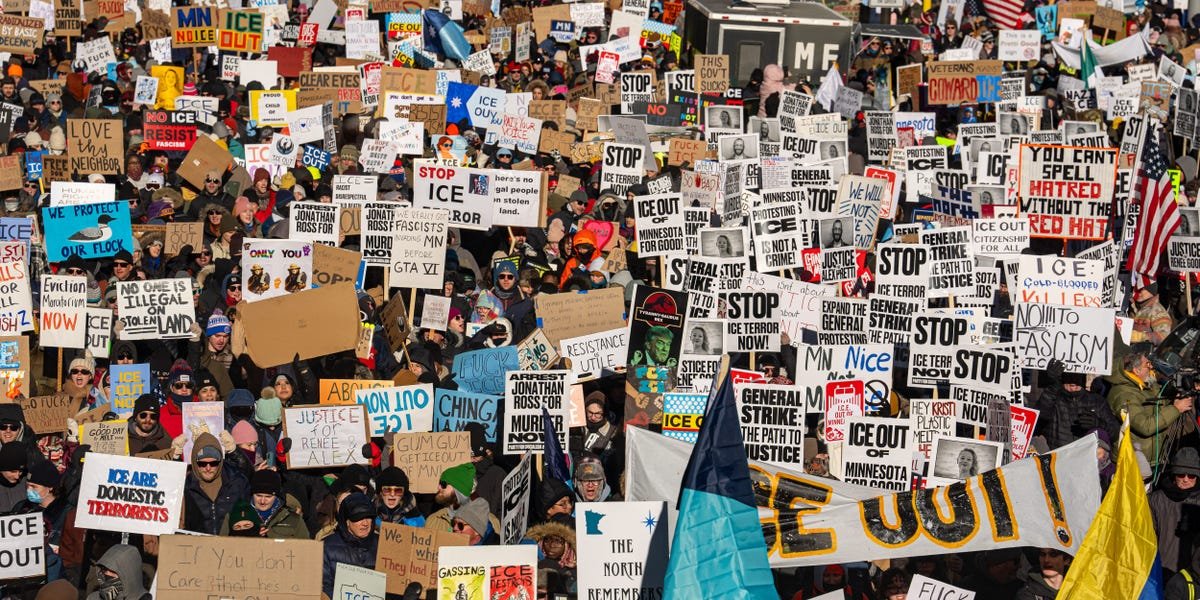
Regular protests against the tactics of ICE and Border Patrol personnel have gripped the country for months. Thousands marched through Minneapolis again on Saturday. Tensions rose dramatically in January after the killings of Renee Good and Alex Pretti in Minneapolis, both at the hands of federal immigration agents.

In both instances, protesters recorded videos and posted them to social media for the world to see, leaving little room for the Trump administration to spin the events in its favor.

While those videos and the subsequent protests — as well as the attempted nationwide shutdown — have spread awareness, they have so far done little to substantively shift the administration’s immigration policies.

The Department of Homeland Security demoted a key Border Patrol official last week and promised more changes. At the same time, however, the acting director of ICE expanded the power agents have to carry out warrantless searches, according to an internal memo seen by The New York Times.

“Real change always comes from the American people, not from our political parties. But power doesn’t fear protests nearly as much as economic withdrawals,” Galloway writes. “Getting off your couch, taking to the streets, and building community is important, but the most radical act in a capitalist society isn’t marching, it’s not spending.”


Source link

Headshot of Ben Shimkus

An ‘ICE OUT Enterprise’ protest is urging Minnesota residents to book and later cancel rental cars

Enterprise is the latest company caught in the crosshairs of anti-ICE protests.

A video showing protesters lined up outside of a Minnesota Enterprise Rent-A-Car location went viral earlier this week on TikTok, part of an “Ice out Enterprise” protest campaign.

Organizers encouraged participants to disrupt Enterprise’s operations by reserving rental cars and then canceling the bookings shortly before pickup — a tactic they say is designed to draw attention and strain vehicle availability that could be utilized by Immigration and Customs Enforcement agents.

“Enterprise is renting cars to ICE agents and profiting from the violence that agents are bringing to our communities,” Minnesota organizers associated with the Sunrise Movement, a progressive climate and social justice advocacy group, posted on social media. The post asked protestors to “please be polite to employees when you contact them.”

An Enterprise employee working the counter at one of the rental car company’s Saint Paul, Minnesota, locations confirmed to Business Insider on Friday that protesters had been calling the store. The employee declined to comment further, citing the company’s media policy.

“I’ve called and told them I was disappointed that they were collaborating with ICE,” a commenter on Instagram said.

“They answered the phone super quickly,” another added. “I was told a complaint would be logged right away.”

The viral video, which was posted on Thursday, had more than 323,000 views on TikTok as of publication. It shows a line of demonstrators holding signs reading “No cars for ICE” and “Cancel ICE contracts now.”

It’s unclear if Enterprise has any contract with ICE. Enterprise did not respond to a request for comment from Business Insider.

The effort is part of a “week of actions” in Minnesota leading up to a “business blackout” on Friday to protest ICE’s presence in the state. The Sunrise and Sunrise Twin Cities groups didn’t respond to requests for comment from Business Insider.

The video has also drawn reactions from conservative commentators on X.

“Anti-ICE leftists are now booking and canceling car reservations at Enterprise to protest them renting cars to ICE,” wrote Chaya Raichik, who operates the popular Libs of TikTik account on X, in a post with more than 208,000 views.

White House spokesperson Abigail Jackson told Business Insider in a statement that “dangerous” protest efforts had led to a rise in violence against ICE officers. “ICE officers act heroically to enforce the law and protect American communities with the utmost professionalism,” she said.

Enterprise is the latest major corporation to face consumer pressure as immigration enforcement activity in Minnesota has drawn widespread protest.

Earlier this month, Hilton removed a franchisee from its portfolio after a video that purported to show a hotel employee refusing to provide immigration enforcement officers rooms.

In a statement, the hotel chain criticized the operator and said its corporate policy was to make all locations “a welcoming place for all” and that it does “not discriminate against any individuals or agencies.”

Minneapolis-based Target has also faced heat from activists who accused the retailer of cooperating with immigration officials. The retailer denied those claims an internal memo obtained by Business Insider.

“Target does not have cooperative agreements with any immigration enforcement agency,” human resources chief Melissa Kremer wrote to employees. “We’re listening and working to de-escalate where possible.”

Enterprise, which runs around two dozen locations in the Twin Cities, is still facing calls from Minnesota-based protestors.


Source link