
Trump-says-US-forces-pulled-off-a-high-risk-rescue-of.jpeg

Trump says US forces pulled off a high-risk rescue of a downed airman being hunted ‘deep inside’ Iran

A US airman who was missing after his aircraft was shot down over Iran on Friday has been rescued, President Donald Trump announced early on Sunday.

“WE GOT HIM!” Trump posted on Truth Social, praising the military for carrying out what he described as “one of the most daring” search-and-rescue operations in US history.

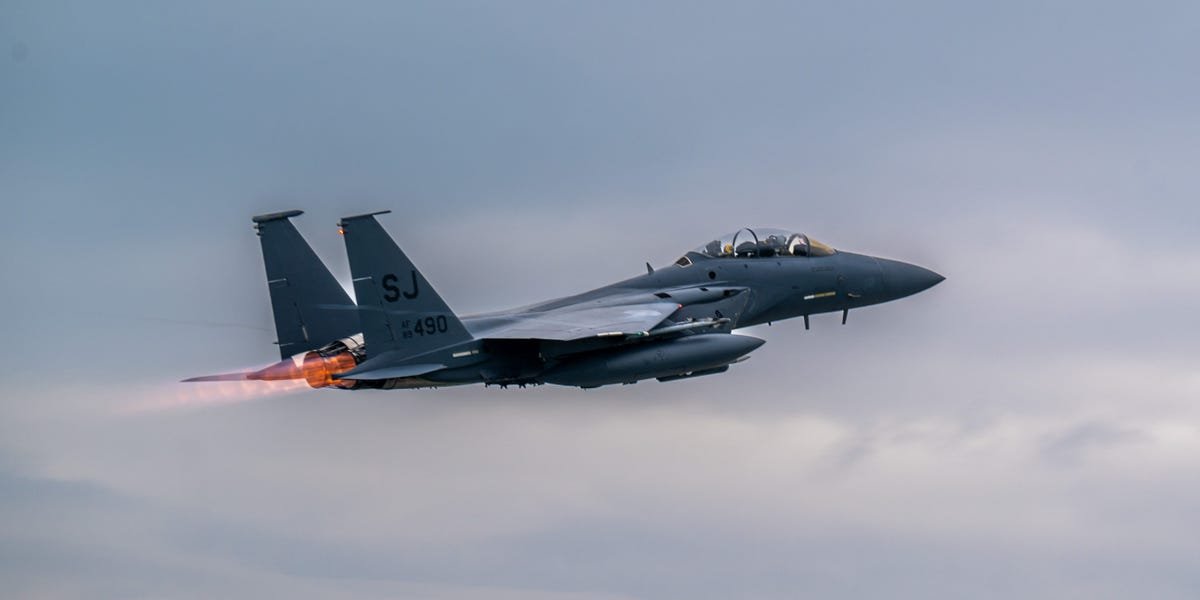
The mission, which a current search-and-rescue pilot described as unbelievably bold in conversations with Business Insider about these challenging operations, was launched after an F-15E Strike Eagle fighter jet, carrying a pilot and weapons system officer, went down over Iran on Friday.

Not long after the aircraft loss, photos of debris said to be from an F-15E fighter jet and video footage appearing to show search-and-rescue operations with Black Hawk helicopters and a C-130 Hercules aircraft began circulating online.

US forces rescued the pilot several hours after their F-15 went down. Trump said the military on Saturday sent dozens of aircraft to retrieve the weapons system officer, a colonel, from “deep inside the mountains of Iran” as Iranian forces closed in on his location.

The president said the airman was “being hunted down by our enemies, who were getting closer and closer by the hour.”

The airman’s condition is unclear. Trump said “he sustained injuries, but he will be just fine.” He later described the injuries as serious.

Combat search-and-rescue missions like this one are rare and rely on highly trained personnel, from the skilled aircrews operating helicopters and refueling tankers to the Pararescue Jumpers that are often sent out with them.

Friday’s F-15 Strike Eagle incident marked the first manned aircraft loss over Iran but not the first US aircraft loss of the war. The Air Force has lost other aircraft since the start of Operation Epic Fury on February 28.

At the start of the Iran war, three US F-15s were mistakenly shot down by Kuwaiti forces in what US Central Command — which oversees American forces in the Middle East characterized as “an apparent friendly fire incident.” All six crew members survived.

Then on March 12, a US KC-135 refueling aircraft crashed in western Iraq, killing all six crew members. A second American aircraft involved in the incident landed safely.

Iran has also shot down several MQ-9 Reaper drones and destroyed or damaged support aircraft on the ground at American bases in the Gulf region.

Reports Friday indicated that in addition to the fighter jet downed over Iran, an A-10 attack aircraft mobilized in support was also hit. It went down over friendly territory, with the pilot ejecting safely.

There have been several close calls as well. A US F-35 stealth fighter jet, for instance, was forced to make an emergency landing at a Middle East base on March 19 after flying a combat mission over Iran, reportedly after it was damaged by Iranian fire.

And in late March, video footage circulating online appeared to show a US Navy F/A-18 Super Hornet narrowly avoiding an Iranian surface-to-air missile.

More than 350 US service members have been wounded in the war, though most of them have already returned to duty. Thirteen troops have been killed.


Source link

The-Marines-pulled-off-another-clean-audit-The-rest-of.jpeg

The Marines pulled off another clean audit. The rest of the US military still hasn’t.

The Marine Corps has again done what the rest of the US military has repeatedly failed to do with its finances — account for its money.

The Corps, the only US military service to pass a clean financial audit, announced its third successful audit on Monday.

The Department of Defense, which was recently authorized to receive a new annual budget of nearly $840 billion a year and could see a substantial increase to $1.5 trillion under the current Trump administration, has consistently failed to pass an audit since audits became legally required for the military in 2018.

Pentagon officials hope the military can get its books in order across the services and pass one by 2028.

“The Marine Corps’ audit process enabled accurate global tracking and reporting of financial transactions, inventory of facilities, equipment and assets, and accounting for taxpayer dollars spent during the last fiscal year,” read a Marine Corps release, “The auditors also tested the Marine Corps’ network, key business systems, and internal controls.”

The result reflects years of effort to modernize financial and logistics systems that have long been siloed across units, making audits agonizingly challenging, said Lt. Gen. James Adams III, the deputy commandant for programs and resources, during a media roundtable. Such bottlenecks have been a long-standing problem across the Defense Department and are a major focus of Pentagon reforms.

“We want to modernize our systems so they’re digitally connected, so that we can do audits in the future that are controls-based,” said Adams, who is set to depart his position soon to lead the Defense Intelligence Agency.

Historically, fragmented military networks have made everything from force-wide equipment tracking to financial oversight difficult, requiring tedious manual reconciliations. While the Corps still relies heavily on human review, officials say automation and artificial intelligence are already reducing the burden.

“Right now, we still take a lot of data and move it onto a macro spreadsheet that our accountants are reviewing, and that’s just a lot of work,” said Edward Gardiner, the assistant deputy commandant for programs and resources. AI tools can help flag discrepancies and pinpoint errors, he said. Officials pointed to one automation system that saved 20,000 hours of painful reconciliation work.

Auditors still found seven “areas of weakness” in the audit, a common feature even among organizations with clean audits, though Adams told reporters the Corps has prioritized fixes to those areas that pose the greatest risk to financial accuracy after its audits, rather than trying to eliminate all concerns at once.

“Passing our third consecutive audit is a direct reflection of who we are as Marines,” the Corps’ commandant, Gen. Eric Smith, said in a statement. “Discipline, accountability, and stewardship are not administrative tasks; they are part of our warfighting culture.”


Source link