

A headshot of Insider's Pete Syme

Charts show how the Iran war has pushed ticket prices sharply higher on 3 major US airline routes

Your next flight could be twice as expensive because the Iran war is causing volatility in oil prices.

Brent crude is up more than 50% over the past month, to around $101 a barrel. Jet fuel costs are rising faster. The Argus US Jet Fuel Index is up 72% over the same period.

That spells difficulty for airlines because jet fuel is typically their biggest expense after labor. While many airlines around the world hedge against fuel costs, most American ones do not.

Using data from Deutsche Bank, Business Insider charted rising airfares in three major markets.

The data looks at the lowest available published fares 21 days in advance of the flights. The published fare doesn’t necessarily mean a ticket has been purchased for that amount, the Deutsche Bank research analysts said.

Cross-country flights, often known in the industry as transcontinental flights, have seen the biggest week-over-week spike — more than double, on average.

New York to Los Angeles is the country’s busiest domestic route, with a capacity of 3.4 million seats out of JFK Airport last year, according to OAG data.
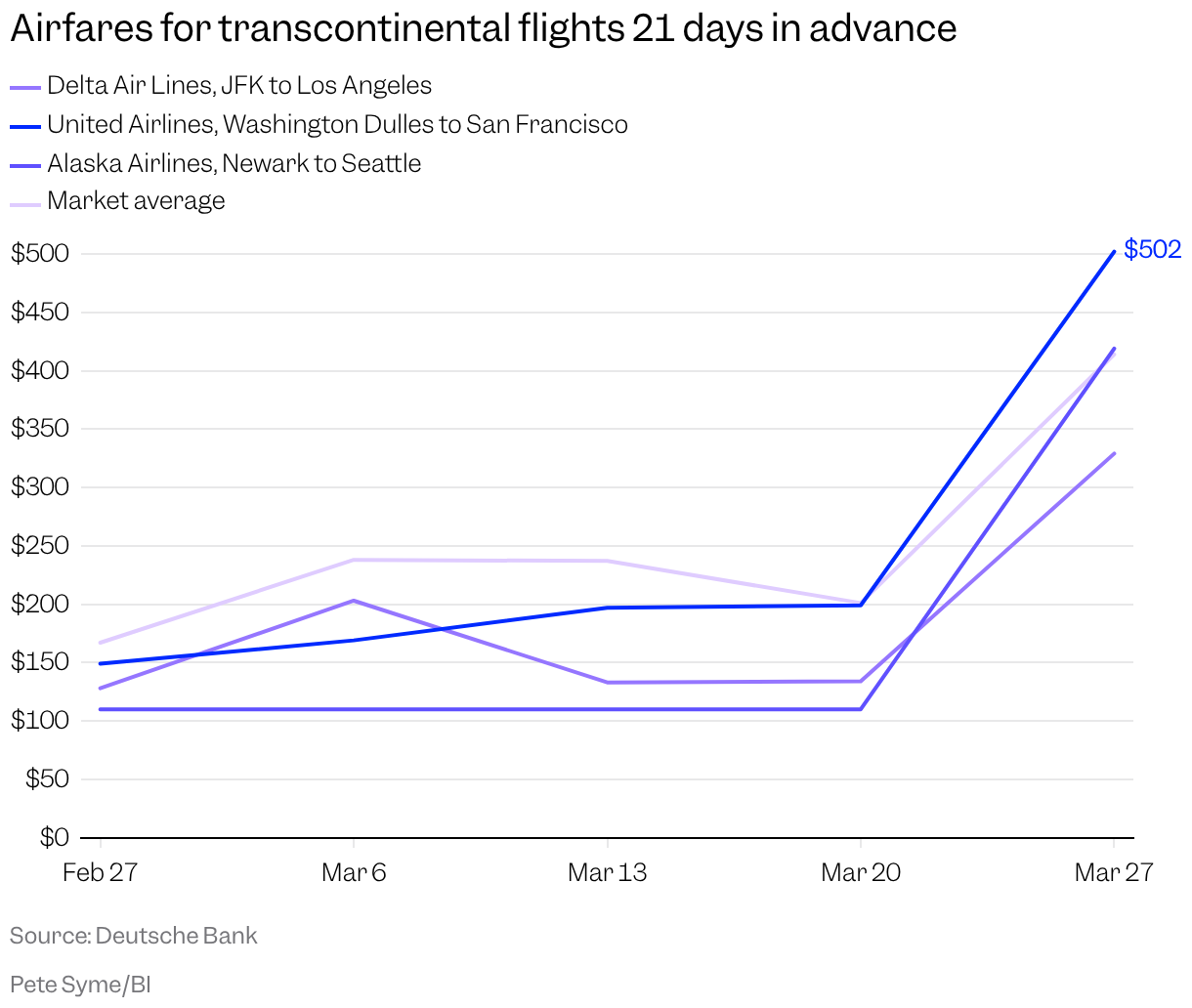
The average price of a transcontinental flight has risen from $167 to $414, Deutsche Bank’s analysis showed. In the past week, the average has spiked 107%.

United Airlines is offering flights from Washington Dulles Airport to San Francisco for $502, up from $149 a month ago.

International business travellers are also seeing flight prices rise.

New York to London is the country’s most popular international route, and the 10th-busiest in the world. Nearly 4 million seats were scheduled on flights between JFK and Heathrow last year, per OAG.
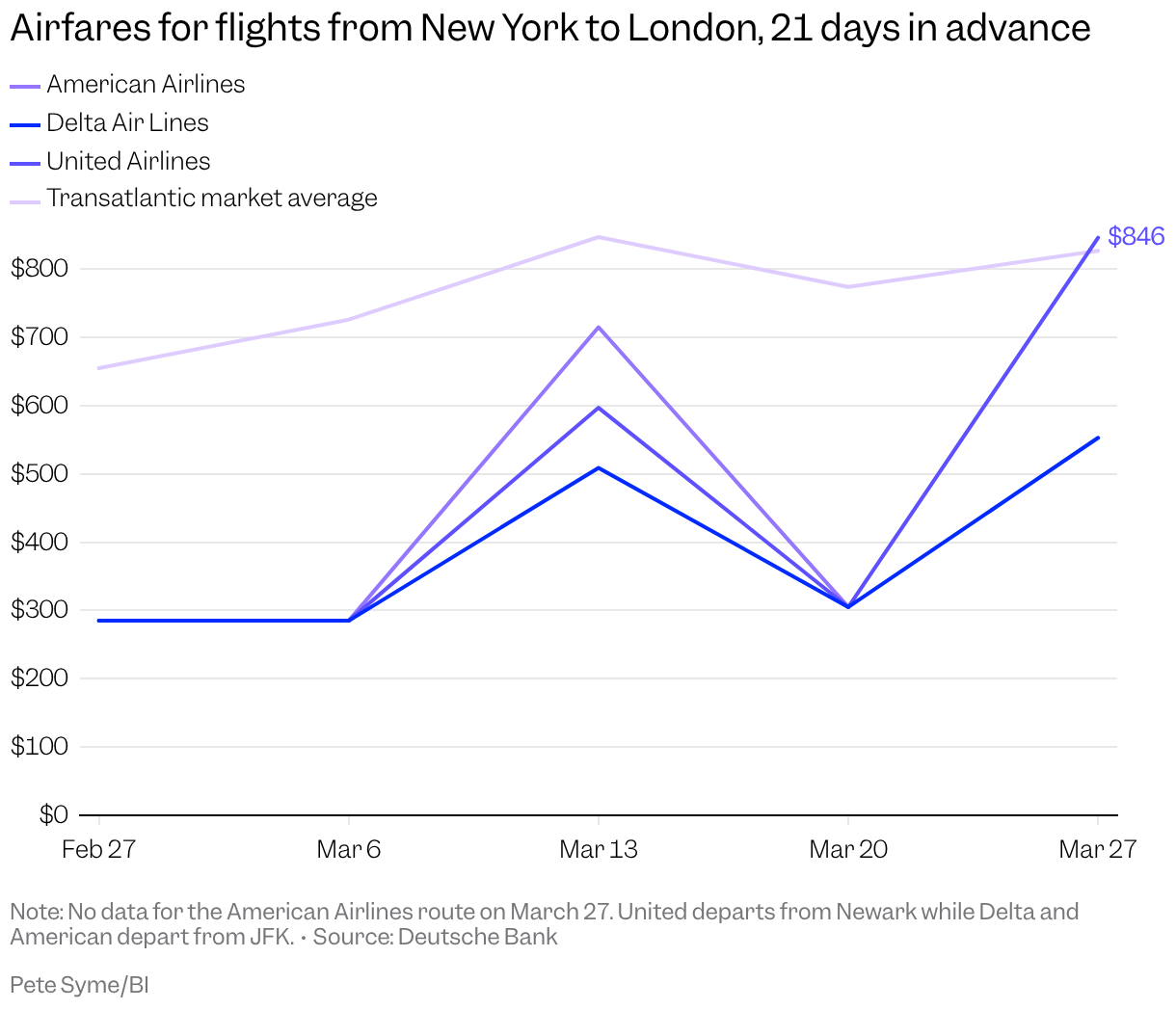
While the average Transatlantic flight is some 40% more expensive than a month ago, there are bigger rises for the New York-London route. However, it also appears more volatile here with a big dip last week.

Delta Air Lines’ service is up from $285 to $553 over the past month, while United’s is up to $846. That’s a 177% rise compared to a week earlier, according to Deutsche Bank’s analysis.

There’s bad news for vacationers, too.

Flights to the Caribbean on March 27 are up 58% on average compared to a week before.
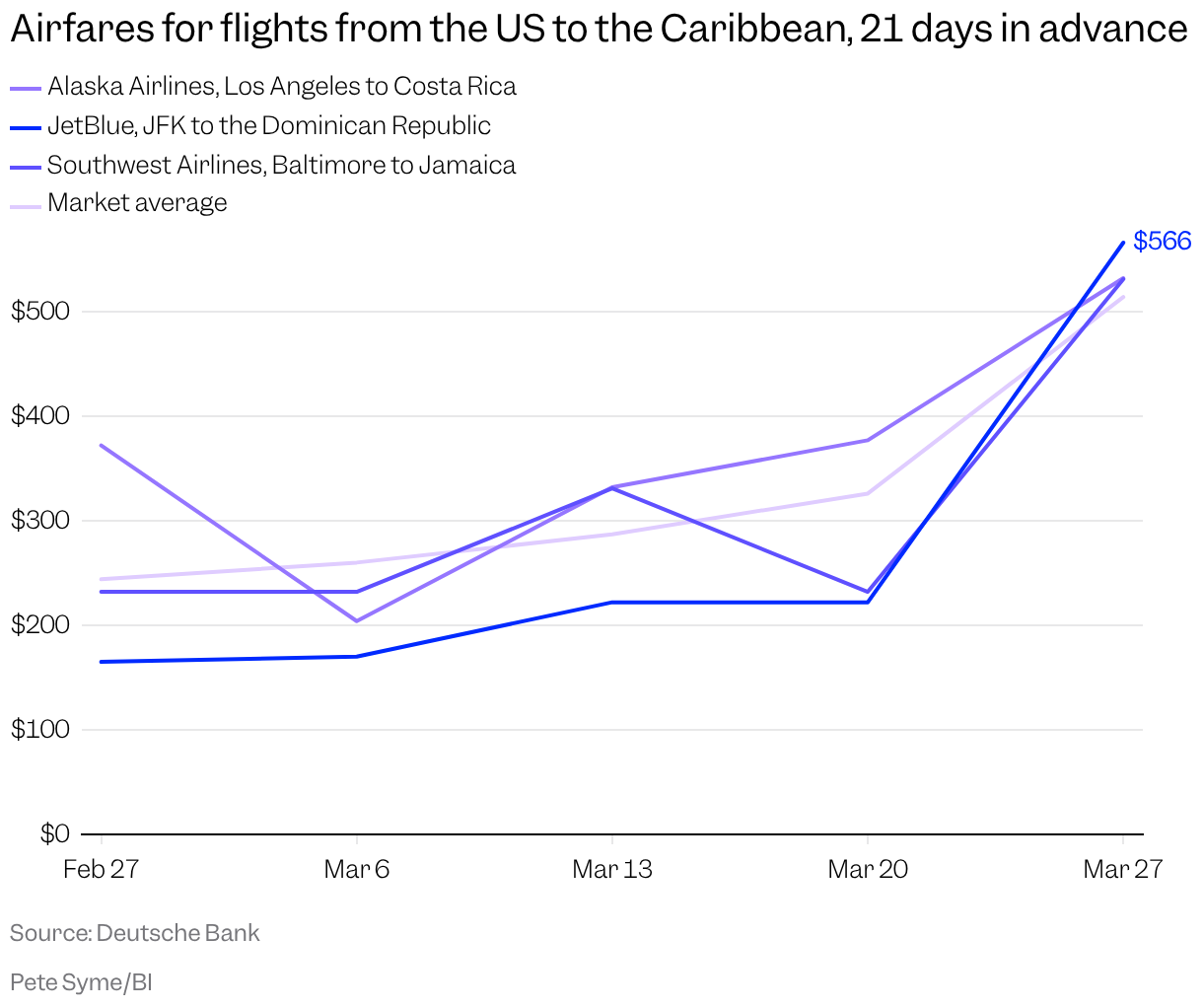
JetBlue’s flight from New York to Santo Domingo, Dominican Republic, has risen from $165 to $566 on March 27.

Compared to a year earlier, that’s a more than fourfold rise, Deutsche Bank found.

Southwest Airlines’ flight from Baltimore to Montego Bay, Jamaica, has more than doubled over the past week. And Alaska Airlines’ service from Los Angeles to San Jose, Costa Rica, is up 40% compared to a week earlier or 120% versus a year ago.


Source link

The-narrow-corridor-planes-are-being-pushed-through-to-avoid.jpeg

The narrow corridor planes are being pushed through to avoid the Middle East just got even narrower

A narrow flight corridor that’s become vital to airlines is shrinking as the Iran conflict expands.

On Thursday, Azerbaijan’s foreign ministry said that Iranian drones attacked the Nakhchivan Autonomous Republic. It’s an exclave to the north of Iran, which is separated from the rest of Azerbaijan by Armenia.

One drone damaged the terminal at Nakhchivan Airport, and another fell near a school building, the ministry said. Two civilians were injured, it added.

As a result, Azerbaijan closed the southern sector of its airspace.

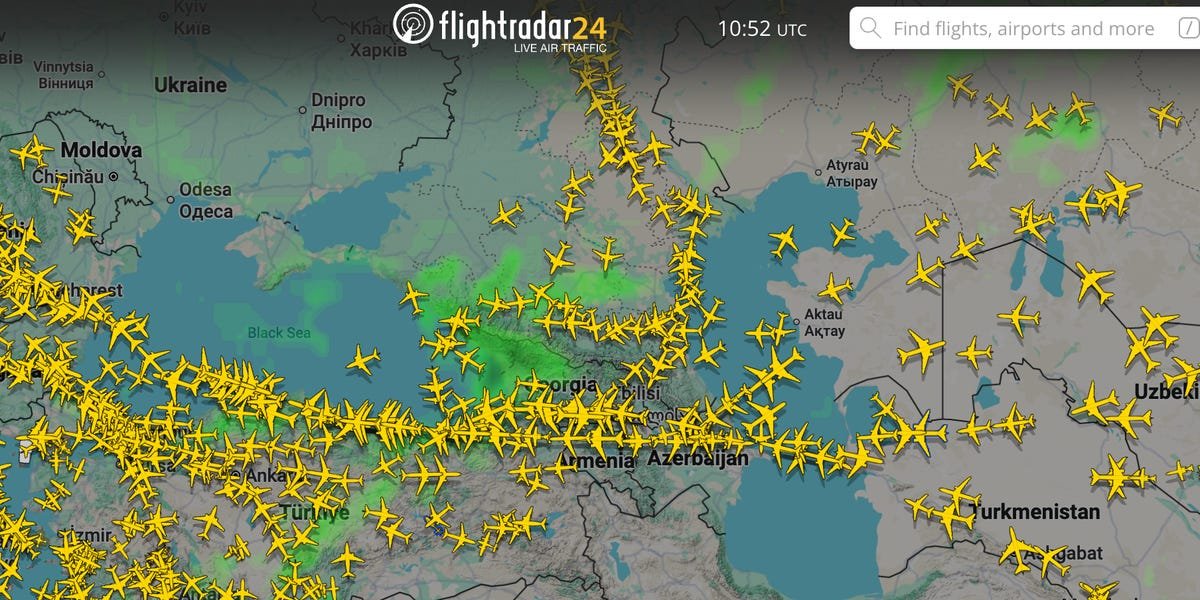
It leaves airplanes flying between Europe and Asia with an even smaller space to navigate.

Since the US and Israel launched strikes against Iran on Saturday, airlines have been unable to fly over the Persian Gulf, which was previously the main route.

Instead, they have been rerouting through Saudi Arabia or the Caucasus. The region consists of Armenia, Georgia, and Azerbaijan, and links the Black Sea with the Caspian Sea. It is bordered by Iran and Turkey to the south, and Russia to the north.

Most airlines have been unable to fly over Russia since the invasion of Ukraine in 2022.

The Caucasus is not without its own tensions, either.

In 2023, Azerbaijan launched a military offensive against Nagorno-Karabakh, a region within its territory that was governed and mostly populated by ethnic Armenians.

The conflict in Iran, however, is encouraging Armenia and Azerbaijan to refrain from escalating tensions.

After the drone attack on Nakhchivan, the two foreign ministers held a phone call where they “noted the importance of sustainable peace between Armenia and Azerbaijan and exchanged views on matters of mutual interest,” according to a press release.


Source link

Google-DeepMind-CEO-Demis-Hassabis-says-AI-scaling-must-be.jpeg

Google DeepMind CEO Demis Hassabis says AI scaling ‘must be pushed to the maximum’

There’s a debate rippling through Silicon Valley: How far can scaling laws take the technology?

Google DeepMind CEO Demis Hassabis, whose company just released Gemini 3 to widespread acclaim, has made it clear where he stands on the issue.

“The scaling of the current systems, we must push that to the maximum, because at the minimum, it will be a key component of the final AGI system,” he said at the Axios’ AI+ Summit in San Francisco last week. “It could be the entirety of the AGI system.”

AGI, or artificial general intelligence, is a still theoretical version of AI that reasons as well as humans. It’s the goal all the leading AI companies are competing to reach, fueling huge amounts of spending on infrastructure and talent.

AI scaling laws suggest that the more data and compute an AI model is given, the smarter it will get.

Hassabis said that scaling alone will likely get the industry to AGI, but that he suspects there will need to be”one or two” other breakthroughs as well.

The problem with scaling alone is that there is a limit to publicly available data, and adding compute means building data centers, which is expensive and taxing on the environment.

Some AI watchers are also concerned that the AI companies behind the leading large-language models are beginning to show diminishing returns on their massive investments in scaling.

Researchers like Yann LeCun, the chief AI scientist at Meta who recently announced he was leaving to run his own startup, believe the industry needs to consider another way.

“Most interesting problems scale extremely badly,” he said at the National University of Singapore in April. “You cannot just assume that more data and more compute means smarter AI.”

LeCun is leaving Meta to work on building world models, an alternative to large-language models that rely on collecting spatial data rather than language-based data.

“The goal of the startup is to bring about the next big revolution in AI: systems that understand the physical world, have persistent memory, can reason, and can plan complex action sequences,” he wrote on LinkedIn in November.


Source link