President Donald Trump’s massive $1.5 trillion defense budget request includes $65.8 billion for Navy shipbuilding. It also establishes the new Golden Fleet, providing funding for the new Trump-class battleship, the White House said.
The fiscal year 2027 shipbuilding request is a marked increase over last year, underscoring the Trump administration’s push to expand the fleet and industrial base.
On Friday, the White House released its budget proposals for the upcoming fiscal year beginning in October. The $1.5 trillion request is a 44% increase and the highest in decades
“The budget restores the readiness and lethality of the force by ensuring America’s warfighters are trained, equipped, and medically ready to fight and win,” the White House’s overview says.
Key to that is more funding for shipbuilding. “As waters around the world become increasingly contested, it is imperative that the United States be able to efficiently deliver the various naval platforms it requires, including both battle force and auxiliary vessels, to ensure maritime domain awareness and deterrence,” the overview document said.
The White House shipbuilding request supports the construction of 18 battle force ships and 16 non-battle force ships, twice the number requested last year.
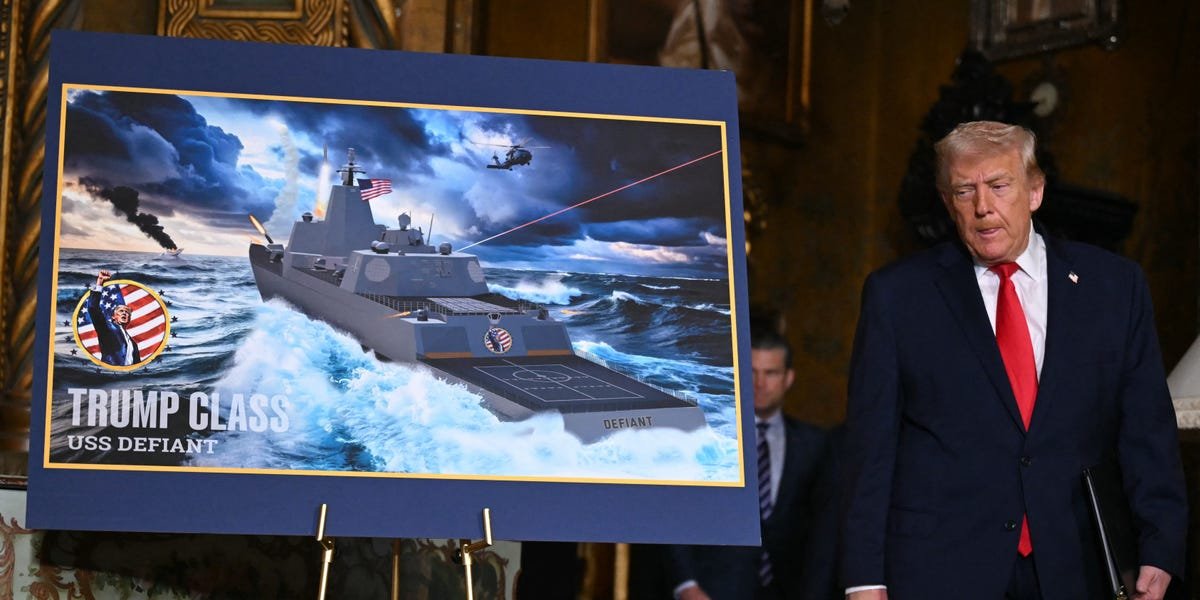
The budget request includes initial funding for the Golden Fleet, its centerpiece Trump-class battleship, and next-generation frigates. The new funding request also supports work on the Columbia-class and Virginia-class submarines, critical naval capabilities. It’s unclear where these vessels fit into the procurement plan.
The broader White House plan also funds sealift and hospital ships, tankers, submarine tenders, and shipyard upgrades aimed at easing production delays.
US Navy photo by Mass Communication Specialist 1st Class Bryan Mai
The Trump administration announced its plans for the “Golden Fleet” last December, as well as its desire to construct a new Trump-class battleship as flagship vessels. These ships are intended to deliver “dominant firepower and a decisive advantage over adversaries by integrating the most advanced deep-strike weapons of today with the revolutionary systems of the years ahead,” the Navy said.
John Phelan, the secretary of the Navy, said last December that “the future Trump-class battleship, the USS Defiant, will be the largest, deadliest and most versatile and best-looking warship anywhere on the world’s oceans.”
The White House budget request also funds the Golden Dome missile defense system and artificial intelligence adoption and continues the development of the Air Force’s F-47 sixth-generation fighter, with a first flight planned for 2028.
Additionally, the request points to 12 “critical munitions” that it plans to procure. One of DoD’s highest funding priorities, the overview said, these munition investments “would generate expanded capacity in America’s defense industrial base, providing a foundation for future scalable munitions production.”
The White House didn’t respond to a request on what those munitions are. Recent deals between industry and the Pentagon have expanded and accelerated orders for more Tomahawk cruise missiles, as well as Standard Missile-6 interceptors, Patriot Advanced Capability-3 (PAC-3) interceptors, and Precision Strike Missiles. These weapons have gotten a workout in the Middle East.
Drones and counter-drone technologies are also listed in the budget as priorities, with the White House saying it is seeking “unprecedented investments” in these systems.
The request said “this funding would arm America’s military combat units with drones while also providing protection against the proliferation of inexpensive and proliferated unmanned systems by near-peer competitors, rogue states, and non-state actors.”
Source link