
Ive-spent-years-living-far-from-my-older-brother-A.jpeg

I’ve spent years living far from my older brother. A 4-day trek in South America put me in the lead for once.

My older brother, Fergus, and I have spent most of our adult lives chasing the same thing — just never in the same place at the same time.

We’re both adventurous, but our lives have unfolded on different continents since 2009. That was the year he left home. I was still in high school.

He spent his 20s traveling around the world. And in 2016, when I was 25 and working as an editor in Toronto, he moved to Australia.

Two years later, when he moved back to Canada, I was the one who’d caught the travel bug. We were only in the same place for a few days before I left for Colombia.

I’ve been living in South America ever since.

Sibling adventure in South America

In January, Fergus visited me in Ecuador, where I’ve been living for eight years. To catch up properly, I planned a multi-day trek through sleepy mountain towns.

Walking for days through remote landscapes felt like the best way to make up for lost time.

We started in a small farming town about two hours outside Quito. With backpacks and a few changes of clothes, we set out along a dirt road tracing green mountains through farmland. Over 26 miles, we passed rows of peaks, clay brick homes, and a river carved into a deep gorge.

With no signal and no one around, we talked about everything: his winter plans, my writing, our younger brother’s upcoming wedding, and memories from camping trips we’d nearly forgotten.

At the river, we sat on rocks and drank beers we’d picked up before leaving town. Cows mooed faintly in the distance. “I’m so glad you finally made it,” I told him.


A man reading signs in Spanish during a hike in Ecuador.

The siblings caught up and celebrated a missed birthday. 

Provided by Sinead Mulhern


Belated celebration

It felt like a celebration six months late. Fergus had turned 40 in July, and living abroad, I’ve missed plenty of milestones. I booked a cabin along the route — a belated birthday gift, complete with a spa and traditional Ecuadorian food.

We stayed close over the years, despite the distance. Out of four siblings, we’re the most alike — athletic, adventurous, drawn to the same kinds of places. As a kid, I stole his CDs; he shaped my taste in music.

Now we both live unconventional lives: me as a freelance writer in Ecuador, him as a tree planter in western Canada.

Still, his 10 days in Ecuador were the most time we’d spent together as adults. A four-day trek through remote terrain could have been a gamble, but I knew he’d be in. No questions asked.


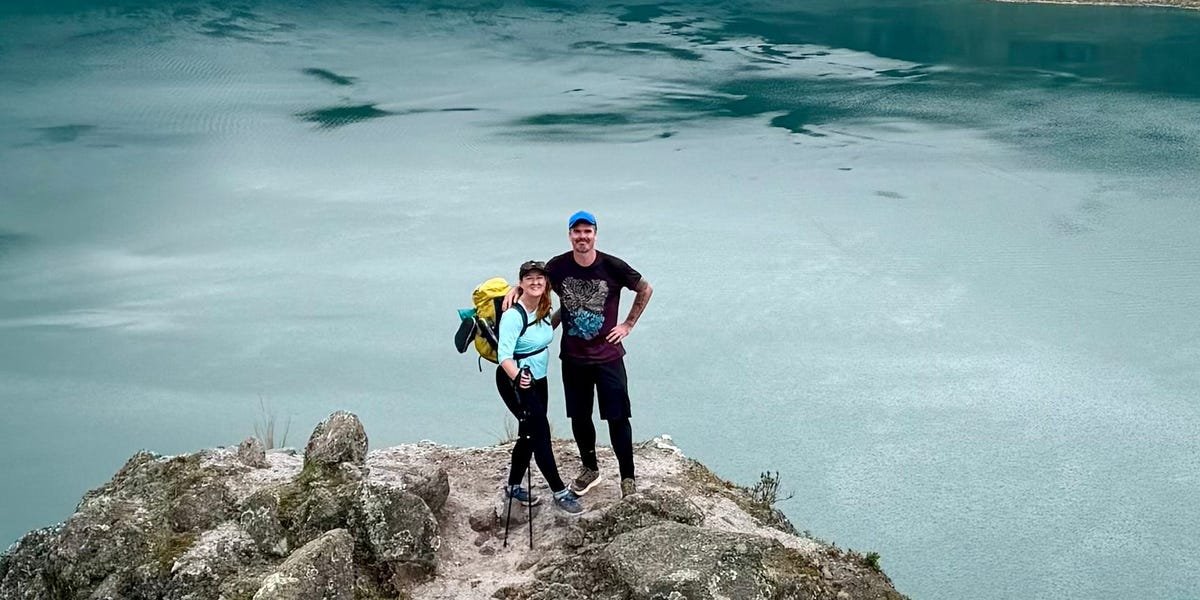
Brother and sister on a trek in South America.

The siblings caught up during the four-day trek. 

Provided by Sinead Mulhern


Witnessing his wanderlust inspired mine

Toward the end of our trip, we reached a tiny town — a church, a few dogs, a handful of homes. It was late afternoon, I was hungry and ready to stop when Fergus pushed ahead, scrambling up a steep gorge and insisting the top was “just a few minutes” away.

Sweating and irritated, I followed. Midway up this impossible-angled gorge, I checked my frustration, recognizing that I had been doing the same to hiking buddies over the past few years. And also, this trek was my idea, and I knew who I was doing it with.

Later, by a turquoise lagoon, I looked at him and saw not just the brother who packed my lunches and drove me to piano lessons, but someone I’ll rely on for decades.

When it was time to leave, our bus to Quito never came. Instead, we hitched a ride, climbing into the back of a moving truck after getting directions from other trekkers.

“Get in,” I told him, quickly translating the driver’s words from Spanish. For once, I was leading.



Source link

After-a-breakup-I-put-my-belongings-in-storage-and.jpeg

After a breakup, I put my belongings in storage and traveled full-time for 3 years. It was the best chapter of my life.

Three and a half years ago, I stood in my New Jersey apartment, surrounded by boxes I was about to put into storage. Tears streamed down my cheeks.

I’d recently ended a two-year, live-in relationship. We loved each other deeply, but just weren’t the right fit — and although the split was a gut-wrenching decision, we both knew it was the right move.

I had just accepted a fully remote job, which allowed me to explore moving out of the New York City area — something I had been considering for about a year.

I planned to just travel for a few months before settling down somewhere, but I ended up spending the next three years as a nomad.

Although it wasn’t quite what I’d pictured when I said goodbye to the apartment I shared with my ex, it turned into one of the most important chapters of my life.

My brief stint abroad turned into a longer chapter


A shot of a building and Mexican flag in Mexico City.

My time in Mexico City taught me about my own resourcefulness and independence.

Samantha Caffrey


My post-breakup plan was to put all of my belongings into a storage unit and spend a few months in Tulum.

After that, I would travel to Miami and Los Angeles, “interviewing” both cities as candidates for a longer-term move. I was about seven months into this plan when I learned my role was going to be eliminated.

Luckily, I was able to secure freelance work, so I decided to continue my travels since I wasn’t needed in one particular place for my job.

From Tulum, I headed to Mexico City. After just a few days, I fell in love with the food, vibrancy, people, and culture. My one-week vacation turned into an almost three-month stay.

During my time in Mexico City, I explored art galleries and museums, learned some Spanish, made friends, went on dates, visited small shops, and tipped local people well.

These little moments helped me learn how adaptable I truly was. I realized I could make friends anywhere, stay disciplined with my work even while exploring a new place, safely navigate dating as a solo traveler, and be extremely resourceful.

I kept exploring. I took the nomad life slowly, spending about four or five months abroad at a time in places like Paris, Lisbon, Málaga, London, Melbourne, Miami, and Tulum.

Between travels, I’d spend a few months recharging in a sublease (or a friend’s apartment) in New York City.

I felt my confidence grow as I navigated new cities and connected with inspiring women from all over the world


The writer roaming a hallway in Versailles.

I traveled the world, from France to Mexico to Australia.

Samantha Caffrey


When traveling solo, every choice you make is yours, from where you eat to how you spend your days. I felt immensely grateful for this freedom — every day, it struck me how lucky I was to have every minuscule decision be solely my own.

That’s not to say I felt lonely, though. With each new city and country I stayed in, I was delighted by the magic of connecting with strangers.

One time, I struck up a conversation with another woman at a particularly intense yoga class in Tulum. She was visiting from Canada, and we ended up spending a whole day together.

I had another memorable experience in Europe. I had been traveling by myself for about three years at that point, and although it was incredible, I was exhausted. I felt ready to return to New York City, but I wasn’t sure I could afford to do so.

Then, one afternoon, my spirits were lifted when I found myself in a café in Paris, enjoying a chocolate-chip cookie and a latte. An older woman started chatting with me, and soon, another young woman traveling solo from Korea joined in.

We all shared stories and giggled as we sipped our coffees. As the older woman left the café, she said, “You two girls exchange numbers now, and spend time together.”

We laughed at the gentle demand, but wound up spending that evening — and the next day, too — exploring the city as a pair. I may or may not ever see her again, but she told me that if I ever visit Seoul, I’ll be welcomed with open arms.

Best of all, this time in my life helped me stay open and live in the moment


The writer standing in front of buildings in London on a sunny day.

One of the best parts of traveling was connecting with people from around the world.

Samantha Caffrey


I learned that not every place has to be a permanent home, and not every relationship has to last forever; in fact, some friendships might just last for the span of a trip.

The memories I made during this time will stick with me, though I’ve since emptied out my storage unit and settled into a one-year lease in New York City.

My nomadic chapter is closed for now, but my encounters with strangers, small moments in new cities, and solo time with myself left me changed for the better — and will surely inspire my next adventure.


Source link

Chong Ming Lee, Junior News Reporter at Business Insider's Singapore bureau.

Drunken boxing and backflips: China put on a robot kung fu display that shows how fast its robotics industry is growing

China didn’t just celebrate Lunar New Year this week. It staged a robotics flex.

At the annual Spring Festival Gala, the Lunar New Year show in China, humanoid robots from Chinese startup Unitree Robotics flipped, lunged, and swung swords and nunchucks just feet from child performers in a tightly choreographed kung fu routine.

In one sequence inspired by “drunken boxing,” a traditional Chinese martial arts style, the robots staggered, fell backward, then rose again — showcasing advances in control and coordination.

Clips circulating online quickly drew comparisons to last year’s broadcast, which featured Unitree humanoid robots performing a Chinese folk dance. The choreography then was noticeably simpler.

The gala, often likened to the US Super Bowl for its massive audience, also featured other Chinese robotics firms, including MagicLab, Galbot, and Noetix, in separate segments throughout the broadcast on Monday evening.

Reactions on Chinese social media showed viewers being struck by how quickly the technology has advanced.

On RedNote, a user who goes by Ma Xiao said in a video posted on Wednesday that during last year’s performance, the robots were only “doing very simple things.”

“Now, they’re doing kung fu, they’re doing flips, they’re doing synchronized dancing,” he said. “Everybody’s shocked.”

“Now the rest of the world knows what China’s speed is,” he added.

Another RedNote user, DKKD, posted a video of friends reacting to the performance on Tuesday, captioning it: “Three Americans were scared by the Spring Festival robot.”

“They were all shocked by the robot’s level of evolution (including me),” the user wrote.

One viewer in the video can be heard saying: “It’s way more impressive than last year. It’s crazy.”

Unitree CEO Wang Xingxing said in an interview with Chinese media following the gala that the company expects to ship up to 20,000 humanoid robots this year, up from about 5,500 in 2025.

Global shipments of humanoid robots could reach “tens of thousands” this year, with Unitree potentially contributing between 10,000 and 20,000 units, Wang said on Tuesday.

China’s push in robotics

Chinese companies developing humanoid robots and autonomous systems are racing to outdo global rivals.

In September, Ant Group, an affiliate of Alibaba Group, unveiled R1, a humanoid robot that drew comparisons to Tesla’s Optimus. Two months later, EV and robotics maker XPeng introduced the latest version of its humanoid, Iron, which the company described as “highly human-like.”

China’s elite universities are also moving to build talent for the sector. In November, China’s Ministry of Education issued a notice stating that top institutions are preparing to launch a new undergraduate major in “embodied intelligence,” a field that combines AI with robotics.

Still, China’s rapid push into robotics hasn’t been seamless.

XPeng’s Iron fell face-first during its first public appearance in China earlier this year. Its CEO, He Xiaopeng, later wrote on Chinese social media that the mishap was part of “learning to walk.”

Last month, a Unitree humanoid kicked an engineer in the groin during a test. Humanoid robots stumbled and fell while racing against humans in a half-marathon in Beijing in April last year.


Source link

Luxury-tycoon-Bernard-Arnault-just-put-one-of-his-sons.jpeg

Luxury tycoon Bernard Arnault just put one of his sons in charge of an LVMH holding company

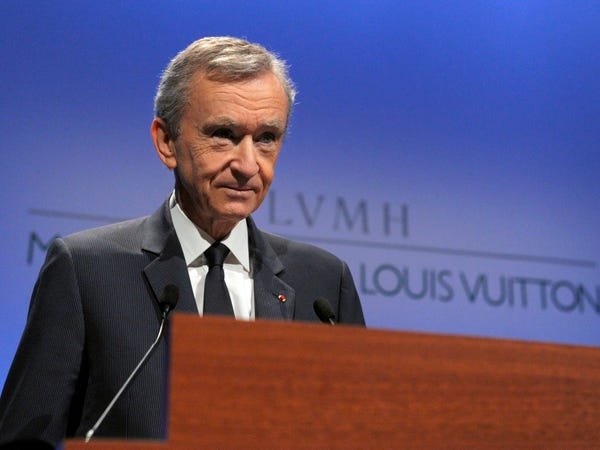
Luxury goods mogul Bernard Arnault is the world’s richest person.


Eric Piermont/Getty Images


Bernard Arnault’s fourth child has been named head of one of the family’s holding companies that control luxury giant LVMH.

Frédéric Arnault, a 29-year-old, was also appointed to the LVMH board alongside his brother Alexandre in April. Those additions mean four out of Arnault’s five children now sit on the LVMH board.

Arnault is currently the world’s richest person with a net worth of about $215 billion, according to estimates by Bloomberg. In 2023, he became only the third person to surpass the $200 billion mark, following tech moguls Jeff Bezos and Elon Musk.

Arnault cofounded LVMH in the 1980s and is its CEO and chair. The French luxury conglomerate owns a range of brands covering fashion, perfume, jewelry, watches, and alcohol, including Louis Vuitton, Dior, Marc Jacobs, Givenchy, Moët & Chandon, Fenty Beauty, and Tiffany & Co.

In February 2023, Arnault’s daughter, Delphine Arnault, became CEO of Dior. But it’s not just Delphine who has risen up LVMH’s ranks. All four of Bernard’s sons work at LVMH and its brands, too.

Bernard, 75, has not said who he wants to take over from him, but it’s a topic that gets discussed every time he gives one of his offspring a new role. In 2022 LVMH raised the age limit of its CEO from 75 to 80, extending Bernard’s possible tenure.

“The best person inside the family or outside the family should be one day my successor,” Bernard told The New York Times in September. “But it’s not something that I hope is a duel for the near future.”

Bernard has primed his children for leadership roles at the company since birth, though they say he never forced them to join LVMH. His offspring were sent to the best schools and as children would get quizzed on their math skills nearly every night, The Times reported.

“I didn’t want them to start going to big parties,” Bernard said of his children. “I made them work.”

The Arnault family has been compared to HBO series “Succession,” which sees the children of media mogul Logan Roy vying to take over as CEO.

“I know it’s disappointing for a lot of people,” Antoine Arnault, Bernard’s oldest son, told The Times, “but we actually get on well.”

Delphine and Antoine already sit on LVMH’s board, leaving only Jean — the youngest of the siblings — off the board.


Source link