Anton, a 44-year-old Russian soldier who heads a workshop responsible for repairing and supplying drones, was at his kitchen table when he learned last month that Elon Musk’s SpaceX had cut off access to Starlink terminals used by Russian forces. He scrambled for alternatives, but none offered unlimited internet, data plans were restrictive, and coverage did not extend to the areas of Ukraine where his unit operated.
It’s not only American tech executives who are narrowing communications options for Russians. Days later, Russian authorities began slowing down access nationwide to the messaging app Telegram, the service that frontline troops use to coordinate directly with one another and bypass slower chains of command.
“All military work goes through Telegram — all communication,” Anton, whose name has been changed because he fears government reprisal, told POLITICO in voice messages sent via the app. “That would be like shooting the entire Russian army in the head.”
Telegram would be joining a home screen’s worth of apps that have become useless to Russians. Kremlin policymakers have already blocked or limited access to WhatsApp, along with parent company Meta’s Facebook and Instagram, Microsoft’s LinkedIn, Google’s YouTube, Apple’s FaceTime, Snapchat and X, which like SpaceX is owned by Musk. Encrypted messaging apps Signal and Discord, as well as Japanese-owned Viber, have been inaccessible since 2024.
Last month, President Vladimir Putin signed a law requiring telecom operators to block cellular and fixed internet access at the request of the Federal Security Service. Shortly after it took effect on March 3, Moscow residents reported widespread problems with mobile internet, calls and text messages across all major operators for several days, with outages affecting mobile service and Wi-Fi even inside the State Duma.
Those decisions have left Russians increasingly cut off from both the outside world and one another, complicating battlefield coordination and disrupting online communities that organize volunteer aid, fundraising and discussion of the war effort. Deepening digital isolation could turn Russia into something akin to “a large, nuclear-armed North Korea and a junior partner to China,” according to Alexander Gabuev, the Berlin-based director of the Carnegie Russia Eurasia Center.
In April, the Kremlin is expected to escalate its campaign against Telegram — already one of Russia’s most popular messaging platforms, but now in the absence of other social-media options, a central hub for news, business and entertainment. It may block the platform altogether. That is likely to fuel an escalating struggle between state censorship and the tools people use to evade it, with Russia’s place in the world hanging in the balance.
“It’s turned into a war,” said Mikhail Klimarev, executive director of the internet Protection Society, a digital rights group that monitors Russia’s censorship infrastructure. “A guerrilla war. They hunt down the VPNs they can see, they block them — and the ‘partisans’ run, build new bunkers, and come back.”
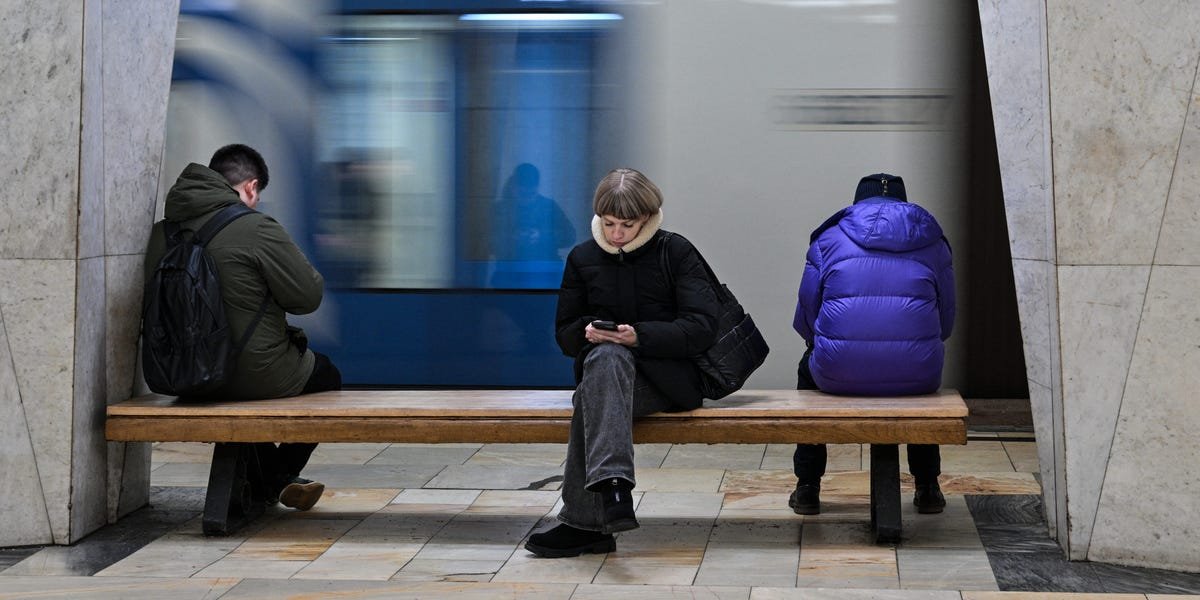
GIUSEPPE CACACE/AFP via Getty Images
The app that runs the war
On Feb. 4, SpaceX tightened the authentication system that Starlink terminals use to connect to its satellite network, introducing stricter verification for registered devices. The change effectively blocked many terminals operated by Russian units relying on unauthorized connections, cutting Starlink traffic inside Ukraine by roughly 75 percent, according to internet traffic analysis by Doug Madory, an analyst at the U.S. network monitoring firm Kentik.
The move threw Russian operations into disarray, allowing Ukraine to make battlefield gains. Russia has turned to a workaround widely used before satellite internet was an option: laying fiber-optic lines, from rear areas toward frontline battlefield positions.
Until then, Starlink terminals had allowed drone operators to stream live video through platforms such as Discord, which is officially blocked in Russia but still sometimes used by the Russian military via VPNs, to commanders at multiple levels. A battalion commander could watch an assault unfold in real time and issue corrections — “enemy ahead” or “turn left” — via radio or Telegram. What once required layers of approval could now happen in minutes. Satellite-connected messaging apps became the fastest way to transmit coordinates, imagery and targeting data.
But on Feb. 10, Roskomnadzor, the Russian communications regulator, began slowing down Telegram for users across Russia, citing alleged violations of Russian law. Russian news outlet RBC reported, citing two sources, that authorities plan to shut down Telegram in early April — though not on the front line.
In mid-February, Digital Development Minister Maksut Shadayev said the government did not yet intend to restrict Telegram at the front but hoped servicemen would gradually transition to other platforms. Kremlin spokesperson Dmitry Peskov said this week the company could avoid a full ban by complying with Russian legislation and maintaining what he described as “flexible contact” with authorities.
Roskomnadzor has accused Telegram of failing to protect personal data, combat fraud and prevent its use by terrorists and criminals. Similar accusations have been directed at other foreign tech platforms. In 2022, a Russian court designated Meta an “extremist organization” after the company said it would temporarily allow posts calling for violence against Russian soldiers in the context of the Ukraine war — a decision authorities used to justify blocking Facebook and Instagram in Russia and increasing pressure on the company’s other services, including WhatsApp.
Telegram founder Pavel Durov, a Russian-born entrepreneur now based in the United Arab Emirates, says the throttling is being used as a pretext to push Russians toward a government-controlled messaging app designed for surveillance and political censorship.
RICCARDO MILANI/Hans Lucas/AFP via Getty Images
That app is MAX, which was launched in March 2025 and has been compared to China’s WeChat in its ambition to anchor a domestic digital ecosystem. Authorities are increasingly steering Russians toward MAX through employers, neighborhood chats and the government services portal Gosuslugi — where citizens retrieve documents, pay fines and book appointments — as well as through banks and retailers. The app’s developer, VK, reports rapid user growth, though those figures are difficult to independently verify.
“They didn’t just leave people to fend for themselves — you could say they led them by the hand through that adaptation by offering alternatives,” said Levada Center pollster Denis Volkov, who has studied Russian attitudes toward technology use. The strategy, he said, has been to provide a Russian or state-backed alternative for the majority, while stopping short of fully criminalizing workarounds for more technologically savvy users who do not want to switch.
Elena, a 38-year-old Yekaterinburg resident whose surname has been withheld because she fears government reprisal, said her daughter’s primary school moved official communication from WhatsApp to MAX without consulting parents. She keeps MAX installed on a separate tablet that remains mostly in a drawer — a version of what some Russians call a “MAXophone,” gadgets solely for that app, without any other data being left on those phones for the (very real) fear the government could access it.
“It works badly. Messages are delayed. Notifications don’t come,” she said. “I don’t trust it … And this whole situation just makes people angry.”
The VPN arms race
Unlike China’s centralized “Great Firewall,” which filters traffic at the country’s digital borders, Russia’s system operates internally. Internet providers are required to route traffic through state-installed deep packet inspection equipment capable of controlling and analyzing data flows in real time.
“It’s not one wall,” Klimarev said. “It’s thousands of fences. You climb one, then there’s another.”
The architecture allows authorities to slow services without formally banning them — a tactic used against YouTube before its web address was removed from government-run domain-name servers last month. Russian law explicitly provides government authority for blocking websites on grounds such as extremism, terrorism, illegal content or violations of data regulations, but it does not clearly define throttling — slowing traffic rather than blocking it outright — as a formal enforcement mechanism. “The slowdown isn’t described anywhere in legislation,” Klimarev said. “It’s pressure without procedure.”
In September, Russia banned advertising for virtual private network services that citizens use to bypass government-imposed restrictions on certain apps or sites. By Klimarev’s estimate, roughly half of Russian internet users now know what a VPN is, and millions pay for one. Polling last year by the Levada Center, Russia’s only major independent pollster, suggests regular use is lower, finding about one-quarter of Russians said they have used VPN services.
Russian courts can treat the use of anonymization tools as an aggravating factor in certain crimes — steps that signal growing pressure on circumvention technologies without formally outlawing them. In February, the Federal Antimonopoly Service opened what appears to be the first case against a media outlet for promoting a VPN after the regional publication Serditaya Chuvashiya advertised such a service on its Telegram channel.
Surveys in recent years have shown that many Russians, particularly older citizens, support tighter internet regulation, often citing fraud, extremism and online safety. That sentiment gives authorities political space to tighten controls even when the restrictions are unpopular among more technologically savvy users.
Even so, the slowdown of Telegram drew criticism from unlikely quarters, including Sergei Mironov, a longtime Kremlin ally and leader of the Just Russia party. In a statement posted on his Telegram channel on Feb. 11, he blasted the regulators behind the move as “idiots,” accusing them of undermining soldiers at the front. He said troops rely on the app to communicate with relatives and organize fundraising for the war effort, warning that restricting it could cost lives. While praising the state-backed messaging app MAX, he argued that Russians should be free to choose which platforms they use.
Pro-war Telegram channels frame the government’s blocking techniques as sabotage of the war effort. Ivan Philippov, who tracks Russia’s influential military bloggers, said the reaction inside that ecosystem to news about Telegram has been visceral “rage.”
Unlike Starlink, whose cutoff could be blamed on a foreign company, restrictions on Telegram are viewed as self-inflicted. Bloggers accuse regulators of undermining the war effort. Telegram is used not only for battlefield coordination but also for volunteer fundraising networks that provide basic logistics the state does not reliably cover — from transport vehicles and fuel to body armor, trench materials and even evacuation equipment. Telegram serves as the primary hub for donations and reporting back to supporters.
“If you break Telegram inside Russia, you break fundraising,” Philippov said. “And without fundraising, a lot of units simply don’t function.”
Few in that community trust MAX, citing technical flaws and privacy concerns. Because MAX operates under Russian data-retention laws and is integrated with state services, many assume their communications would be accessible to authorities.
Philippov said the app’s prominent defenders are largely figures tied to state media or the presidential administration. “Among independent military bloggers, I haven’t seen a single person who supports it,” he said.
Small groups of activists attempted to organize rallies in at least 11 Russian cities, including Moscow, Irkutsk and Novosibirsk, in defense of Telegram. Authorities rejected or obstructed most of the proposed demonstrations — in some cases citing pandemic-era restrictions, weather conditions or vague security concerns — and in several cases revoked previously issued permits. In Novosibirsk, police detained around 15 people ahead of a planned rally. Although a small number of protests were formally approved, no large-scale demonstrations ultimately took place.
The power to pull the plug
The new law signed last month allows Russia’s Federal Security Service to order telecom operators to block cellular and fixed internet access. Peskov, the Kremlin spokesman, said subsequent shutdowns of service in Moscow were linked to security measures aimed at protecting critical infrastructure and countering drone threats, adding that such limitations would remain in place “for as long as necessary.”
In practice, the disruptions rarely amount to a total communications blackout. Most target mobile internet rather than all services, while voice calls and SMS often continue to function. Some domestic websites and apps — including government portals or banking services — may remain accessible through “whitelists,” meaning authorities allow certain services to keep operating even while broader internet access is restricted. The restrictions are typically localized and temporary, affecting specific regions or parts of cities rather than the entire country.
Internet disruptions have increasingly become a tool of control beyond individual platforms. Research by the independent outlet Meduza and the monitoring project Na Svyazi has documented dozens of regional internet shutdowns and mobile network restrictions across Russia, with disruptions occurring regularly since May 2025.
The communications shutdown, and uncertainty around where it will go next, is affecting life for citizens of all kinds, from the elderly struggling to contact family members abroad to tech-savvy users who juggle SIM cards and secondary phones to stay connected. Demand has risen for dated communication devices — including walkie-talkies, pagers and landline phones — along with paper maps as mobile networks become less reliable, according to retailers interviewed by RBC.
“It feels like we’re isolating ourselves,” said Dmitry, 35, who splits his time between Moscow and Dubai and whose surname has been withheld to protect his identity under fear of governmental reprisal. “Like building a sovereign grave.”
Those who track Russian public opinion say the pattern is consistent: irritation followed by adaptation. When Instagram and YouTube were blocked or slowed in recent years, their audiences shrank rapidly as users migrated to alternative services rather than mobilizing against the restrictions.
For now, Russia’s digital tightening resembles managed escalation rather than total isolation. Officials deny plans for a full shutdown, and even critics say a complete severing would cripple banking, logistics and foreign trade.
“It’s possible,” Klimarev said. “But if they do that, the internet won’t be the main problem anymore.”
This story originally ran in POLITICO and appears on Business Insider through the Axel Springer Global Reporters Network. The network publishes major stories from the Axel Springer network of publications, a worldwide group of news outlets that includes Business Insider.