The Navy’s USS Gerald R. Ford supercarrier is about to break a modern record for the longest deployment of an aircraft carrier since the Vietnam War.
By Tuesday, the Ford will have been at sea for 294 days, tying the record the USS Abraham Lincoln set in 2020.
If the Ford stays at sea for 333 days, it will surpass the record set by the USS Midway, which saw the longest deployment ever for a carrier in 1973 during the Vietnam War.
This as-told-to essay is based on a conversation with Kyle Troup. It has been edited for length and clarity.
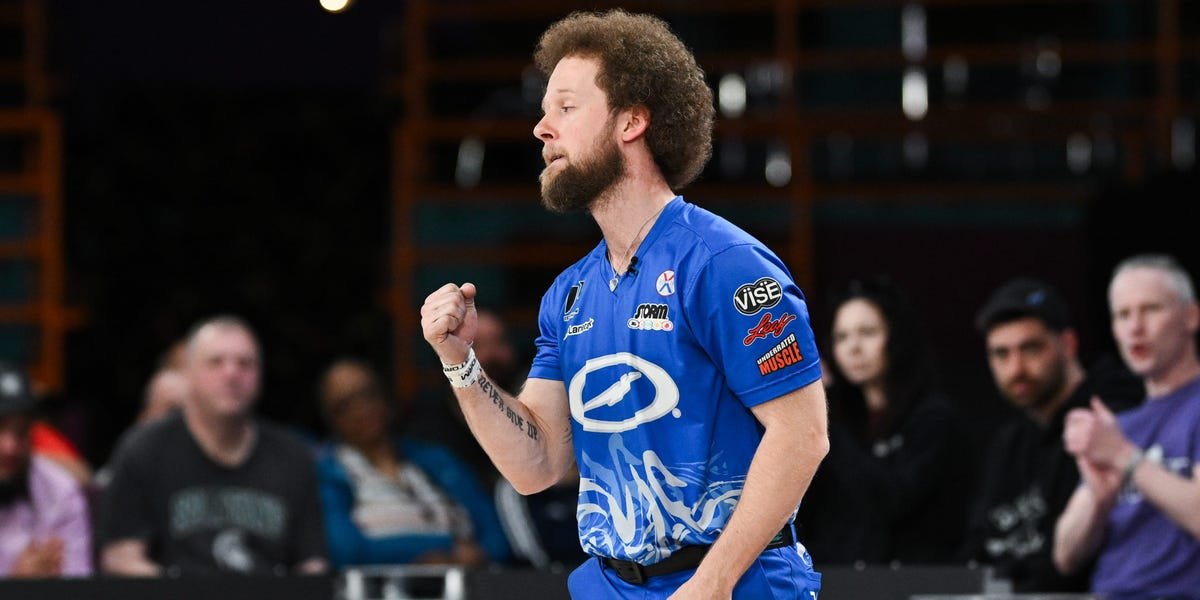
Growing up, my parents used to pay me if I could beat them at bowling. I got $5 if I beat my mom, and $20 if I beat my dad, Guppy. He was a professional bowler with the Professional Bowlers Association (PBA), and my brother and I often went to PBA events with him.
Around the time I was 13 or so, I started beating my dad so often that he dropped my pay down to $10 per victory, then $0. I figured I must be getting pretty good.
I wanted to be just like my father — and not because he was a professional bowler. People loved him, whether he was bowling or not. He was a cool, popular guy who often hung out at the bowling alley bar after his games. He loved his life and career, and it was clear he was having a lot of fun.
I started working at Wendy’s early in my bowling career
At 16, I started bowling with the PBA. In the first few years, I didn’t win much money at all. Still, the experience of bowling for money and spending my own income to bowl taught me a lot.
Around the same time, I started working at Wendy’s. By 18, I was a manager there, and still making next to nothing bowling. I’ve always been good with money, so I was getting by, but one time when money was tight I remember thinking “What could I be doing if I wasn’t chasing the dream of being a professional bowler?”
After a minute, I realized I didn’t need that answer. I was going to be a professional bowler, and that was that.
A record-setting year helped establish my financial future
By my early 20s, I started winning more tournaments and, therefore, earning more. By 2016, I made about $44,000 — enough to leave my job at Wendy’s.
Then, in 2021, I had a great year. I won the PBA Player’s Championship and earned a record-setting $496,900 that season. That’s not much compared to many other professional sports, but for me, it was a blessing.
I worked with a financial advisor and invested a lot of that money to build the foundation for my future. Bowling is a physical activity, and I know I won’t be able to do it forever. Since 2021, I’ve felt financially set. That allows me to go out and be the best version of myself each week I’m on tour.
Becoming a dad has given me purpose beyond bowling
About five years ago, I met Breanna, and we got married last year. She had two kids who were about 6 and 11 when we met. Becoming a dad to them has given me perspective about what’s important in life. My life isn’t about bowling anymore; it’s about my kids.
Courtesy of Kyle Troup
The PBA tour schedule can be hard on the family. I’m gone for about three to four months, traveling around the country for competitions. I’ve always had that schedule, but being away from my kids took some emotional adjustment.
I used to stay in hotels while I was on the road, but that was draining: I was always in a hotel, a restaurant, or a bowling alley. Now, I stay at Airbnbs with my best friend, who’s also a professional bowler. Being in a house means we can cook healthy meals and generally feel more at home, even when we’re on the road.
I’m happy with what I’ve achieved
I would love to win a title again, since it’s been a few years. At the same time, I can see that I’ve already achieved a lot, from winning Player of the Year to providing for my family to raising money to help more kids explore the sport.
Now, I want to give back to this sport. I’m happy it’s getting more attention, including the new HBO series. I get to play a game for a living, and I really enjoy what I do. That’s a blessing in my life.
Student-loan borrowers are falling behind on payments at record levels.
A new report by left-leaning groups, the Century Foundation and Protect Borrowers, found that nearly 9 million student-loan borrowers — or one out of every five — are in default, which typically occurs after a federal borrower hasn’t made a payment for more than 270 days.
Additionally, the report said that one in four borrowers with a payment due is in delinquency, meaning they’re behind on payments, and those borrowers have seen their credit scores decrease by 57 points on average over the first three quarters of 2025. A drop in credit can cause borrowers to lose access to various forms of credit or loans, making it difficult to afford basic necessities, the report said.
This data follows President Donald Trump’s restart of collections for defaulted borrowers in May 2025 after a five-year pause. While the Department of Education announced in January that it was pausing wage garnishments and tax refund seizures for defaulted borrowers, it’s unclear when the pause will lift, and more borrowers could be at risk of facing those consequences.
The report said that the pause is “welcome” but “puts a band-aid on a serious wound.”
“Considering the nation’s worsening affordability crisis and unprecedented number of borrowers entering default, resuming garnishments would be cruel and economically reckless,” the report said.
Ellen Keast, the Department of Education’s press secretary for higher education, attributed the rise in delinquency and defaults to various relief measures that the Biden administration put in place, including the “on-ramp” to repayment, during which the department did not report any missed payments to credit agencies.
“The idea of a sudden increase in delinquencies in student loans is a misnomer — the Trump Administration is once again reporting full and accurate data on student loan repayment instead of extending so-called flexibilities related to a pandemic that ended five years ago,” Keast said. She added that the department “will continue to support regular, on-time repayment.”
Options for defaulted student-loan borrowers
The Department of Education released guidance on February 18, urging institutions to reduce student default rates. The guidance included updated nonpayment rates, which are the percentage of borrowers who entered repayment between January 2020 and May 2024 with federal student loans more than 90 days delinquent. Over 1800 institutions have nonpayment rates at or above 25%, the guidance said.
“Student borrowers have an obligation to repay their loans, but institutions also share a responsibility to ensure their students are prepared to enter repayment and understand the consequences of nonpayment,” Undersecretary of Education Nicholas Kent said in a statement. “Institutions cannot benefit from taxpayer dollars while ignoring the fact that a significant share of their students are not well-prepared to repay their loans.”
The department’s looming repayment changes could make things more difficult for some borrowers. Trump’s “big beautiful” spending legislation eliminated existing income-driven repayment plans and replaced them with less generous options, meaning borrowers will face longer timelines to loan forgiveness and likely higher monthly payments.
The department also announced a settlement to eliminate Biden’s SAVE plan, which would have allowed for cheaper monthly payments and a shorter timeline to relief. The report said that SAVE borrowers are “more financially fragile than the average borrower,” citing data from the Biden administration showing that more than half of them qualified for $0 monthly payments, putting them at greater risk of delinquency and default.
Student loan borrowers have a few options to get out of default. One option is loan rehabilitation, in which a borrower must contact their servicer and enter an agreement to make nine payments over 10 consecutive months. While wage and benefits garnishment will continue during this time, the default status will be removed from the borrower’s credit report once rehabilitation is complete.
Another option is loan consolidation, in which a borrower can apply to consolidate a defaulted student loan into a federal consolidation loan. After consolidation, the borrower would become eligible for federal benefits, but the default status would remain on the borrower’s credit history.
This story is available exclusively to Business Insider
subscribers. Become an Insider
and start reading now. Have an account? .
Sunday’s Super Bowl was the second-most-watched after the 2025 game.
NBC’s broadcast, featuring a lopsided game and a Bad Bunny performance, was viewed by 124.9 million.
A new ratings calculation method introduced last year has helped boost ratings.
The Seattle Seahawks won Super Bowl 60 and so did NBC — but not by as much as they would have liked.
An average of 124.9 million people tuned in, per NBC Sports. NBC generated the second-most-watched Super Bowl — behind 2025’s game on FOX Sports — in its broadcast of the Big Game.It ended a two-year streak of record-breaking Super Bowl viewership.
Telemundo, however, delivered a record with the most-watched Super Bowl in US Spanish-language history with an average of 3.3 million viewers. That viewership peaked during Bad Bunny’s halftime show performance, with 4.9 million viewers.
Overall, viewership was an average of 128.2 million from 8:15 to 8:30 p.m. ET during Bad Bunny’s performance.
An all-time record 137.8 million viewers watched across NBC, Peacock, and Telemundo during the second quarter, according to NBC Sports.
Every time James publishes a story, you’ll get an alert straight to your inbox!
Stay connected to James and get more of their work as it publishes.
A more detailed breakdown will be available from Nielsen later this week, NBC Sports said in its press release.
Many major sporting events — including last year’s Super Bowl — have seen their ratings increase since Nielsen changed its ratings calculation in late January 2025 to better account for out-of-home viewing, such as people watching at restaurants and bars.
The college football National Championship Game drew in just over 30 million people, up about 36% from last year’s mark of 22.1 million and close to the all-time record of 33.9 million in 2015.
Under Nielsen’s prior ratings methodology, this year’s college football championship would have generated just over 28 million viewers. That’s based on an ESPN spokesperson telling The Athletic that the game’s ratings would have risen 27% year over year under the old format. In other words, out-of-home viewing appeared to add 2 million viewers to the game’s total.
So while Nielsen’s revamped viewership calculations may have affected Sunday’s ratings, it might not have made a massive difference.
This story is available exclusively to Business Insider
subscribers. Become an Insider
and start reading now. Have an account? .
Even as the broader US job market cools, AI keeps punching above its weight.
New data from Indeed shows overall job postings ended 2025 just 6% above pre-pandemic levels, but postings that mention AI are up more than 130% since early 2020.
The standout stat: more than 1 in 25 job postings now reference AI, pushing Indeed’s AI Tracker to a record 4.2% in December.
The skew is striking. Nearly 45% of data and analytics roles mention AI, compared with about 15% in marketing and 9% in HR, even as hiring across many knowledge-work fields remains weak.
As employers narrow hiring plans, AI roles are absorbing a growing share of expectations, raising a big question: Can AI carry the labor market in 2026?
Sign up for BI’s Tech Memo newsletter here. Reach out to me via email at abarr@businessinsider.com.