This story is available exclusively to Business Insider
subscribers. Become an Insider
and start reading now. Have an account? .
A KC-135 refueling aircraft “went down” in Iraq, the US military announced Friday evening.
A second unidentified aircraft was involved but landed safely.
The status of the refueling aircraft’s crew is unknown.
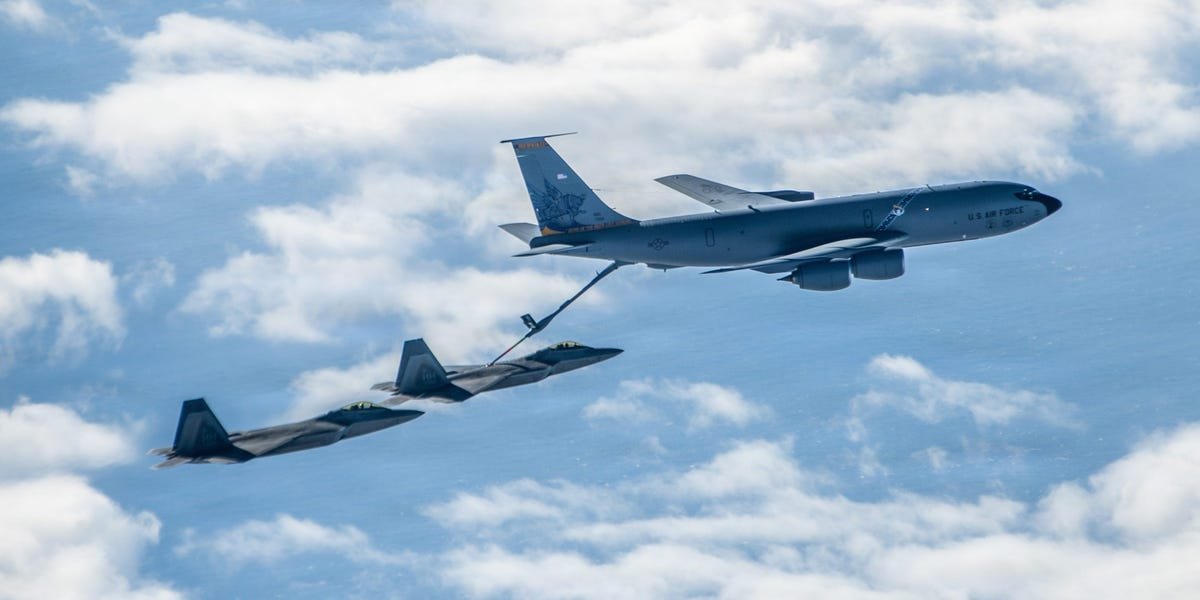
A US military KC-135 refueling aircraft involved in Operation Epic Fury has crashed in Iraq, US Central Command said in a statement on Friday evening.
“Central Command is aware of the loss of a US KC-135 refueling aircraft,” the command, which oversees US military operations in the Middle East, said, adding that the incident involved two aircraft operating in friendly airspace in support of Epic Fury.
One aircraft “went down” in western Iraq, while a second unidentified aircraft landed safely. The aircraft loss “was not due to hostile fire or friendly fire,” CENTCOM said.
This marks the fourth American aircraft loss since the start of Operation Epic Fury, the Pentagon’s name for US operations against Iran, nearly two weeks ago. Just days into the war, CENTCOM announced that three American F-15E Strike Eagles were downed by friendly fire over Kuwait. The aircraft were lost, but all six aircrew members were able to eject safely.
The KC-135 Stratotanker is an Air Force asset that supports the broader joint force by refueling other aircraft — including fighter jets, bombers, and cargo aircraft — in notoriously complex midair refueling operations. It’s essentially a flying gas station that executes fuel transfers at high speed with aircraft in close proximity.
The KC-135 typically carries a three-person crew — a pilot, co-pilot, and boom operator. The status of the crew is not known at this time. CENTCOM said rescue operations are ongoing.
In a fight against a formidable enemy, there’s no guarantee medical evacuation crews will be able to reach wounded troops.Facing this possibility, the US Army is looking at using ground robots instead to get injured troops off the battlefield.
The Army’s 2nd Cavalry Regiment is drawing hard-won lessons from the war in Ukraine, where drones and artillery have made any battlefield movements extremelyhigh-risk.
“When we’re looking at the conflict in Ukraine specifically, most of the use cases for unmanned ground vehicles have actually been in the sustainment and logistics,” said Maj. Andrew Kang, the fire support officer for the 2nd Cavalry Regiment.
That work includes casualty evacuations, Kang told reporters during a media roundtable last Friday, sharing that the regiment’s soldiers are providing industry partners with feedback during testing through the xTech innovation program.
The 2nd Cavalry Regiment, an Army Stryker brigade permanently based in Europe, would serve as a critical American combat force in a major conflict on the continent. The unit has been outfitting its soldiers with counter-drone systems through the Army’s Transformation in Contact 2.0 initiative,a force-wide push to more quickly adopt new technologies, and leaning into using uncrewed systems to its advantage.
The unit has trained Ukrainian troops cycling on/off the battlefield on American equipment, but concurrently with the training, the unit has become a sort of test bed for helping senior US leaders understand what troops will need in a future fight, experimenting with new technologies and tactics.
“During the training,” Col. Donald Neal, the 2nd Cavalry Regiment commander, said, “we learned a lot about their use of what we refer to as the triad: Unmanned Aerial Systems (UAS), counter-UAS operations, electronic warfare, and the network that enables all of it.” Those, however, aren’t the only lessons.
The Ukrainian battlefield has proven to be exceptionally grueling for casualty evacuations, a stark contrast to the quick evacuations on which American troops could rely during the wars in Iraq and Afghanistan. In Ukraine, helicopters are vulnerable to short-range air defenses, while medical teams and vehicles are haunted by drones.
That’s where the robots come in.
Ukrainian soldiers have been using uncrewed ground vehicles, or UGVs, for offensive missions. These operate like rugged flatbed trucks without a driver, and Ukraine has mounted machine guns and other weapons on them to attack Russian forces. Ukrainian troops also use them as mine-layers, scouts, and vehicle-borne improvised explosive devices.
Casualty evacuations, though, are proving to be a particularly critical area where these robots can help mitigate risk to medics.
Col. Donald Neal, Regimental Commander, 2d Cavalry Regiment, spoke at the same roundtable event.
U.S. Army photo by Sgt. Tien Dat Ngo
While aerial drones have been revolutionary for warfare, a trend that is continuing to expand abroad in the new US war in Iran, the uncrewed ground vehicles have been slower to proliferate.
Of the hundreds of thousands of Ukrainian drone missions that were executed last year, only 2,000 were UGVs. It’s more difficult to remotely drive them across varied terrain, but they offer the ability to move much larger payloads. For casualty evacuation and logistics, the ability to carry more is invaluable.
Rather than risk more injuries by sending medics forward, soldiers can send a UGV to pick up a wounded soldier. It’s an imperfect solution, as a wounded soldier has to be able to pull themselves onto the vehicle. Many UGVs are also susceptible to electronic interference andsimple drone-spotting. These systems have, however, proven effective at getting troops off the battlefield, even surviving attempts to eliminate them by enemy forces. It’s another tool in the kit.
UGVs may also prove useful as decoys or sensors in areas too risky for troops, Neal said during Friday’s roundtable, and for boosting communications networks as mobile relays.
“Potentially, we see the biggest bang for our buck in utilizing them for things like breaching,” Kang added.
Breaching fortified enemy positions is one of the most dangerous jobs on the battlefield, requiring specialized combat vehicles to clear mines and cross obstacles while under fire. In Ukraine, breach operations have proven costly, with delays hindering breakthroughs and preventing armored formations from moving forward.
“Now, instead of having a manned formation go to the breach point, we could potentially load an explosive on a [remote-control] car-type platform and drive,” Kang said. The vehicle could blast a path forward for combat vehicles like 2nd Cavalry’s Strykers, wheeled armored fighting vehicles equipped with a mix of armaments.
One of the biggest challenges for the Army as it explores UGVs is the high price tag for some systems, Kang said. The platforms vary dramatically in cost, he said. While some more expendable versions are under $1,000,some cost almost $1 million.
“The cheaper the better,” Neal said of the affordability of ground robots. “In most uses for unmanned ground vehicles, we know we’re going to put them in a position where we’re not going to recover them, or they’ll be destroyed.”
It’s been a confusing six days since missile attacks across the Middle East stranded travelers and planes in airports across the world.
Things are still far from normal as of Wednesday, but some travelers are getting home.
There is a slow-growing recovery in the United Arab Emirates, which has partially opened its skies and designated “safe” corridors for rescue planes to use.
There are a lot of people to move: cities like Dubai and Abu Dhabi host large expat populations and tourists, and their hubs usually handle tens of thousands of transit passengers a day.
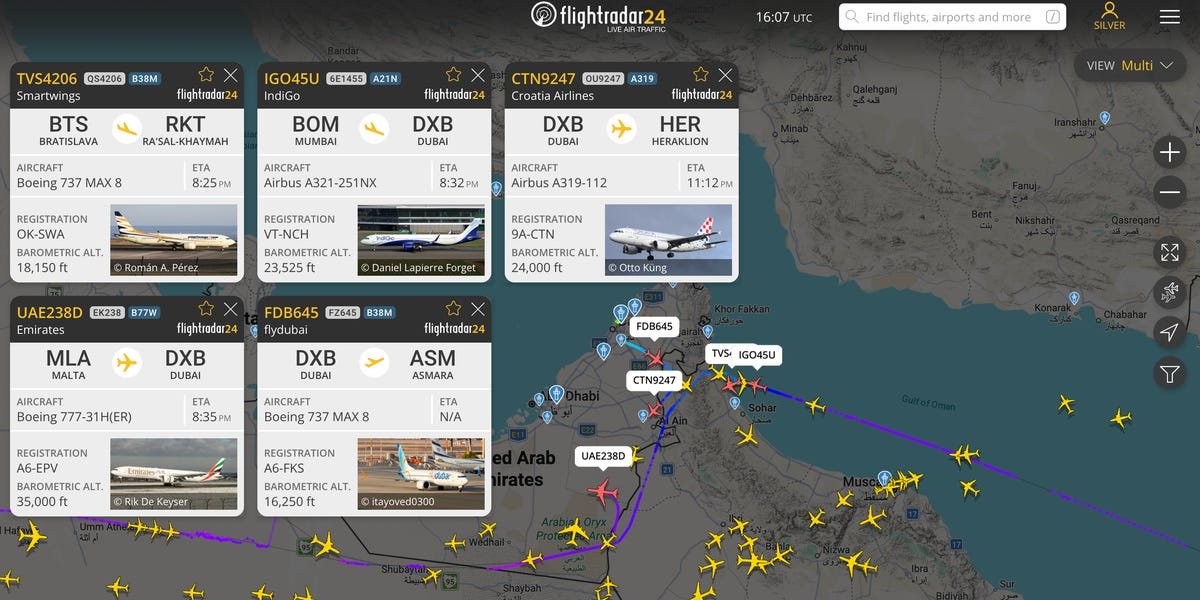
Working with local officials, Emirates, Flydubai, IndiGo, and Etihad Airways were among the first airlines to depart the UAE with passengers, crews, and cargo. Over 100,000 people followed these aircraft live on the aviation tracking website Flightradar24.
Even as Iranian threats continue to disrupt flying — forcing diversions, holds, and U-turns — airlines are still transporting passengers to destinations across Europe, Asia, and Africa.
Fortunately, Emirates and Etihad have big planes: many of their Airbus A380s, capable of carrying up to 615 passengers, have flown to cities such as London, Istanbul, Jeddah, Singapore, Paris, and Düsseldorf.
Although these flights don’t always take travelers all the way home, they offer a crucial escape from limbo — getting people into countries with open airspace and far more onward flight options.
Flightradar24 data shows several other carriers have joined the crowd: Air India, Air Arabia, Uzbekistan Airways, Kenya Airways, Morocco’s Royal Air Maroc, Saudi airline Flynas, Royal Jordanian, and India’s SpiceJet are all flying from Dubai to their respective hubs.
Passengers on a Kenya Airways rescue flight from Dubai arrive back home.
Thomas Mukoya/Reuters
European carriers, including Lufthansa, Swiss International Air Lines, Prague-based Smartwings, Aegean Air, and British Airways, are running special rescue flights from neighboring Muscat, Oman. Smartwings and Croatia Airlines are running select flights from Dubai.
Air France scheduled a repatriation flight from Dubai to Paris on Thursday evening, but suspended the plan shortly after the announcement due to “the ongoing security situation.”
Russian carriers Aeroflot and S7 Airlines have similarly departed with passengers, though their flights to Moscow are taking up to three hours longer because they have to fly the long way around closed airspace rather than fly directly over it.
Still, most airlines’ regular schedules to and from much of the Middle East remain suspended until at least the weekend, and they have asked passengers not to go to the airport unless they have been specifically notified.
No US airlines have sent rescue planes as of Thursday. Mark Dombroff, an aviation attorney with the law firm Fox Rothschild, told Business Insider that even if US carriers like United or American wanted to help, they legally can’t.
“The decision-making resides with the Federal Aviation Administration,” he said. “If the FAA says you can’t fly there as a US certificated carrier, that’s it. And in a sense, it’s no different than any other restricted airspace in this country, like Washington, DC.”
Some Americans have gotten home with the help of the State Department; it previously told those in over a dozen Middle Eastern countries to evacuate. The agency said it flew a charter flight to the US on Wednesday, and that more will be “surged across the region.”
It added that, as of Wednesday, “nearly 18,000 Americans have safely returned to the US,” including 7,300 helped by the State Department. It said thousands of others made it to Europe and Asia and are in transit back, and told those still stuck to get in touch for help by calling +1 (202) 501-4444 or filling out this form.
Some airlines remain effectively frozen. Qatar Airways has not flown a plane since Saturday due to Qatar’s airspace closure, leaving practically no options for those in Doha except to wait or drive hours to Saudi Arabia and fly out from there.
Flight options are still extremely limited
While some flights are better than none at all, special airline operations remain limited to certain routes and airports.
Flightradar24 data shows that Dubai International has seen just 100 takeoffs and landings since Saturday. Operations ramped up from Monday to Tuesday — but that was still less than 10% of the roughly 1,200 flights in and out on a usual day.
Rescue flights are largely restricted to the UAE, Oman, and Saudi Arabia: the skies over Iran, Kuwait, Iraq, Syria, Israel, Qatar, and Bahrain remain closed.
An Emirates A380 ferried hundreds of stranded people back to Germany.
Andreas Rentz/Getty Images
Aviation analytics Cirium estimates there are normally about 900,000 daily seats to, from, and within the Middle East; it said about 4.4 million seats in and out of the Middle East have been canceled since Saturday.
While airlines are actively adding flights to the schedule — despite the on-and-off missile threats in the region — there are nowhere near enough rescue seats yet to accommodate the tens of thousands of stranded travelers. British Airways said on social media on Wednesday that the rescue flights it planned through Saturday are already full.
Some wealthy travelers have abandoned commercial flying altogether, instead paying hundreds of thousands of dollars to charter private jets. Flightradar24 data shows a number of business aircraft flying to and from Oman, Saudi Arabia, and the UAE since Sunday.
Those with less deep pockets have chosen to travel by bus to Oman and Saudi Arabia, hoping to secure seats from airports still operating flights as normal.
But the drives are hourslong, and Oman Air warned Muscat-bound travelers crossing in from the UAE to arrive 12 hours early as traffic backs up for miles.
Almost 1,000 flights to and from the Caribbean were canceled on Saturday after the US raid on Venezuela.
The Federal Aviation Administration banned commercial aircraft from flying over Venezuelan airspace before expanding restrictions to much of the Caribbean.
Puerto Rico was the most affected, with 400 flights canceled to or from the main airport in San Juan.
There were also over 140 cancellations in the US Virgin Islands, and 91 in Aruba, which is only about 20 miles off the Venezuelan coast.
Using data from FlightAware, Business Insider put together this map to show the scale of the disruption. You can hover over an icon to see the number of cancellations at the airport.
After airspace restrictions ended early Sunday, airlines added dozens of extra flights to help passengers get where they needed to go.
The region is a particularly popular destination for vacationers seeking some winter sun over the New Year holiday.
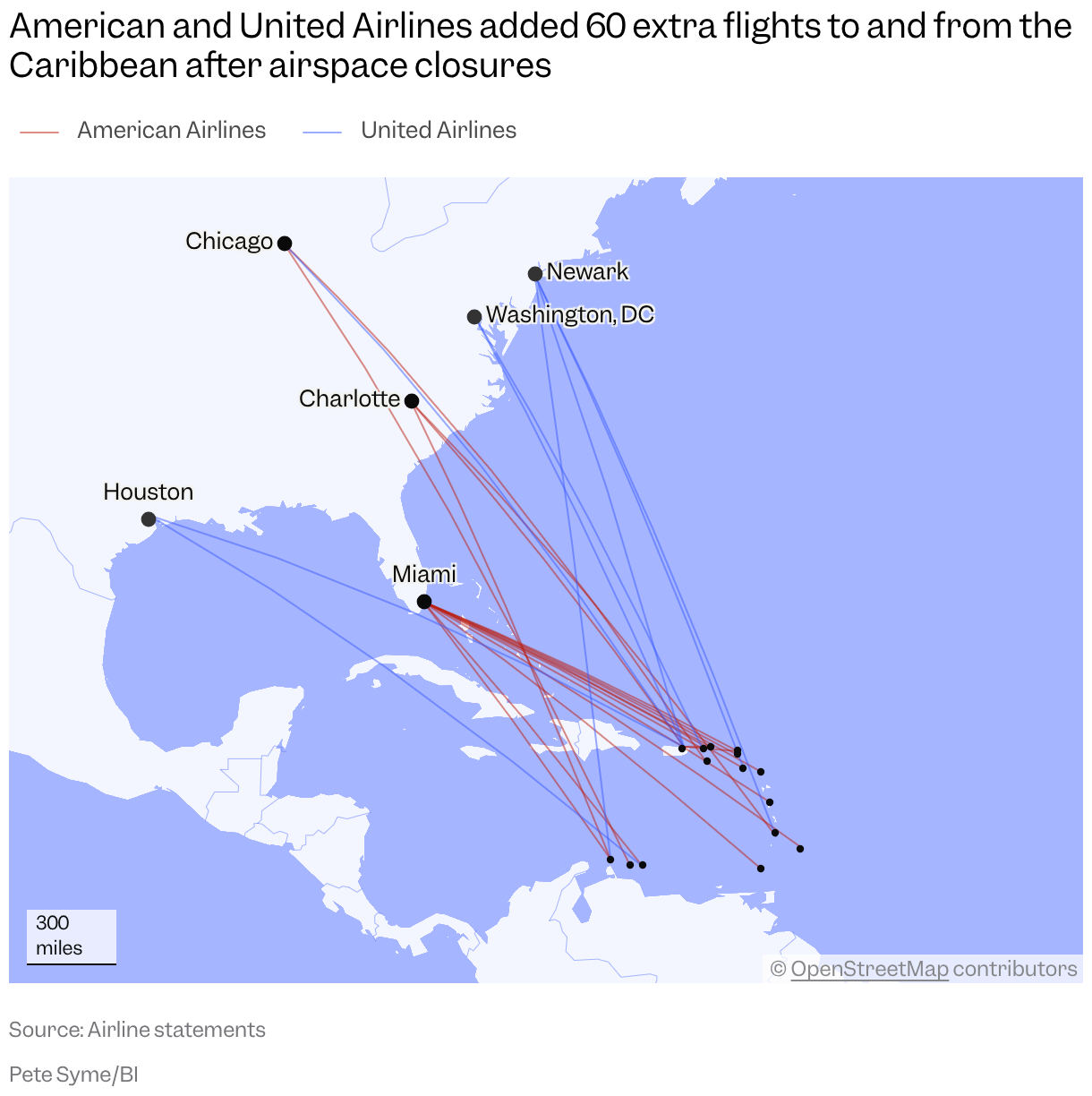
American Airlines added 43 extra flights on Sunday and Monday, with room for 7,000 passengers.
For the first time in over a decade, it operated interisland flights in the eastern Caribbean on Monday. Namely, to Puerto Rico from Anguilla and the British Virgin Islands.
American’s expanded schedule included deploying a Boeing 777-300, the largest model in its fleet, to ferry passengers between Miami and Puerto Rico.
United Airlines listed 17 additional flights scheduled for Sunday and Monday, to and from its hubs in Houston, Newark, and Washington, DC.
Delta Air Lines said that it has added space for 2,600 people on Monday. It didn’t immediately provide details of the extra flights it has scheduled.
Airlines have waived change fees and fare differences for passengers flying to or from the Caribbean, to rebook for flights later in the month.
Have you been affected by the travel disruption in the Caribbean? Reach out to this reporter at psyme@businessinsider.com or via Signal at syme.99