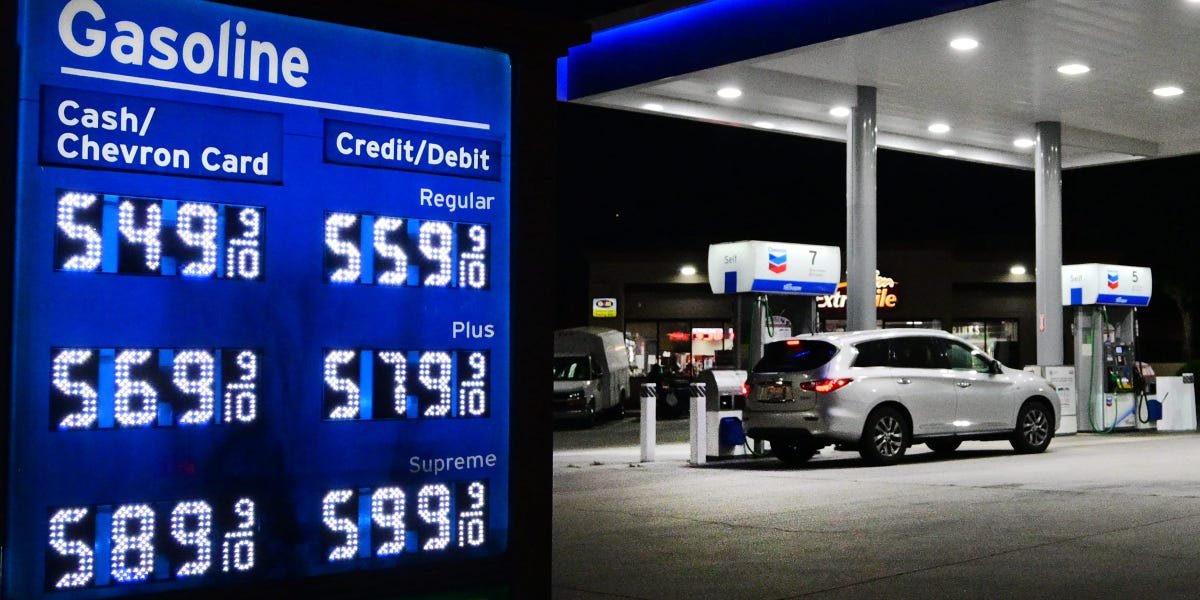
War in the Middle East is fuelling a surge in US gas prices — and drivers for services like Uber and Lyft are among the first to feel the pain.
Several ride-hailing drivers told Business Insider they’re prioritizing the most profitable trips offered by the Uber and Lyft apps to protect their earnings from rising gas prices, while dozens bemoaned the “insane” price spike on Reddit.
Oil prices blew past the $100-a-barrel mark on Monday, before falling back to around $90 after President Donald Trump suggested the war with Iran could soon come to a close.
The impact is already being felt at the pumps. The average price of a gallon of gasoline in the US has jumped by about $0.40 over the past week, according to AAA data.
Justin Fisher, who works as a ride-hailing driver for Uber in Houston, told Business Insider that he has changed which rides he accepts on the app in response to gas prices. He now focuses on taking the most profitable rides, even if they involve going to areas that he doesn’t believe are safe.
“The cost of gas is an unpleasant reality,” Fisher said.
Sergio Avedian, a former Wall Street trader who now drives for Uber and Lyft in Southern California, told Business Insider that the price of a gallon of gas at his two local gas stations in suburban Los Angeles had increased by $1 over the past week.
“It’s been extremely noticeable,” Avedian said.
Avedian said he expected Uber and Lyft drivers to adapt by accepting fewer short city trips, which often consume more gas due to frequent stopping and starting in traffic, and instead target longer trips and freeway rides that offer superior gas mileage.
The primary issue for drivers, he said, is that Uber and Lyft control fare prices, meaning drivers can’t raise their prices when their operating costs soar.
“We do not call the shots. The fares are not going up, and Uber and Lyft are not paying us more to make up this difference, which is immense,” Avedian said.
Uber and Lyft did not respond to inquiries about whether they are considering introducing a surcharge, as they did in 2022 after oil prices spiked following the Russian invasion of Ukraine.
EV drivers take a victory lap
One group of drivers appears to be reaping the benefits of the gas price volatility. Jaret, an Uber and Lyft driver in North Carolina, told Business Insider that the past weekend was one of the best he had had on Lyft.
The Tesla driver said owning an EV meant he didn’t have to worry about gas price increases.
“I don’t pay attention, because I haven’t been in a gas station in forever,” he said.
Jaret estimated that charging his Tesla Model Y at home means $1 out of every $14 he earns goes toward refuelling, compared to $1 in every $3 with a gas-powered car.
“I love having an EV,” he said. “I’m not happy that gas prices are going up, but I’m happy that it’s not affecting me.”
Temporary surcharge?
Uber and Lyft both introduced a temporary surcharge of $0.45 to $0.55 per ride to help cover the soaring cost of gas following Russia’s invasion of Ukraine in 2022.
Avedian and Jaret both said that doing the same again would help, but that it would only be a partial fix amid ballooning gas prices and shrinking payouts from rides.
“It isn’t really solving the problem,” said Jaret. “It’s a Band-Aid; it’s treating a symptom more than you’re treating a cause. But will it help? Of course.”
Avedian said he would advise rideshare drivers to take extra care when deciding which trips are profitable, and to decline those that aren’t.
“If a trip that is offered to you as a driver is not profitable, I tell them to ‘decline and recline.’ You have to decline bad offers, because this is not a public service,” he said.
Do you work for Uber, Lyft, or another ride-hailing service? Contact this reporter at abitter@businessinsider.com or via encrypted messaging app Signal at 808-854-4501. Use a personal email address, a nonwork WiFi network, and a nonwork device; here’s our guide to sharing information securely.
Hannah Donovan is four months pregnant. And with two little ones already at home, she and her husband had been banking on one family trip before life got even more hectic.
Puerto Vallarta was meant to be a babymoon — a chance to meet up with family nearby, soak up the sun, and actually relax for a few days.
However, less than 24 hours before they were set to head to their airport in Idaho, videos and pictures of burning cars and billowing smoke began circulating on social media.
Donovan said the images she saw online followed reports that Mexican forces carried out an operation on Sunday in Tapalpa, Jalisco, that killed Nemesio “El Mencho” Oseguera Cervantes, the leader of the Jalisco New Generation Cartel. The incident sparked retaliatory violence across multiple cities in Mexico, including in Puerto Vallarta.
The Donovans have since canceled their trip to Mexico and will play it by ear on whether they’ll try to visit Puerto Vallarta later.
“We’re incredibly grateful we’re not there, but we’re worried about the people who are, including travelers and our family who live there,” Donovan, 28, told Business Insider. “We’re definitely a little traumatized by the situation.”
Americans are rethinking their travel plans to Puerto Vallarta
The Donovans are among many Americans rethinking trips, moves, and stays in the region after chaos flared across parts of Mexico following the killing of Oseguera Cervantes on Sunday. Four people at the scene were killed, according to authorities. Three others — including Oseguera Cervantes — were wounded and later died, and two people were arrested. Three members of the armed forces were also wounded.
It comes after President Donald Trump designated the cartel a foreign terrorist organization. White House press secretary Karoline Leavitt said the US provided intelligence support for the operation, but stopped short of offering details on how. The administration has prioritized cracking down on Latin American cartels, urging leaders to take a harder line and deploying military force against suspected drug-smuggling vessels in the eastern Pacific and Caribbean.
In the hours since, the US and Canadian governments have urged citizens in some areas to shelter in place, and said most domestic and international flights in Guadalajara and Puerto Vallarta were grounded. On Monday, Mexican President Claudia Sheinbaum called for calm in the country, but many of those flights remained canceled.
Smoke over the city of Puerto Vallarta.
@morelifediares via Instagram/Youtube/@morelifediares via REUTERS
Mexico has become increasingly popular with American tourists, drawn by its vibrant nightlife, strong culinary scene, and affordability compared to other trendy international destinations such as France and Japan.
“Americans, especially on the West Coast, have long used it as an inexpensive place to go on vacation,” Robin Ingle, a specialist in travel security, told Business Insider.
Mexico has also seen a surge in tourism from people who previously would have traveled to the US but are avoiding the country for various political or financial reasons, he said.
“A lot of the people I’ve spoken to over the weekend would have gone to places like Florida, California, Arizona — now they’re going to Mexico instead,” he said of the tourists he’s spoken to since cartel violence broke out.
But as unrest spreads, some Americans who had planned to vacation or relocate there, or who are already in Mexico, are watching those plans unravel.
Business Insider spoke with three of them about what comes next.
Doug Howell will return to the US if things get worse
Doug Howell, a retired sales and distribution executive from the Spokane, Washington area, bought a rental place in Puerto Vallarta and now spends roughly six months a year there — a routine he’s kept up for the past 20 years.
“It’s very vibrant,” Howell, 63, told Business Insider. “I like to walk around the neighborhoods, everything is pretty close, or a short bus ride away if you want to check out the beaches or the waterfalls. There’s always something to do, and the food is incredible.”
Doug Howell and his daughters.
Courtesy of Doug Howell
On Sunday, Howell said he was standing on his balcony when he started hearing explosions, then saw plumes of smoke rising nearby. Before long, he said, he noticed highways and roads in and out of the area had been blocked off.
He was scared at first, he said, and hunkered down with neighbors.”We just stayed inside all day yesterday, and I didn’t go anywhere,” he recalled. “They actually bombed a store on a corner and a car on the bridge that’s not even a quarter of a mile away.”
By Monday, Howell, a member of MedJetHorizon — a global air medical transport and security response membership that provides evacuations— said things had calmed down in his neighborhood.
“They’re already on it today, and people are supporting each other in the community — that’s what I like about it,” he said. “One question everybody asks me: Is it safe? And it’s like, yeah, it is, unless you go to the wrong place at the wrong time. And that’s anywhere in the world.”
For now, Howell plans to stay in Mexico, but if things worsen, he said he plans to return to the States.
Linda Armijo worries about the future of the city
Linda Armijo and her husband have been visiting Puerto Vallarta for the past 25 years.
In January, they returned for a three-month stay in the city’s Marina Vallarta district, an upscale, waterfront area in northern Puerto Vallarta.
Armijo said that on Sunday, after her husband’s massage therapist warned that roads downtown were blocked, she went up to the rooftop terrace of their condo, which overlooks the city. From there, she said she could see five or six plumes of smoke.
Linda Armijo and her husband have been spending time in Puerto Vallarta for 25 years.
Courtesy of Linda Armijo
Smoke isn’t entirely unusual in Puerto Vallarta — controlled burns are common — but Armijo said this was more than she typically sees. “I came down to our condo and told Anthony, ‘There’s something going on, there are fires everywhere,'” she recalled.
Armijo said the city was hit by a series of disruptions, including the blast of an engine as a car was set on fire, interruptions to water service, and highways and roads blocked off. Although the uncertainty has left tourists and locals scrambling, they’re relying on each other to get by.
“I met two girls from LA who are renting a condo upstairs. They were meant to fly out yesterday, and threw away all their food and supplies before learning their flight was canceled. I shared some water with them,” Armijo said. She added that a building worker told her they were also accommodating those who needed to extend their stay.
Tourists watching fires in Puerto Vallarta.
Stringer/REUTERS
Armijo plans to stay put for now and said she isn’t especially worried about her safety. Instead, she’s thinking about what this could mean for the city.
“I feel safe in my building, and we have plenty of food and water,” the Spanish-speaker said. “It’s a minor inconvenience not being able to leave, but my biggest emotions are sadness and concern for the people of Puerto Vallarta.”
Long-term impact
In the near term, Ingle, the travel security specialist, said he expects to see an impact on the tourism scene.
“I know there’s going to be a blowback in the next month, people deciding not to go, because there’s a percentage of the population that doesn’t want to take risks,” he said. “Governments are putting out warnings, and that affects travel insurance.”
When it comes to the long-term impact, however, Ingle doesn’t see this weekend’s violence creating a lasting stain on Puerto Vallarta’s ability to attract tourists.
“If all the violence dies down quickly and gets cleaned up, I think this will go away,” Ingle said. “Normally, this will take a couple days, and then it will fix itself.”