
Nike-salary-data-reveals-what-employees-can-make-at-the.jpeg

Nike salary data reveals what employees can make at the sportswear giant

As Nike continues its quest to come back as a dominant retail force, the sportswear giant has continued to invest in tech and design jobs.

Publicly available work visa data, which companies are required to disclose to the US Department of Labor, gives an idea of how much Nike’s employees bring home and some of the roles it has invested in.

Nike had about 755 open positions worldwide listed on its jobs board as of February 13. In January, the company also said it planned to lay off 775 employees at its distribution centers, citing efforts to accelerate the use of “advanced technology and automation.”

Nike had several leadership shake-ups in 2025, including promoting at least four insiders to senior roles reporting directly to CEO Elliott Hill.

Hill, who rejoined the company in October 2024, has told investors that Nike is aligning its employees around five key action areas: culture, product, marketing, marketplace, and connecting with consumers on the ground in their communities.

That strategy plays into Nike’s efforts to focus its marquee brands — Nike, Jordan, and Converse — on key sports such as running and basketball. It’s also pushing a new collaboration, NikeSKIMS, an athleisure brand for women.

“We are in the midst of realignment at Nike,” Nike said in a July statement to Business Insider. The realignment and sport strategy aim to “create sharper distinction and dimension” for its brands, the company said.

Here’s what some key Nike roles can earn, based on work visa data for the year ending September 30.

The salary data includes information from Nike Inc. and some subsidiaries, such as its retail services arm and Air Manufacturing Innovation division. It reflects US-based roles and, given that it’s based on H-1 B visa disclosures, tends to skew more tech-focused.

Data and engineering roles: Software engineers can earn more than $300,000

Software Engineer: $124,592 to $203,581 a year

Software Engineer I: $120,000 to $144,612 a year

Software Engineer II: $152,007 to $178,231 a year

Software Engineer III: $139,845 to $180,353 a year

Senior Director, Software Engineering: $301,378 a year

Data Engineering: $104,500 to $175,000 a year

Data Analytics: $114,600 to $118,398 a year

Director, Supply Chain AI/ML Engineering: $252,535 a year

Design roles: Some designers make around $200,000

Designer II: $94,691 a year

Materials Designer: $100,000 a year

Senior Digital Product Designer: $155,810 a year

Senior 3D Designer: $106,605 a year

Director, NikeSKIMS Apparel Design: $244,466 a year

Manager roles: Managers can take home more than $270,000

Senior Manager, Software Engineering: $273,156 a year

Delivery Excellence, Uniform Operations Manager: $164,439 a year

Senior Product Manager: $153,431 to $169,744 a year

Manager, Data Engineer: $168,031 to $213,190 a year

Senior Program Manager: $147,434 a year

Supply Chain Intelligence Manager: $158,311 a year

Marketing roles: Some marketing jobs can earn as much as $425,000

Lead Professional, Sports Marketing: $128,434 to $143,251 a year

VP, Global Brand Marketing, Women’s: $425,000 a year

Have a tip? Contact Jordan Hart via email at jhart@insider.com or Signal at jordanhart.99. Use a personal email address, a nonwork WiFi network, and a nonwork device; here’s our guide to sharing information securely.



Source link

Bill Ackman attends 2025 Pershing Square Foundation MIND and Cancer Prize Award Dinner at The Pool on May 22, 2025 in New York.

Bill Ackman’s hedge fund reveals big stake in Meta — ‘one of the clearest beneficiaries of AI integration’


Michael Ostuni/Patrick McMullan via Getty Images

  • Bill Ackman’s Pershing Square has invested roughly 10% of its capital in Meta.
  • The fund told investors Meta is set to be “one of the clearest beneficiaries of AI integration.”
  • Meta has been plowing cash into data center projects, which Ackman’s firm expect to pay off long-term.

Bill Ackman is betting big on Meta — saying it believes it to be “one of the clearest beneficiaries of AI integration.”

The billionaire investor’s Pershing Square hedge fund revealed Wednesday that it has invested around 10% of its capital in Meta, or approximately $2 billion, as of the end of December.

“We believe Meta’s current share price underappreciates the company’s long-term upside potential from AI and represents a deeply discounted valuation for one of the world’s greatest businesses,” the presentation said.

At around $668 per share on Wednesday afternoon, Meta’s stock price is roughly flat in 2026 so far, and down approximately 7% from one year ago.

Pershing Square also revealed it had allocated 13% of its fund to Amazon as of the end of 2025, and a 2% position in Hertz in late 2024.

Wall Street has been less than enthusiastic about some of Big Tech’s planned capital expenditure plans, but Meta’s budget-busting $135 billion forecasted spend was rewarded last month with a short-lived 8% bump the share price.

Either way, Ackman’s team says they’re very much on board with the strategy.

“We believe concerns around META’s AI-related spending initiatives are underestimating the company’s long-term upside potential from AI,” the presentation said.


Pershing's Meta investment thesis

Pershing Square’s investment thesis for its stake in Meta.

Pershing Square


The presentation also said Meta’s 3.5 billion users are increasing at a steady clip, setting the company up as the “dominant” leader in digital ads.

“Meta’s business model is one of the clearest beneficiaries of AI integration,” the presentation said.


Source link

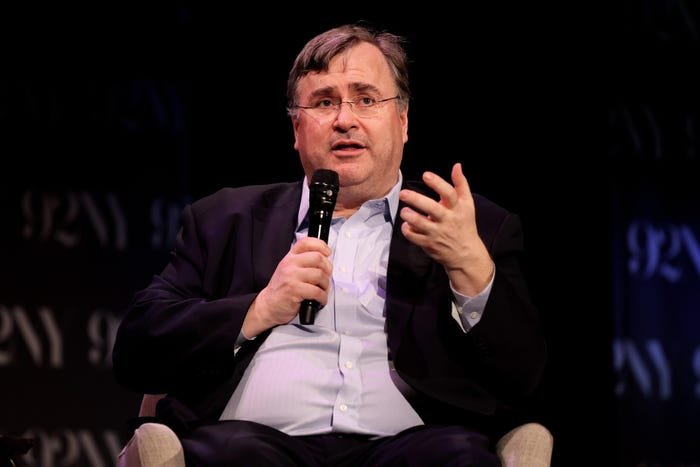
LinkedIn co-founder Reid Hoffman

LinkedIn billionaire Reid Hoffman reveals he had more meetings with Epstein


Dominik Bindl/Getty Images

  • LinkedIn cofounder Reid Hoffman said he met with Jeffrey Epstein for fundraising purposes.
  • Hoffman previously said his last meeting with Epstein was in 2015.
  • Now he says there were six more meetings, from 2016 to 2018.

Reid Hoffman says he had more meetings with Jeffrey Epstein than he originally thought.

The billionaire LinkedIn cofounder previously maintained that the last time he met with Epstein was in 2015, and that he only knew Epstein via fundraising efforts for the MIT Media Lab.

This week, as the latest tranche of Epstein-related documents from the Justice Department continues to make headlines, Hoffman revised his accounting.

“I was mistaken, as according to calendar entries I have become aware there were additional fundraising meetings in 2016 and 2018,” Hoffman wrote in a post on X on Tuesday night.

Hoffman listed six additional meetings, including various Skype calls and in-person meetings in Cambridge and Palo Alto. The most recent meeting Hoffman listed was a Skype call in March 2018.

“I have done multiple calendar searches, and if I find any other meetings, I will continue to share them,” Hoffman wrote. “The victims of Epstein’s abhorrent and vile actions deserve all the information they are seeking, and I continue to call on President Trump to deliver that for them.”

Hoffman said that those meetings had also been scheduled as part of his fundraising relationship with the MIT Media Lab.

Hoffman has also said he visited Epstein’s private island, Little Saint James, in the US Virgin Islands. In December, he told a podcast host that he stayed on the island for one night on a trip connected to fundraising activities.

“Note to self: Google before going,” Hoffman said on the podcast.

Hoffman’s appearance in the Epstein files has helped reignite the billionaire’s feud with Elon Musk.


Source link

US-planning-for-the-Maduro-raid-eyed-a-time-when.jpeg

US planning for the Maduro raid eyed a time when much of the Venezuelan military was expected to be on holiday, memo reveals

US planning for the high-risk raid to apprehend Venezuela’s former president, Nicolás Maduro, centered on a time when much of the country’s military would be on holiday leave, a newly released memo reveals.

The December 23 memorandum from the Department of Justice’s Office of Legal Counsel offers fresh details about how the US planned to pull off the daring nighttime raid to capture Maduro in his fortified compound and transport him to New York to stand trial. The former leader has pleaded not guilty to the drug and weapons charges he faces.

The raid began late on January 2 and ran into the next day. President Donald Trump said on January 3 that the initial plan was for the operation to occur four days earlier, on December 30, but he decided to wait for better weather.

“The expected duration of the operation within Venezuelan territory is [redacted] hours,” wrote T. Elliot Gaiser, a US assistant attorney general, wrote in the late December DOJ memo, which looks into the legality of the raid and was made public this week. Much of the planning section is blacked out.

“In order to minimize casualties, the strike will take place at 0100 am (local time) on a date where a maximum number of Venezuelan military would be on leave for the holidays,” Gaiser wrote.


A squad of Venezuelan Air Force K8W aircraft overflies during the 2025 Venezuela industrial aviation expo at the Libertador Air Base in Maracay, Aragua State, Venezuela, on November 29, 2025.

The US attacked Venezuelan military targets as part of its raid earlier this month.

Federico PARRA/AFP via Getty Images


It’s unclear how many soldiers were away when the US actually executed the operation in January. Dozens of Venezuelan and Cuban security personnel were killed, the two countries said after Operation Absolute Resolve concluded.

The DOJ memo, which cited Pentagon planning information and details how the US could effectively present the action as a law enforcement operation rather than an act of war, said that the US expected to encounter “significant resistance” from Venezuela’s air defenses.

That anticipated resistance includes several dozen anti-aircraft systems on the approach to Fuerte Tiuna, a major military installation in Caracas where Maduro and his wife were believed to be and, indeed, were at the time of the operation.

The memo outlined how US aircraft would strike air defense systems to clear a path for assault forces to reach Tiuna. It said that the Pentagon aimed to target a local power switching station to keep the power off, which could explain Trump’s post-raid remarks that a “certain expertise” was used to turn off the lights in Caracas.

The US could have also carried out a cyberattack or employed electronic warfare capabilities. “Kinetic operations will be preceded by non-kinetic action,” the memo said.


A fuel tanker truck drives past US Air Force F-35 Lightning II and F-22 Raptor fighter jets on the tarmac at the former Roosevelt Roads naval base, after US President Donald Trump said the US has struck Venezuela and captured its President Nicolás Maduro, in Ceiba, Puerto Rico, January 3, 2026.

More than 150 US aircraft participated in the operation.

Eva Marie Uzcategui/REUTERS


The memo was published several days before the raid, so it’s unclear how US planning may have changed between the time it was written and the actual operation.

Dan Caine, the chairman of the Joint Chiefs of Staff, said on January 3 after the raid that more than 150 US aircraft participated in the operation, including stealth jets, electronic attack aircraft, surveillance and reconnaissance planes, airborne early warning aircraft, bombers, and drones.

Many of these aircraft targeted and engaged Venezuela’s air defenses to clear a path for low-flying helicopters carrying the forces that stormed Maduro’s compound and apprehended the former president and his wife, consistent with the planning memo.

The US didn’t lose any aircraft during the raid. A helicopter took a hit but still remained operational, and a defense official said seven American service members were wounded during the night.

“Risks to the mission are significant,” the memo said, adding that its “success will depend on surprise.” In the aftermath, Caine said the US achieved “totally the element of surprise.”


Source link

Netflix-co-CEO-Ted-Sarandos-reveals-how-he-personally-pitched-Trump.jpeg

Netflix co-CEO Ted Sarandos reveals how he personally pitched Trump on the Warner Bros. deal

Before Netflix made its winning bid for Warner Bros., its co-CEO pitched President Donald Trump directly on the merits of the deal.

The pair found common ground, Netflix co-CEO Ted Sarandos said.

“The president’s interests in this are the same as ours, which is to create and protect jobs,” Sarandos said of Trump at the UBS media conference on Monday afternoon.

Sarandos said he’d talked to Trump “many times since the election about the different challenges facing the entertainment industry.”

“The president cares deeply about the entertainment industry, and he loves the entertainment industry,” Sarandos continued.

Trump praised Sarandos on Sunday, calling him a “great person” who he said had done “one of the greatest jobs in the history of movies.” Still, Trump said Netflix’s “big market share” in the streaming space “could be a problem” as it tries to buy Warner Bros. Discovery’s streaming and studio assets.

The Netflix-Warner Bros. deal reached on Friday is worth $82.7 billion, including $72 billion in equity. WBD’s TV networks like CNN or HGTV, aren’t in the proposal.

Rival suitor Paramount Skydance responded on Monday with a hostile bid in the form of a $30-per-share, all-cash offer for all of WBD, including the declining TV networks. Netflix’s offer is $27.75 per share, comprising mostly cash and some stock. There’s debate among analysts about whether Netflix’s or Paramount’s renewed offer is more attractive, as it depends on the value of WBD’s TV networks.

Paramount’s move “was entirely expected,” Sarandos said.

Paramount CEO David Ellison, who Trump has publicly praised, went on CNBC on Monday morning to tout his company’s offer as “pro-consumer, pro-creative talent,” and “pro-competition.” Ellison said his company’s offer had “faster regulatory certainty to close” than Netflix’s. Ellison’s father, Oracle cofounder Larry Ellison, is a longtime Trump ally and one of the richest people on the planet.

However, Netflix also seems to be building rapport with Trump. That could help explain why Netflix’s Sarandos and fellow co-CEO Greg Peters are optimistic about their deal.

“We are very confident that regulators should, and will, approve it,” Peters said of the WBD deal.

Sarandos pitched the streaming giant’s proposed acquisition as a net positive for the labor market, despite the concerns of many in Hollywood. He also said the company is “deeply committed” to releasing movies from Warner Bros. in theaters, “exactly the way they’ve released those movies today.”

That overture could help ease Trump’s concerns. Sarandos pitched Netflix as a great job saver.

“What the president has been interested in, in this deal, has been: To what extent does it protect and create jobs in America?” Sarandos said.

Sarandos warned that Ellison would implement lots of layoffs if his bid won and said the Paramount CEO promised about $6 billion in cost savings from a WBD deal. Those so-called “synergies,” in analyst jargon, translate to a smaller workforce, Sarandos said.

“Where do you think synergies come from? Cutting jobs,” Sarandos said. “We’re not cutting jobs — we’re making jobs.”

Netflix has promised investors $2 billion to $3 billion in its own cost savings from its Warner Bros. deal, however.


Source link