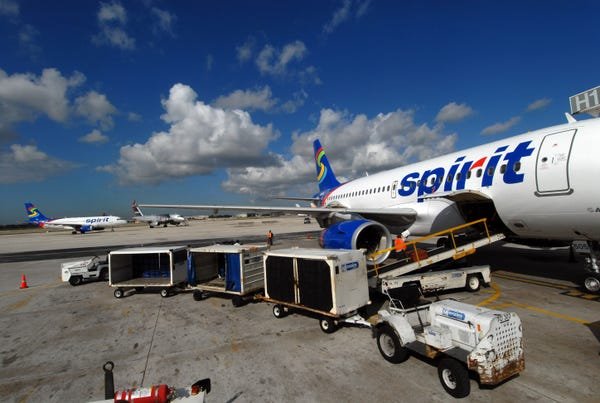
Spirit-could-disappear-from-the-skies-as-fuel-costs-rise.jpeg

Spirit could disappear from the skies as fuel costs rise. See how it rose from a trucking company to a low-cost giant.

Spirit Airlines’ iconic yellow paint job could soon fade from the skies.

CNBC reported on Wednesday that the ultra-low-cost carrier, which has struggled to return to profitability post-pandemic amid changing traveler habits and rising costs, could liquidate as early as this week.

The airline had recently shown signs of progress in its Chapter 11 bankruptcy proceedings — its second since 2024 — but rising fuel costs tied to Middle East conflict are now making that recovery even harder.

A Spirit spokesperson told Business Insider that it doesn’t “comment on market rumors and speculation.”

It’s unclear what would happen if Spirit were to abruptly shutter. Beyond the immediate impact on customers, the airline’s operations would likely cease and its fleet would be grounded.

Any potential outcome would depend on whether a buyer emerges for its assets. JetBlue Airways, which attempted to acquire Spirit for $3.8 billion in 2024 before the deal was blocked by regulators, could revisit a bid.

Other carriers eyeing Spirit’s relatively young aircraft and sizeable East Coast network could also see value, though no formal interest has been announced.

If Spirit were to disappear — the nail in its coffin likely being the oil crisis and rising demand for premium travel it can’t match — it would close the book on a 62-year history.

Spirit started as Clippert Trucking Company in 1964.

Spirit’s livery in 2007. Charter One’s operation in the Bahamas means Spirit has always offered passenger service beyond the US.

Richard Sheinwald/Bloomberg via Getty Images

In 1974, the company was refounded as Ground Air Transport Inc. by Michigan-native Ned Homfeld.

Homfeld eventually founded the first passenger version of Spirit in 1980: Detroit-based Charter One Airlines. The charter tour company officially launched operations in 1983 using turboprop aircraft.

It focused on gambling trips, offering routes to Atlantic City, New Jersey, from Chicago, Detroit, Boston, and Providence, Rhode Island.

As gambling soon became popular in other states, Charter One began ferrying northerners to warmer destinations, including Florida, the Bahamas, Las Vegas, and San Juan.

Scheduled air service officially launched in 1990.


A Convair

Convair 580 turboprop (not Charter One Airlines).

Carlos Yudica/Shutterstock

A decade after its founding, Charter One launched scheduled air service from Boston, Detroit, and Providence to Atlantic City, marking the start of the company’s commercial operations.

Charter One leased two Convair 580 twin-engine turboprops for the service. It would operate the planes for only a couple of years before rebranding to Spirit Airlines.

Charter One became Spirit Airlines on May 29, 1992.


Spirit Airlines McDonnell Douglas MD-80

Spirit Airlines McDonnell Douglas MD-80.

Ivan Cholakov/Shutterstock

Spirit rebranded and added four DC-9 jets to its fleet. The company was able to secure the planes at a low price after the demise of low-cost competitor Midway Airlines brought down used-aircraft prices.

In June, the company launched its first flight from Detroit to Atlantic City, which operated twice daily. The airline’s code is NK for “Ned’s Kids.”

Spirit’s early fleet also included McDonnell Douglas MD-80 aircraft. According to Plane Spotters, 44 DC-9 and MD80 planes were delivered through the 1990s and early 2000s, with the last MD80 leaving the company in July 2010.

Spirit was small but gained early momentum with its staple cheap fares.


The snacks on Spirit

The snacks on a Spirit Airlines flight. The offerings change over the seasons.

Thomas Pallini/Business Insider

Spirit flew more than a quarter-million passengers in 1993 and generated $21 million in revenue. The company’s background as a tour operator helped it fill planes.

The carrier won over customers with cheap fares, powered by its low-cost business model in which everything beyond an unassigned seat — even water — cost extra. This secured lucrative ancillary revenue.

Legacy airlines with higher operational costs were often forced to slash fares to stay competitive when Spirit entered the market. This exacerbated the financial strains of the 1990s.

Spirit thrived as legacy airlines struggled during the 1990s recession.


Pan Am flight attendant serving drinks on the company's 747.

A Pan Am flight attendant seen serving drinks on the company’s 747.

Bettmann/Contributor/Getty Images

The 1990-1991 US recession opened the door for startups to acquire cheap planes and nonunion staff who had been employed by collapsed Pan Am, Trans World Airways, Eastern Air Lines, and Midway.

From 1993 to 1999, Spirit expanded its route network, offering flights to Philadelphia, Orlando, St. Petersburg, Myrtle Beach, Los Angeles, and New York City.

Spirit’s brand was tarnished after a failed deal with Delta Air Lines.


Spirit's catch the spirit livery.

The “Catch the Spirit” livery.

Mark Kopczak/Airliners.net

Delta’s defunct regional carrier, Comair, wanted to buy Spirit for $20 million in the mid-1990s. The deal was part of Spirit’s attempt to find a home in a bigger organization to help it expand amid growing competition.

The deal never materialized. Comair pulled out after a budget carrier, ValuJet, crashed into the Everglades in 1996, which created a stigma about the safety of low-cost airlines.

To address customer concerns, Spirit sent thousands of postcards to reassure customers about the safety of its planes.

It also launched a “Catch the Spirit” media campaign that included TV, radio, and billboard ads to sell Spirit’s perfect safety record and involved adding a new logo to its aircraft.

It took advantage of Northwest’s pilot strike.


Northwest pilot strike.

In 1998, pilots at Northwest, which merged with Delta in 2008, went on strike, leading to thousands of flight cancellations.

JEFF KOWALSKY/AFP via Getty Images

Spirit recorded a loss in 1996, mostly due to a 25% rise in fuel prices, consumer hesitation to fly low-cost carriers, and some legacy carriers matching Spirit’s fares and pushing it out of key markets.

However, Spirit’s planes began filling again in 1997. In June of that year, Spirit took over defunct carrier Sun Jet’s routes from New Jersey to Florida. It also acquired more planes to take advantage of Northwest’s 1998 pilot strike that grounded the rival for weeks.

That year, Spirit reported revenue of $121 million, had 20 aircraft in its fleet, posted the industry’s highest load factor at 76.4%, and carried 1.4 million passengers, an increase of 80% from 1997.

Spirit moved its headquarters to Florida in 1999.


Spirit Airlines headquarters in Mirimar, FL

Spirit Airlines is headquarted in Miramar, Florida.

Joe Raedle/Getty Images

The airline had been courted by several other cities, including Detroit and Atlantic City, before making its move from Eastpointe, Michigan to Miramar, Florida.

Miramar made sense because it was in the Fort Lauderdale area where Spirit’s tour company was already based, and the airline had been serving Fort Lauderdale-Hollywood International Airport since 1993.

It still has a stronghold in the city, though it has trimmed capacity in recent years to optimize its network and better manage costs.

Spirit began growing its Airbus A320 fleet in 2002.


Spirit Airlines plane in San Juan, Puerto Rico

The first livery was greyscale, the second was a blue paint scheme, and the third and most recognizable is the all-yellow “Bare Fare” livery introduced in 2014.

RICARDO ARDUENGO/Getty Images

It’s still the only aircraft family in its fleet today, and it’s relatively young at an average of eight years. The planes are no-frills with only economy seats and a few rows of premium loungers.

Spirit continued to expand throughout the 2000s. It added San Juan, Puerto Rico in 2001. Boston, Grand Cayman, and San Francisco were added in 2006.

The airline has rebranded its premium seats over the years.


Flying Spirit Airlines across the US — Spirit Airlines Flight 2021

A Spirit Airlines flight from Santa Ana, California to Newark, New Jersey.

Thomas Pallini/Insider

In 2007, the airline rebranded its “first class” as the Big Front Seat, which passengers can secure for an extra fee.

Spirit has since further revamped its most expensive seats, adding legroom, wider seating, and bundled perks to lure more premium flyers.

It’s part of a wide industry focus on premium revenue as flyers remain willing to pay up for comfort.

The last US pilot strike was by Spirit pilots in 2010.


Spirit Airlines pilot strike

Pilot strikes are rare because the Railway Labor Act makes it extremely difficult.

Joe Raedle/Shutterstock

The strike occurred amid poor wages and benefits, leading to thousands of flight disruptions.

At the time, Spirit crews were among the lowest-paid pilots in the US despite flying the same planes as their higher-paid counterparts at other airlines.

Spirit was the first airline to charge for carry-on bags.


Spirit Airlines bag size checker

Spirit Airlines bag size checker.

EQRoy/Shutterstock

The move reduced its operating costs because the resulting fewer overall bags lowered the aircraft’s fuel consumption. It also sped up the boarding process and freed up overhead bin space.

The à la carte model became its bread and butter.

In 2011, the carrier began charging for boarding passes printed at the airport ticket counter and reduced its maximum checked baggage weight from 50 to 40 pounds.

Spirit’s no-frills strategy has been controversial throughout its history.


Flying Spirit Airlines across the US — Spirit Airlines Flight 2021

A Spirit ticketing kiosk.

Thomas Pallini/Insider

In 2008, Spirit was the number one airline for customer complaints. It still managed to fly five million passengers and achieve a net profit during the recession, making it one of the few carriers to do so.

In 2011, the Department of Transportation fined the airline $50,000 for what it described as deceptive advertising, claiming it did not disclose hidden fees, like baggage.

In 2014, Spirit was the top airline pick for growth among investors, and in 2016, Spirit was the first US carrier to add the A320neo to its fleet.

By 2019, Spirit was consistently profitable and popular.


Spirit Airlines in the Caribbean

Spirit Airlines in the Caribbean

Skycolors/Shutterstock

It had become a budget leader and consistently turned a profit as people sought cheap vacations and didn’t mind a bare-bones experience.

By 2019, the airline was operating 600 daily flights to 72 destinations across the US, Mexico, Central America, and the Caribbean.

The pandemic changed everything.

Spirit was hit hard during the coronavirus pandemic.


Spirit Airlines passengers during the pandemic

Spirit took advantage of people with more limited budgets during the pandemic who still wanted to travel.

PATRICK T. FALLON/Getty Images

Spirit recorded a 2020 net loss of $428 million. Nevertheless, Spirit expanded operations with new city pairs and airports in 2021.

It ended the year with what it described as a “better than expected” operating revenue, despite the mix of poorly timed weather, system outages, and staff shortages that left thousands of customers stranded.

The customer outrage led to a warning from regulators. Still, Spirit continued to improve in 2022, reporting strong ancillary revenue in the first quarter. Things appeared to be moving back toward how they were in 2019.

Changing traveler habits derailed everything.


Spirit's barebones planes.

Spirit planes are still largely barebones, with some rows now offering more legroom and perks.

Thomas Pallini/Business Insider

Airlines have been doubling down on premium revenue as flyers remain willing to pay extra for better comfort across all cabins. This prompted Spirit to rethink its all-economy strategy.

It started bundling its fares and offering premium seating to lure more customers, but its “first class” seat still pales in comparison to the amenity-stuffed loungers on rivals like Delta and United.

In its latest update, it said it would continue to focus on high-demand routes, reduce its debt, and have just 80 aircraft by late 2026 — down from over 200 at its peak.


Source link

The-rise-fall-and-revival-of-Victorias-Secret-Americas-biggest.jpeg

The rise, fall, and revival of Victoria’s Secret: America’s biggest lingerie brand brings sexy back

Updated

  • Victoria’s Secret is the largest lingerie retailer in the US, and has been for several decades.
  • After explosive success, it had several stumbles but has since overhauled its brand image.
  • In 2025, the company reported its strongest year in sales growth since it split from L Brands.

Victoria’s Secret is back.

The lingerie retailer has been an industry leader in the US for several decades. But in recent years, it has faced sluggish sales, criticism for its lack of model diversity and size inclusivity, scandal over its former CEO’s ties to Jeffrey Epstein, and an overhaul of its brand image.

Things have been looking up for Victoria’s Secret since it hired a CEO, Hillary Super, who previously led Savage x Fenty, in 2024.

On March 5, the company reported that comparable-store sales rose 5% in fiscal 2025. This marked the company’s strongest sales growth since its split from L Brands in 2021.

CEO Super has brought back the Victoria’s Secret fashion show that was once broadcast annually, and said she isn’t shying away from sex appeal. She told The Wall Street Journal that the brand became “watered down” by trying not to offend anyone.

Here’s a look at Victoria’s Secret’s rise and fall and the brand’s plan for redemption. 

Victoria’s Secret was founded in 1977 by American businessman Roy Raymond.

Roy Raymond (left).

Wikimedia Commons

Inspired by an uncomfortable trip to a department store to buy underwear for his wife, Raymond set out to create a place where men would feel comfortable shopping for lingerie. He wanted to create a women’s underwear shop that was targeted at men.  

He named the brand after the Victorian era in England, wanting to evoke the refinement of this period in his lingerie.


Victoria Secret vintage catalog 1982

Victoria’s Secret vintage catalog 1982.

Victoria’s Secret

Raymond’s vision was summed up by Slate’s Naomi Barr in 2013: “Raymond imagined a Victorian boudoir, replete with dark wood, oriental rugs, and silk drapery. He chose the name ‘Victoria’ to evoke the propriety and respectability associated with the Victorian era; outwardly refined, Victoria’s ‘secrets’ were hidden beneath.”

He went on to open a handful of Victoria’s Secret stores and launched its famous catalog. 

By 1982, the company was making more than $4 million in annual sales, but according to reports, it was nearing bankruptcy at the time.


Les Wexner

Les Wexner (center).

Getty/Astrid Stawiarz / Stringer

At this point, Les Wexner swooped in. Wexner, who founded L Brands (formerly Limited Brands), was already making a name for himself in the retail world as he gradually built up an impressive empire.

By June 1982, Limited — which had previously acquired Express and Lane Bryant — was listed on the New York Stock Exchange. One month later, under Wexner’s leadership, the company acquired Victoria’s Secret’s six stores and its catalog for $1 million. 

Wexner turned Raymond’s vision on its head, creating a store that was focused on women rather than men.


Les Wexner

Wexner wanted to create affordable lingerie that looked luxurious.

Nicholas Hunt/Getty

He was closely following the European lingerie market of that time and wanted to bring this aesthetic to the US. So, he set out to create a more affordable version of the European upscale brand “La Perla” — lingerie that looked luxurious and expensive but was affordable.  

And it worked. By the early 1990s, Victoria’s Secret had become the largest lingerie retailer in the US.


Victoria's Secret runway show

Victoria’s Secret spring lingerie collection in New York, February 6, 1996.

AP Photo/Adam Nadel

It had 350 stores nationally and sales topping $1 billion, The Telegraph reported.

The brand began to cement its image over the next few years. In 1995, its famous annual fashion show was born.


Ed Razek

Ed Razek.

AP Photo/Terry Gilliam

The show, which was run by Ed Razek (longtime chief marketing officer of L Brands), became an iconic part of the brand’s image. 

Razek and his team were responsible for hand-picking the models to walk the show. Because of this, he became one of the most important people in the modeling world, helping to launch the careers of Gisele Bündchen, Tyra Banks, and Heidi Klum. 

In 1999, the show aired for the first time online.


Victoria's Secret

Model Tyra Banks at Victoria’s Secret fashion show on Wednesday, February 3, 1999, in New York.

AP Photo/Mark Lennihan

Time described it as the “internet-breaking moment” of this era after 1.5 million viewers tried to tune in and crashed the site.

Meanwhile, the brand was also launching some of its best-known and most successful products, including its heavily padded Miracle Bra and Body by Victoria.


Claudia Schiffer shown in a photo display wearing a million dollar diamond miracle bra.

Claudia Schiffer wearing a million-dollar diamond Miracle Bra in a five-story display in New York City, 1996.

Evan Agostini/Getty Images

Body by Victoria was a “blockbuster success” and more than doubled the sales volume of any other bra that Victoria’s Secret had previously launched, Michael Silverstein wrote in his book, “Trading Up.”

Around 1997, the idea of the Victoria’s Secret “Angel” came into play.


Victoria's Secret old

Victoria’s Secret Angels.

Victoria’s Secret

It was after a commercial featuring Helena Christensen, Karen Mulder, Daniela Peštová, Stephanie Seymour, and Tyra Banks ran to promote its “Angels” underwear collection. It was tradition for an Angel to wear a Fantasy Bra at every runway show starting in 1996. They changed each year.

Throughout the ’90s and early 2000s, its commercials featured heavily made-up and scantily dressed Angels.


Victoria's Secret ad 1997

A Victoria’s Secret ad from 1997.

YouTube/Derek Dahlsad

Razek hired the best photographers and television directors in the world to make commercials for the brand. 

The runway shows became more lavish.


Gisele

Gisele Bündchen.

AP Photo/Stephen Chernin

In 2000, model Gisele Bündchen walked the runway in what was then the most expensive item of lingerie ever created, a $15 million diamond-and-ruby-encrusted ‘Fantasy Bra.’

In 2000, Sharen Jester Turney became CEO of Victoria’s Secret Direct and headed up its catalog business.


Sharen Jester Turney

Sharen Jester Turney is in the center.

AP Photo/Richard Drew

According to reports at the time, Turney wanted to remove the “hooker looks” in the catalog and make the aesthetic more like Vogue than Playboy.

She became CEO of the whole brand in 2006.


Sharen Jester Turney and VIctoria's Secret models

Turney with a group of Victoria’s Secret models.

Dimitrios Kambouris/Getty Images

Under her nine-year tenure, the company thrived; sales increased by 70% to $7.7 billion.

Turney abruptly stepped down in 2016 and was succeeded by Wexner as interim CEO.


Les Wexner

Les Wexner took over after Turney abruptly left.

Jay LaPrete/AP

Wexner made a series of quick and fast changes: killing the catalog, swimwear, and apparel to focus solely on lingerie, the core part of its business.

He also split the brand into three — Victoria’s Secret Lingerie, Victoria’s Secret Beauty, and Pink — and recruited a CEO for each division.

Jan Singer became CEO of Victoria’s Secret Lingerie in September 2016.


Jan Singer

Jan Singer took the job in 2016.

Courtesy of Spanx

Singer spent over a decade at Nike and was CEO of Spanx before she joined Victoria’s Secret. 

Between 2015 and 2018, sales began to falter.


Victoria's Secret

A Victoria’s Secret store in New York.

AP Photo/Mary Altaffer

Victoria’s Secret was slow to adjust to a shift from padded and push-up bras toward bralettes and sports bras, missing out on a major fashion trend. 

More body-positive underwear brands such as Aerie, ThirdLove, and Lively cropped up, taking market share.


Aerie

Brands like Aerie began to threaten Victoria’s Secret.

Facebook/Aerie

Victoria’s Secret was accused of failing to adapt to the times. Between 2016 and 2018, its market share in the US dropped from 33% to 24%. Some shoppers complained that the quality of its underwear had slipped.

One of its biggest assets, the teen-centric brand Pink, also began to struggle. Sales slipped, and it resorted to heavy discounting to woo shoppers.


PINK

Pink, a more teen-focused brand, also suffered.

Business Insider/Mary Hanbury

“We believe Pink is on the precipice of collapse,” Jefferies analyst Randal Konik wrote in a note to investors in March 2018, commenting on the level of promotions in store.

Some parents complained that Pink was being brought down by Victoria’s Secret’s over-sexualized ads.

Its annual fashion show drew criticism for being outdated, and viewership slipped.


Victoria's Secret

Its 2018 fashion show didn’t get quite the fanfare it had gotten in the past.

AP Images

In November 2018, Ed Razek, then-chief marketing officer of L Brands, made controversial comments about transgender and plus-size models.

Razek said in an interview with Vogue that he didn’t think the show should feature “transsexuals” because the show is a “fantasy.”


victoria's secret ed razek

Ed Razek spoke to the 2018 Victoria’s Secret runway models backstage during the 2018 Victoria’s Secret Fashion Show.

Getty Images/Dia Dipasupil

“It’s a 42-minute entertainment special. That’s what it is,” he said in the interview.

Razek made a formal apology online, but some of his critics called for him to step down. 

Barington also called out the lack of diversity in its board of directors as an issue for the brand. At the time, of the 11 board members, nine were men.


Les Wexner

Wexner and his wife, Abigail, both sat on the board of directors.

AP Photo/Jay LaPrete

The company appointed two new female board directors — Sarah E. Nash and Anne Sheehan — and made steps to address the comments about the brand image being outdated. 

It hired a more body-inclusive model.


Barbara Palvin

Hungarian model Barbara Palvin.

Charles Sykes/Invision/AP

While she is not a plus-size model, fans praised the company for choosing Hungarian model Barbara Palvin as one of its newest Angels.

Instagrammers celebrated a post starring Palvin for being more body-inclusive, as they perceived her to be curvier than some of the brand’s other models.

“This model actually looks healthy..& I’m loving it!” one Instagram user wrote.

It also hired its first openly transgender model.


Model Valentina Sampaio

Sampaio signed with Victoria’s Secret in 2019.

Arturo Holmes/Getty Images for Victoria’s Secret

Brazilian transgender model Valentina Sampaio, shared a photograph of herself on Instagram in August 2019, tagging the Victoria’s Secret Pink brand along with the hashtags: “campaign,” “vspink,” and “diversity.”A day later, she shared a video of herself with the caption “Never stop dreaming.”

Her agent later confirmed that she had signed a contract with Victoria’s Secret. Sampaio is expected to hit the runway for the 2024 show.

“Today Is the day!!! Finally after 6 years since my first VS casting, today the dream will come true,” she wrote in an Instagram post ahead of the show.

The same day, Wexner announced that Razek would be resigning in the middle of August in a memo sent out to employees.


leslie wexner ed razek

Razek resigned the same day Victoria’s Secret signed a transgender model.


Astrid Stawiarz/Getty Images for Fragrance Foundation


Razek ran the fashion show, so its future seemed unclear at the time of his departure. 

On November 21, 2019, the company confirmed that it had officially canceled its runway fashion show for that year.


VS fashion show

Wexner previously told employees in May that Victoria’s Secret was “rethinking” the show.

Dimitrios Kambouris/Getty Images

At the time, L Brands CFO Stuart Burgdoerfer told analysts that the fashion show had little impact on boosting sales at the brand. 

While these were potentially positive changes, the brand found itself caught up in a new challenge in the summer of 2019: its CEO and the company being linked to convicted sex offender Jeffrey Epstein.


Epstein/Wexner

Les Wexner (L) and Jeffrey Epstein (R).

Astrid Stawiarz and Patrick McMullan/Getty Images

Epstein managed Wexner’s money for several years, and former company executives told The Wall Street Journal that he tried to meddle in Victoria’s Secret’s business, offering input on which women should be models.

Some of Epstein’s victims came forward saying that he used his connection to Victoria’s Secret to coerce them into sexual acts.

L Brands’ board of directors announced that it had hired an outside law firm to review its relationship with Epstein, who died by suicide in jail in August 2019.

In September, Wexner addressed his ties to Epstein at L Brands’ investor meeting. “At some point in your life we are all betrayed by friends,” Wexner said. “Being taken advantage of by someone who was so sick, so cunning, so depraved, is something that I’m embarrassed I was even close to. But that is in the past.”

In February 2020, the company announced that Wexner would be stepping down as chairman and CEO of L Brands.


Les Wexner painting

Wexner stepped down in 2020.

Jay LaPrete/AP Images

Still, he’d stay on as chairman emeritus and sit on the board of directors. At the same time, it announced that it was selling a 55% stake in Victoria’s Secret to private equity firm Sycamore Partners.

In a statement to the press announcing the news, Wexner said that Sycamore has “deep experience in the retail industry and a superior track record of success,” and that it “will bring a fresh perspective and greater focus to the business.”

In March 2020, the coronavirus pandemic swept across the US, and Victoria’s Secret was forced to shutter its stores.


Victoria's Secret

Stores close during the COVID-19 pandemic.

Victoria’s Secret

In April 2020, Sycamore filed a lawsuit to back out of the deal, alleging that Victoria’s Secret’s actions taken during the pandemic to close stores, cut back on new inventory, and not pay rent for the month of April were in violation of the agreement that the two parties had made in February.

L Brands immediately issued a statement saying that a termination of the agreement is “invalid,” and that it would “vigorously defend” the lawsuit and “pursue all legal remedies to enforce its contractual rights.”

On May 4, 2020, L Brands announced that the deal with Sycamore had officially fallen apart.


Victoria's Secret

The Sycamore deal falls through.

REUTERS/Brendan McDermid

L Brands said that it had come to a “mutual agreement” with Sycamore to “terminate” the deal.

The company also said that it had reshuffled its management team and would focus on “implementing significant cost reduction actions and performance improvements at Victoria’s Secret.”

This included permanently closing as many as 250 Victoria’s Secret and Pink stores in the US and Canada in 2020.

In the second half of 2020, the brand started to recover, boosted by more sales online.


Victoria's Secret

Victoria’s Secret becomes a standalone company.

Mike Kemp/In Pictures via Getty Images

Jefferies analysts described Victoria’s Secret’s progress as “admirable” after it reported strong fourth-quarter earnings in early 2021. 

Bloomberg later reported that L Brands had resumed discussions to sell the brand once more and was seeking a much higher valuation in the region of $3 billion.

But in May of that year, L Brands put an end to speculation and said that it was no longer looking for a buyer. Instead, it would split the company into two and spin off Victoria’s Secret to become a stand-alone business.

It then worked hard to execute a turnaround under new leadership.


Priyanka Chopra Jonas

Priyanka Chopra Jonas.

Courtesy Dan Schawbel

It overhauled its brand image — swapping its Angels for a new group of activists and entrepreneurial women to be the face of the brand.

In 2022, a three-part documentary series on Hulu titled “Victoria’s Secret: Angels and Demons” shook up the brand in the public’s eyes.


Jeffrey Epstein.

Jeffrey Epstein had connections to Les Wexner.


Kypros/Getty Images


The series delved into Wexner’s ties with Jeffrey Epstein and said that questions remained about the nature of their relationship.

In the background, the company was continuing with its turnaround effort by launching new ventures such as Happy Nation, a brand that sold first bras and apparel to pre-teen shoppers.


Happy Nation

Happy Nation.

Happy Nation

It also began selling Victoria’s Secret beauty products and underwear on Amazon. 

In March 2023, the company said its annual fashion show would return after a four-year hiatus.


Kate Grigorieva

Victoria’s Secret model Kate Grigorieva.

Getty Images

The company is constantly innovating “in all spheres of the business,” a spokesperson for Victoria’s Secret previously told Business Insider, adding: “This will lead us into new spaces like reclaiming one of our best marketing and entertainment properties to date and turning it on its head to reflect who we are today.”

Its “reimagined” fashion show premiered in September 2023.


Lila Moss attends the Victoria's Secret red carpet on September 6, 2023.

Lila Moss attended the Victoria’s Secret red carpet on September 6, 2023, in an Angel-inspired look.

Taylor Hill/Getty Images

The show received mixed reactions. Although Victoria’s Secret was praised for its attempt to appeal to a wider audience, it lacked one important aspect for a fashion show: a runway.

Instead, the live fashion event was a premiere, of sorts, for the film, which was released on Prime Video days later. 

Victoria’s Secret took a similar approach to the old ways for the 2024 fashion show.


Gigi Hadid for Victoria's Secret

Prominent models in the industry donned wings and walked the runway.

Mike Coppola/Getty Images for Victoria’s Secret

The fashion show featured musical guests, including Cher and K-pop star Lisa, as well as a runway presentation — similar to how it was done before the 2019 cancellation.

It closed out the brand’s third quarter of 2024, during which it reported a 7% year-over-year increase in net sales. Victoria’s Secret told investors that the show also earned it more than 4 million new TikTok followers.

“In addition to driving brand awareness leading into holiday, the show drove brand relevance, putting VS at the center of culture and fashion conversations,” CEO Hillary Super said at the time. Super took on the role in September 2024.

Super’s first holiday season showed promise, but 2025 also brought the threat of tariffs.


Iris Law for Victorias Secret

Models, influencers, and athletes will grace the runway in 2025.

Dimitrios Kambouris/Getty Images for Victoria’s Secret

Victoria’s Secret appeared to have a happy holiday in 2024 under the leadership of its new CEO, with its operating income exceeding expectations and comparable sales bumping 5%.

“After my first holiday season with the business, I continue to be optimistic about our future, our opportunity to further differentiate the brands with compelling storytelling and make even deeper emotional connections with our customers,” Super said on an earnings call.

However, in 2025, Victoria’s Secret also faced the financial challenges posed by tariffs on countries like China. The company said in June 2025 that it would cut back on promotional sales as tariffs affected business.

In the end, 2025 beat expectations.


Hillary Super at the 2025 Victoria's Secret Fashion Show held at Steiner Studios on October 15, 2025 in New York, New York. (Photo by Kristina Bumphrey/Variety via Getty Images)

Hillary Super oversaw Victoria’s Secret’s best year in half a decade in 2025.

Kristina Bumphrey/Variety via Getty Images

On March 5, the company reported a 5% increase in sales for fiscal 2025, marking its strongest year since splitting from L Brands in 2021 and beating analyst expectations.

“We delivered an exceptional fourth quarter and a standout year,” CEO Super said in a statement.

“We enter fiscal 2026 from a position of strength. With a clear brand vision, a faster and more agile operating model, and a strong pipeline of product and brand moments ahead,” she added.

Super has been credited with revitalizing the company by re-embracing its “sexy” image in our more inclusive way. Her turnaround effort has also focused on owning the bra category and growing its teen brand, Pink, and beauty division.


Source link

The-rise-and-fall-of-American-vinyl-manufacturers.jpeg

The rise and fall of American vinyl manufacturers

Vinyl has made a record-breaking comeback, with sales now outpacing those of CDs and mp3 downloads. It is now the music industry’s highest-grossing physical format.

We visited the world’s biggest vinyl factory, GZ Media, in the Czech Republic to find out how it became the largest manufacturer in the industry, as well as a smaller pressing plant in New Jersey to see how US factories are staying afloat despite cutthroat competition.


Source link

Heart-disease-is-on-the-rise-in-younger-adults-A.jpeg

Heart disease is on the rise in younger adults. A cardiologist says prevention needs to start sooner.

You wouldn’t wait until your 50s to start saving for retirement — so why wait until your heart is already at risk to start protecting it?

Heart disease is spiking among younger people, in part because people in their 20s, 30s, and 40s are procrastinating on their health, according to Dr. Sadiya Khan.

Khan, a professor of cardiovascular epidemiology at Northwestern University, told Business Insider that changes to your diet and exercise habits now can pay big dividends as you age.

“You can’t just become older and then hope to make all these changes,” she said.

The earlier you understand your heart health, the better equipped you are to make healthy decisions for future you.

Your heart may be aging too quickly

Right now, most of us are behind in our investments to our cardiovascular health. The average American’s heart is 4 to 7 years older than their calendar age, according to Khan’s research.

“All of us are naturally driven to procrastinate,” she said. “You try to worry about the things that are immediately in front of you, and it’s harder to prioritize and give as much attention to something that is a long-term consequence.

An online tool, developed by Khan and her team, helps forecast a person’s risk of heart attack or stroke over the next 30 years by illustrating how they stack up to their peers. It shows their percentile rank for heart health: in other words, out of 100 people the same age and sex, how many have a higher or lower risk of cardiovascular disease.

Khan said the new tool uniquely uses percentiles to help people manage their health by understanding their risk and making changes if needed. Patients can then prioritize which habits provide the best bang for their buck in terms of health benefits, starting with what Khan recommends most.

How to invest in your heart health now

Khan said a big challenge with heart health is that it can be highly individualized. All the factors involved — diet, exercise habits, genetics, and stress — can vary widely from person to person.

“It’s not going to be a one-size-fits-all,” she said. “It’s this overarching goal that we need to personalize how we communicate risk and how we can share that information in a way that works for each patient.”

That makes it hard to recommend a specific game plan to boost everyone’s heart health. However, there are a few strategies that can pay off for most people.

  • Stop smoking. It may seem obvious, but if you’re a smoker even occasionally, quitting is one of the most effective ways you can reduce heart health risks (and yes, smoking cannabis is bad for your heart, too).
  • Get your steps in. Exercise helps strengthen the heart and stave off age-related disease, and most of us don’t get enough. Walking an extra 500 steps a day can help start building better fitness from the ground up. Short bursts of high-intensity movement quickly add up for better health.
  • Lift weights. Strength training is increasingly linked to better longevity, and movements like squats and deadlifts or at-home exercises like push-ups or wall sits can support a strong heart.
  • Eat more beans. Most of us could benefit from eating more nutrients like fiber that protect heart health. Affordable foods like whole grains and beans offer protein, fiber, and nutrients to fuel better heart health. Plant-based whole foods also help to keep you full, making it easier to cut back on sweets and processed foods that can be hard on your heart.
  • Take a tai chi break. It’s no secret that stress can be harmful, and over time, it can take a major toll on your heart. Relaxing habits like spending time outdoors and doing yoga or tai chi help to lower your blood pressure and reduce cardiovascular strain. Getting enough quality, consistent sleep is crucial, too.

For best results, try to make small, sustainable changes that you can keep up over time.

“It depends on what works for you and what you are able to stick with,” Khan said. “They all matter, but you don’t also need to do it all at once.”


Source link

Inside-the-rise-fall-and-resurrection-of-Toys-R-Us.jpeg

Inside the rise, fall, and resurrection of Toys R Us, the chain that once commanded a quarter of the toy market

  • Toys R Us opened pop-up stores at some US malls this holiday season.
  • The retailer has been the subject of multiple revival efforts since it ended operations in 2018.
  • Here’s a look at the history of Toys R Us, from its founding to zombie-brand status.

Toys R Us is back — again.

The latest phase of the toy store chain’s comeback came this holiday season as Toys R Us stores popped up at a handful of malls around the US. The temporary stores are part of a broader revitalization opportunity by brand management company WHP and Go! Retail Group.

It’s the latest example of how the once-dominant chain is trying to make a comeback.

Toys R Us used to operate around 700 stores in the US. Then, after years of faltering financial results, the chain filed for Chapter 11 bankruptcy before deciding to liquidate and close its operations in 2018.

Since then, there have been multiple efforts to revive the brand, including opening locations within Macy’s department stores and teaming up with Amazon.

Here’s a closer look at the history of the historic toy company, from its founding just after World War 2 to the revival attempt.

Toys R Us was founded in 1948 by Charles Lazarus after he returned from World War II.

Charles Lazarus in front of an early Toys R Us store.


Mike Derer/AP


Lazarus was inspired by what was then the emerging post-war “baby boom” and sought a way to capitalize.

The company started as a baby goods and furniture store called Children’s Bargain Town in Washington, D.C.


toys r us store

Toys R Us had a different name when Lazarus founded the chain.


Mario Tama/Getty Images


In the subsequent years, Lazarus began expanding into toys and the company officially adopted the name Toys R Us in 1957.

Over the next two decades, Toys R Us played a significant role in putting iconic toys on the map for American youngsters, such as Mr. Potato Head.


mr potato head

Former NBA player Allen Iverson holds up a Mr Potato Head toy.

AP Photo/William Thomas Cain

Lazarus was able to corner the market by buying and selling so many toys that he could negotiate more lucrative contracts than his competitors.

The company was also known for bringing big names in for promotional events or philanthropic work, such as NBA Hall of Famer Magic Johnson.


toys r us magic johnson

Magic Johnson greets kids at a Toys R Us event.


AP Photo/Thomas Kenzle


Kids and their parents would line up for hours to meet their favorite stars — and do a little shopping while they were there.

In 1966, Lazarus sold the company to Interstate Sales to help finance a larger national expansion.


charles lazarus

Lazarus appears in front of a selection of toys with former President George HW Bush.


AP Photo/File


According to Encyclopedia.com, he transitioned from chief executive to head the Toys R Us division, which was already thriving at profits of $12 million.

In 1969, Toys R Us developed its beloved Geoffrey the Giraffe character.


geoffrey the giraffe

Toys R Us still uses Geoffrey as its mascot.


AP Photo/Seth Wenig


The mascot became synonymous with the brand and its advertising campaigns over the decades.

In 1974, parent company Interstate Sales filed for bankruptcy.


toys r us giraffe

A sign outside of a Toys R Us store.


Justin Sullivan/Getty Images


Lazarus handled the restructuring process, according to USA Today.

Lazarus sold off struggling pieces of the business and got the company back on track.


toys r us 1993

A customer walks over a large floor sticker featuring Geoffrey the Giraffe.


AP Photo/Daniel Hulshizer


In 1978, it was able to file its initial public offering.

In 1983, the company opened a clothing store spinoff called Kids R Us.


kids r us

Kids R Us was one of multiple spin-off brands that Toys R Us launched.


AP Photo/Marty Lederhandler


The Toys R Us empire was steadily expanding.

Lazarus eventually stepped down as chief executive in 1994.


toys r us 1990

Turtle Mania hit Teesside today, at the opening of the new Toys R Us at Teesside Shopping Park, Sandown Way, Stockton on Tees. 6th October 1990. Pictured, Emma Michelle Todd after opening the store.

Getty Images

The move signified a series of woes for the brand, including high executive turnover and the looming pressure of ecommerce.

Building upon the success of Kids R Us, the company expanded into baby clothing with Babies R Us in 1996.


babies r us


AP Photo/Julio Cortez


The stores saw success with selling baby-related merchandise.

In the 1990s and early aughts, Toys R Us began expanding into major cities like New York.


Toys R Us store 1990


AP Photo/Richard Drew


In the Big Apple, Toys R Us opened its iconic multi-story store with a fully functioning Ferris wheel in 2001.

Around this time, Toys R Us and its spinoff brands began to experience mounting competition from fellow big-box stores like Walmart and Target.


Toys R Us black friday


Tom Pennington/Getty Images


In fact, according to The Associated Press, in 1998, Walmart had already surpassed the company as the top US toy seller.

The mounting competition led to the eventual closure of Kids R Us.


kids r us


Tim Boyle/Getty Images


All 146 Kids R Us stores were closed in 2003.

In 2005, a conglomerate of private equity firms — including Bain Capital, Kohlberg Kravis Roberts, and Vornado Realty Trust — purchased Toys R Us for $6.6 billion, taking the company private in the process.


toys r us exterior


Getty

According to USA Today, the plan was to boost Toys R Us sales and position the company for a stock offering that would allow investors to cash out.

In an attempt to compete with the ecommerce boom, the company purchased Etoys.com and Toys.com in 2009.


fao schwarz 2640


Business Insider/Jessica Tyler

That same year, it bought KB Toys and the famed New York City toy store, F.A.O. Schwarz.

In 2010 the company registered once again to go public.


toys r us


Stan Honda/AFP via Getty Images


However, by 2013 it withdrew from the process due to sales slumps, according to USA Today.

In 2015, Dave Brandon – formerly the CEO of Domino’s Pizza — took over the helm of Toys R Us.


david brandon


AP Photo/Tony Ding


According to USA Today, Brandon marked the fourth CEO over the course of 16 years “tasked with turning the company around.”

Still, the company continued to struggle, especially during the 2016 holiday season.


toys r us bikes


Joe Raedle/Getty Images


According to Business Insider, the chain lost significant traction to ecommerce giants like Amazon, Target, and Walmart.

The company officially filed for Chapter 11 bankruptcy protection in September 2017.


Toys R Us shopper


Richard Drew/AP Images

The chain hoped to gain control of its debt and continue to operate its 1,600 stores around the world as normal, according to the Washington Post.

With its hopes for a financial savior ultimately dashed, Toys R Us announced in March 2018 that it would liquidate and permanently close all of its 700-plus stores across the US.


toys r us closing


AP Photo/Julio Cortez


According to Business Insider, the decision threatened the jobs of the 33,000 people employed by Toys R Us at the time.

That same year, the company issued an emotional goodbye as it prepared to permanently shutter its Toys R Us and Babies R Us websites.

“We encourage you to stop by your local store and take full advantage of the deep discounts and deals available,” the message read. “Thank you for your business and support over the years.”

It was later announced that gift-card holders could use any remaining funds at Bed Bath & Beyond stores, according to Business Insider.

The CEO of the toy company MGA Entertainment issued a last-minute bid of $890 million to save the company.


black friday 2004 Toys R Us


Shannon Stapleton/Reuters

However, the offer was ultimately rejected by Toys R Us.

Throughout the rest of 2018, stores like Walmart began to position themselves to take over the void left behind in the market by Toys R Us.


Walmart, New Jersey

Walmart Supercenter in New Jersey

Rachel Askinasi/Business Insider

The chain strategized to overtake Toys R Us’s legacy by adding mass amounts of baby-related products to its inventory.

By the fall of 2018, abandoned Toys R Us stores had been temporarily converted into Halloween costume shops across the country.


toys r us closing 9006


Business Insider/Jessica Tyler

According to Business Insider, Halloween costume retailers Spirit Halloween and Halloween City set up shop in the abandoned stores but kept most of the remaining Toys R Us signage and wallpaper.

In February 2019, Toys R Us appeared to rise from the dead when Tru Kids Brands purchased the rights to the company.


Toys R Us store front


Courtesy of Tru Kids Brands

Tru Kids Brands also purchased the rights to the Geoffrey the Giraffe mascot with plans to revitalize it.

Later that year, Tru Kids Brands announced it would open a series of holiday pop-up stores under the Toys R Us name.


tru kids

Toys R Us redesigned store rendering.

Tru Kids

The stores would sell popular toys directly from manufacturers, meaning that any sales would directly go to the toy companies rather than Toys R Us.

Read more: Toys R Us is officially back from the dead, but its new stores won’t actually make any money selling toys

In October 2019, the company announced it was back online but with a catch — you couldn’t actually buy anything directly from the Toys R Us site.


toyrs r us dot com


ToysRUs.com


Instead, users would be directed to make purchases from Target’s website.

In fall 2019, empty Toys R Us stores were once again used for Halloween purposes — this time to host haunted houses.


Toys R Us Haunted house


Shoshy Ciment/Business Insider

The haunted houses were a far cry from the joy-filled Toys R Us stores of the 1990s.

In August 2020, it was confirmed that Toys R Us had ended its partnership with Target.


toys r us amazon


Toys R Us


Toys R Us would now partner with Amazon as its fulfillment partner, according to Business Insider.

The coronavirus pandemic decimated in-store sales for many retailers, including Toys R Us.


toys r us store

A Toys “R” Us storefront closed during the coronavirus pandemic.

Andrew Chin/Getty Images

CNBC reported in January 2021 that the retailer was facing hardships due to dwindling in-store sales amid the coronavirus pandemic. As a result, the chain’s last two remaining stores in the US officially shuttered for good, bringing an end to a years-long ordeal to attempt to revitalize the brand.

The final stores were in Texas and New Jersey, Bloomberg reported.

“Consumer demand in the toy category and for Toys ‘R’ Us remains strong and we will continue to invest in the channels where the customer wants to experience our brand,” a Tru Kids spokesperson told CNBC.

Read more: The last 2 Toys ‘R’ Us stores in the US have closed down after the COVID-19 pandemic hit sales

In 2022, Toys R Us announced it was making yet another comeback, by opening in-store shops at Macy’s around the country.


Macy's Toys R Us homepage

Macy’s Toys R Us homepage

Macy’s

The Toys R Us in-store locations opened in time for the holiday season that year.

In 2025, Toys R Us opened pop-up shops in time for holiday shoppers.


The entrance to a Toys R Us store in Maryland.

A Toys R Us pop-up location in Maryland

Alex Bitter/BI

The stores, operated by Go! Retail Group, include eight flagship locations and 20 seasonal pop-ups around the US.

The stores are different from the original Toy R Us locations.


A banner above some calendars at Toys R Us reads:

A selection of calendars sits under a banner at a seasonal Toys R Us store.

Alex Bitter/BI

Although the pop-ups use the Toys R Us name and slogans, they also feature a different product selection compared to the Toys R Us stores of years past, Business Insider found during a recent visit to one store in Maryland. The store included a wide selection of calendars, for example.

While Toys R Us technically still exists, the brand is a shadow of what it once was.


Black friday women

Customers wait in line to enter Toys R Us in Times Square on Thanksgiving evening.

Yana Paskova/ Getty Images

While some shoppers were able to check out the brand’s pop-up stores, the chain has far fewer locations than it did a decade ago.


Source link