
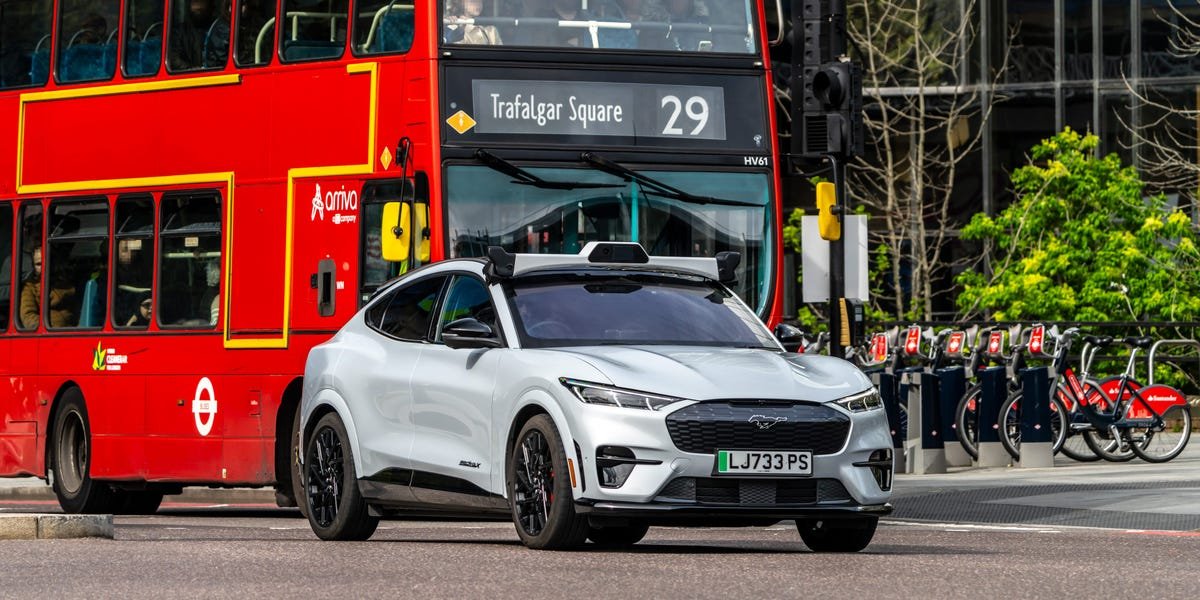
Wayve is revving up its global robotaxi ambitions with fresh funding as it prepares to take on Waymo in London.
The UK-based autonomous vehicle software startup announced early Tuesday in the UK that it had raised $1.5 billion from a host of Big Tech giants and major automakers.
The funding round, which values the startup at $8.6 billion, includes $1.2 billion from investors including Microsoft, Nvidia, and Uber, as well as Mercedes-Benz, Nissan, and Stellantis.
It also includes additional capital from Uber, which is tied to deployments of Wayve-powered robotaxis across the globe. The two companies have a deal to launch self-driving vehicles on Uber’s app in over 10 markets worldwide, starting with London this year.
“We’ve been learning to drive on British roads for the last eight years, and so this is our home turf,” Alex Kendall, CEO of Wayve, told Business Insider in an interview.
The CEO said the latest funding round is key to pursuing the company’s ambition to license its software to major automakers and robotaxi fleet platforms like Uber.
Unlike Tesla or Waymo, Wayve is solely focused on developing software for other companies looking to deploy self-driving cars. It is not building its own fleet of robotaxis.
Kendall said owning a fleet is expensive, and Tesla’s approach to building its own car can be a constraint since it limits the company to one vehicle platform.
“Everyone wants autonomy, but not everyone wants to buy a Tesla,” he said.
Kendall added that Wayve’s AI driver is designed to be generalizable — the same way a human can quickly learn to drive different cars and in new cities.
That allows Wayve’s technology to quickly adapt to new driving environments and learn new road rules, from switching to the opposite side of the road to right turns at a red light, without relying on high-definition mapping and sensors, the approach taken by rivals like Waymo. It also allows the AI driver to be adapted by different automakers, which may have different sensor configurations on their cars, such as lidar or cameras.
“Because that’s what we’ve built, it enables us to take this business model that enables high-margin software revenues,” Kendall said.
Wayve says that over the past year, its fleet of Ford Mach-Es outfitted with its AI driver has driven in more than 500 cities across Europe, North America, and Japan without being trained on city-specific data.
The company is also planning to license its technology to carmakers as an advanced driver-assistance system like Tesla’s Full Self-Driving, which handles most driving tasks with human supervision. Wayve has a deal with Nissan that will see its AI tech power the Japanese carmaker’s ProPilot driver assistance system from 2027.
The UK-based startup has been testing its tech in London since 2017, and its public debut comes as the city’s robotaxi scene gets increasingly crowded.
Waymo is aiming to begin operating its autonomous vehicles in London, its first international location, this year, while Wayve vehicles will be joined on the Uber app by robotaxis from Chinese tech giant Baidu, which is also partnering with Lyft.
