
Rivians-autonomy-chief-says-lidar-is-very-affordable-and-a.jpeg

Rivian’s autonomy chief says lidar is ‘very affordable’ and a ‘no-brainer’ decision

For Rivian’s chief of autonomy, the decision to put in lidar for the EV company’s coming R2 SUV was obvious.

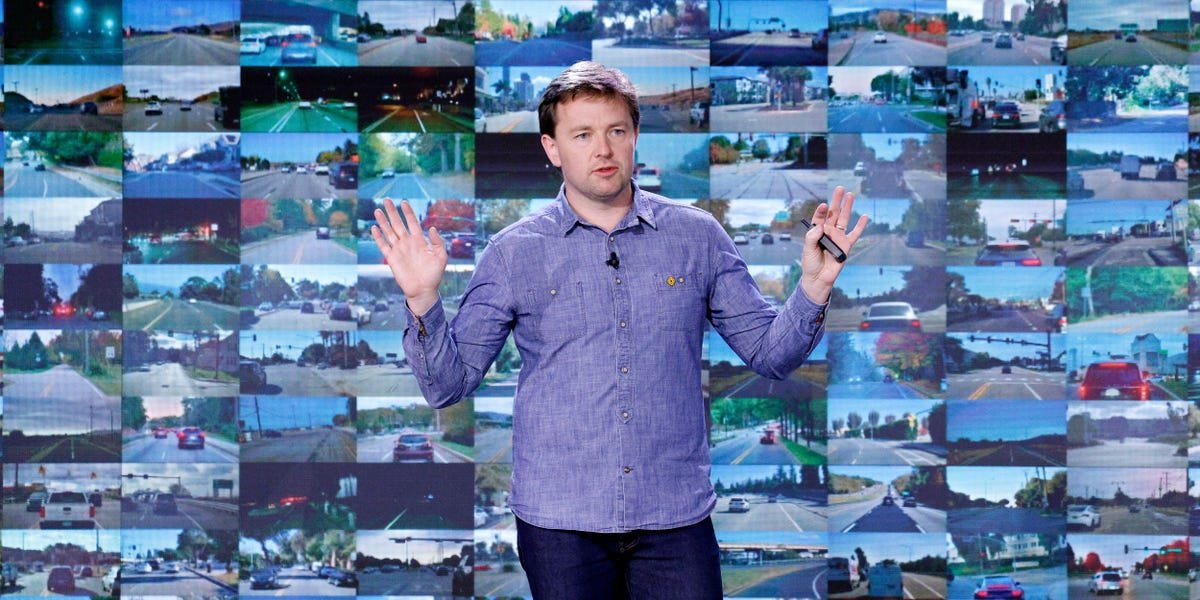
James Philbin, Rivian’s VP of autonomy and AI, told Business Insider that the price of lidar has decreased significantly enough in recent years to be able to put the sensor inside a personally-owned, mass-production vehicle.

“It’s been on this incredible cost curve, where 10 years ago, it would be just unimaginable that you could put a lidar on a consumer vehicle. And now it’s getting into that price point, kind of in the range of a radar,” Philbin said. Radar, a sensor that uses radio waves, is commonly seen in modern cars that have an advanced driver-assistance system (ADAS) or blind spot detection.

Lidar is a sensor that uses laser light to measure depth. While it’s historically been used for topography, the sensor has gained more visibility in the automotive world with the advent of self-driving cars.

Most notably, Waymo’s robotaxis have multiple lidar sensors, including the spinning lidar on the roof of the vehicle. Waymo has said that lidar provides additional safety to the vehicle’s AI driver.

On Thursday, Rivian announced a road map to fully autonomous driving, which includes building an in-house chip and installing a lidar sensor in the company’s coming SUV, the R2.

Philbin, who previously worked at Zoox and Waymo, told Business Insider that lidar makes an autonomous system “more robust” and can help the company get to its self-driving goal “faster.”

“It’s very affordable,” he said. “The performance it gives you for that cost is really amazing. And so to me, it’s kind of a no-brainer that you would want more sensors and more modalities for something that’s so safety critical.”

Using lidar diverges from the strategy of Rivian’s main EV competitor, Tesla, which has taken a strong stance on pursuing self-driving with cameras only.

Tesla CEO Elon Musk once called lidar an expensive “crutch.”

In the late 2000s, during the days of the Google Self-Driving Car Project, a single lidar unit could come with a five-figure price tag. Today, industry leaders say a similar unit could cost a few hundred dollars.

Rivian employees, including Philbin, did not disclose the cost of the lidar unit in the R2 when asked by Business Insider.

R2 will first be launched without the sensor in early 2026. It’s slated to be Rivian’s cheapest car to date, with a starting price of $45,000. The company aims to launch an R2 with lidar in late 2026.

When asked what the cost difference was to put a lidar in the R2, Philbin declined to comment but said that it was “not a significant consideration.”


Source link

Rivians-CEO-said-theres-a-shocking-lack-of-choice-for.jpeg

Rivian’s CEO said there’s a ‘shocking lack of choice’ for EVs in the US

Rivian’s CEO and founder, RJ Scaringe, said the US needs a lot more cheap electric vehicles.

Speaking at the Fortune Brainstorm AI conference in San Francisco on Tuesday, Scaringe said a lack of choices was the reason for low EV penetration in the US.

He said that electric vehicle adoption in the US, at 8%, is significantly lower than in the rest of the world.

“I really think the constraint isn’t the demand side, I think it’s the supply side,” Scaringe said. “I think there’s a shocking lack of choice, that there are much better choices in Europe. And by far, there’s the most choice in China.”

He said that for consumers interested in EVs, there were “well under five great choices” at a price point close to the average price of a new car in the US.

He added that, within a price range of $50,000, there was only one compelling choice of EV: a Tesla. In October, Tesla unveiled its most affordable models to date: the $36,990 Model 3 Standard and the $39,990 Model Y Standard.

“And that’s not a reflection of a healthy market with lots of choice,” Scaringe said. “If you think of it as a consumer, you have 300 different internal combustion engine choices at that price or lower, and you have maybe one highly compelling EV choice.”

Rivian is working to provide cheaper EV alternatives. It is gearing up to start production on its cheapest EV to date, the R2 model, a $45,000 SUV.

In the interview, Scaringe also said he agrees with the Trump administration’s push to bring manufacturing back to the US.

“I think the push to industrialize in the United States is appropriate, and it’s something we’re very aligned with the administration on,” he said.

The US EV industry comprises Rivian, Tesla, Ford, General Motors, Hyundai, BMW, and Kia, among others.

Brands like Volkswagen, BMW, Mercedes-Benz, and Tesla dominate the EV market in Europe. Chinese brands like BYD, NIO, and MG also sell on the continent.

Meanwhile, the EV industry in China is seeing fierce competition. BYD, Tesla’s biggest global rival, saw its sales fall 12% in October compared to the same period a year earlier, as it faces a tough fight from local EV startups Xpeng, Nio, and Leapmotor.

Other players, such as smartphone manufacturer-turned EV maker Xiaomi, are also seeing success in the country with strong sales.


Source link