
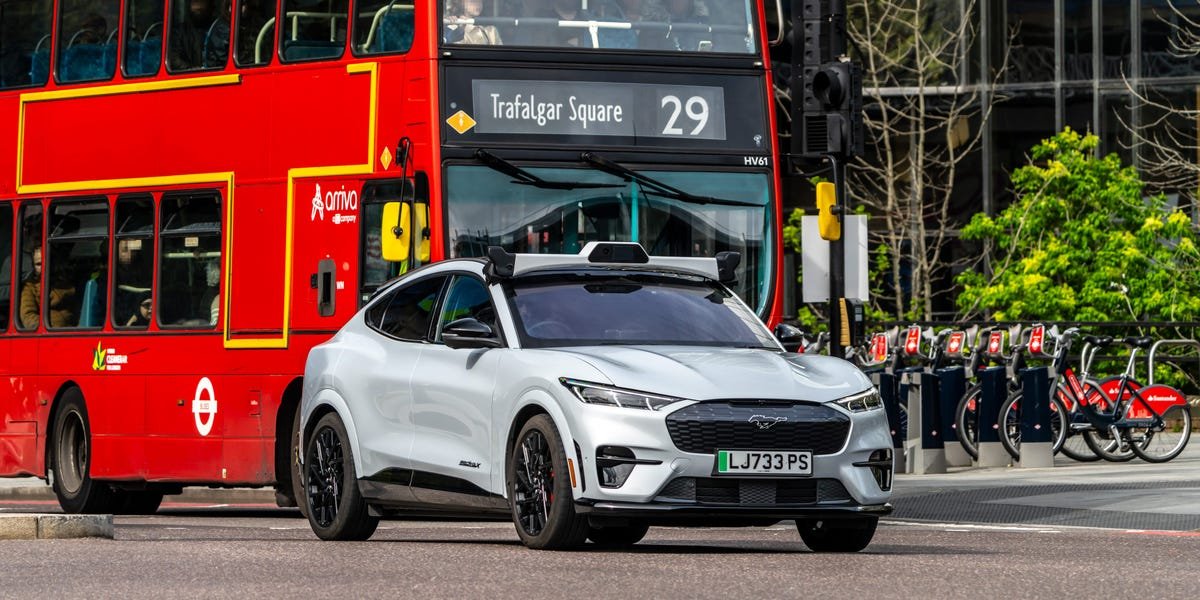
Microsoft-backed-Wayve-raises-15-billion-to-take-its-robotaxis-global.jpeg

Microsoft-backed Wayve raises $1.5 billion to take its robotaxis global and take on rival Waymo in London

Wayve is revving up its global robotaxi ambitions with fresh funding as it prepares to take on Waymo in London.

The UK-based autonomous vehicle software startup announced early Tuesday in the UK that it had raised $1.5 billion from a host of Big Tech giants and major automakers.

The funding round, which values the startup at $8.6 billion, includes $1.2 billion from investors including Microsoft, Nvidia, and Uber, as well as Mercedes-Benz, Nissan, and Stellantis.

It also includes additional capital from Uber, which is tied to deployments of Wayve-powered robotaxis across the globe. The two companies have a deal to launch self-driving vehicles on Uber’s app in over 10 markets worldwide, starting with London this year.

“We’ve been learning to drive on British roads for the last eight years, and so this is our home turf,” Alex Kendall, CEO of Wayve, told Business Insider in an interview.

The CEO said the latest funding round is key to pursuing the company’s ambition to license its software to major automakers and robotaxi fleet platforms like Uber.

Unlike Tesla or Waymo, Wayve is solely focused on developing software for other companies looking to deploy self-driving cars. It is not building its own fleet of robotaxis.

Kendall said owning a fleet is expensive, and Tesla’s approach to building its own car can be a constraint since it limits the company to one vehicle platform.

“Everyone wants autonomy, but not everyone wants to buy a Tesla,” he said.

Kendall added that Wayve’s AI driver is designed to be generalizable — the same way a human can quickly learn to drive different cars and in new cities.

That allows Wayve’s technology to quickly adapt to new driving environments and learn new road rules, from switching to the opposite side of the road to right turns at a red light, without relying on high-definition mapping and sensors, the approach taken by rivals like Waymo. It also allows the AI driver to be adapted by different automakers, which may have different sensor configurations on their cars, such as lidar or cameras.

“Because that’s what we’ve built, it enables us to take this business model that enables high-margin software revenues,” Kendall said.

Wayve says that over the past year, its fleet of Ford Mach-Es outfitted with its AI driver has driven in more than 500 cities across Europe, North America, and Japan without being trained on city-specific data.

The company is also planning to license its technology to carmakers as an advanced driver-assistance system like Tesla’s Full Self-Driving, which handles most driving tasks with human supervision. Wayve has a deal with Nissan that will see its AI tech power the Japanese carmaker’s ProPilot driver assistance system from 2027.

The UK-based startup has been testing its tech in London since 2017, and its public debut comes as the city’s robotaxi scene gets increasingly crowded.

Waymo is aiming to begin operating its autonomous vehicles in London, its first international location, this year, while Wayve vehicles will be joined on the Uber app by robotaxis from Chinese tech giant Baidu, which is also partnering with Lyft.




Source link

Lloyd Lee

Why Waymo believes robotaxis must be safer than human drivers

If people can drive with their eyes, can an AI drive only with cameras?

Tesla leans on that analogy to defend its hotly debated cameras-only approach to autonomous cars.

“It should be solved with cameras just like how every other human or animal lives around this world,” Ashok Elluswamy, Tesla’s vice president of AI, said at the ScaledML Conference on January 29. “Self-driving problem is thought of as a sensor problem. It’s actually not a sensor problem, it’s an AI problem.”

Alphabet’s Waymo has a fundamentally different engineering approach to autonomy. Srikanth Thirumalai, Waymo’s vice president of onboard software, pushed back on Elluswamy’s comparison.

“I think the bar is higher than human driving,” he told Business Insider.

The contrast between Waymo and Tesla goes beyond philosophy and is built into the hardware.

Tesla wants to reach autonomy with fewer than 10 cameras and an AI trained on billions of miles of real-world driving data. Waymo also relies on AI, but is paired with a multi-sensor system — 29 cameras, five lidars, and six radars — to give the AI driver different ways to perceive an environment. The Alphabet company has so far deployed about 2,500 robotaxis across multiple US cities.

The debate often boils down to cost and safety: More sensors could increase costs, which could be a barrier to scale. Fewer sensors could present safety challenges, some say, which is another constraint for mass robotaxi adoption.


Srikanth Thirumalai

Srikanth Thirumalai, Waymo’s vice president of onboard software

Lloyd Lee/BI


Thirumalai manages a team of more than 600 people building Waymo’s AI driver software. During a rare interview at Waymo’s HQ, which spans multiple buildings, the vice president told Business Insider he expects the sensor suite to shrink over time as the hardware improves and gets cheaper. But he framed the lidar or no-lidar debate as a distraction from the company’s safety-oriented objective.

“Given where the technology is right now, the question is what is it going to take for that product to be safe?” he said. “So you work backwards from that safety bar and say, ‘What does it take to build a safe product?’ And then keep pushing and iterating and innovating to reduce the cost of the sensors, and to improve the quality of the software and how it uses the sensors.”

The soft-spoken Thirumalai looked to the future and explained his position.

“In three to five years, will our sensor stack look different than it is right now? Absolutely.”

Waymo has previously said it expects the next generation of robotaxis to have fewer sensors: 13 cameras, four lidars, and six radars. A Waymo spokesperson previously told Business Insider that the company expects to serve public riders by late 2026.

A Tesla spokesperson did not respond to a request for comment.

How safe should a robotaxi be?

Humans can be bad drivers. They’re easily distracted, swayed by emotions, and can be slow to make the right decisions. Leaders in autonomy will say they’re driven by a mission to build something safer than humans. The challenge is defining what “safer” means in a way that regulators, riders, and engineers can measure.

“This notion of what the bar is is a very important question,” Thirumalai said. “And one that we have only refined over the years, and in some cases, we’re still sort of discovering what the bar is.”

Instead of an arbitrary goalpost that says robots will be multiple times safer than a human driver, Thirumalai said Waymo looks at individual driving cases and assesses how often those events can occur.

“We break it down and say, ‘Well, how often do those events actually occur per million miles of driving? And how serious are those events?” he said, adding that his team can then aim for a lower incident rate.

Thirumalai and even Waymo’s top brass aren’t selling perfection. A human fatality caused by a robotaxi isn’t a matter of if but when, Waymo co-CEO Tekedra Mawakana has said.

Reports and videos shared across social media have shown that AVs can make mistakes, whether in school zones, emergency response scenes, bad weather, or even seemingly ordinary driving scenarios.

“People might say, ‘Hey, look, this is AI. We never want it to make a mistake.’ That is an unachievable bar,” Thirumalai said.


Source link

Lloyd Lee

Uber’s new plan to deploy 25,000 robotaxis will come from an autonomous trucking company led by ex-Uber alum

Uber has a new plan to get 25,000 robotaxis on the road — and it will come with the aid of some Uber alums and an autonomous trucking company.

On Wednesday, the ride-hailing giant announced a partnership with Waabi, a Canadian self-driving trucking startup founded by Raquel Urtasun. The partnership will include a $250 million investment from Uber, dependent on a set of milestones Waabi will have to achieve. The companies did not disclose what those were.

There are a few familiar faces here. Urtasun was the chief scientist at Uber’s self-driving car division, Advanced Technologies Group. That division was sold in 2020 to Aurora Innovation, another autonomous trucking company and Waabi’s competitor.

Waabi’s chief operating officer, Lior Ron, is also an Uber alum who founded and led the ride-hailing company’s trucking business, Uber Freight.

“Uber has always been great in building marketplaces, in matching supply and demand, and in pricing,” Ron told Business Insider. “That’s what created Uber, that what’s created Uber Eats, and that’s what I created with Uber Freight.”

Alphabet’s Waymo and Amazon’s Zoox are already on the ground providing unsupervised rides. Even in its core business, that is, autonomous trucking, Waabi has yet to deploy a fully driverless truck without safety drivers on commercial routes.

The startup didn’t disclose a timeline or announce a partnership with an automaker that can deliver that many cars.

However, Ron dismissed the first-mover advantage narrative.

“I think it’s really about: Can the system scale? Can the system be mass-deployed?” he said. “It’s not about getting the first driver out of the car or truck. It’s not about the first lane. It’s not about the first neighborhood.”

How will an autonomous trucking startup cater to robotaxis?

Trucking and ride-hailing are two different beasts. One has set routes and long stretches of highway driving; the other sees dense neighborhoods and unpredictable pedestrians.

Ron told Business Insider that Waabi has been building a generalizable AI “brain” that can be transferred to different vehicle platforms since “day one.”

“Nothing needs to be rebuilt,” Ron said.

In addition, Ron said Waabi has built a sophisticated simulator that allows the AI driver to learn from an infinite number of scenarios that can’t easily be replicated in the real world.

The simulation allows for “mixed reality testing”: An AI driver steering a truck or car is deployed on a closed course but responds to simulated events like a traffic jam or a lane-changing car that isn’t really there.

Video from Waabi shows how a truck driving on a closed-course environment can slow down, reacting to a virtual traffic jam.

“Now we can test anything you can imagine — every permutation of traffic jam under the sun, every millions of different scenarios of construction zone,” Ron said. “A motorbike cutting you off — you can never do that because you’ll be endangering the tester.”


Source link