
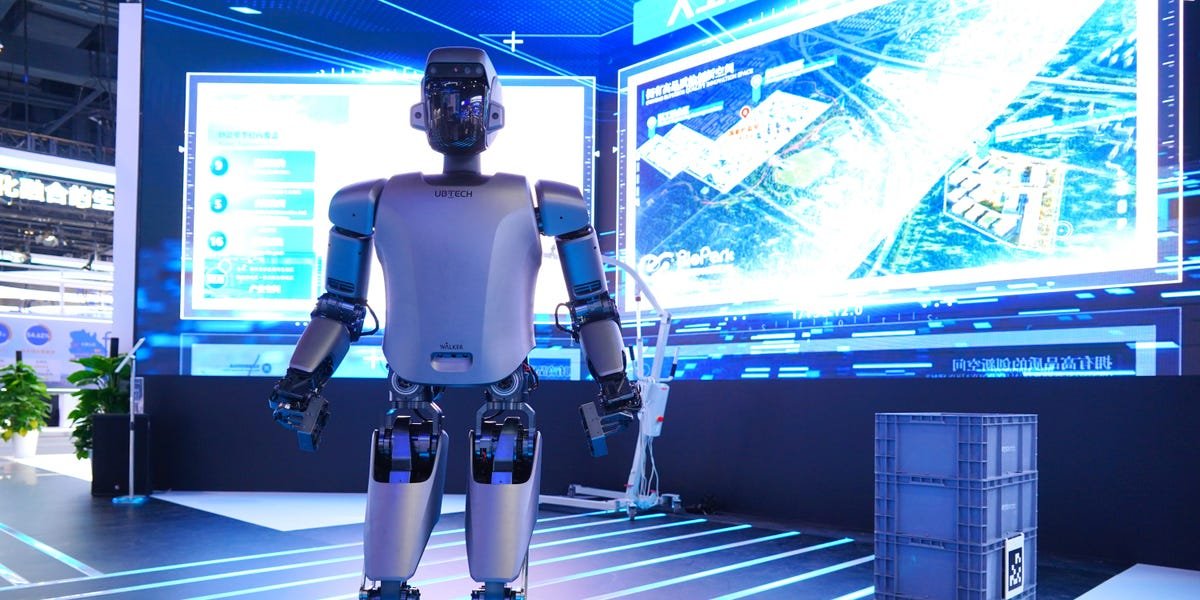
A-Chinese-robotics-startup-with-a-Tesla-Optimus-rival-is.jpeg

A Chinese robotics startup with a Tesla Optimus rival is seeking a new chief scientist with an $18 million salary

The AI talent war is spreading to robotics.

Chinese humanoid robotics startup UBTech announced this month that it was seeking a new Chief Scientist with a maximum salary of 124 million yuan ($18 million), per a translated job listing.

The top-end pay sits some way below the most eye-watering earnings offered during the scramble for AI talent, with Meta and OpenAI previously accusing each other of trying to poach star talent with paydays of up to $100 million.

But it marks a departure for China’s fast-growing AI and robotics industries, which have until now appeared to avoid the vast payouts that have shaken up Silicon Valley — signaling that China is becoming more aggressive in attracting top-end talent.

UBTech was founded in 2012 and has grown into one of China’s most prominent humanoid robot companies.

The Shenzhen-based startup’s main product is the 5-foot-9 Walker S2 humanoid robot, which, like Tesla’s Optimus robot, is designed to operate autonomously and work in factories. UBTech said earlier this year it struck a deal with Airbus to test its Walker S2 humanoids on factory production lines.

In a job listing posted this month, UBTech said the salary range for the position of “Chief Scientist of Embodied Intelligence” would span from 15 million to 124 million yuan ($2.2 million to $18 million).

The executive will be responsible for accelerating UBTech’s humanoid robotics push into manufacturing, services, and “family companionship,” per the translated job listing.

Chinese firms appear to be ahead in deploying humanoid robots, with nearly 90% of global shipments last year coming from Chinese companies, according to data from research firm Omdia.

Locally built robots also played a major role in China’s Spring Festival, a major public showcase of the country’s most cutting-edge tech, with humanoids from Unitree performing kung-fu and acrobatics.

Elon Musk said in a January earnings call that the biggest competition for Tesla’s Optimus robot will come from China — although he said he expects Optimus, which begins mass production this year, to outperform any robot under development in China.


Source link

Chong Ming Lee, Junior News Reporter at Business Insider's Singapore bureau.

Drunken boxing and backflips: China put on a robot kung fu display that shows how fast its robotics industry is growing

China didn’t just celebrate Lunar New Year this week. It staged a robotics flex.

At the annual Spring Festival Gala, the Lunar New Year show in China, humanoid robots from Chinese startup Unitree Robotics flipped, lunged, and swung swords and nunchucks just feet from child performers in a tightly choreographed kung fu routine.

In one sequence inspired by “drunken boxing,” a traditional Chinese martial arts style, the robots staggered, fell backward, then rose again — showcasing advances in control and coordination.

Clips circulating online quickly drew comparisons to last year’s broadcast, which featured Unitree humanoid robots performing a Chinese folk dance. The choreography then was noticeably simpler.

The gala, often likened to the US Super Bowl for its massive audience, also featured other Chinese robotics firms, including MagicLab, Galbot, and Noetix, in separate segments throughout the broadcast on Monday evening.

Reactions on Chinese social media showed viewers being struck by how quickly the technology has advanced.

On RedNote, a user who goes by Ma Xiao said in a video posted on Wednesday that during last year’s performance, the robots were only “doing very simple things.”

“Now, they’re doing kung fu, they’re doing flips, they’re doing synchronized dancing,” he said. “Everybody’s shocked.”

“Now the rest of the world knows what China’s speed is,” he added.

Another RedNote user, DKKD, posted a video of friends reacting to the performance on Tuesday, captioning it: “Three Americans were scared by the Spring Festival robot.”

“They were all shocked by the robot’s level of evolution (including me),” the user wrote.

One viewer in the video can be heard saying: “It’s way more impressive than last year. It’s crazy.”

Unitree CEO Wang Xingxing said in an interview with Chinese media following the gala that the company expects to ship up to 20,000 humanoid robots this year, up from about 5,500 in 2025.

Global shipments of humanoid robots could reach “tens of thousands” this year, with Unitree potentially contributing between 10,000 and 20,000 units, Wang said on Tuesday.

China’s push in robotics

Chinese companies developing humanoid robots and autonomous systems are racing to outdo global rivals.

In September, Ant Group, an affiliate of Alibaba Group, unveiled R1, a humanoid robot that drew comparisons to Tesla’s Optimus. Two months later, EV and robotics maker XPeng introduced the latest version of its humanoid, Iron, which the company described as “highly human-like.”

China’s elite universities are also moving to build talent for the sector. In November, China’s Ministry of Education issued a notice stating that top institutions are preparing to launch a new undergraduate major in “embodied intelligence,” a field that combines AI with robotics.

Still, China’s rapid push into robotics hasn’t been seamless.

XPeng’s Iron fell face-first during its first public appearance in China earlier this year. Its CEO, He Xiaopeng, later wrote on Chinese social media that the mishap was part of “learning to walk.”

Last month, a Unitree humanoid kicked an engineer in the groin during a test. Humanoid robots stumbled and fell while racing against humans in a half-marathon in Beijing in April last year.


Source link