
Ukraine-says-it-replaced-human-soldiers-with-ground-robots-in.jpeg

Ukraine says it replaced human soldiers with ‘ground robots’ in over 21,000 missions for Q1

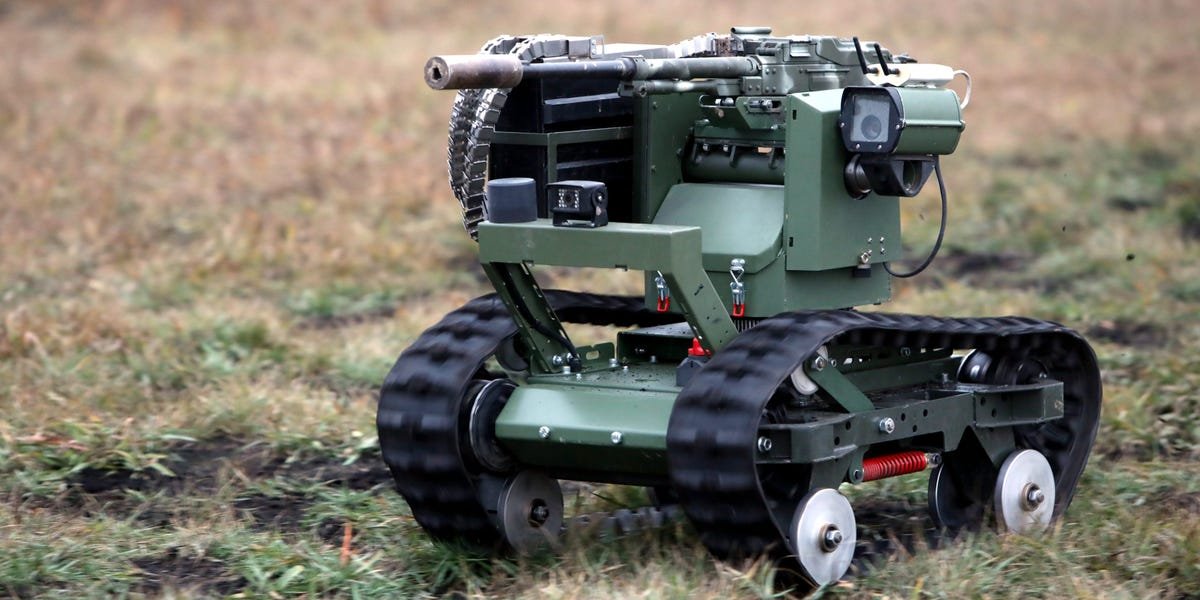
Ukraine’s defense ministry said on Tuesday that the number of uncrewed ground vehicle missions carried out by its forces had tripled in the last five months.

These ground-based systems executed over 9,000 combat and logistics missions on the front lines in March alone, up from over 2,900 in November, the ministry said in a statement.

March’s numbers contributed to the more than 21,500 Ukrainian ground drone missions in the first quarter, the ministry added.

Uncrewed ground vehicles, or UGVs, are remotely piloted ground systems generally intended to replace human soldiers in dangerous tasks such as frontline supply drops, mine-clearing, and holding fortified positions.

They’re usually tracked or wheeled systems built to traverse difficult terrain and can serve as platforms to carry supplies, ammunition, wounded troops, or, in some cases, remotely controlled weapons.

The defense ministry said on Tuesday that the number of Ukrainian units deploying UGVs had nearly tripled since November.

“167 units of the Defense Forces used ground robots in March. For comparison, in November 2025, there were 67 such units,” the statement said.

According to the ministry, four of the top five UGV units registered in its DELTA battle management system were combat brigades known to be fighting in the eastern and northeastern fronts.

The other listed unit was the 1st Separate Medical Battalion, a unit under Ukraine’s International Legion known for pioneering the use of UGVs to evacuate wounded troops.

UGVs have become increasingly relevant as the war drags into its fifth year. Ukraine is struggling to fill its ranks with fresh troops, and small drones make frontline areas especially perilous to navigate. Russia, also hard-pressed to sustain the pace of its infantry attacks, has been deploying UGVs as well.

Ukraine signaled as early as 2024 that it expected to use more UGVs. But it was only in the last year that these systems have received more widespread recognition, with some brigades launching their own UGV-dedicated units.

Despite its rapid growth, UGV use in the war pales in comparison to that of flying drones.

In December, Ukraine’s commander in chief, Oleksandr Syrskyi, said that his troops had carried out over 304,000 uncrewed aerial vehicle missions in November alone.



Source link

Lloyd Lee

These robots are coming for the jobs no one wants — and could fill workforce gaps

Backflipping robots make for splashy demos and viral videos, but Agility Robotics sees humanoid bots doing something simpler — solving an urgent global labor issue inside manufacturing plants.

The Oregon-based startup has so far deployed its humanoid robot, Digit, at Amazon, Schaeffler Group, and GXO, a logistics company. The startup announced in February that a few Digit robots would be deployed in Toyota’s massive manufacturing plant in Canada, marking yet another automaker betting on bipedal bots.

Daniel Diez, Agility’s chief business officer, told Business Insider that there’s a common thread at the companies he visits around the world. In Germany, Korea, Japan, or the US, manufacturers just don’t have enough people who want to work mundane, repetitive jobs.


Headshot of Daniel Diez, chief business officer of Agility Robotics

Daniel Diez, Agility Robotics’ chief business officer, said there’s a labor gap in manufacturing that will require automation.

Courtesy Agility Robotics


“It’s the same exact issue: Labor gaps in these highly repetitive physical tasks,” Diez said. “They simply can’t find the people to do this work.”

There is no shortage of manufacturing roles. According to the Bureau of Labor Statistics, there are more than 400,000 job openings in the sector in the US as of December 2025.

In addition to vacancies, talent retention remains a top concern for manufacturers, according to a 2024 survey of more than 200 companies conducted by The Manufacturing Institute and Deloitte.

Diez said there are “compounding effects” to the so-called labor gap.

A significant share of the manufacturing workforce is 55 and over, he said, meaning they’re approaching retirement. BLS’s Current Population Survey clocks the number at a little over 25%.

Add to that the Trump Administration’s push to bring onshore manufacturing back, which Diez said will only create more jobs and a greater need for automation.

“This re-shoring of manufacturing in the US is going to only occur through a combination of human employment and automation technology, like humans and robotics,” he said.

Automakers are notably bracing for this shifting tide. Tesla, Volkswagen, Ford, Mercedes-Benz, and Hyundai, among others, have made significant investments in humanoid robots with the prospect that they’ll work the assembly lines in the near future.


A humanoid robot stands

Atlas, Boston Dynamics’ humanoid robot, will be deployed in Hyundai’s factory in 2028.

Lloyd Lee/BI


Boston Dynamics in January unveiled a new iteration of Atlas, an all-electric humanoid, that the startup aims to deploy in Hyundai’s Georgia factory in a few years.

The company’s former CEO, Robert Playter, previously told Business Insider that Boston Dynamics is helping companies brace for population decline and increased manufacturing demand.

At Toyota Motor’s manufacturing plant in Ontario, the automaker is starting with three Digit bots that will do the simple task of moving totes, or plastic containers, from one spot to another.


Digit robot moves a tub

Courtesy Agility Robotics


There are robots out there that could execute much more complex tasks, while some industry insiders say humanoids, or bots with two legs and arms, are still years away from scaling. Part of the pitch for the bipedal form factor is easier integration into existing or older factories, Diez said.

“At this moment in time, it feels like an ideal solution for brownfield facilities,” he said, referring to underutilized industrial facilities that tend to have a baked-in layout. In other words, with humanoids, manufacturers can automate their properties without making significant changes to the factory layout and workflow.

Diez said that any industry with highly repetitive tasks is ripe for the adoption of humanoid robots. The industries Agility Robotics is seeing with the most “inbound” requests are coming from warehouse logistics, e-commerce fulfillment, automotive, and pharmaceutical manufacturing, he said.

“We’re not having to convince people that this is a technology need,” Diez said. “We have more than enough hand-raisers who are coming to us.”


Source link