

A-room-full-of-seniors-took-on-AI-—-and.jpeg

A room full of seniors took on AI — and didn’t blink

Susanna Lau, 70, squinted at her screen, then laughed.

The AI chatbot she was playing with had just generated a dish she described as “an extravagant Hokkien mee,” a Singapore dish of stir-fried noodles in a seafood broth.

Around her, 15 retirees in their 60s and 70s were hunched over laptops, tinkering with AI models and reacting — often out loud — to what they could do.

Asif Saleem, a financial services go-to-market lead for Japan and Asia Pacific at Google, was running the session as a community class in Singapore.

Over four hours, retirees stayed locked in, asking questions, testing prompts, and trying to work out what AI could do for them.

Some came out of fear of being left behind. Others came with doubts. But all were intent on sharpening their skills — proof that learning doesn’t stop with age.

Hands up, questions aplenty

The first hour was spent on teaching them the basics: What AI is, what a large language model is, and how multimodal AI works.

Questions came quickly. Retirees interrupted Saleem to ask about AI videos they had seen on social media, whether those clips could be trusted, and what happens to personal data once it’s fed into a chatbot.


Asif Saleem

Asif Saleem is introducing the tools for the AI workshop in Singapore.

Lee Chong Ming/Business Insider


After fielding their questions, Saleem moved on to teach them prompting. He began with a low-stakes use case: generating images with Google’s Gemini.

The retirees were asked to prompt the AI to design a unique fusion dish, drawing on a hobby many of them already loved.

After generating a Chinese-Japanese fusion dish that looked like “Hokkien Mee,” Lau learned how to prompt the AI to go further. She asked it to generate a full recipe, suggest possible names (“Umami Forest Lo Mien”), and even recommend additional ingredients she could add to elevate the dish.

I asked if she’d try cooking it at home. She paused, then laughed. “I’ll give it some thought.”


Suzannah Lau

Retiree Susanna Lau used AI to generate a Chinese-Japanese fusion noodle dish.

Lee Chong Ming/Business Insider


Another exercise quickly caught on: creating travel postcards.

Retirees prompted the AI to generate images from past trips: a sauna in Japan, a beach in Thailand, and a seaside view in Croatia. They superimposed themselves into the scenes, turning the images into postcards they could send to friends.

Ann Seow, 60, told me she was impressed by AI’s “ability to understand language and create its own interpretative work, like a piece of art.”

AI opens up “immense possibilities” for what people can do in retirement, such as discovering new hobbies, learning new skills, or even starting a business, she added.

Using AI to supercharge work

Next, the class was introduced to NotebookLM, Google’s research and note-taking tool.

At first, I was skeptical about introducing this tool to retirees. NotebookLM is typically pitched as a productivity tool for students, researchers, and office workers.

Saleem quickly showed why that assumption didn’t hold. He taught them how to upload a report to NotebookLM and transform it into a summary — not just text, but also audio, visuals, mind maps, and even presentation slides.

For older people in the room, the appeal was immediate. Instead of straining their eyes over a hundred-page document, they could listen to a spoken summary or grasp key ideas through a visual map.

“How can we know the information is accurate?” one participant asked.

It was a familiar concern. AI systems can hallucinate and sometimes produce inaccurate answers. Saleem acknowledged the risk but pointed out a key difference with NotebookLM: It draws only from the sources the user uploads, rather than the open internet.

Seow was visibly impressed. “That would have saved me so much time when I was working on PowerPoint slides,” she said.

“Work that we used to do manually and take days, now it is done speedily in split seconds for us,” said another retiree, Cindy Ang.

“Looks like there are more plus points to use AI. I was wondering, why do I have to fear AI?” Ang added.


Cindy Ang Retiree

Retiree Cindy Ang said she has learned to embrace AI rather than reject it.

Lee Chong Ming/Business Insider


Engaging AI — on their own terms

For the final segment of the class, the seniors were meant to try vibe coding a simple web app themselves. Time ran out.

Saleem gave a quick demo of how easily one could vibe-code an app using Google AI Studio. In minutes, he built a Lunar New Year app that identified one’s zodiac sign and explained it.

The retirees watched closely. When the app worked, the room broke into excited chatter.

After class, Ang told me she had initially arrived with “some mixed feelings.”

She wanted to master AI skills because she feared she might “become irrelevant.” At the same time, she was wary. “What if AI is out of control?” she said.

By the end of the workshop, she’s convinced that older people “have to engage AI rather than reject it.”

“AI is definitely going to stay. Like it or not, we have to engage it,” she said.

“However, it is important not to be totally reliant on AI, that we forget we have a human brain to use,” she added.


Retiree asking AI questions

Retiree Cindy Ang fired multiple questions at the instructor during the AI class for seniors in Singapore.

Lee Chong Ming/Business Insider


While Seow said she found learning AI useful, she worries the AI era is widening what she calls an “information gap.”

“Seniors did not grow up with smartphones or tablets or digital services, so we may be slower to understand tech concepts,” she explained.

Throughout the session, many furiously scribbled notes as Saleem spoke. They also peppered him with probing questions, rarely accepting explanations at face value.

When I later asked Ang if she might write to me about her reflections, she quipped: “What if I use AI to help me?”




Source link

A-family-ditched-their-dining-room-and-added-a-primary.jpeg

A family ditched their dining room and added a primary suite above the garage in a $1 million renovation of their home

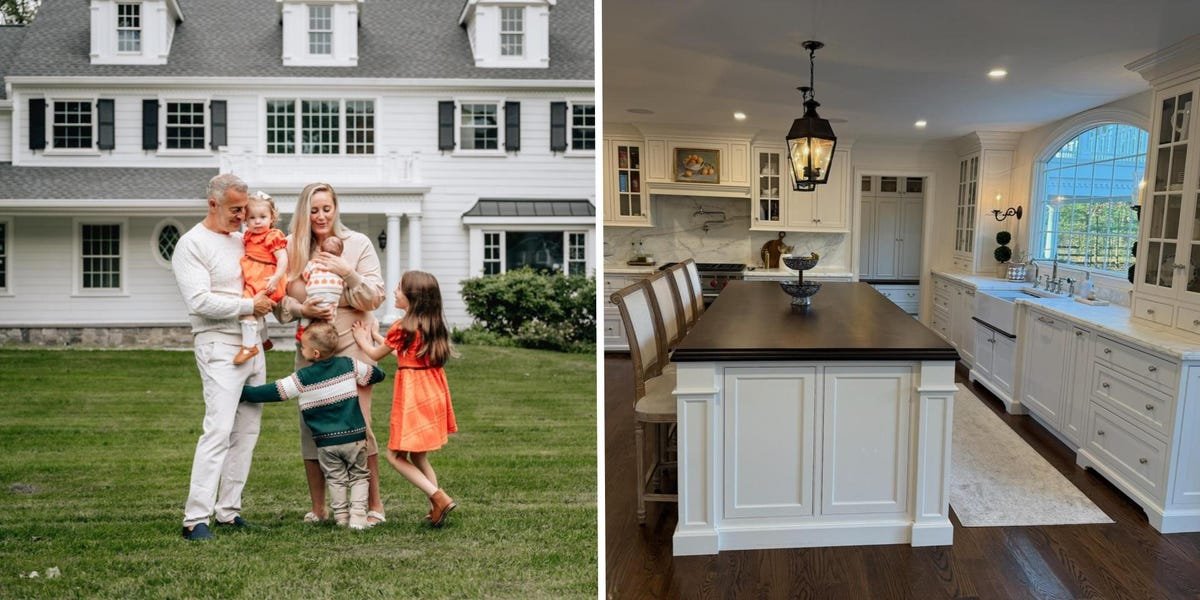
In October 2022, they saw a 2,700-square-foot house built in 1979 that spoke to Martino. It had four bedrooms, two bathrooms, and two half bathrooms, one of which was in the three-car garage. It was clearly a family home.

“The owners were there for 20-something years,” she said. “It was just dated, but it was very well cared for.”

Martino knew she would want to make substantial changes to the house, but the land it sat on made it feel like the perfect place to turn into their home.

“On our property, we have dozens of 100-foot trees,” Martino said. “All of the properties that you find for a brand-new build have nothing on them.”

She also loved the surrounding area, which offers easy access to apple orchards and horseback riding while remaining within commuting distance of her partner’s restaurants.

“It was like right price, right location, and we can do what we need to do to make it look how we wanted to in the end,” she said.

They bought the house for $1.075 million.


Source link

We-paid-9000-for-the-cheapest-room-on-an-ultra-luxury.jpeg

We paid $9,000 for the cheapest room on an ultra-luxury Caribbean cruise. See inside our ship and 302-square-foot suite.

  • We booked the least expensive suite on a Seabourn ultra-luxury cruise for about $9,000.
  • After crunching numbers and seeing high-end resort prices, this felt reasonable for a family trip.
  • We loved getting to see lots of new places and not worry about having to plan our meals.

I paid $9,000 for what was technically the cheapest room on an ultra-luxury cruise — a price that initially felt steep until I compared it with alternatives.

My family had been planning a multigenerational trip to the Caribbean during the busy period between Christmas and New Year’s Eve, which is also one of the most expensive travel weeks of the year.

We wanted something that felt indulgent without becoming logistically exhausting or financially disproportionate once all the extras were added up.

At first, we looked at high-end beach resorts, but they were commanding eye-watering rates. I saw a few in Barbados and St. Barts charging over $4,000 a night for a room, and that price doesn’t even include food, drinks, and gratuities.

The costs seemed like they could really add up. As we ran the numbers, an all-inclusive cruise began to make more sense.

Plus, we liked the idea of exploring Caribbean destinations we hadn’t visited before without having to deal with multiple hotel check-ins, flights, and transfers. A port-heavy itinerary could allow us to sample several places while unpacking just once.

So, our group settled on a 12-night Caribbean cruise aboard the Seabourn Ovation.

Our family booked two rooms and spent about $20,000 on the cruise.

Our group of five set sail on the Seabourn Ovation.

David Morris

We traveled as a group of five: my mother, my brother and sister-in-law, their 7-year-old son, and me.

In total, we booked two entry-level suites — one for my mother and me, and another for my brother, sister-in-law, and their son — bringing the combined cruise fare to just over $20,000 for five people across 12 nights.

This figure includes accommodations, all meals, a selection of soft drinks and alcoholic beverages, and gratuities. We saved some money on my 7-year-old nephew’s fare thanks to the cruise line’s third-guest-at-half-price policy.

By booking through a preferred travel advisor, I also received $400 in onboard credit, plus an additional $250 referral credit (which my brother’s family also received).

Our cabin felt like part of a boutique hotel.


Two beds in cabin on cruise ship

A wide shot of our suite’s interior on the Seabourn Ovation.

David Morris

Our suite measured 302 square feet, plus a 68-square-foot balcony.

Its decor was pretty minimal, but it felt a bit elevated with accents of marble, dark wood, and glass.

Despite being the cheapest option on the ship, this room felt more like it was part of a boutique hotel than just a standard cruise cabin.

The walk-in closet was a pleasant surprise.


Closet with draw chest, hooks on walls

We could fit a lot of clothes in here.

David Morris

The base-category suite felt thoughtfully laid out, with a seating area, a couch, a table, two beds, and a generously sized walk-in closet. Our clothes and bags easily fit inside with space to spare.

In the other suite, a sofa bed was set up as a dedicated sleeping space for my nephew.

The bathroom had dual sinks, a tub, and a compact but functional shower.


White bathroom with large mirror, counter

The bathroom felt spacious enough.

David Morris

The bright-white bathroom featured dual vanities, a soaking tub, and a glass-enclosed shower. My only critique was the shower size, which felt slightly tight compared to ones in some newer ships we’ve sailed on.

Our room’s minibar was stocked exactly to our preferences.


Top of mini fridge with canned drinks, bottle of water

Before sailing, we submitted drink preferences to the Seabourn crew.

David Morris

We were delighted to find our room’s minibar stocked with complimentary ginger beer, juices, and the spirits we requested prior to our sailing.

Twice-daily housekeeping kept everything meticulously refreshed.

Room aside, we were pretty happy with the ship.


Sushi on plates

We had sushi on the ship.

David Morris

Since all of our meals, standard beverages, and gratuities were included in the cost of the cruise fare, we didn’t have to budget or crunch numbers during our trip.

We had most of our dinners in the ship’s main dining room, which was so easy. It felt quite formal, and the rotating menus kept things interesting across the 12-night itinerary.

Passengers also had access to The Patio, a poolside eatery with laid-back fare, and The Colonnade, a more casual spot serving buffet breakfasts and lunches, plus seated themed dinners.

We also enjoyed our opportunities for specialty dining.


Charred seafood and steak in plates

The food at Solis really impressed me.

David Morris

Options for specialty dining included a sushi restaurant and a Mediterranean eatery called Solis, which was a standout for me.

The menu featured steak, lobster, and whole grilled fish deboned tableside. I particularly loved its post-dinner affogatos

Pools, hot tubs, and quieter outdoor spaces were easy to find.


Author David Morris smiling on top deck of cruise

The main deck was lit up at night.

David Morris

The ship has a large main pool surrounded by lots of loungers, though we preferred the smaller hot tubs in other areas.

Quieter spots, like the hot tub at the bow with incredible views of the ocean, quickly became our favorites.

My favorite area on board was The Retreat.


Partially covered deck area with lounge chairs

The Retreat was one of the best places to get work done.

David Morris

Located on the top sundeck, The Retreat was my favorite area on the ship.

The space offered shaded cabanas, a noticeably calmer atmosphere than the main pool deck, and attentive, unhurried service.

To access it, passengers had to pay an additional $150 per day on port days or $250 on sea days.

Booking it on sea days felt especially worthwhile. The quiet setting made it easy to relax or catch up on a bit of remote work on my laptop without feeling out of place.

Excursions cost extra, but they felt well-organized and fairly priced.


Selfie of author and family on cruise ship

We embarked on some excursions at the ports.

David Morris

We mostly booked excursions through the cruise line for peace of mind.

Our favorite was in Saint Lucia, where a packed day included a catamaran ride, volcano hike, mud bath, and snorkeling.

The excursion ran late, but the ship waited for us as it had been booked through them.

Holiday surprises added to the experience.


People in sand on beach with cooler of drinks

We spent the holiday on a beach.

David Morris

On Saint Kitts, the crew arranged a private Christmas Day beach party with grilled lobster and drinks. Later, Santa Claus arrived by Jet Ski to serve caviar and Champagne in the surf.

The cruise’s overall cost felt reasonable considering everything it included.


Group of people dressed up, posing by stairs on cruise ship

The cruise meant we could visit new places without planning out flights and hotels.

David Morris

Ultimately, our cruise averaged out to about $333 per person, per night. That felt surprisingly fair considering how much was included in our 12-night trip.

We also really enjoyed the ship’s intimate size. Compared to other mega-ships carrying thousands of people, this 600-passenger vessel felt calm, navigable, and personal. We never felt overwhelmed by crowds, even on sea days.

Although children aren’t typically the target audience for ultra-luxury cruises, my nephew genuinely had a great time alongside the mostly older guests. His sailing also felt like a great value, considering he was charged half price as a third guest and still had his own proper bed.

For a multigenerational holiday trip that combined ease, variety, and consistent service, the value ultimately justified the price.

All in all, we enjoyed the trip enough to book another Seabourn voyage (at a discounted price) before disembarking.


Source link

jill robbins smiles in front of a tree

I’m a seasoned cruiser, but I still booked the wrong room for my family of 4 on a recent sailing

As our family’s primary vacation planner, I’ve found we get the most mileage out of cruises. The “most things included” pricing is easy on our budget, and we like the wide range of activities and dining options.

My kids are in high school, and we’ve been cruising together since they were in first grade. Still, I managed to make a rookie mistake with our most recent seven-night Western Caribbean Princess cruise.

I had booked it while on a Princess Alaskan cruise with my husband and got a great rate. However, I had a moment of panic when we boarded the Regal Princess weeks later and got a first look at our stateroom.

Although I’d selected a “cabin that sleeps four,” I only saw two twin beds.

Everyone ended up having a bed, but the setup was far from ideal


Two twin beds in Princess cruise cabin

When I got our first look at our stateroom on the Regal Princess, I had a moment of panic when I saw two twin beds.

Jill Ribbons


Despite the initial shock, we quickly realized our 222-square-foot cabin could indeed sleep four people. Our steward told us there were two additional beds stored in the ceiling that he would pull out every evening.

We asked if the two twin beds on the ground could be converted into a queen for my husband and me, and were told they could, but there would be no place to put the ladder for the upper bunks.

So, we left the arrangement as it was.


Beds from ceiling with ladders leading up to them

We ended up putting the ladders against the wall to give us some more room to walk.

Jill Ribbons


On the bright side, we had sufficient sleeping space, and my kids didn’t have to share a bed. Our steward set up the beds each evening while we were at dinner and put them up again after breakfast.

Despite being small, the beds were comfortable, and we all got decent sleep.

The biggest issue was that there was no room to sit up and read or watch TV in bed — the upper bunk was that close to the ceiling. The ladders also made moving around the cabin a game of Tetris, especially at night.


Beds from ceiling with ladders leading up to them

With the beds and ladders out, our path to the bathroom was incredibly narrow.

Jill Ribbons


Casualties included one head bump (me, the first night) and one kid stepping on my legs when he skipped the ladder. After that, we adjusted.

On the bright side, having a small balcony (albeit one with an obstructed view of the ocean) meant we had easy access to natural light, fresh air, and a bit of extra space, which made a difference.

Despite the drawbacks, we still had a great time


Author Jill Robbins and husband smiling with drinks on balcony on Princess Cruise

My husband and I spent some time on our obstructed balcony.

Jill Robbins


In the end, we got a good enough discount on the room that I didn’t mind a little extra inconvenience.

Though I would’ve liked a bigger bed and more room, our small stateroom didn’t stop us from enjoying the cruise. We were only in the room to sleep and shower, and after a day or two, the bunks didn’t feel like a big deal.

This was the first time my kids had sailed on Princess, and our postcard-sized digs didn’t affect how we felt about the cruise overall.

We’d 1000% do this cruise with teenagers again — just not in this stateroom.

Admittedly, I made a rookie mistake — and I know just how I’ll avoid it next time


View off of balcony on Princess cruise with lifeboat blocking part of the view

We booked a cabin with an obstructed-view balcony.

Jill Ribbons


Looking back, I can see what led me to choose the wrong cabin for our family.

While booking with a sales rep on a previous cruise, I got caught up in the moment and the good deal. I didn’t think to ask detailed questions, like the specifics of the bed arrangements.

My biggest mistake was assuming. On cruises I’ve been on with Disney and Carnival, cabins that sleep four are configured differently, with a queen bed and a couch that converts into bunks across the room.

I should’ve asked more questions and watched fellow cruisers’ cabin tour videos online before booking anything. Had I done that, I likely would’ve chosen a different cabin or adjusted my reservation before our departure.

By the time we’d boarded, our cruise was full, and even if a larger cabin had been available, it would’ve cost more.

Next time, I’d be more prepared, or just book my cruise at home, where it’d be easier to review the details on my own.

A travel advisor familiar with cruising could also have steered us toward a better option for a family of four with teens. Though I recommend them to first-timers, I don’t usually use one for cruises.

At the end of the day, even though I should have known better, I couldn’t help but laugh at myself.


Source link

3-design-mistakes-youre-making-in-each-room-of-your.jpeg

3 design mistakes you’re making in each room of your house

The internet is full of interior design aesthetics — Scandinavian, Boho, Country House, Maximalist — each complete with its own set of experts and influencers explaining what must-haves you need to best accomplish the trend.

From quirky pastel candles and oblong mirrors to designer couches and industrial curtain rods, it’s no wonder Americans spend an average of $1,599 on home decor annually, per a 2024 Opendoor survey.

But LA-based content creators Robert Gigliotti and Ethan Gaskill have taken a different approach to interior design influencing.

The friends and collaborators have garnered more than 3.5 million views on TikTok sharing their most disliked interior design and home decor trends in a series called “home decor icks.”

Gigliotti and Gaskill are not designers but have self-taught eyes for design fostered by family experiences.

Gigliotti told Business Insider that his mother flipped houses while he was growing up in Connecticut and he became “tired of them all being builder gray,” so he got involved in helping pick out tiles and other finishes.

Meanwhile, Gaskill was raised in North Carolina and drew inspiration from his father, a custom home builder, and his mother, a real-estate agent.

“My mom was always around the house and really ingrained in my brain the idea of keeping a tidy space and making sure your space is a kind of reflection of who you are, in the way that it sort of impacts your mind,” he said.

Gigliotti and Gaskill said their opinions have resonated with audiences online partly because they’re calling out mistakes they’ve made or seen themselves.

“It’s all things that people kind of agree on or relate to in a way, that they can kind of laugh about,” Gaskill said.

Gigliotti added, “The second anything becomes too serious, it’s not fun anymore, so it’s not like we would actually go in someone’s home and be like, ‘This is disgusting.’ Honestly, it’s amazing effort if you painted everything pink and did your statement wall of floral wallpaper. At least you’re having fun. If you love it, we like it.”

Business Insider spoke with Gigliotti and Gaskill to hear more about what they think you should avoid when decorating each room of your home, from “cringey” art prints and DIYs to overly curated shelving.


Source link